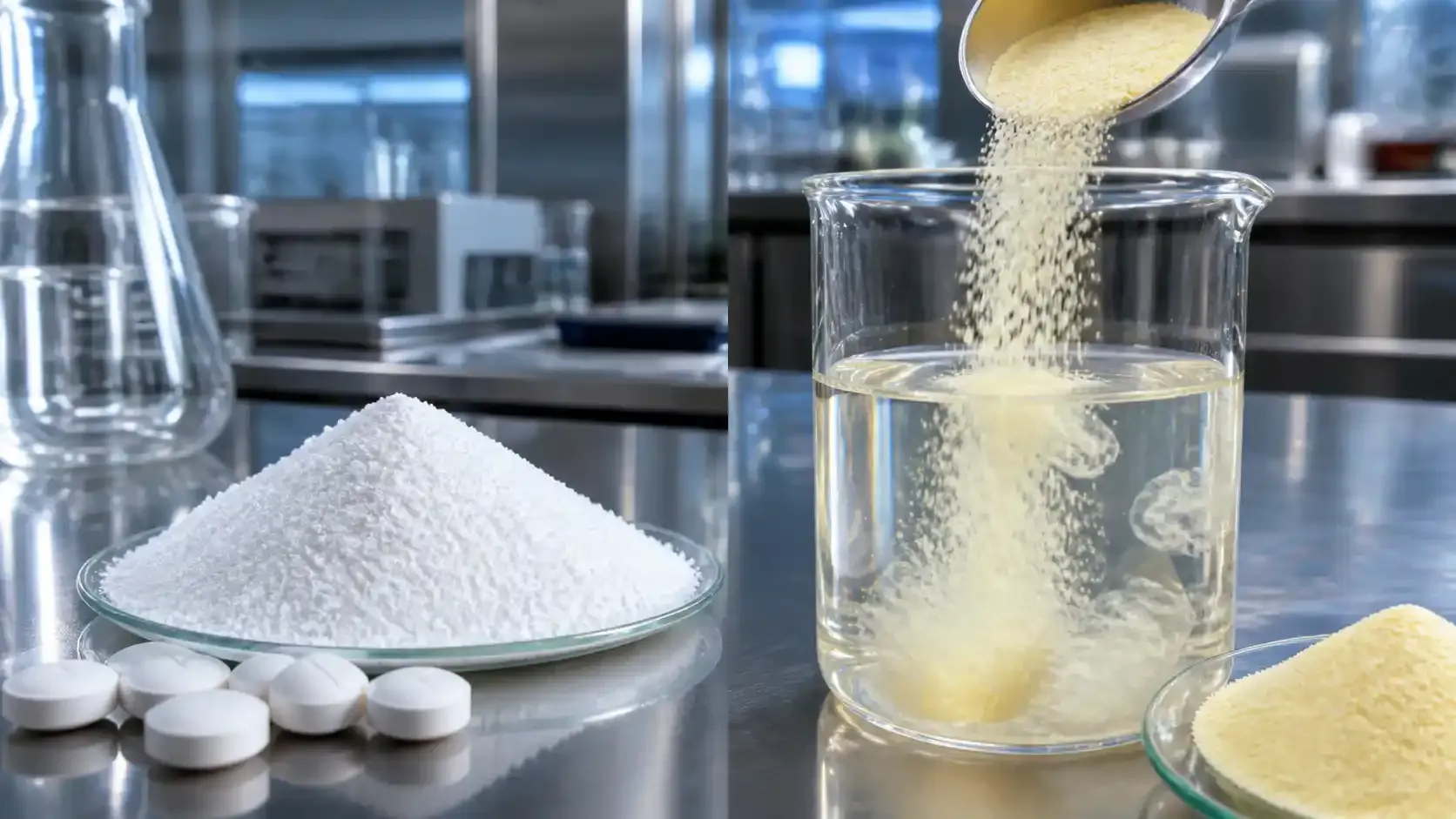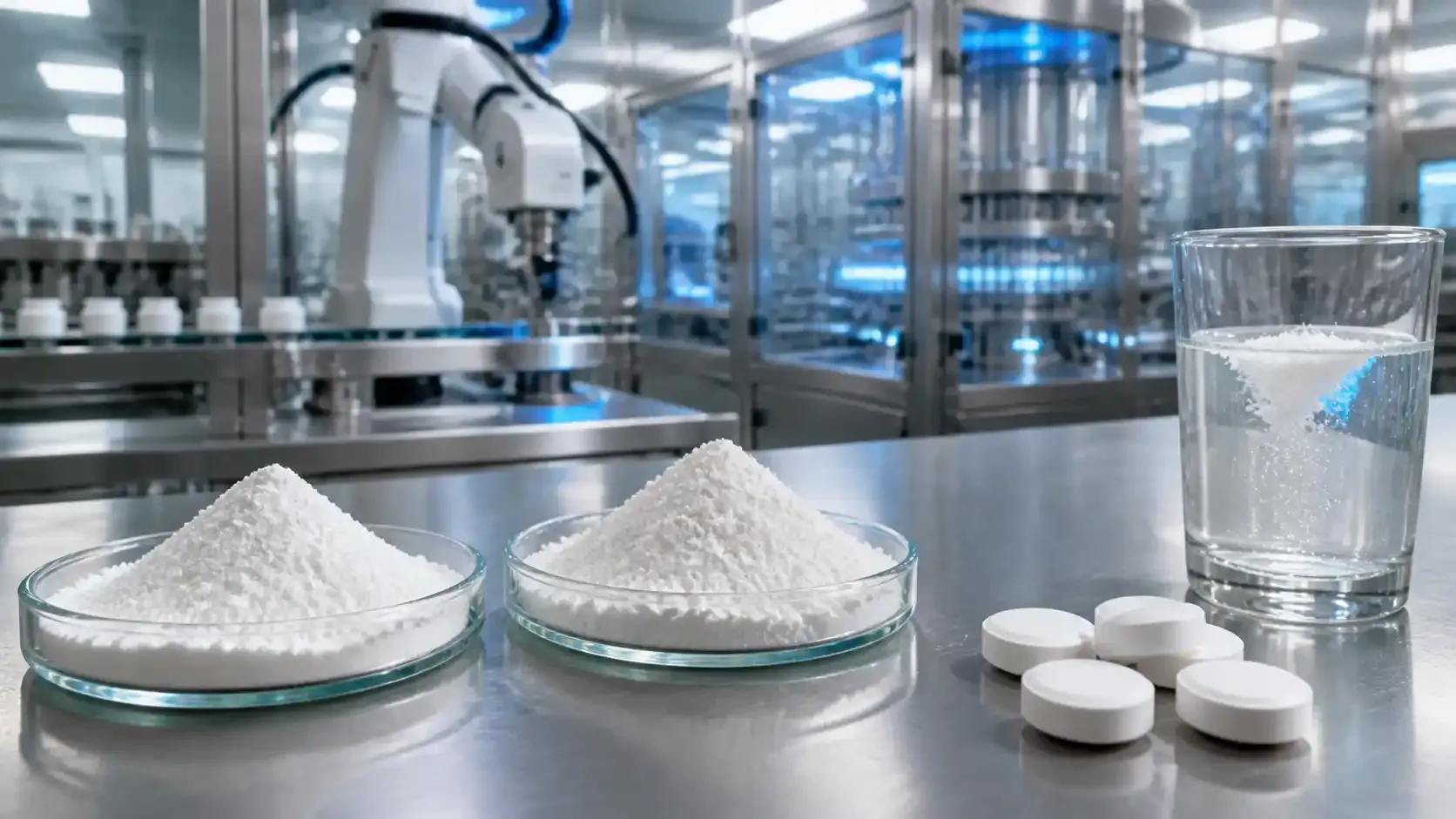
In 2026, procurement teams are being asked to do more than just “find a lower FOB price.” For microcrystalline cellulose (MCC) and resistant dextrin, demand is rising with low-sugar and higher-fiber product lines, while supply chains still grapple with disruptions, tariff uncertainty, and stricter documentation expectations. What happens next is clear: the cheapest offer often becomes the most expensive once failures, re-testing, or reformulation issues emerge.
This industry guide takes an application-led approach—starting from what MCC and resistant dextrin must achieve in real products—and shaping it into a sourcing framework buyers can use to qualify a recommended Chinese microcrystalline cellulose manufacturer or a recommended Chinese resistant dextrin manufacturer.

Why Application-First Sourcing is Replacing Spec-Sheet Sourcing
Procurement teams usually receive the same inputs across suppliers: a microcrystalline cellulose grade list, a fiber content number for resistant dextrin, and a basic COA. The real surprises, the costly ones, often come from what those documents don’t show:
- MCC that meets a basic appearance spec but causes tablet weight variation, capping, or slow disintegration.
- Resistant dextrin that is nominally soluble but creates haze, clumping, or flavor drift in beverage or powder systems.
- Documentation gaps that delay import clearance or customer approvals.
Application-first sourcing flips the process:
- Define the performance outcomes (e.g., tablet robustness, blend flow, neutral taste, heat stability).
- Translate these outcomes into critical-to-quality attributes.
- Evaluate Chinese suppliers by their ability to control those attributes at scale.
This offers the most direct route to a “recommended” supplier short list—especially when both MCC and resistant dextrin are being sourced for the same product portfolio.
What’s Changing in China’s MCC and Resistant Dextrin Landscape
Two linked market signals are shaping 2026 sourcing decisions:
- China’s consumer shift toward lower sugar, higher fiber products is accelerating ingredient pull-through, including resistant dextrin dietary fiber.
- Manufacturers globally are investing in automation and resilient operations to handle labor constraints, disruptions, and cost pressure.
What buyers should really take away from this is that supplier selection should pay close attention to process control, automation level, and documentation maturity—because those factors directly lead to fewer batch issues and faster qualification.
Application Solution 1: MCC that Runs Cleanly in Tablets and Capsules
Microcrystalline cellulose is valued because it can act as a binder, filler, and disintegrant. Yet, these functions only help when MCC behaves consistently under a customer’s exact press conditions.
What to Confirm for MCC in Solid Dosage Manufacturing
When MCC is intended for tablets, capsules, or nutraceutical compacts, buyers should treat these as absolute essentials:
- Grade fit: Common MCC families include PH-101/102 and other variants; grade choice affects flow, compressibility, and blend uniformity.
- Compendial alignment: Many buyers request MCC meeting BP/USP/FCC/JP expectations.
- Particle and flow consistency: Practical indicators include a stable mesh range and repeatable bulk handling.
- Change control discipline: Even “minor” adjustments in pulp source or milling can alter tableting behavior.
A good sign of a recommended Chinese microcrystalline cellulose supplier is how clearly they explain which MCC grades match which operating windows (e.g., direct compression vs. granulation, low-dose actives vs. high-load tablets).
Buyers looking for a clear grade overview can review an example product page for microcrystalline cellulose wholesale in China and use it as a benchmark for what “complete” documentation and grade coverage should look like during RFQ.
Mini Case Contrast Buyers Can Replicate
Take two hypothetical MCC offers:
- Offer A (lowest price): Basic COA, broad grade claim, limited discussion of compendial alignment.
- Offer B (process-controlled): Clear grade list, compendial references, and stronger evidence of consistent production and QC routines.
In tablet operations, Offer A frequently inflates the true cost through press stoppages, higher rejection rates, or added incoming testing. Offer B often proves to be the better choice for total cost of ownership (TCO), even if its unit price is a bit higher.
Application Solution 2: Resistant Dextrin that Behaves in Beverages and Nutrition Powders
Resistant dextrin is often chosen because it is a soluble dietary fiber that can be used to raise fiber content while keeping taste and texture consumer-friendly.
Key Performance Traits Buyers Should Validate in Resistant Dextrin
For drink mixes, ready-to-mix powders, and fiber-fortified foods, buyers typically want resistant dextrin with:
- High fiber content (many formulations target ≥82% fiber content).
- Neutral taste and color to avoid masking costs.
- Solubility and low clumping for easy processing.
- Heat and acid stability to survive pasteurization or acidic systems.
A smart sourcing shortcut involves asking for two things simultaneously:
- A resistant dextrin COA with a fiber statement aligned to your label requirements.
- A simple application trial plan (your QC lab or co-manufacturer can run it quickly).
For buyers who want a specification-style starting point, this page is a useful example of how suppliers describe fiber content and manufacturing controls for resistant maltodextrin fiber.
Tapioca or Corn-Based Resistant Dextrin: When it Matters
Some buyers prefer tapioca-derived options to support specific positioning choices (e.g., allergen perception or label strategy). Others standardize on corn-based resistant dextrin for continuity.
Where tapioca-based sourcing is required, buyers can compare requirements against a reference product listing such as tapioca resistant dextrin powder and then request matching evidence: raw material statements, batch traceability approach, and stability expectations.
Application Solution 3: Combining MCC and Resistant Dextrin in One Portfolio Strategy
Many procurement teams now source microcrystalline cellulose and resistant dextrin together because the end products often overlap:
- Nutritional tablets that use MCC for compression and resistant dextrin for fiber claims.
- Powder sticks where resistant dextrin provides soluble fiber and MCC may be used in other SKUs (capsules, tablets) under the same quality system.
Why Bundling the Qualification Work Reduces Risk
When MCC and resistant dextrin come from different suppliers with varying documentation quality, qualification timelines tend to expand. Buyers often end up maintaining two audit tracks, two documentation standards, and two communication loops.
A practical alternative is to evaluate whether one supplier can credibly support both ingredient families under consistent documentation and export experience. This isn’t about single-sourcing; it’s more about cutting down on qualification’s operational costs.
To see how soluble dietary fiber products may be positioned and documented, buyers can use soluble fiber powder as a reference point for what an “application-ready” description looks like.
A Buyer-Friendly TCO Model for Chinese MCC and Resistant Dextrin
A good TCO model simplifies the math and zeroes in on what procurement can truly manage.

The Five Cost Buckets That Usually Decide the Winner
- Unit price (FOB or EXW)
- Landed cost (freight, handling, customs readiness)
- Qualification cost (samples, lab tests, supplier onboarding time)
- Failure cost (batch rejection, rework, reformulation, customer claims)
- Service cost (response time, technical support, document turnaround)
For microcrystalline cellulose, the failure cost often manifests as production downtime and rejected tablets. For resistant dextrin, it often appears as sensory adjustments, solubility fixes, or customer complaints when a powder “doesn’t mix right.”
Procurement teams can reduce TCO faster by selecting suppliers that prevent failures—not by squeezing unit price alone.
The Supplier Evidence Checklist That Supports “Recommended” Status
A supplier earns the title of a recommended Chinese microcrystalline cellulose manufacturer or recommended Chinese resistant dextrin manufacturer not through marketing talk, but through solid evidence. Buyers should request evidence that maps to controllable risk.
Evidence Set A: Raw Materials and Traceability
- Raw material identity (wood pulp or plant-based fibers for MCC; corn starch or tapioca sources for resistant dextrin).
- Batch traceability explanation (how lots are tracked end-to-end).
- GMO and allergen statements where applicable.
Evidence Set B: Process Control and Automation Signals
- Clear description of in-process controls (beyond just “QC is strict”).
- Consistency measures that reduce batch-to-batch variation.
- Signs of automation and standardized operations that support scale and repeatability.
Evidence Set C: Quality System and Certifications
Buyers often look for signals such as ISO9001 and food safety frameworks (e.g., BRC, HACCP) plus relevant religious certifications (HALAL, KOSHER) depending on the market and customer requirements.
Evidence Set D: Documentation Pack Readiness
Request a standard pack that includes:
- Specification sheet and detailed COA.
- Stability and storage guidance.
- Change control statement or process for notifying changes.
- Export and labeling support (HS code clarity, packaging details).
A supplier that delivers these quickly—and consistently—usually reduces procurement workload dramatically.
A Realistic “Best Practice” Example from Shandong
Some Chinese manufacturers illustrate how the MCC and resistant dextrin categories have matured: more automation, stronger QC routines, and clearer documentation expectations.
One example buyers often find during their research is Shandong Shine Health Co., Ltd., which publishes detailed product descriptions across both microcrystalline cellulose and resistant dextrin lines. For procurement teams, looking at such examples isn’t about picking a brand; it’s about setting a benchmark. It helps clarify what ‘good’ actually means when you’re putting together a list of recommended suppliers.
How to Turn This Into Your Next RFQ Process
Procurement teams can apply the same workflow across MCC and resistant dextrin:
- Start with the application: Tablets, capsules, drink powders, or multi-format portfolios.
- Lock critical attributes: Grade fit for microcrystalline cellulose; fiber content and solubility behavior for resistant dextrin.
- Request evidence up front: Documentation pack, traceability explanation, and quality system signals.
- Run one short trial: A tableting run for MCC or a solubility/sensory screen for resistant dextrin.
- Score suppliers on TCO: Include qualification time, failures avoided, and service responsiveness.
This approach supports a defensible short list of a recommended Chinese microcrystalline cellulose supplier and a recommended Chinese resistant dextrin manufacturer—without overcomplicating the process. For further insights into high-quality functional ingredients and pharmaceutical excipients, visit their official website at www.sdshinehealth.com.