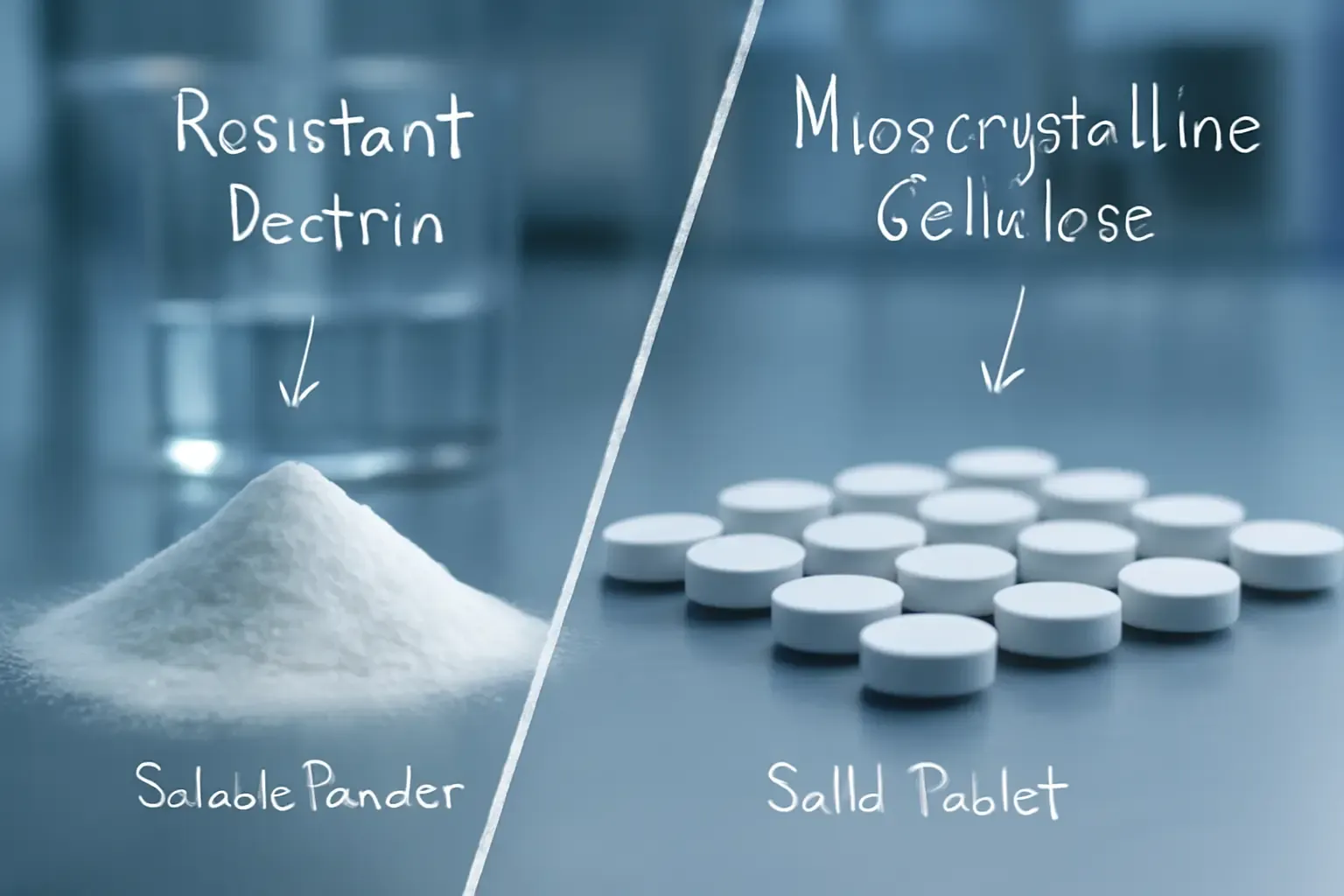
Procurement teams rarely source **
resistant dextrin** and **
microcrystalline cellulose (MCC)** for the same reason—but in real formulations, they often solve adjacent problems. Resistant dextrin helps brands hit **low-calorie, high-fiber** targets without compromising taste or process stability.
MCC helps solid dosage forms stay **compressible, uniform, and reliably disintegrating**. When these two ingredients are specified together early, buyers typically see fewer reformulations, smoother scale-up, and clearer QC acceptance criteria.

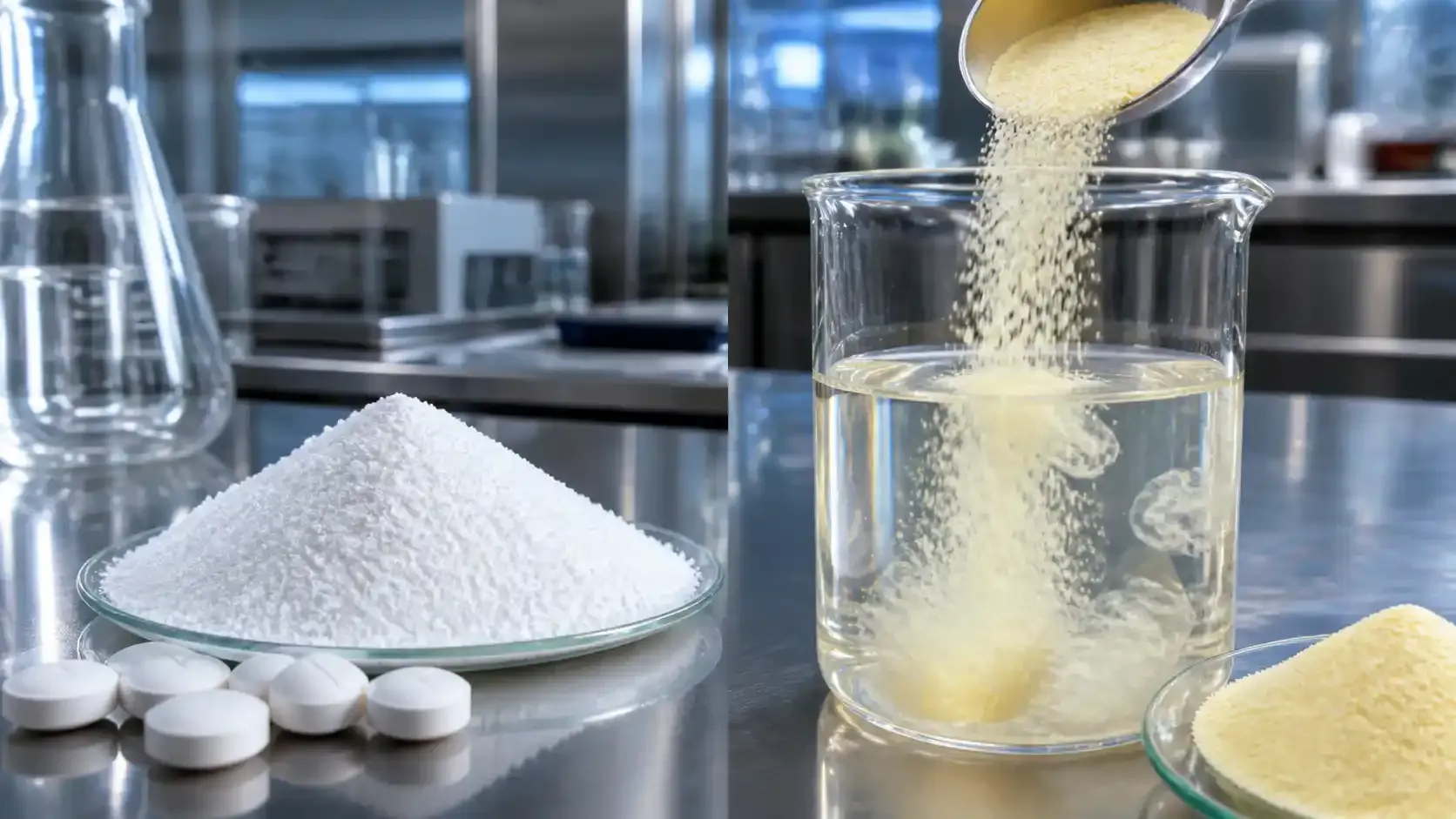
## How the two ingredients “fit” in real product development Resistant dextrin is primarily a **soluble dietary fiber** used to raise fiber content while keeping texture and flavor clean. MCC is a **pharmaceutical excipient** valued for its **compressibility, flow properties, and biocompatibility**, and is widely used in oral solid dosage forms. In procurement terms, the pairing is less about chemistry and more about workflow: - **Resistant dextrin** supports consumer-facing claims and sensory targets (neutral taste, easy dissolution, low viscosity). - **Microcrystalline cellulose** supports manufacturing targets (tablet hardness, content uniformity, predictable disintegration). When a brand sells both drink mixes and tablets (or wants line extensions across formats), aligning supplier documentation and batch consistency across both ingredients becomes a practical advantage. ## Technical basics buyers should lock down before sampling Here are the parameters that most often decide whether resistant dextrin and MCC work smoothly across pilot and production. ### Resistant dextrin specs that drive formulation stability Shine Health’s resistant dextrin pages describe a typical profile for resistant dextrin derived from **NON-GMO corn starch**, including consistent appearance and core composition limits. | Item | Typical spec shown on supplier pages | |---|---| | Product | Resistant dextrin (soluble dietary fiber) | | Raw material | Corn starch (NON-GMO options highlighted) | | Appearance | White to light yellow | | Fiber content | **≥82%** | | Protein content | **≤6.0%** | | Stability notes | Stable under heat and across pH ranges; neutral taste | **What this means for buyers:** if resistant dextrin is going into beverages, bars, or supplement blends, the combination of **high fiber content**, **neutral taste**, and **heat/acid stability** reduces the chance that sensory or viscosity shifts appear after pasteurization, baking, or acidic flavor systems. ### MCC functions buyers typically rely on Microcrystalline Cellulose Disintegrant is described as a pharmaceutical excipient produced from purified cellulose fibers and known for: - **Excellent compressibility** - **Good flow properties** - **Biocompatibility** - A key role in **oral solid dosage forms** as a processing aid and performance excipient For procurement, that translates into fewer surprises during compression and a more controllable pathway to target hardness and disintegration. > **Practical rule of thumb:** resistant dextrin is often judged by “does the consumer notice it?” while MCC is judged by “does the production line notice it?” Successful launches need both answers to be “no.” ## Case study 1 — Nutritional dietary fiber powders and supplement blends Powdered supplement formats (instant drink mixes, stick packs, canister blends) are a common entry point for resistant dextrin because they reward solubility and taste neutrality. **Formulation goal** - Increase fiber with minimal impact on taste and mouthfeel - Maintain clear solubility in water or juice - Preserve stability across storage and typical consumer prep **Why resistant dextrin is used here** Resistant dextrin is positioned as a soluble dietary fiber with **neutral taste** and **process stability**. Those traits help it blend into flavored systems where sweetness, acids, and aromas can amplify off-notes from less neutral fibers. 
A useful benchmark page for buyers evaluating this application is the **nutritional dietary fiber powder** listing: nutritional dietary fiber powder (resistant dextrin). **Procurement checkpoints that prevent rework** - Confirm the source claim: **NON-GMO corn starch** is explicitly called out on multiple supplier pages. - Align COA acceptance lines to the formulation brief (at minimum: appearance, fiber content, protein content, storage guidance). - Ask how batch consistency is protected at scale. Shine Health describes **fully automated central control** from raw material feeding to filling on resistant dextrin pages—automation matters because powders are unforgiving when a small shift causes caking, sweetness perception changes, or blend segregation. **Where MCC may enter the same product program** Even if the hero SKU is a powder, many brands later add tablets or capsules as a convenience format. If that roadmap exists, it is cost-efficient to pre-qualify an MCC option early rather than waiting for tablet stability issues to appear. ## Case study 2 — Low-calorie and sugar-reduction foods that must survive processing In functional foods, resistant dextrin tends to be selected when the product must hold up under processing stress while staying consumer-friendly. **Typical use cases** - Bars and cereals - Meal replacements - Beverages positioned for low-calorie or sugar-reduction strategies **Why resistant dextrin performs well in these matrices** Supplier descriptions emphasize **heat and acid stability** and a **neutral taste**, which are both relevant in real-world processing: - Heat stability supports baking, extrusion, and hot-fill steps. - Acid stability helps in fruit-flavored beverages and systems where pH control is part of shelf-life design. For buyers sourcing by application, the following product page is a direct example of how suppliers position resistant dextrin for calorie control: low calorie dietary fiber (resistant dextrin). **Quality and supply signals buyers should read as “scale-ready”** Instead of evaluating only price per metric ton, procurement teams usually get better outcomes by validating whether the supplier can protect consistency during sustained runs. Signals described across Shine Health materials include: - Use of **advanced biological enzymes imported from overseas** - A **precision production line of German origin** - **GMP-standard workshops** and a **fully equipped QC laboratory** - Fully automated operation from feeding to filling Those details matter in foods because the same resistant dextrin may be used across multiple SKUs; preventing cross-batch variability reduces re-qualification work for each new flavor, format, or geography. **Packaging and handling reality** Resistant dextrin pages describe flexible packaging from small packs up to **25 kg moisture-proof bags**, which is a practical requirement for both pilot trials and scaled manufacturing. If a supplier cannot keep packaging consistent, bulk handling issues can show up as moisture pickup or inconsistent flow at the blending step. ## Case study 3 — Tablets where MCC does the mechanical work and coatings do the finishing Tablets are where MCC becomes a strategic ingredient, because mechanical behavior determines whether the dosage form meets both production and user expectations. **What MCC is typically asked to deliver** - Help achieve target tablet hardness without sacrificing disintegration - Improve powder flow and compressibility in the press - Support content uniformity in blends that include fine, low-dose actives A relevant starting point for buyers comparing options is the supplier’s microcrystalline cellulose category: microcrystalline cellulose, with examples such as: - Microcrystalline Cellulose powder additive - Microcrystalline cellulose bulk **Where resistant dextrin can overlap in solid formats** When resistant dextrin is part of the formula (for fiber tablets or multi-benefit supplement tablets), the excipient system has to handle a higher mass fraction of functional powder. This is where MCC’s role as a compressible excipient can help reduce tablet defects and improve robustness. **Film coating as the “user experience” layer** Even when the core tablet compresses well, coatings frequently decide market acceptance: appearance, swallowability, and taste masking. Shine Health’s materials on coatings describe benefits such as improved swallowability and protection against moisture and light. Buyers who want an integrated sourcing route can use the coating overview as a reference point: pharmaceutical tablet film coatings. ## What procurement teams mean by “recommended” in China sourcing Search terms like **Recommended Chinese Microcrystalline Cellulose Manufacturer**, **Recommended Chinese Microcrystalline Cellulose Supplier**, and **Recommended Chinese Resistant Dextrin Manufacturer** are often shorthand for a supplier that can pass three tests: 1. **Specs are stable and easy to verify** - Resistant dextrin with clear, repeatable lines like fiber **≥82%**, protein **≤6.0%**, and consistent appearance. 2. **Manufacturing controls reduce human variability** - Automation from feeding to filling and a QC laboratory that can support lot release documentation. 3. **Certifications and systems match global go-to-market needs** - Shine Health lists certifications across its materials (e.g., ISO systems and food safety/religious certifications depending on product line and page), and it highlights GMP workshops—buyers typically treat these as baseline evidence for export-oriented supply. For teams building a shortlist, a company profile page is often the fastest place to confirm facility scale and portfolio fit. One example buyers use for benchmarking is: Shandong Shine Health company profile. ## A practical sourcing workflow that keeps projects moving To reduce the “trial-and-error tax,” buyers can structure qualification around the same three application formats used above: - **Powders:** verify resistant dextrin solubility behavior and confirm documentation (COA availability, batch traceability cues). - **Foods/beverages:** confirm heat/acid stability claims align with the process steps the SKU will face. - **Tablets:** pre-qualify MCC as a compression and disintegration tool, and verify whether a compatible coating system is available if swallowability or stability is a priority. When this is done up front, resistant dextrin and microcrystalline cellulose become less of a procurement risk and more of a reusable toolkit across multiple launches. If further detail on resistant dextrin, MCC grades, or coating systems is needed, buyers often review technical pages and company background on the supplier’s main site: [www.sdshinehealth.com](https://www.sdshinehealth.com). --- ## On-page supplier benchmarks consulted - Nutritional dietary fiber powder (resistant dextrin) - Low calorie dietary fiber (resistant dextrin) - Resistant dextrin maize - Microcrystalline cellulose category - Pharmaceutical tablet film coatings - Company profile benchmark for supplier evaluation