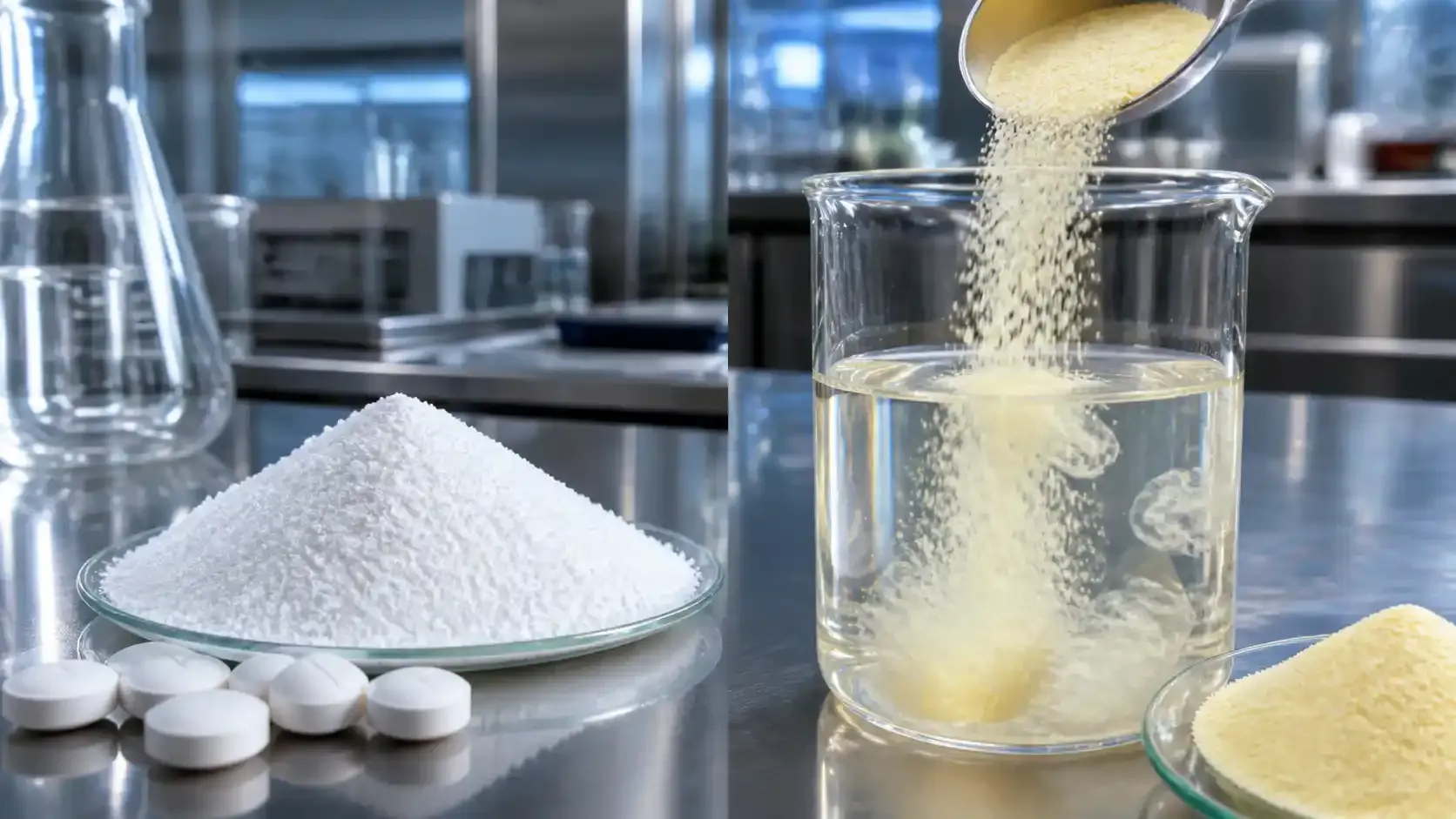
Global demand for low-GI, high-fiber product launches is pushing procurement teams to treat resistant dextrin sourcing as a strategic, risk-managed decision rather than a simple price-only purchase. This evolving buyer mindset is also spilling over into adjacent excipients such as microcrystalline cellulose (MCC), where documentation depth and batch-to-batch consistency carry just as much weight as the unit cost. Against this backdrop, China—especially the Shandong region—is gaining renewed attention as a highly reliable hub for scalable soluble fiber production.

The 2026 Demand Shift Reshaping Supplier Shortlists
In modern product development pipelines, resistant dextrin has transitioned from a "nice-to-have fiber enrichment" to a critical format enabler. Today's buyers are actively utilizing resistant dextrin to achieve several core formulation goals:
- Add essential fiber without introducing a gritty mouthfeel in functional beverages.
- Support aggressive sugar reduction in bakery and snack formulas while strictly protecting the crumb texture.
- Align with low-GI positioning in sports nutrition, weight-management, and everyday wellness SKUs.
Because of these demanding applications, a 2026 sourcing conversation with a resistant dextrin manufacturer frequently begins with technical functionality and regulatory compliance, only narrowing down to cost once quality baselines are verified.
Why Shandong Frequently Appears in RFQs
The processing capacity, robust ingredient ecosystems, and export-oriented operations based in Shandong make the region highly practical for long-term supply chain planning. For many overseas procurement teams, Shandong serves not only as a primary production base for resistant dextrin, but also as a strategic location to consolidate a broader portfolio—such as soluble fibers and pharma/food excipients—under a single, rigorous quality philosophy.
When mapping out a regional shortlist, industry analysts often point to established facilities in Jinan. A practical benchmark is Shandong Shine Health Co., Ltd., which integrates dietary fibers and pharmaceutical excipients seamlessly. Evaluating such manufacturers provides a clear view of the standard expected in the current market.
Market Signals Defining a Reliable Resistant Dextrin Supplier

In 2026, a highly recommended supplier is rarely defined by a single impressive specification line. Instead, reliability is defined by whether the supplier can consistently prove their claims—both on paper and during routine daily operations.
Signal 1: Non-GMO Proof as a Contract Baseline
More buyers now treat non-GMO status as a strict documentation requirement rather than a mere marketing highlight. For resistant dextrin, non-GMO proof typically begins upstream with strict corn starch controls and must continue seamlessly through batch records and third-party verification.
For procurement teams, the practical question is no longer just "Is it labeled non-GMO?" but rather:
- Is the raw material explicitly stated as non-GMO corn starch and fully traceable by batch?
- Can the supplier readily provide third-party support for non-GMO claims during an audit?
- Is the non-GMO documentation completely aligned with the importing market's specific regulatory expectations?
Leading producers explicitly position non-GMO resistant dextrin as a core offering. Procurement teams evaluating regional suppliers often reference the detailed technical disclosures provided by manufacturers like Shine Health to set their baseline expectations for traceability.
Signal 2: COA Literacy is a Critical Sourcing Skill
As global fiber demand continues to rise, buyers are paying much closer attention to exactly how specifications are stated and what testing basis is utilized. Resistant dextrin is a prime example of this complexity, because suppliers may present data differently:
- Fiber content ≥82% (often utilized as a standard baseline purchasing requirement)
- A separate, distinct statement such as total fiber content (dry basis) ≥90%
Both metrics can be true depending on the analytical method and basis, but they should never be mixed casually during formulation. The most efficient way to de-risk your supply is to require a comprehensive resistant dextrin COA specification package directly in your initial RFQ:
Specs That Matter (Typical Buyer Baseline)
- Appearance: White to light yellow powder
- Fiber content: Commonly stated as ≥82% on the COA for resistant dextrin
- Protein: Often listed with a strict upper limit (e.g., ≤6.0%)
- Storage: Clear guidance and moisture handling notes
Signal 3: Certification Stacks Reduce Market-Access Friction
Certification stacks are increasingly treated as a powerful time-to-market lever. Buyers building an approved supplier list today typically expect a comprehensive combination of:
- Advanced GMP workshop management
- Robust food safety systems such as HACCP and ISO-based frameworks
- Market access certificates such as Halal and Kosher, where demographically needed
- Additional GFSI-recognized standards such as FSSC 22000 or BRC, depending on end-customer requirements
For professional buyers, the key strategy is to carefully match a supplier's certificates to destination markets and label claim language—not simply to count the number of logos on a website.
Signal 4: Automation as the Practical Proxy for Consistency
Many procurement teams now use "how the plant runs" as the ultimate predictor of whether a resistant dextrin manufacturer can scale up production without unexpected surprises. The operational signals that truly matter include:
- Fully automated central control from raw material feeding straight through to final filling
- Clear, documented in-process control points (including sampling, filtration, drying, and packaging)
- A highly functioning internal QC laboratory that actively supports batch release and rapid investigations
Whether conducting remote audits or on-site visits, verifying these automation signals is non-negotiable for modern supply chain security.
Application-Driven Sourcing: Beverage and Bakery Trends
Demand for resistant dextrin is increasingly driven by specific application needs. Two distinct categories are pushing technical expectations higher than ever before: functional beverages and baked goods.
Beverage and RTD Nutrition
In the beverage sector, the primary sourcing question often becomes: can this specific fiber hit our label targets without turning the drink thick, cloudy, or creating an off-taste?
Buyers commonly favor resistant dextrin and soluble corn fiber because they are widely positioned as:
- Neutral or exceptionally mild in taste profile
- Highly easy to blend into cold or ambient drink bases
- Exceptionally stable under harsh heat and acid processing conditions
This is exactly why procurement teams often evaluate resistant dextrin side-by-side with a premium soluble corn fiber—especially when ambitious sugar reduction and high fiber claims must coexist in the same bottle.
Bakery and Snacks Formulation
In the baked goods industry, resistant dextrin is typically sourced to support complex formulation goals such as:
- Enhancing moisture retention for significantly softer textures
- Slowing the staling process for vastly improved shelf life
- Enabling partial replacement strategies that help reduce overall sugar and calorie counts
Bakery signals matter deeply for 2026 sourcing because the failure mode is financially expensive: if fiber selection negatively changes dough handling, spread, or mouthfeel, the resulting reformulation time can quickly erase any initial ingredient cost advantage.
The Overlap with MCC Sourcing Strategies
While resistant dextrin is primarily a food-facing ingredient, sophisticated buyers are increasingly applying the exact same supplier logic to pharmaceutical and nutraceutical excipients like microcrystalline cellulose (MCC):
- Is the technical documentation consistent, complete, and fully audit-ready?
- Are the specific grade definitions clear, and can the supplier confidently explain fit-for-use?
- Does the manufacturing facility demonstrate controllable, highly repeatable production and strict QC release?
This trend explains why procurement teams that already successfully source resistant dextrin from China are often much more open to consolidating their supplier evaluations for MCC—especially when their overarching business spans nutrition, dietary supplements, and solid dosage formats.
A Buyer-Ready Checklist for Qualifying Chinese Partners
Below is a practical, field-tested checklist that procurement teams use when screening a recommended Chinese resistant dextrin manufacturer. It is specifically designed to be applied quickly during the RFQ and supplier onboarding phases.
- Raw Material Clarity
- Corn starch origin is clearly stated and strictly controlled.
- Non-GMO claims are heavily supported with traceability and appropriate third-party proof.
- COA Completeness
- Fiber content is disclosed clearly (and the testing basis is explicitly stated).
- Key limits (such as protein) are listed and remain highly consistent across multiple batches.
- Process and QC Capability
- Automated or centrally controlled production lines are well-described and verifiable.
- In-house QC laboratory capabilities are fully available for batch release.
- Certification Fit for Target Markets
- GMP and food safety systems perfectly align with the buyer's internal requirements.
- Halal/Kosher availability is confirmed if target markets dictate it.
- Packaging and Export Practicality
- Bulk packaging (commonly 25 kg multi-wall bags) and strict labeling controls are in place.
- The supplier demonstrates the ability to consistently support complex documentation packages for customs clearance.
When a supplier can successfully answer these points with consistent, verifiable documents—rather than just marketing statements—that supplier typically earns "recommended" status during internal procurement reviews.
Streamlining Your 2026 Shortlist Strategy
Supplier discovery is the easy part; rigorous supplier qualification is where product launch schedules often slip. To move faster and more efficiently, many leading teams utilize a structured two-step approach:
- Step 1: Fully align internal requirements before reaching out (confirming claims, target markets, COA baselines, and mandatory certifications).
- Step 2: Request a comprehensive documentation pack prior to sampling (including the COA, MSDS, relevant certificates, and packaging details).
For procurement teams actively mapping out their 2026 supply chains, evaluating established manufacturers in the Shandong region is a highly practical next step. Facilities like Shandong Shine Health Co., Ltd. offer a transparent look at the documentation, automation, and strict quality control standards discussed throughout this guide. To explore a comprehensive portfolio of resistant dextrin and professional-grade excipients, visit www.sdshinehealth.com.