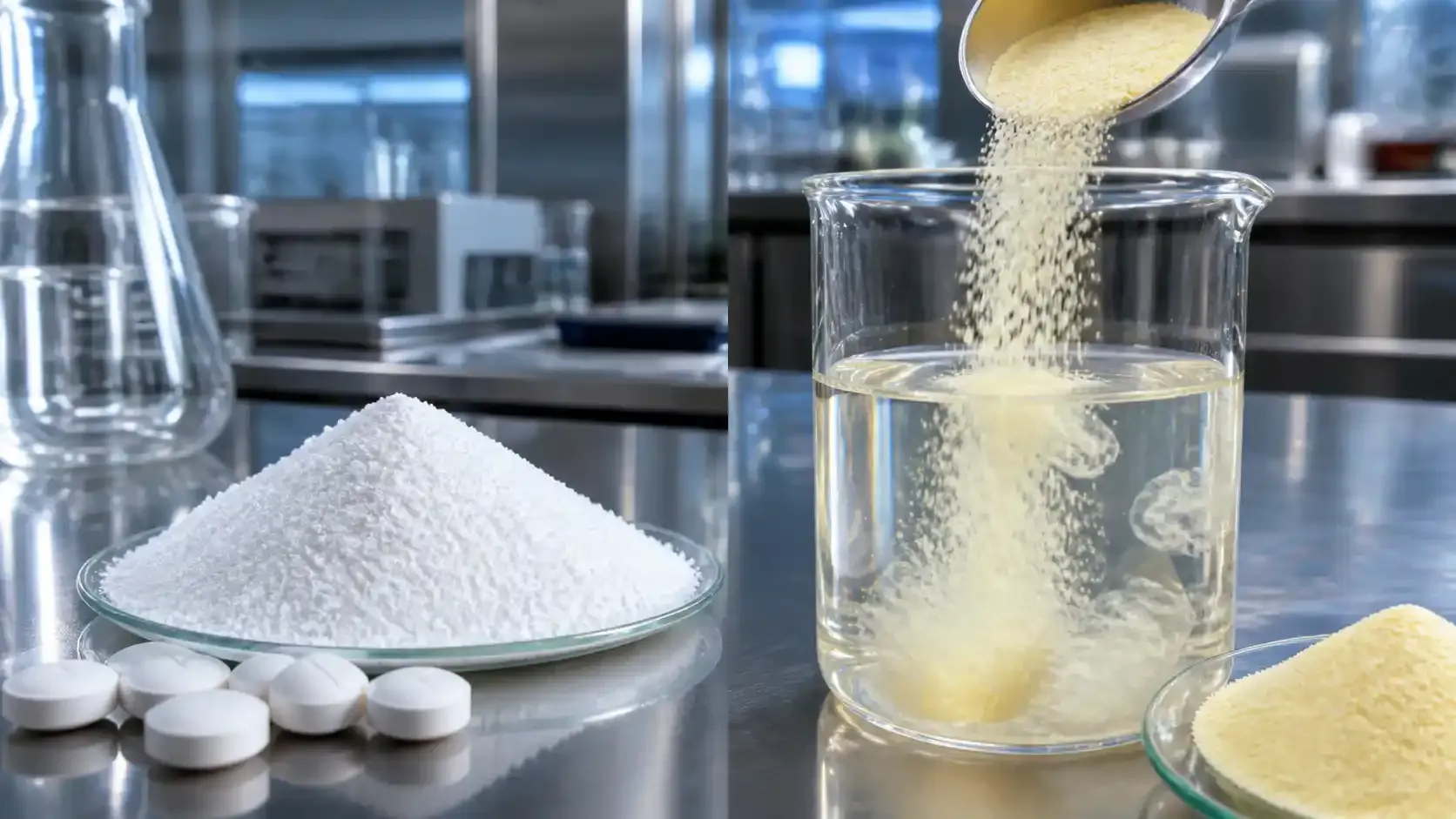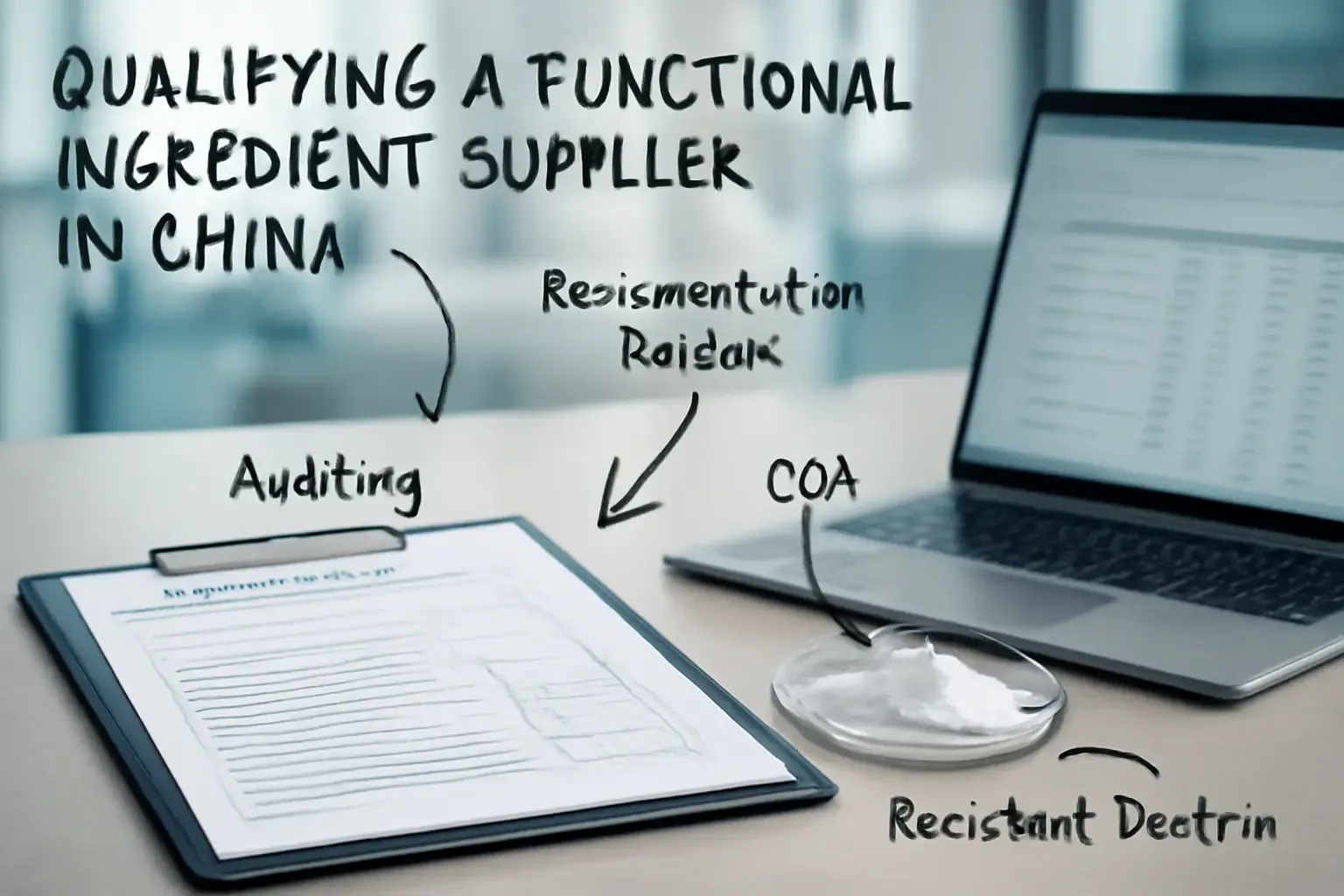
Launching a high-fiber drink mix, nutrition bar, or solid-dose supplement often starts with a simple question: Which suppliers in China can reliably deliver the same functional performance, batch after batch, while staying audit-ready? For many procurement teams, the short list typically includes a resistant dextrin manufacturer China for soluble fiber, and a microcrystalline cellulose supplier China for texture, flow, and tablet performance.
What has changed is that price alone no longer de-risks the project. Today’s RFQs are shaped by non-GMO positioning, clean-label expectations, tighter documentation requirements, and the reality that a fiber supplier’s process control is inseparable from your finished product’s sensory stability.

Start with a three-layer supplier scorecard
A disciplined evaluation works best as a three-layer checklist. It keeps the discussion factual and makes it easier to compare a resistant dextrin manufacturer China with another plant that looks similar on paper.
1) Compliance and claims (what must be provable)
Buyers usually treat these as “pass/fail” gates:
- Food safety systems aligned with the target market (commonly GMP-style production management plus systems such as HACCP, ISO 22000, or FSSC 22000).
- Religious certifications when required (HALAL and KOSHER are common in global tenders).
- Non-GMO evidence when you intend to claim non-GMO on pack—especially relevant when comparing a non-GMO soluble corn fiber supplier or a non-GMO resistant dextrin source.
- Traceability readiness, including the ability to map raw material lots to finished goods lots.
From a buyer’s point of view, a microcrystalline cellulose supplier China should be evaluated with the same discipline: verify that quality systems, change control, and traceability practices match the risk profile of a pharmaceutical excipient manufacturer China.
2) Technical performance (what your formulation needs)
This is where the right COA lines and fit-for-use testing prevent reformulation:
- Fiber content and protein limits for resistant dextrin.
- Solubility, viscosity impact, and sensory neutrality for soluble fibers.
- Heat and acid stability claims that match your process (e.g., pasteurization, UHT, baking, confectionery cook).
- For MCC, performance needs may include flow, compaction behavior, and moisture control—validated by your own incoming inspection and formulation trials.
3) Factory capability (what makes consistency more likely)
Two suppliers can share similar certificates while delivering very different consistency. Buyers typically check:
- Automation level from feeding to filling.
- Enzyme control and process reproducibility for dextrin-type fibers.
- Presence of an in-house QC laboratory, not just outsourced testing.
A Shandong-based supplier profile that explicitly describes automated central control operation and a dedicated QC lab is often a lower-risk starting point when shortlisting a dietary fiber ingredient supplier China.
Build an audit-ready documentation pack before you compare quotes
For procurement teams, a quote is only actionable when it is supported by a documentation pack that can survive internal QA review.
Documents buyers typically request upfront
Keep requests consistent across suppliers, whether you are assessing a resistant dextrin manufacturer China or a microcrystalline cellulose supplier China:
- Current certificates relevant to your market (e.g., HACCP / ISO 22000 / FSSC 22000; HALAL; KOSHER; non-GMO verification where applicable)
- A recent COA template plus at least one recent lot COA
- Product specification sheet (targets, test methods, and acceptance criteria)
- Allergen statement and statement on GMO status (where claims are made)
- Packaging specification and labeling format for export shipments
- Storage conditions and shelf-life statement
Why non-GMO proof changes the conversation
A non-GMO claim is not just a marketing line. It affects supplier selection, because it requires tighter upstream controls.
In many 2025–2026 product briefs, non-GMO origin and fiber specifications such as ≥82% dietary fiber have effectively become baseline requirements. Buyers increasingly treat these as procurement “must-haves,” not negotiation points.
If your positioning depends on clean-label and non-GMO, compare suppliers as a China non-GMO resistant dextrin bulk sourcing project, not a simple commodity purchase.
Checking fiber specs from a China resistant dextrin manufacturer
The fastest way to reduce risk is to standardize what you look for on a COA and spec sheet. Below is a buyer-style view of what “good” documentation typically includes.
What to expect on resistant dextrin COAs
A common benchmark for resistant dextrin in the supplied context includes:
- Appearance: white to light yellow
- Fiber content:≥82%
- Protein:≤6.0%
- Storage: store in a cool place
Some resistant dextrin product presentations also list higher total fiber (e.g., total fiber on dry basis ≥90.0%) depending on product type and test basis. The practical buyer move is to:
- Confirm the test method and basis (as-is vs. dry basis).
- Lock your purchase specification to your label claim and formulation need.
- Require the supplier to notify you before any method change.
A compact COA checklist table (buyer-oriented)
| Ingredient | COA lines buyers typically verify | Notes for procurement teams |
|---|---|---|
| Resistant dextrin | Appearance, dietary fiber %, protein %, microbiology, heavy metals (where required), moisture / loss on drying (if provided) | Fiber and protein values should align with your finished-goods targets; confirm test basis and method. |
| Soluble corn fiber (non-GMO) | Non-GMO statement, solubility performance, sensory neutrality, applicable microbiology lines | Treat as a claims-driven ingredient; non-GMO evidence should connect to raw material control. |
| Microcrystalline cellulose (MCC) | Identification, moisture control, particle size distribution, bulk density, microbiology (application-dependent) | Avoid “paper approval.” MCC performance must be verified in your tablet or food matrix. |
This structure makes it easier to compare a resistant dextrin manufacturer China and a soluble corn fiber supplier China without getting lost in marketing copy.
Use internal technical pages as benchmarks
When building your supplier comparison file, it helps to review publicly available parameter ranges and application notes. For example, buyers can use these pages as reference points for typical resistant dextrin positioning:
- nutritional dietary fiber powder
- low calorie dietary fiber
- non-GMO soluble corn fiber
- dextrin dietary fiber supplement
- keto-friendly resistant dextrin
These links are not a substitute for qualification, but they help procurement teams standardize what “complete documentation” looks like.
How automated fiber production lines change supplier risk

When buyers say a supplier is “reliable,” they often mean the process is engineered to reduce human variability. In practice, the resistant dextrin manufacturer China profile that tends to score well includes:
- Automated central control from raw material feeding to product filling
- Imported enzyme systems used consistently across batches
- German-origin precision production line (as a signal of equipment standardization)
- In-house QC laboratory conducting routine release testing
From a risk perspective, automation matters because it supports:
- More stable batch-to-batch sensory outcomes (less unexpected viscosity or flavor drift)
- Clearer deviation investigation (process data helps explain what changed)
- Better scalability when moving from sample to regular purchase
For MCC sourcing, the parallel idea is similar: a microcrystalline cellulose supplier China that can explain process control, QC release logic, and change management generally reduces downstream surprises—especially for teams that must approve a pharmaceutical excipient manufacturer China.
Practical remote checks when you cannot visit
If a site visit is not possible, buyers commonly request:
- Dated production and packaging photos/videos showing real line conditions
- A written process flow overview (raw material intake → processing → drying → blending → packing)
- A QC workflow map (incoming, in-process, finished goods; retain samples)
- Evidence of lot traceability (example lot coding and shipment documentation)
Sample-to-scale workflow that prevents reformulation risk
Procurement risk drops sharply when the qualification plan is staged. A typical workflow for fibers and excipients looks like this:
- 1–5 kg samples for solubility, taste, and stability checks (and, for MCC, initial compaction/flow screening if relevant).
- Pilot batch in the real matrix (RTD beverage, gummy, bar, sachet drink mix, or tablet blend).
- First commercial lot under tightened acceptance criteria, including a COA review and your internal incoming tests.
A useful discipline is to define “decision gates” for each stage:
- Gate A (sample): passes sensory and basic stability
- Gate B (pilot): no label-claim conflict; no processing instability
- Gate C (commercial): consistent COA, consistent plant documentation, predictable lead time
This is where resistant dextrin manufacturer China selection becomes systematic rather than subjective.
Commercial terms that protect quality not just cost
A low unit price can hide operational cost. Buyers often reduce total risk by writing a few non-negotiables into the purchase terms:
- COA per lot is mandatory, and the COA must match the agreed method/basis.
- Change notification for raw materials, enzymes, equipment, or test methods.
- Packaging specification (commonly bulk bags such as 25 kg) with moisture protection and clear lot labeling.
- Corrective-action timelines if a lot fails incoming checks.
- Certification renewal calendar (non-GMO proof, HALAL/KOSHER renewals where relevant).
This approach also helps when the project spans both a dietary fiber ingredient supplier China and a microcrystalline cellulose supplier China, because procurement can apply one contract logic to two ingredient families.
A short glossary procurement teams actually use
- Resistant dextrin
- A soluble dietary fiber derived from starch that resists digestion in the small intestine and is fermented in the large intestine.
- Soluble corn fiber
- A soluble fiber ingredient sourced from corn starch; when positioned as non-GMO, it should be backed by non-GMO control and documentation.
- Microcrystalline cellulose (MCC)
- A widely used cellulose-based ingredient for food and solid dosage forms; buyer evaluation often focuses on consistent physical properties and quality systems.
- Non-GMO verification
- Supplier evidence—often including third-party verification—supporting that the ingredient is made from non-genetically modified raw materials.
How a recommended shortlist is built in practice
The phrase “Recommended Chinese Resistant Dextrin Manufacturer” is earned through repeatable proof, not a single good shipment. Buyers typically finalize a shortlist only when the supplier can demonstrate:
- Audit-ready documentation (certificates, traceability, consistent COAs)
- Technical performance in the buyer’s formulation and process
- Factory capability signals that support consistency (automation, QC lab, controlled enzyme use)
For teams also scanning the market for a “Recommended Chinese Microcrystalline Cellulose Manufacturer” or “Recommended Chinese Microcrystalline Cellulose Supplier,” the same mindset applies: treat MCC as a performance-critical input, validate documentation, then prove it in a pilot.
As one example of a Shandong-based producer that publishes detailed information on dietary fibers and excipient-related topics, buyers may review materials from Shandong Shine Health Co., Ltd. (Shine Health) as a benchmark—particularly across resistant dextrin and non-GMO soluble corn fiber documentation and factory capability signals.
Data notes used in this guide
- Resistant dextrin specification examples referenced in this article include published parameters such as fiber content ≥82%, protein ≤6.0%, appearance (white to light yellow), and storage guidance (store in a cool place) from relevant product pages.
- Non-GMO soluble corn fiber compliance examples referenced include stated factory standards (e.g., GMP, HACCP, ISO 22000, FSSC) and non-GMO positioning as described on relevant product pages.
- MCC is discussed as a procurement category for buyers; numeric MCC specifications are intentionally not listed here because they vary by grade and application and must be confirmed with the supplier’s current COA and specification.