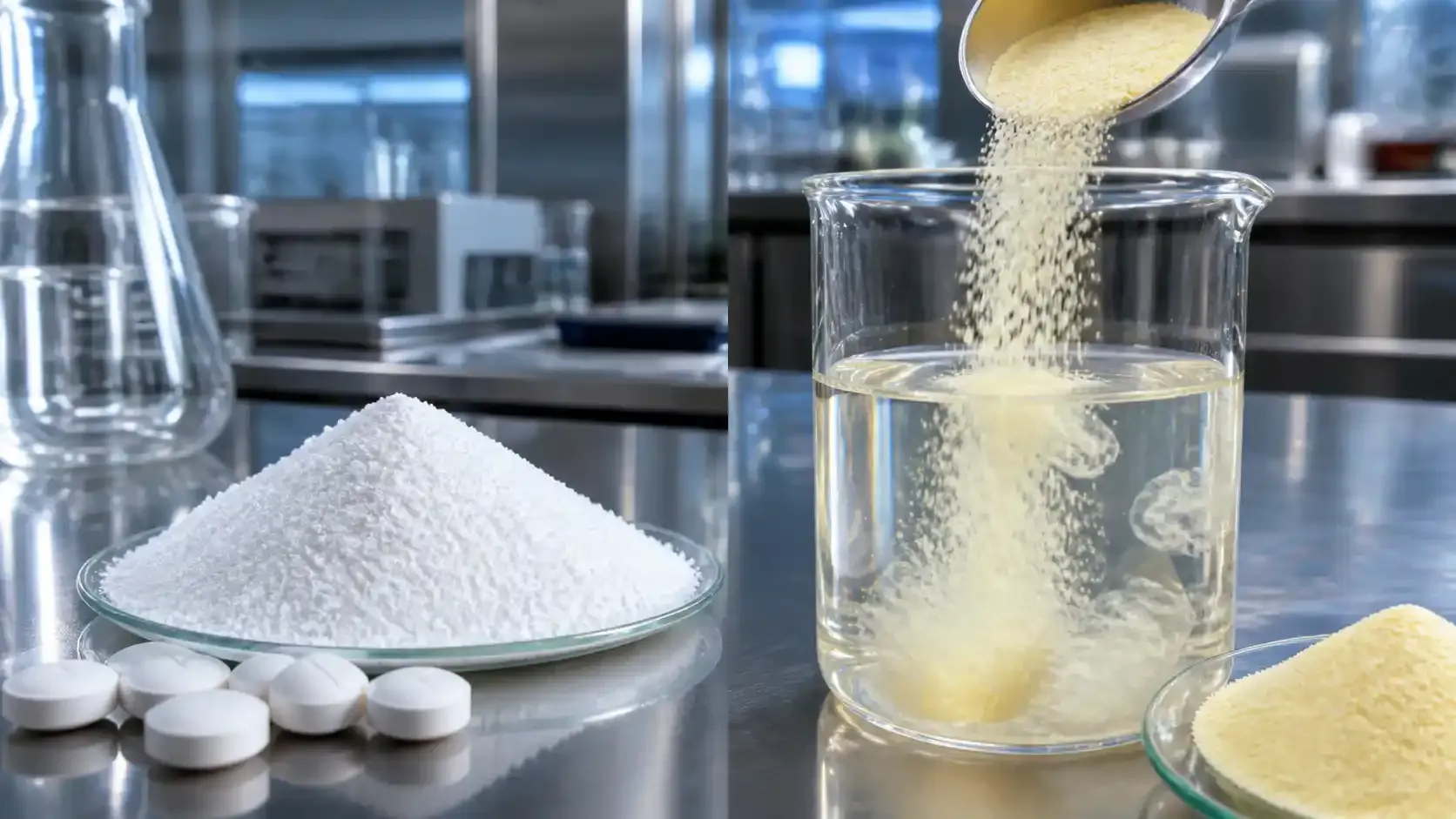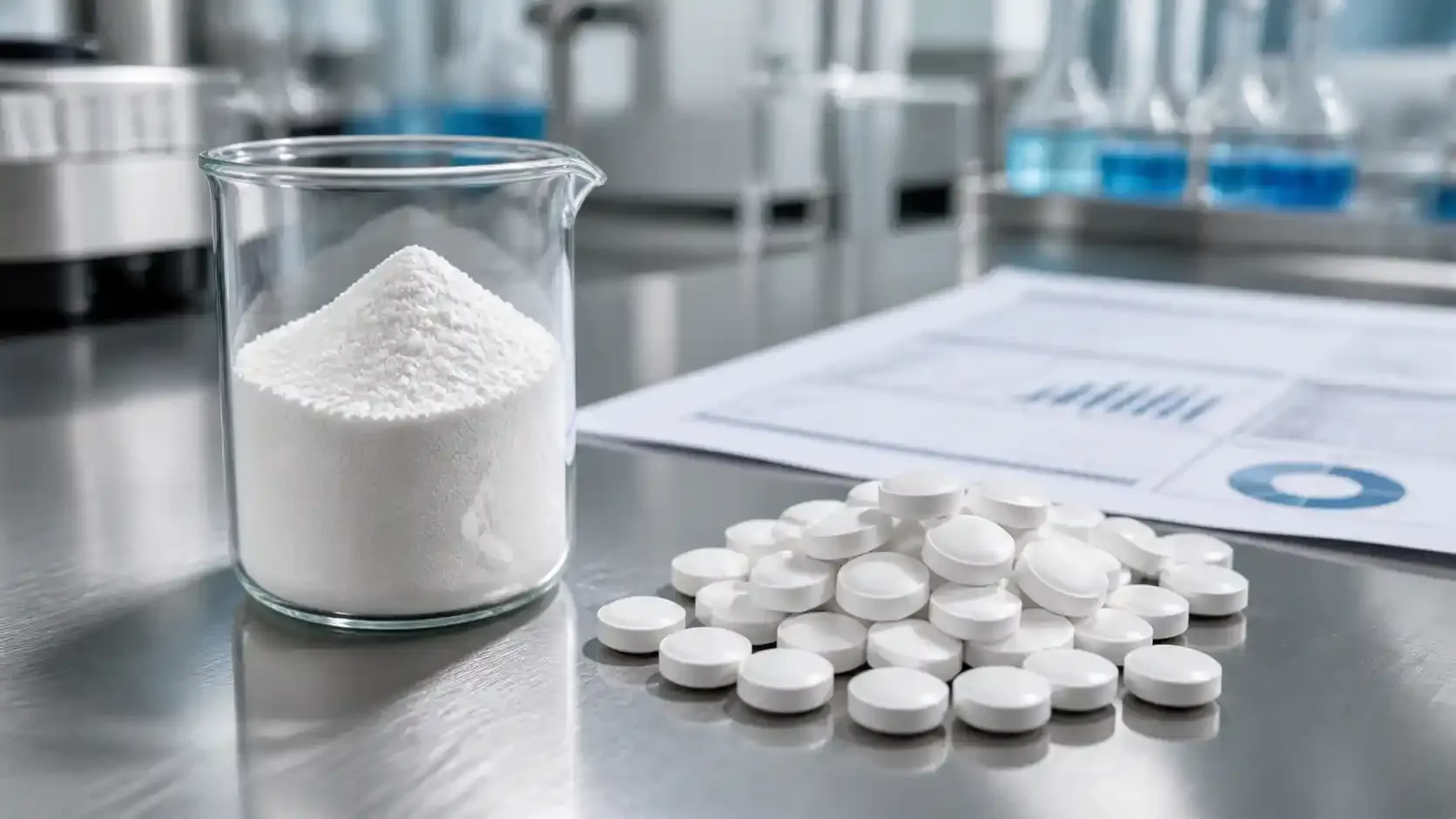
Procurement teams and formulators are under the same pressure: deliver higher-fiber and lower-sugar products without sacrificing taste, stability, or label clarity. That shift has made two ingredient families show up in the same sourcing conversations more often than ever—resistant dextrin (a soluble dietary fiber used in foods and beverages) and microcrystalline cellulose (MCC) (a widely used excipient and texturizer).
The challenge is rarely “Can you get it?” The harder question is “Can you trust it at scale?” The quickest way to answer that is understanding what really matters on a Certificate of Analysis (COA) and how those numbers translate into performance on your lines.

Why resistant dextrin and MCC keep landing on the same shortlist
Resistant dextrin is typically selected when a formulation needs soluble fiber that dissolves easily, stays stable in processing, and supports digestive-friendly positioning. Microcrystalline cellulose (MCC) is often selected when a product needs structure—tablet robustness, flow properties, or controlled texture in certain food systems.
For buyers, the overlap is practical: a brand may source resistant dextrin for fiber beverages and powdered supplements, while sourcing MCC for tablet lines or texture management. The commercial risk is also shared: if a supplier cannot consistently meet COA targets, both product claims and manufacturing efficiency can unravel quickly.
What exactly is resistant dextrin in plain language
Resistant dextrin is a soluble dietary fiber derived from starch (commonly corn starch). It is designed to resist digestion in the small intestine and reach the colon, where it can be fermented by gut microbiota. This is why resistant dextrin is frequently discussed as a prebiotic-friendly fiber option in beverages and nutrition products.
From a formulation standpoint, resistant dextrin is popular because it can be:
- Highly soluble (useful for clear or lightly flavored drinks)
- Low in viscosity (helps avoid heavy mouthfeel at practical use levels)
- Stable under heat and acid (important for pasteurization and many beverage pH ranges)
- Neutral to mildly sweet (less flavor masking than many fibers)
For buyers who search terms like resistant dextrin supplier China or non-GMO resistant dextrin bulk supplier, those functional attributes should be verified through documentation—not assumed.
How resistant dextrin is made and why buyers should care
Most sourcing issues show up later as “performance problems,” but the root cause is often upstream. In simplified steps, resistant dextrin production typically follows this sequence:
- Non-GMO corn starch (or another starch source) selection and incoming inspection
- Enzymatic conversion to create digestion-resistant linkages
- Purification to remove unwanted impurities and improve sensory neutrality
- Drying (commonly spray drying) to achieve powder flow and moisture targets
- Batch testing and release based on COA limits
As an example of the kind of manufacturing detail buyers may see in supplier documentation, the Shine Health portfolio describes production built around imported biological enzymes, a precision production line of German origin, Japanese craftsmanship practices, and a fully equipped QC laboratory for batch control (see: food supplement resistant dextrin). This is not a guarantee by itself—buyers still need COA proof—but it is the type of process transparency that helps a technical review.
Reading a resistant dextrin COA without getting lost in numbers
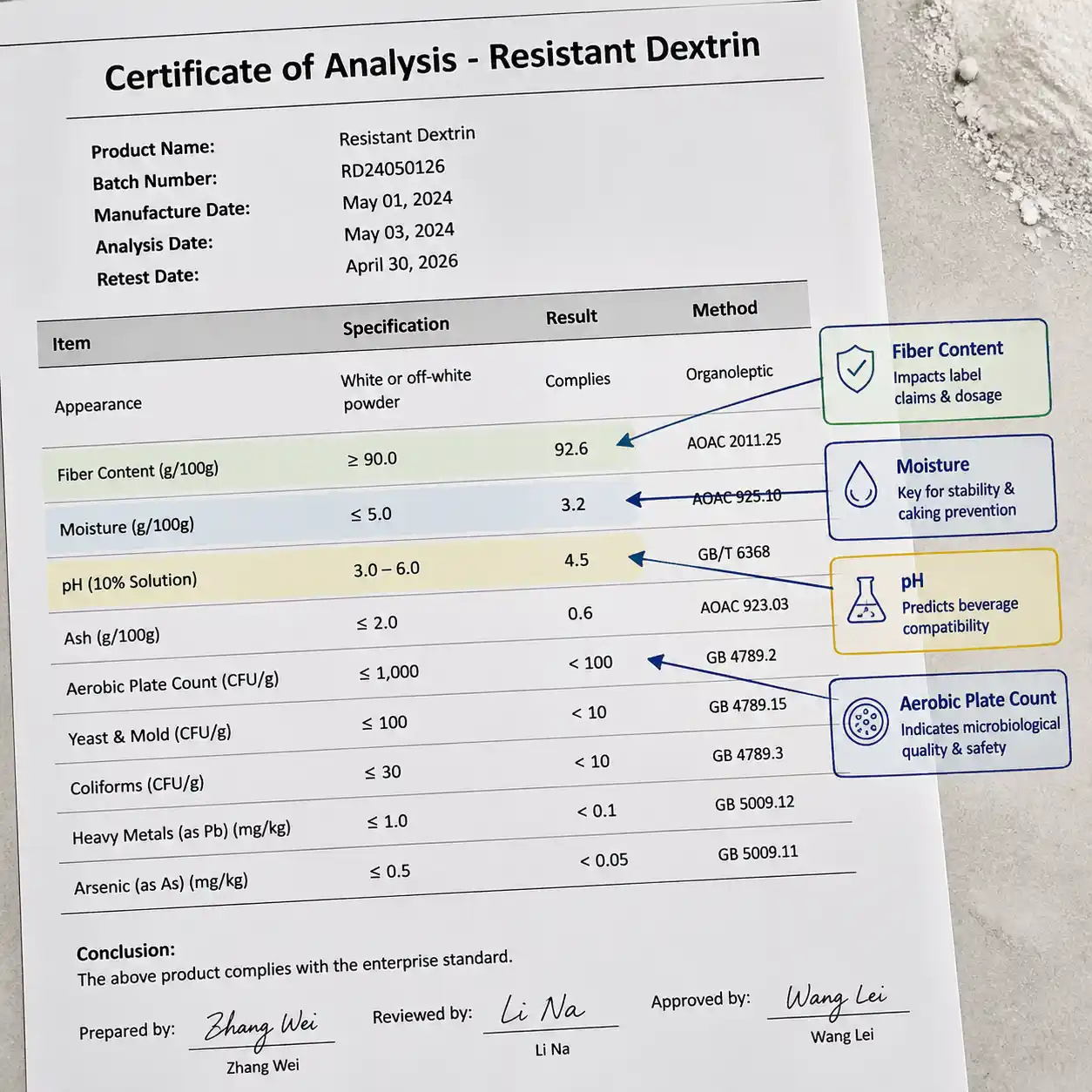
A resistant dextrin COA is not just a checklist; it’s a practical prediction of how the ingredient behaves in your product.
The core lines that usually decide acceptance
- Appearance and flavor: Typical descriptions include white to light yellow powder and sweet, mild, pure. These cues matter for beverages and lightly flavored powders.
- Fiber content (often listed as “Content”): Many suppliers offer multiple grades. Higher fiber grades are commonly preferred when label claims must be achieved with minimal use level.
- Moisture: Moisture control supports shelf life and reduces caking risk during storage.
- Ash: A low ash target generally indicates a cleaner purified product.
- pH: A pH range gives early warning about compatibility with acidic systems and helps predict flavor interactions.
- Water activity: Low water activity helps reduce microbial growth potential and supports long-term storage.
- Microbiological limits: Aerobic plate count, coliforms, yeast, and mold limits protect food safety and reduce downstream QA surprises.
A buyer-friendly snapshot of typical resistant dextrin specifications
The following parameters are commonly used in Shine Health resistant dextrin grades and are representative of what many buyers compare when they buy resistant dextrin bulk from a China source.
| COA item | Typical specification buyers compare | What it means in practice |
|---|---|---|
| Appearance | White to light yellow powder | Supports clean visuals in powders and many drink systems |
| Flavor | Sweet, mild, pure | Helps reduce masking costs |
| Fiber content grades | ≥70%, ≥85%, ≥90%, ≥95% | Grade selection affects dosage, label claims, and cost-in-use |
| Moisture | ≤5.0 g/100g | Lower moisture often improves flow and storage stability |
| Ash | ≤0.1 g/100g | Often associated with purification quality |
| pH | 3–6 | Useful for predicting compatibility in acidic beverages |
| Water activity | ≤0.2 | Helps reduce risk of microbial growth during storage |
| Aerobic plate count | ≤1000 CFU/g | Baseline hygiene indicator |
| Coliforms | ≤3 MPN/g | Key safety screen |
| Mold / Yeast | ≤25 CFU/g each | Important for powder stability and compliance |
Practical tip for RFQs: request COAs for multiple recent lots, not a single “typical” sheet. If numbers shift materially between lots, you may see haze, sediment, or sweetness drift in finished products.
How resistant dextrin behaves in real products
A resistant dextrin grade that looks perfect on paper can still disappoint if it’s mismatched to the application. These three formats account for most early-stage sourcing trials.
1) Clear and functional beverages
For resistant dextrin prebiotic for beverages, buyers typically prioritize:
- Fast dissolution and minimal sediment
- Low viscosity to maintain a clean mouthfeel
- Stability under heat and acid to survive pasteurization and typical beverage pH
When beverage clarity is a core requirement, it’s worth piloting two grades—often a mid-to-high fiber grade and a higher fiber grade—to see how taste and clarity respond at the target serving size.
2) Low-carb foods, bakery, and snacks
In low-carb and sugar-reduced systems, resistant dextrin often plays two roles: fiber enrichment and bulking/texture support. It can also support a gentler sweetness profile because many grades are described as mildly sweet.
For formulation examples and category context, see Shine Health’s resistant dextrin positioning for low carb foods: Low Carb Food Additives. In buyer terms, this is where “China resistant dextrin manufacturer for low carb foods” becomes more than a search phrase—what matters is whether the COA and trial data match your processing conditions.
3) Powdered supplements and drink mixes
For powdered supplements, resistant dextrin is often selected for:
- Neutral sensory profile
- Easy blending with proteins, flavors, and minerals
- Shelf-stable powder behavior when moisture and water activity are controlled
A good starting point for spec matching is the supplier’s supplement-oriented grade pages, such as food supplement resistant dextrin.
Where MCC fits beside resistant dextrin in buyer decisions
Microcrystalline cellulose (MCC) is a purified cellulose material used heavily in pharmaceuticals and also used in some food systems. In sourcing discussions, MCC typically appears when the product needs:
- Tablet binding and disintegration performance
- Powder flow support
- Texture stabilization in selected food matrices
Understanding PH101 and PH102 without a pharmacopeia lecture
Most buyers encounter MCC in common grade language such as MCC PH101 and MCC PH102 pharmaceutical grade specifications. The key point is not memorizing numbers; it’s understanding what grades signal:
- Particle size distribution and bulk density influence flow, compressibility, and content uniformity.
- Different grades can change tablet hardness, friability, and disintegration time.
If MCC is part of your ingredient strategy, it helps to align procurement and QA around a shared internal checklist. For an accessible overview of grade logic, see: MCC Grades Formulation and QC Guide.
In many projects, MCC and resistant dextrin are not competitors—they solve different problems. A supplement line might use resistant dextrin for a fiber claim and MCC for reliable tableting.
Why Shandong matters when sourcing resistant dextrin in China
Buyers often notice geographic clustering when they search for a resistant dextrin supplier China. In practice, regions with dense food and pharma supply chains tend to develop faster around QC talent, logistics infrastructure, and export routines.
Shandong is frequently cited by buyers because it combines strong agricultural inputs (corn-based supply chains) with large-scale processing and export experience. That matters when you need stable lead times and predictable documentation.
One Shandong-based example is Shandong Shenghuai Health Co., Ltd. under the Shine Health brand, which positions itself as a manufacturer and supplier for resistant dextrin and related fibers (homepage: learn more about a Shandong-based resistant dextrin manufacturer). For neutral due diligence, the useful takeaway is what buyers can verify: non-GMO corn starch sourcing claims, enzyme inputs, workshop controls, and batch COA consistency.
A practical buyer checklist before placing a bulk order
The goal is to prevent late-stage reformulation and QA disputes—especially when the plan is to buy resistant dextrin bulk or qualify a second source.
- Confirm the target application first (clear beverage, baked goods, powder blend, tablets).
- Choose the grade by fiber target, not by the lowest quote. Higher fiber grades can reduce cost-in-use.
- Match the COA lines to your process: pH, heat steps, and shelf-life expectations.
- Request multi-lot COAs and compare variability.
- Align micro limits with your internal QA standard (don’t assume your spec matches the supplier’s default).
- Ask for TDS and MSDS alongside the COA for a complete technical file.
- Pilot at realistic inclusion levels and measure clarity, sweetness drift, and mouthfeel.
For sugar-reduction concepts that still need fiber, buyers may also review supplier pages such as Sugar Replace Cassava Resistant Dextrin as a reference point for positioning and grade selection.
Turning specs into fewer surprises
Resistant dextrin is not a “mystery fiber,” and MCC is not a “generic excipient.” Both are mature ingredients—but the difference between a smooth launch and a costly rework often comes down to whether procurement can translate COA specs into real product behavior.
When buyers treat resistant dextrin as a functional system—grade, COA stability, application fit, and supplier process control—the ingredient becomes easier to qualify, easier to scale, and easier to defend in internal audits.
For teams that want to benchmark specific resistant dextrin and MCC options from China, an additional step is comparing real COAs and trial data from multiple producers in the same region. Platforms and producers based in established hubs such as Shandong often publish detailed specs and application notes that make this comparison faster.
If you’d like to map the criteria in this guide to concrete supplier shortlists or review example COAs and application grades from Shandong-based producers, you can explore the official Shine Health website at www.sdshinehealth.com and combine that with your own internal auditing and sourcing process.