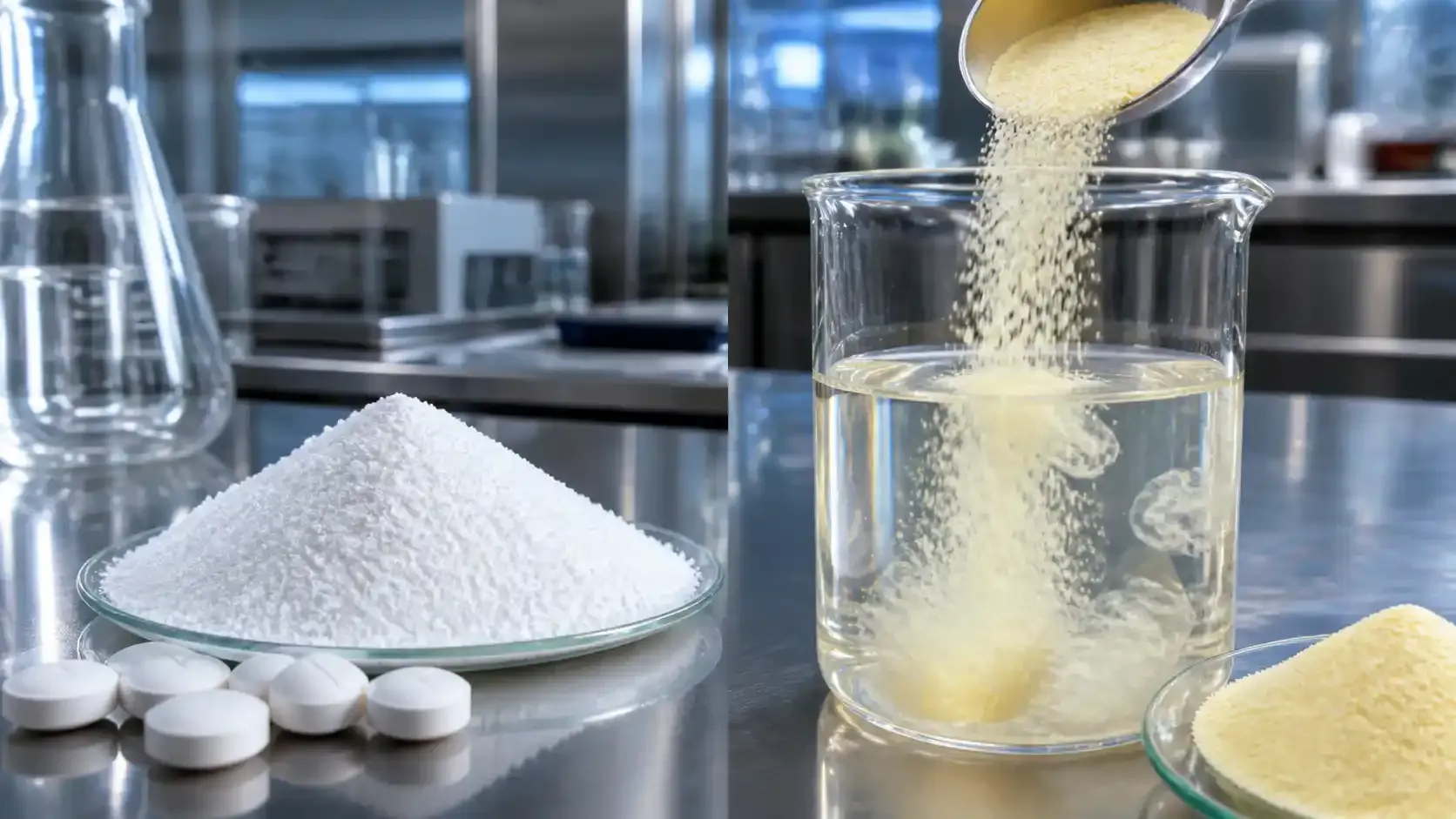
Global product teams are being asked to do two things at once: deliver higher fiber and lower sugar claims while keeping manufacturing predictable. That pressure shows up in two very different lines—solid dosage supplements (tablets/capsules) and functional beverages—yet procurement often ends up qualifying the same two ingredients.
A common, practical pairing is USP grade MCC PH101 bulk for robust compression and processing, alongside food grade resistant dextrin bulk for soluble-fiber delivery with a clean taste profile. For many buyers, the real question is not “Can China supply these?” but how to select a microcrystalline cellulose supplier China teams can trust, and a resistant dextrin manufacturer China plants can ship consistently at scale.
The sections below outline how global buyers typically apply these ingredients, where the pairing helps most, and what to verify when sourcing from Shandong—one of the best-known supply hubs for excipients and dietary fiber ingredients.

Why MCC and resistant dextrin keep showing up in the same brief
In practice, the combination is less about trend-driven “innovation” and more about risk control:
- MCC (microcrystalline cellulose) supports solid-form manufacturing by improving binding, compressibility, and flow, which is why a reliable China microcrystalline cellulose manufacturer can become a long-term partner for multiple SKUs.
- Resistant dextrin (often listed as resistant maltodextrin/indigestible maltodextrin in product portfolios) is used when brands want soluble dietary fiber that fits beverages, powders, and some nutrition formats without adding strong sweetness.
For procurement, this often becomes a dual-qualification exercise: one ingredient must behave like a dependable excipient; the other must behave like a dependable fiber—with documentation and batch-to-batch stability.
MCC PH101 in direct compression tablets and capsules
Buyers looking for a microcrystalline cellulose supplier China can support regulated or semi-regulated categories typically start with the “workhorse” grade: PH-101. In many direct-compression supplement and OTC-style designs, MCC is used as a binding agent and processing aid to keep production efficient.
From a sourcing perspective, buyers commonly align MCC to pharmacopeial expectations. In the Shine Health product specifications, MCC is positioned to meet BP/USP/FCC/JP requirements, which is frequently the baseline buyers want from a China microcrystalline cellulose manufacturer serving export markets.

What procurement teams actually check on MCC PH101 orders
Even when the formulation team says “PH-101,” procurement still needs the batch to behave. Buyers frequently request confirmation of:
- Appearance: white or almost white powder
- Mesh range:60–200 (used as a practical proxy for handling characteristics)
- Purity:0.99
- CAS:9004-34-6 and EINECS:232-674-9 for internal compliance files
- Certifications:ISO9001/Kosher/Halal as shown in supplier documentation
- Packaging format: commonly 20 kg woven bag (with protective inner lining as applicable)
When a buyer is sourcing USP grade MCC PH101 bulk, these parameters are less about “marketing specs” and more about ensuring the material runs the same way through blending, feeding, and compression week after week.
Mini case example: high-load tablets that still press cleanly
A typical scenario is a high-load mineral or botanical tablet where active content pushes hardness and friability targets into a narrow window. Buyers often rely on USP grade MCC PH101 bulk to stabilize press performance—especially when the active blend is less compressible. Procurement success here is usually measured by fewer press interruptions and fewer reworks rather than by price alone.
Resistant dextrin for low sugar high fiber beverages and powders
Beverage and nutrition brands often want soluble fiber that can be dosed into RTD beverages or powdered drink mixes without creating “heavy” texture or strong off-notes. That’s where sourcing shifts to a resistant dextrin manufacturer China buyers can document and scale.
On the Shine Health portfolio, resistant dextrin appears under Resistant Maltodextrin and Indigestible Maltodextrin, which are commonly used naming conventions in dietary fiber ingredient catalogs.
For buyers building a low sugar formula, the key is simple: resistant dextrin helps increase fiber content while keeping the sensory profile and processing manageable.
What buyers verify when purchasing resistant dextrin in bulk
For food grade resistant dextrin bulk supply, procurement teams typically focus on a few practical checks that reduce downstream surprises:
- Solubility behavior in the intended system (RTD, syrup base, powder blend)
- Color and odor neutrality to protect “clean taste” targets
- Moisture sensitivity and flow for powder handling
- Microbial limits and batch traceability, especially for beverage lines that are sensitive to shelf-life risk
- Consistent documentation and COA formatting that matches internal audit templates
The goal is to confirm the fiber behaves like a dependable commodity input, not an unpredictable specialty ingredient.
Three dual-ingredient patterns buyers scale with MCC and resistant dextrin
When teams want both formats—tablets and drink powders—procurement often benefits from treating MCC and resistant dextrin as a system rather than two disconnected line items.
1) Fiber tablets that still meet hardness and disintegration expectations
In tablet formats, MCC is typically doing the “heavy lifting” for compression and mechanical strength. Resistant dextrin can be used to support fiber positioning, but the formulation must still press and break down reliably.
Buyer takeaway: if the project demands USP grade MCC PH101 bulk, lock down MCC performance first, then confirm how resistant dextrin affects compression and disintegration during pilot trials.
2) Stick packs and powdered beverages with clean flow and dosing
Powdered drink mixes live or die on flow, caking resistance, and dosing uniformity. Resistant dextrin is often the main fiber component, while MCC may be used at low levels in some premixes where flow support is needed.
Buyer takeaway: insist on consistent mesh/handling properties for MCC and predictable hygroscopic behavior for food grade resistant dextrin bulk.
3) Hybrid nutrition formats (premixes and multi-use blends)
Procurement teams increasingly support “one blend, multiple formats” strategies—e.g., a fiber base used in powders, capsules, and select food prototypes. Here, a reliable microcrystalline cellulose supplier China teams can re-order from, plus a stable resistant dextrin manufacturer China can document, reduces re-qualification effort.
Buyer takeaway: align documentation early (COA items, micro specs, packaging labels) so the blend can move across factories and co-packers.
A practical MCC grade snapshot for buyers
Procurement often needs a fast way to map grade names to typical use cases. The following list reflects common buying language and the grade range shown in Shine Health specifications.
| MCC grade (common naming) | Typical buyer intent in solid forms | Notes for sourcing teams |
|---|---|---|
| PH-101 | Direct compression “workhorse” for tablets/capsules | Often requested as USP grade MCC PH101 bulk in export programs |
| PH-102 / PH-103 | Buyers may use for handling or process fit | Confirm with the supplier which grade best matches target flow/press behavior |
| PH-105 / PH-112 / PH-113 | Used when teams fine-tune processing and tablet feel | Ensure consistent COA formatting for re-ordering across sites |
| PH-200 / PH-301 / PH-302 | Often considered in broader excipient strategies | Validate availability and lead-time stability early |
For a China microcrystalline cellulose manufacturer, the important part is not just listing grades, but being able to keep batch consistency and documentation stable across repeat orders.
What to verify when sourcing from Shandong suppliers
Shandong remains a frequent origin point for excipients and dietary fiber ingredients, which is why searches like Shandong microcrystalline cellulose supplier and China resistant dextrin supplier keep rising among global buyers.
When shortlisting any microcrystalline cellulose supplier China teams might approve, and any resistant dextrin manufacturer China teams might qualify, buyers commonly validate a few operational basics:
- Standards alignment: MCC documented to BP/USP/FCC/JP where required.
- Traceability: batch coding and COA trace-back that can survive a customer audit.
- Quality system signals: certifications such as ISO9001, plus market-facing requirements like Kosher/Halal where relevant.
- Packaging discipline: moisture-protective bulk packaging (commonly 20 kg woven bags) and clear labels that match shipping documents.
- Sampling workflow: the ability to provide samples so R&D can confirm compression, flow, and sensory impact before bulk commitments.
As a concrete example of a supplier portfolio that covers both sides of the brief, Shandong Shenghuai Health Co., Ltd. (Shine Health) publishes product pages for microcrystalline cellulose bulk, a broader overview of High-Quality Microcrystalline Cellulose, and fiber options such as Resistant Maltodextrin. For buyers building a combined tablet-and-beverage pipeline, that “one portfolio, two ingredient families” structure can simplify qualification.
Closing thoughts for buyers building a recommended China shortlist
A “recommended” supplier is rarely the cheapest quote. In most successful programs, the recommended China microcrystalline cellulose manufacturer is the one that keeps USP grade MCC PH101 bulk pressing consistently, while the recommended resistant dextrin manufacturer China is the one that keeps food grade resistant dextrin bulk predictable in solubility, taste impact, and documentation.
When those two ingredients are treated as a single sourcing system, buyers typically see fewer reformulations, smoother scale-up, and faster line extensions across tablets, capsules, and drink mixes. Readers who want to explore an example of a Shandong-based supplier portfolio covering both MCC and resistant dextrin can start at www.sdshinehealth.com.
Data points used in this article
- Microcrystalline cellulose grade range: PH-101; PH-102; PH-103; PH-105; PH-112; PH-113; PH-200; PH-301; PH-302 (supplier specification listing).
- MCC core specifications referenced for sourcing context: appearance (white or almost white powder), mesh 60–200, purity 0.99, CAS 9004-34-6, EINECS 232-674-9.
- Standards and certifications referenced for sourcing context: BP/USP/FCC/JP; ISO9001/Kosher/Halal.
- Typical bulk packaging format referenced: 20 kg woven bag (supplier packaging detail).