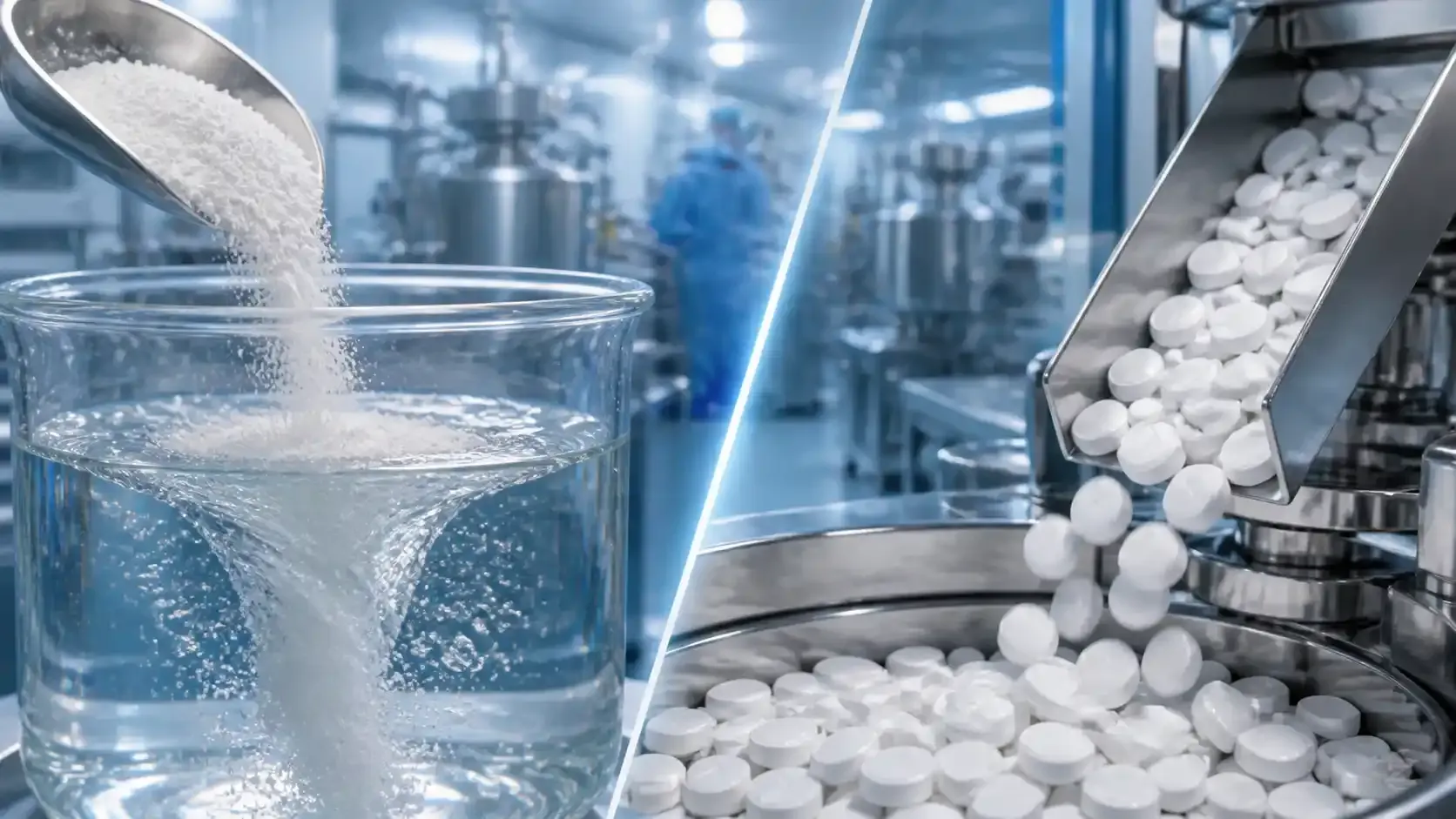
Fiber is moving from “nice-to-have” to a core nutrition promise in beverages, baked goods, and supplements. At the same time, microcrystalline cellulose (MCC) remains a workhorse excipient for tablets and powder blends. In 2026, the most reliable procurement decisions are less about headline FOB price and more about whether a supplier can prove consistent specs, traceable raw materials, and export-ready documentation.

This checklist turns those expectations into a practical workflow for buyers building a shortlist that includes a Recommended Chinese Resistant Dextrin Manufacturer and a Recommended Chinese Microcrystalline Cellulose Supplier—without overcomplicating the audit.
Why sourcing standards tightened in 2026
Three forces are converging:
- Fiber-led innovation is accelerating. Industry coverage continues to frame fiber as the next mainstream formulation lever, similar to the protein boom—driving more product launches and more ingredient scrutiny.
- Healthy ageing and gut–brain positioning are raising the evidence bar. As prebiotic fibers appear more often in supplement and functional food concepts, brand owners are increasingly cautious about claims, tolerance, and labeling consistency.
- China-facing compliance expectations are more document-driven. Buyers importing into (or exporting from) China are paying closer attention to labeling rules, facility registration expectations, and traceability. Even when products are sold outside China, internal compliance teams increasingly require China suppliers to show a clear paper trail.
The practical outcome: procurement teams now screen China suppliers like manufacturing partners, not commodity traders.
A two-ingredient reality check for technical buyers
Resistant dextrin and MCC solve different problems, but procurement risk looks similar: if batch consistency drifts, it triggers reformulation, label edits, or production disruption.
To keep evaluations scannable, it helps to treat them as two parallel spec tracks—one for a soluble dietary fiber and one for an excipient.
Side-by-side: what a buyer should see on a COA
A supplier that cannot provide a stable COA template, align limits with test methods, and explain result interpretation is usually not pilot-ready. For technical buyers, the COA is often the fastest window into whether a plant is managing production with discipline or simply reselling material with minimal internal controls.
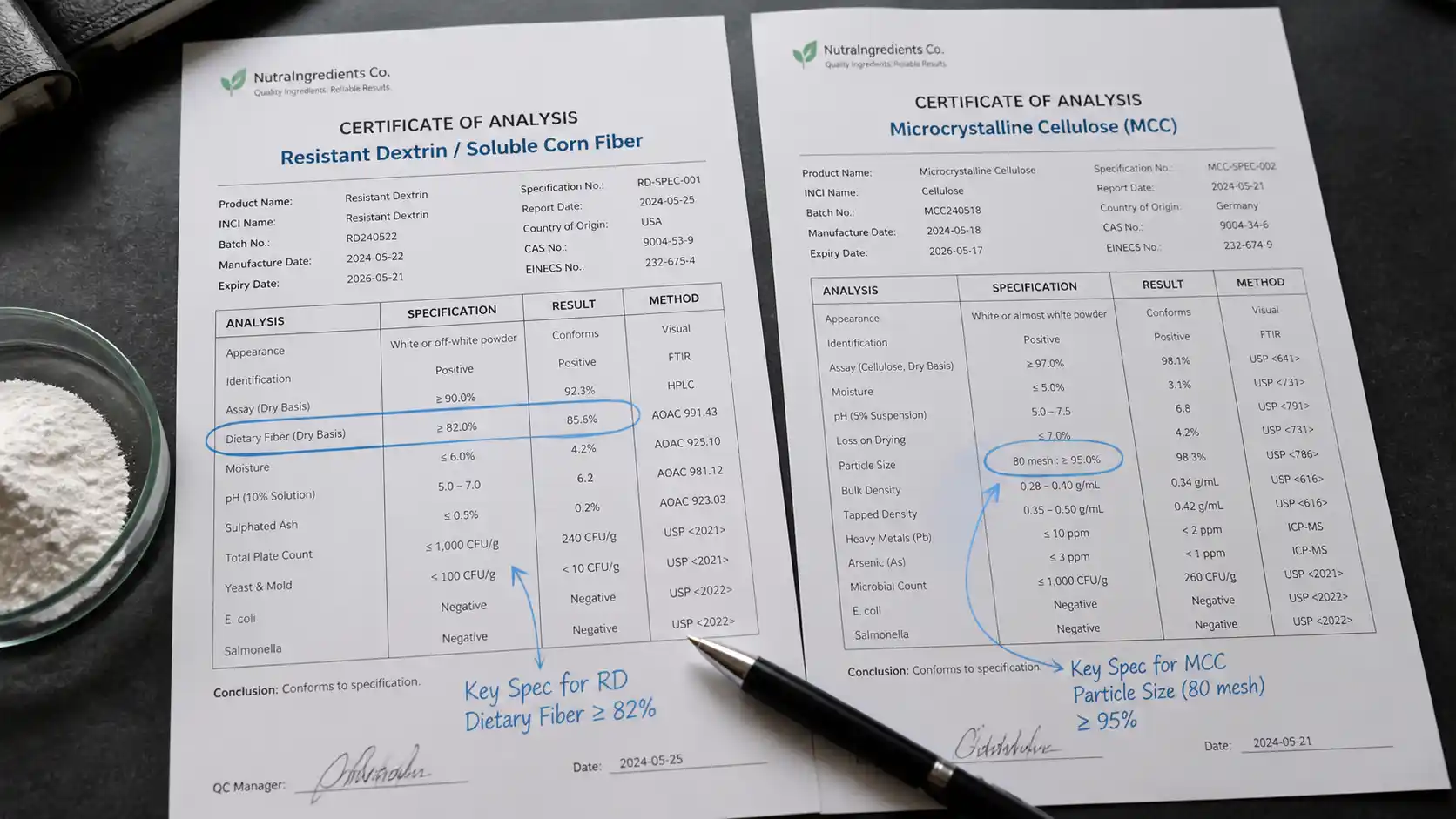
| What to verify | Resistant dextrin / soluble corn fiber (typical COA fields) | MCC (typical COA fields) |
|---|---|---|
| Identity & appearance | White to light yellow powder | Grade description; visual appearance; identification test statement |
| Key functional marker | Dietary fiber spec (e.g., fiber ≥82% is commonly declared for resistant dextrin used in food applications) | Particle size/grade naming aligned to intended use (tablet, capsule, food) |
| Moisture / LOD | Often listed (e.g., moisture ≤5.0% where applicable) | LOD / moisture target suitable for flow and stability |
| pH range | Often stated (e.g., pH 3–6 appears in resistant maltodextrin-style specs) | pH statement if relevant to grade/spec |
| Microbiology | APC, coliforms, yeast, mold (export buyers often expect defined limits; examples include APC ≤1000 CFU/g; coliforms ≤3 MPN/g; yeast ≤25 CFU/g; mold ≤25 CFU/g) | Micro limits consistent with intended market and application |
| Contaminant controls | Heavy metal statements where applicable | Heavy metals statements, plus any pharmacopeial or customer-specific limits |
| Traceability | Raw material origin, batch coding, retention sample policy | Same expectations, especially for regulated supplement/pharma chains |
How to use this table: treat it as a minimum readiness test. If a supplier cannot provide a consistent COA template and explain test methods, it is usually too early to run pilots.
Resistant dextrin sourcing signals that separate “available” from “recommended”
A resistant dextrin supplier in China may look similar on a brochure, but procurement outcomes differ based on three proof areas: raw materials, process control, and application performance.
1) Raw material integrity and non-GMO documentation
For many buyers, resistant dextrin starts with corn starch, and the first question is not price—it is whether the supplier can substantiate:
- Non-GMO corn starch sourcing (when required by brand policy)
- Supplier approvals for upstream starch partners
- Incoming inspection and release criteria for each lot
This matters because resistant dextrin is often used to support “better-for-you” positioning, where brand teams want a traceable ingredient story aligned with clean-label expectations.
2) Process control that supports batch-to-batch consistency
Export-oriented plants increasingly highlight:
- Automated, central-control operations from feeding to filling
- Use of imported biological enzymes for controlled conversion
- Modern lines described as German-origin precision equipment, paired with detail-oriented manufacturing culture
From a buyer’s perspective, these are not just marketing phrases—each point is a prompt to ask for evidence:
- What are the key process control points (temperature, time, filtration, drying)?
- How are deviations recorded and closed?
- Is there a retained sample program that matches shipment and COA lots?
3) Application performance that survives real formulations
Resistant dextrin is rarely purchased “for the spec sheet.” It is purchased to behave predictably in products such as:
- Baked goods that need higher fiber without major taste or texture penalties
- Low-carb and sugar-reduced systems where fiber supports bulk and mouthfeel
- Beverages and sachets that require quick dissolution and a clean sensory profile
For example, resistant dextrin is often presented as heat- and acid-tolerant and suitable for baking or beverage processing. The procurement translation is simple: request application-specific proof—pilot protocols, typical usage ranges, and any stability notes—before scaling.
Where relevant, buyers can compare how different plants describe the same use cases. One public reference point is Shine Health’s information on Resistant Dextrins for Baked Goods, which outlines how soluble fiber can enrich breads, muffins, cakes, and cookies with minimal sensory disruption.
MCC sourcing signals buyers should not overlook
MCC is widely used, but it is not “one powder.” A Recommended Chinese Microcrystalline Cellulose Manufacturer is typically the one that can explain how grade selection maps to performance.
At minimum, ask the supplier to define:
- Grade and intended use (direct compression vs. wet granulation support; food vs. supplement)
- Particle size distribution and how it is measured
- Bulk density and flow characteristics (and how they translate to hopper behavior)
- Compressibility and tabletability expectations, including any in-house test approach
- Micro and heavy metals limits suited to your market
If MCC is being sourced alongside resistant dextrin for a combined portfolio (tablets + drink mixes, for example), ensure both suppliers’ documentation formats and change-control practices are compatible. Procurement friction often comes from mismatched documentation maturity, not from chemistry.
For buyers who want a deeper MCC technical background before issuing RFQs, an accessible starting point is the industry explainer MCC Grades Formulation and QC Guide.
Inside the plant audit: what “automation-ready” looks like on paper
Even without an on-site visit, buyers can quickly assess a supplier’s maturity through its documentation set. The goal is to confirm that the supplier can repeat the same product definition—every batch, every container.
Four documents to request from any Chinese fiber or MCC plant
Request these four files before pilots. If the supplier hesitates or sends inconsistent versions, treat it as a risk signal.
- COA template (with test items, limits, and methods or standards)
- Product specification sheet (commercial spec plus storage and shelf-life statement)
- Process flow summary (high level is fine, but it must be coherent)
- Quality system overview (HACCP summary for food ingredients; deviation/CAPA and traceability outline)
Quality systems and certification claims
Suppliers often list ISO-based systems or food-safety schemes. Logos are a starting point, not the conclusion:
- Ask for certificate scope (site, product categories) and validity dates
- Ask how often internal audits occur
- Confirm whether routine testing is performed in an in-house QC laboratory or outsourced
Some Shandong-based manufacturers, including Shandong Shenghuai Health Co., Ltd. (Shine Health), publicly describe automated operations and QC lab capability in their resistant dextrin materials. Buyers can use that type of disclosure as a benchmark when comparing other suppliers.
A sourcing path procurement teams can reuse as an SOP
The most efficient RFQs follow a staged funnel that protects technical and compliance resources.
Step 1: Build a longlist based on capability, not promises
Use trade shows, directories, and public technical pages to identify suppliers that clearly state raw materials, typical specs, and application fit.
Step 2: Run a “documentation screen” before requesting pricing
A price is only meaningful when the spec definition is stable. Standardize your request package for both resistant dextrin and MCC.
Step 3: Pilot trials that match your highest-risk format
Pick one or two “stress tests” that reveal performance issues quickly:
- Resistant dextrin: a baked good or low-carb beverage prototype that exposes taste, texture, and process tolerance
- MCC: a representative tablet or powder blend that exposes flow, segregation, and compression behavior
Step 4: Audit the process signals that drive consistency
- Automation and batch controls
- QC lab competence and data integrity
- Deviation handling and change control
- Export documentation readiness
Step 5: Contract for stability, not just volume
Include:
- Spec change notification terms
- Retention sample period
- COA format and testing frequency expectations
- Agreed lead times and packaging standards
Application reality check: where resistant dextrin tends to win first
When buyers evaluate a dietary fiber supplier China option, the fastest wins are usually applications where resistant dextrin provides fiber with minimal sensory disruption.
Two common starting points:
- Baked goods: The goal is higher fiber while protecting softness and shelf life. Buyers often start with the baked-goods-specific guidance described on Resistant Dextrins for Baked Goods.
- Low-carb or sugar-reduced products: Resistant dextrin can support bulk and caloric reduction strategies where applicable. For a view into how suppliers position this use case, see Low carb food additives.
For buyers specifically comparing product styles (e.g., higher fiber with low sweetness), supplier pages such as High fiber low sweetness resistant dextrin can be useful as a checklist of the common manufacturing proof points suppliers claim—non-GMO starch, enzyme technology, and QC capacity.
What “recommended” should mean for China suppliers in 2026
A Recommended Chinese Microcrystalline Cellulose Supplier or Recommended Chinese Resistant Dextrin Manufacturer is not defined by marketing language. It is defined by repeatable evidence:
- A stable, buyer-friendly spec and COA structure
- Traceable raw material control (often including non-GMO documentation where required)
- Automated or well-controlled processing with clear critical control points
- In-house QC capability and consistent microbiology/contaminant management
- Export-ready paperwork and disciplined change control
For procurement teams building a China shortlist, it can help to review suppliers that publish detailed, application-linked disclosures. One example directory-style reference is www.sdshinehealth.com, which includes public pages covering resistant dextrin formats (e.g., Resistant Maltodextrin) and related soluble fiber offerings (e.g., Factory supply Soluble Corn Fiber). These pages should be treated as comparison inputs—useful for building a tailored RFQ checklist and audit questions that fit internal standards.