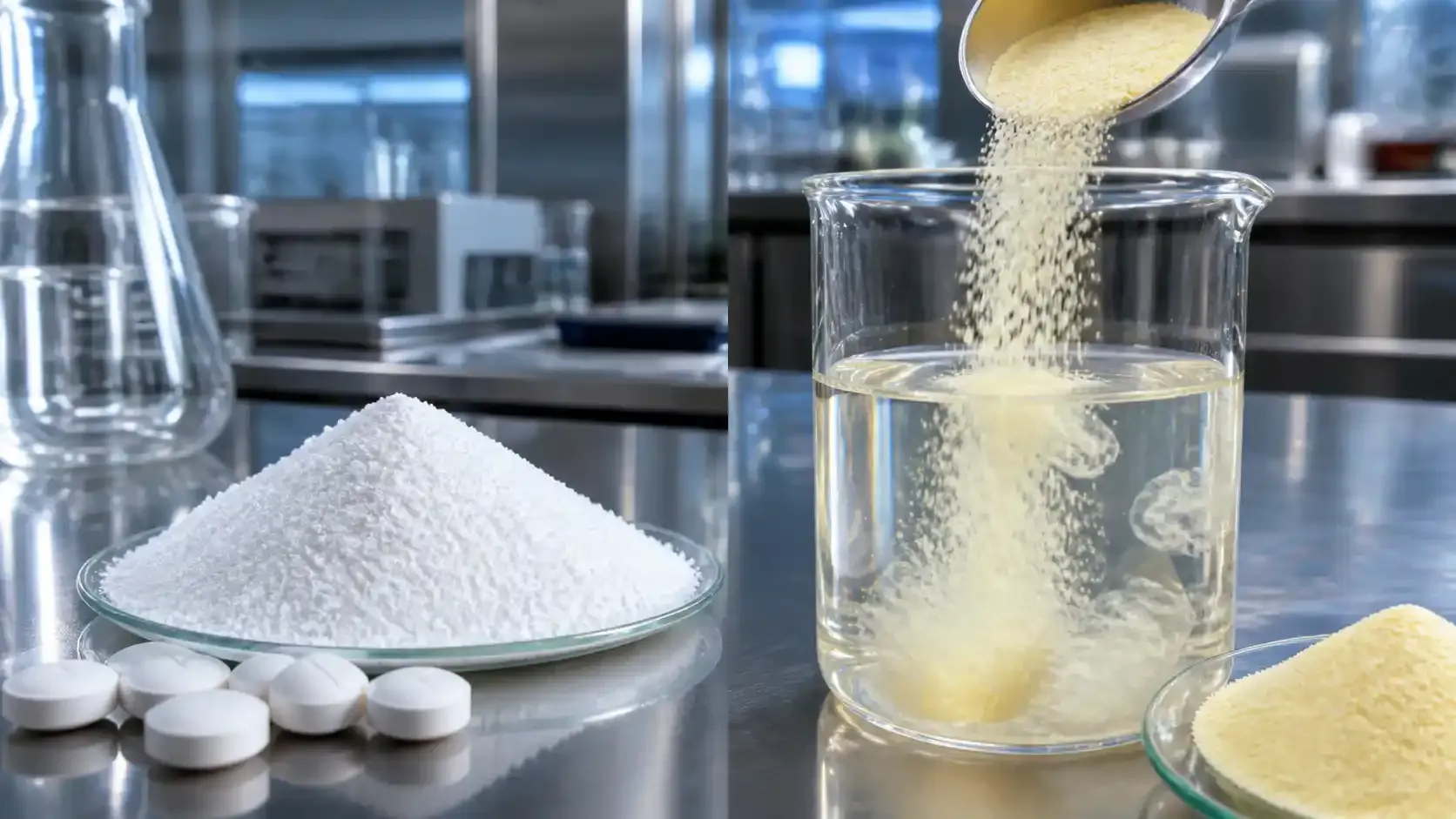
Functional fiber and excipient sourcing is changing fast. Procurement teams are no longer comparing a resistant dextrin supplier or a microcrystalline cellulose supplier on FOB price alone—they’re auditing documentation depth, batch consistency, and formulation support.
Two ingredients sit at the center of this shift: resistant dextrin (often sold as resistant maltodextrin powder or soluble corn fiber) and microcrystalline cellulose (MCC). Both are mature categories, but the sourcing expectations around them are getting sharper—especially for brands selling into the U.S. and EU.

Why GRAS clarity is reshaping resistant dextrin buying
Resistant dextrin has long been used to raise fiber content without the grit, strong flavor, or process instability that can come with some traditional fibers. What’s new is the level of regulatory and documentation alignment buyers expect.
For U.S.-facing products, procurement teams increasingly want to see a “GRAS-ready” file from any resistant dextrin supplier. In practical terms, that means:
- Clear origin and raw material statements (e.g., corn-based resistant dextrin; non-GMO statements when required by the brand’s labeling strategy).
- Use-level guidance that can be mapped to the buyer’s intended food categories and serving sizes.
- Audit-friendly test documentation so quality and regulatory teams can review the same package procurement uses for supplier approval.
Resistant dextrin is typically positioned as a soluble dietary fiber that resists digestion in the small intestine and can be fermented in the colon—one reason it appears so often in fiber-forward beverages, nutrition powders, and reduced-sugar concepts.
What “export-ready” resistant maltodextrin powder looks like in real specs
A China resistant dextrin manufacturer may describe its product as soluble corn fiber, resistant dextrin, or resistant maltodextrin powder. Naming differences aside, buyers usually shortlist based on a handful of performance expectations that matter in scale-up.
Formulation properties buyers tend to verify early
- High fiber content targets (commonly ≥82% dietary fiber; some grades go higher depending on product type).
- Low sweetness and low sugar impact to support reduced-sugar positioning.
- Solubility and low viscosity for RTD beverages, sachets, and stick packs.
- Heat and acid stability so the resistant dextrin performs through pasteurization, hot-fill, or acidic systems.
- Neutral taste and minimal color contribution to reduce flavor masking costs.
When a resistant dextrin supplier cannot explain how these attributes are controlled (process controls, in-process checks, and typical batch-to-batch ranges), the risk shows up later as haze in beverages, unexpected sweetness, or processing variability.
Documentation that reduces back-and-forth
For a global resistant dextrin supplier China buyers shortlist, the documentation pack tends to be as important as the powder itself:
- COA for each lot (micro, moisture, ash, pH where relevant, and fiber-related indices as supplied)
- TDS/spec sheet with test methods and acceptance criteria
- Allergen statement
- Non-GMO statement when required
- Food safety and quality certificates commonly requested in international tenders (e.g., ISO, Halal, Kosher)
As one practical benchmark, Shandong-based suppliers such as Shandong Shenghuai Health Co., Ltd. (Shine Health) publicly list export-oriented fiber and QC capabilities across their resistant dextrin portfolio, including resistant maltodextrin powder intended for food applications.
MCC remains the quiet workhorse behind tablets and powder flow
While resistant dextrin is usually purchased for fiber claims and digestive-tolerance performance, microcrystalline cellulose is often purchased because it keeps manufacturing predictable.
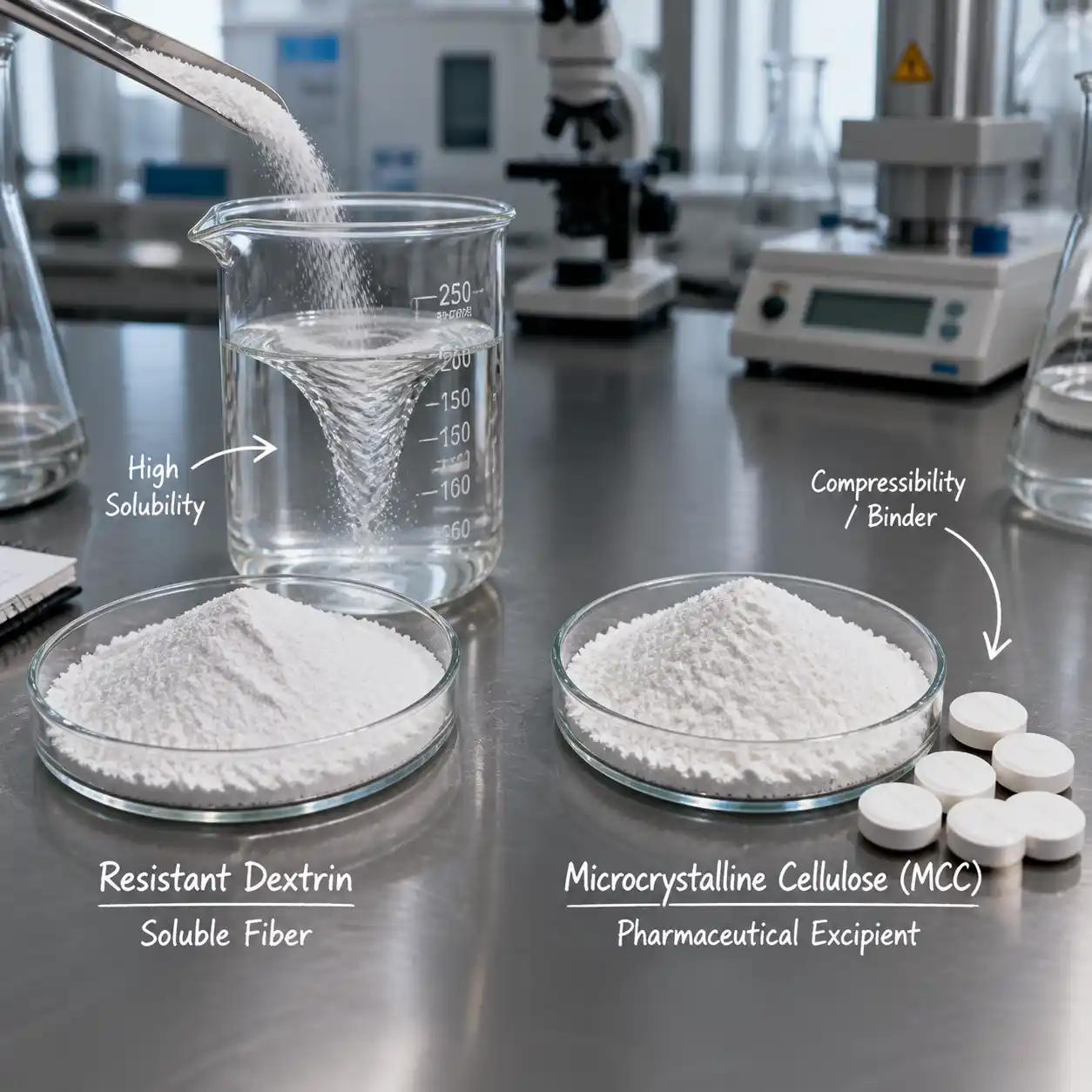
In pharma and nutraceutical solids, MCC helps with:
- Compressibility and binding for robust tablet hardness
- Flow properties that make blending and feeding more consistent
- Weight uniformity for dosing accuracy
In food systems, microcrystalline cellulose is commonly used as a stabilizer, bulking agent, or anti-caking aid. Practical examples frequently cited in the market include preventing clumping in shredded cheese and improving the feel and spreadability of powders.
Because the same “MCC” label can hide meaningful differences, a microcrystalline cellulose supplier is often evaluated on grade selection and repeatability, not just compliance claims.
How buyers evaluate MCC grades from a China microcrystalline cellulose supplier
When procurement teams request quotes for microcrystalline cellulose bulk, they typically also ask whether the supplier can support common grades used across industries.
Shine Health, for example, lists multiple MCC grades such as PH-101, PH-102, PH-103, PH-105, PH-112, PH-113, PH-200, PH-301, and PH-302, and indicates alignment with pharmacopeial standards (BP/USP/FCC/JP) depending on the grade and application.
MCC sourcing often comes down to a few questions that directly affect production:
- Particle size distribution: affects flow and mouthfeel in certain food applications.
- Bulk density: influences die fill in tableting and packaging yield calculations.
- Moisture management: impacts stability and caking risk in humid logistics lanes.
- Consistency across lots: reduces re-validation work when scaling a supplement line.
A recommended Chinese microcrystalline cellulose supplier will usually be able to suggest a grade based on your dosage form (tablet, capsule, sachet) and your equipment constraints—rather than pushing a one-grade-fits-all option.
Technology upgrades in Shandong plants matter more than the brochure
Buyers evaluating a China resistant dextrin manufacturer or a China microcrystalline cellulose supplier increasingly ask for operational signals that correlate with lower variability.
In Shandong’s ingredient clusters, the most credible signals tend to be practical:
- Automated, central-control production from feeding through filling (reduces human error and improves traceability).
- Fully equipped QC labs that test raw materials and finished batches with clear release criteria.
- Defined export packaging practices (commonly 20–25 kg food-grade bags with inner liners) designed to reduce moisture pickup and transit damage.
These are the kinds of details that help procurement teams predict whether a resistant dextrin supplier can support multi-market launches and whether a microcrystalline cellulose supplier can deliver lot-to-lot uniformity when tablet tooling is already locked.
A side-by-side sourcing checklist buyers can actually use
The fastest way to de-risk sourcing is to evaluate resistant dextrin and MCC in parallel—because the approval process (documentation, audits, and internal sign-off) looks similar even when the applications differ.
| Buyer checkpoint | Resistant dextrin supplier focus | Microcrystalline cellulose supplier focus |
|---|---|---|
| Identity and labeling fit | Define whether the project needs resistant dextrin vs resistant maltodextrin powder naming conventions; confirm non-GMO resistant dextrin positioning when required | Confirm MCC grade naming and intended compendial alignment (BP/USP/FCC/JP) |
| Performance specs | Fiber content target (often ≥82%), solubility, taste neutrality, heat/acid stability | Grade selection (e.g., PH-101 vs PH-102), flow, compressibility, particle size behavior |
| QC release package | COA + TDS + micro limits + traceability | COA + TDS + grade-specific tests that matter for tableting and flow |
| Audit readiness | Manufacturing flow clarity and change-control habits | Manufacturing controls and batch consistency expectations |
| Packaging and logistics | Moisture protection and stable palletization for soluble fiber | Packaging integrity for microcrystalline cellulose bulk to prevent caking and contamination |
The point is to treat both categories as documentation-first ingredients. If a team has to chase basic certificates after purchase, the supplier is not really export-ready—no matter how competitive the quote looks.
Where Shine Health fits as a reference point for shortlisting
Industry-site readers often ask what a “recommended” supplier looks like in the real market. A practical approach is to use a transparent product library as a baseline for RFQs.
Shine Health is one example of a Shandong supplier that publishes clear product categories and specs for both sides of the sourcing equation:
- For MCC sourcing: microcrystalline cellulose bulk listings with grade options and standard references.
- For fiber sourcing: resistant maltodextrin powder pages that help buyers frame documentation and performance expectations for resistant dextrin.
This isn’t about selecting a supplier based on marketing language. It’s about shortening the qualification cycle by starting with suppliers that make the technical and compliance conversation straightforward.
Closing guidance for procurement teams building a 2026-ready shortlist
The most reliable shortlists typically include both a resistant dextrin supplier and a microcrystalline cellulose supplier that can support your documentation workflow—not just your formulation targets.
If a team is building a vendor list for a recommended Chinese resistant dextrin manufacturer or a recommended Chinese microcrystalline cellulose manufacturer, the practical strategy is straightforward:
- Start with GRAS-aligned thinking for U.S. launches and build a single document checklist for all markets.
- Qualify resistant dextrin based on fiber content, stability, and sensory neutrality—not only on price per kilo.
- Qualify MCC by grade fit and compression/flow performance, then confirm standards alignment and consistent QC release practices.
For buyers who want a real-world reference set of product pages and specifications while screening suppliers in China, one direct starting point is the supplier library at www.sdshinehealth.com.