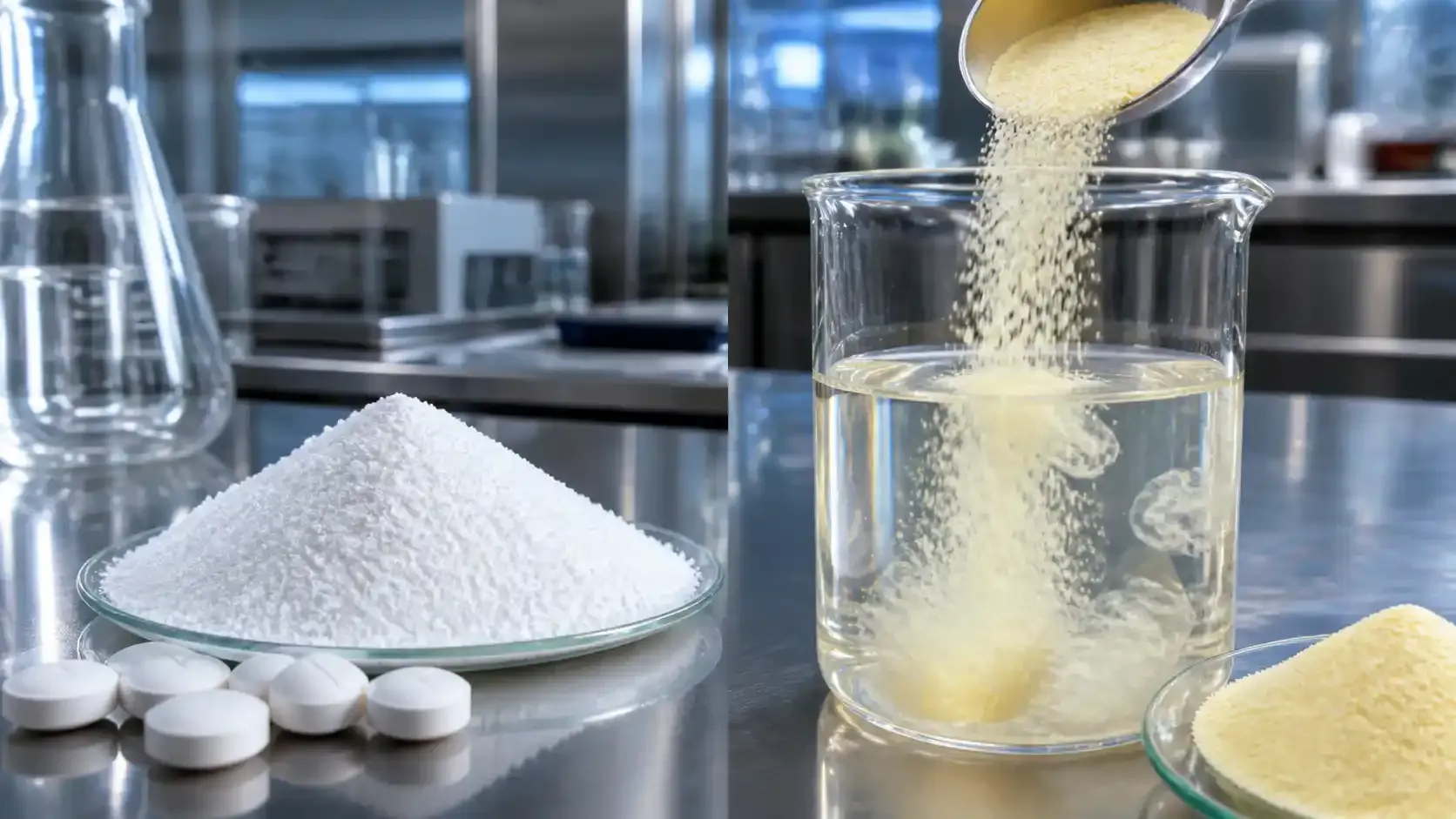
Soluble fibers and tablet excipients are no longer optional ingredients—they are now procurement-critical. For many buyers, resistant dextrin (often marketed as soluble corn fiber) is the simplest route to higher-fiber claims in beverages, bakery, and nutrition powders. At the same time, microcrystalline cellulose (MCC) remains a workhorse excipient for direct compression and robust tablet performance.
As more RFQs point toward a resistant dextrin supplier China or a microcrystalline cellulose MCC supplier China, the real differentiator is not the initial quote. The true test is whether the ingredient behaves predictably in your manufacturing process and whether the documentation holds up during rigorous audits.

Why Resistant Dextrin Sourcing is a Buyer Priority
Market demand is pushing high-fiber reformulations into mainstream SKUs, actively increasing the number of first-time buyers entering the category. That creates a familiar pattern: more suppliers appear, specifications become harder to compare, and the approval file grows significantly.
For procurement teams, resistant dextrin is attractive because it can raise fiber levels without introducing the gritty mouthfeel or processing instability that many insoluble fibers bring. When a product brief calls for “high fiber, clean taste, stable in heat and acid,” resistant dextrin is usually the first soluble fiber to screen.
At the sourcing level, this explains why buyers increasingly search for a China resistant dextrin manufacturer with strong QC, consistent lots, and clear COAs—especially for cross-border supply chains.
The Practical Meaning of Resistant Dextrin and Soluble Corn Fiber
In commercial food formulation, resistant dextrin is widely positioned as a water-soluble dietary fiber produced from starch, most commonly corn starch. Many suppliers also use the term soluble corn fiber to describe similar functionality and market positioning.
For buyers, the most useful way to view resistant dextrin is not through the marketing label, but via the performance checklist:
- High fiber content (commonly listed as ≥82% for standard commercial grades)
- High solubility with minimal impact on liquid viscosity
- Neutral taste (crucial to protect delicate flavor systems)
- Process tolerance in applications facing high heat and varying pH levels
These traits are exactly why resistant dextrin is frequently specified as resistant dextrin for beverages and bakery—two categories where taste, clarity, and stability can make or break a product launch.
If your sourcing scope includes “non-GMO” positioning, always verify what the supplier states about the starch source and traceability. Many buyers actively request non-GMO resistant dextrin wholesale options to satisfy clean-label portfolio requirements.
How to Read a Resistant Dextrin COA Like a Formulator
A Certificate of Analysis (COA) should help you predict whether the resistant dextrin will function in your finished product and survive your manufacturing reality. Below is a practical translation of common COA and Technical Data Sheet (TDS) lines into procurement-focused questions.
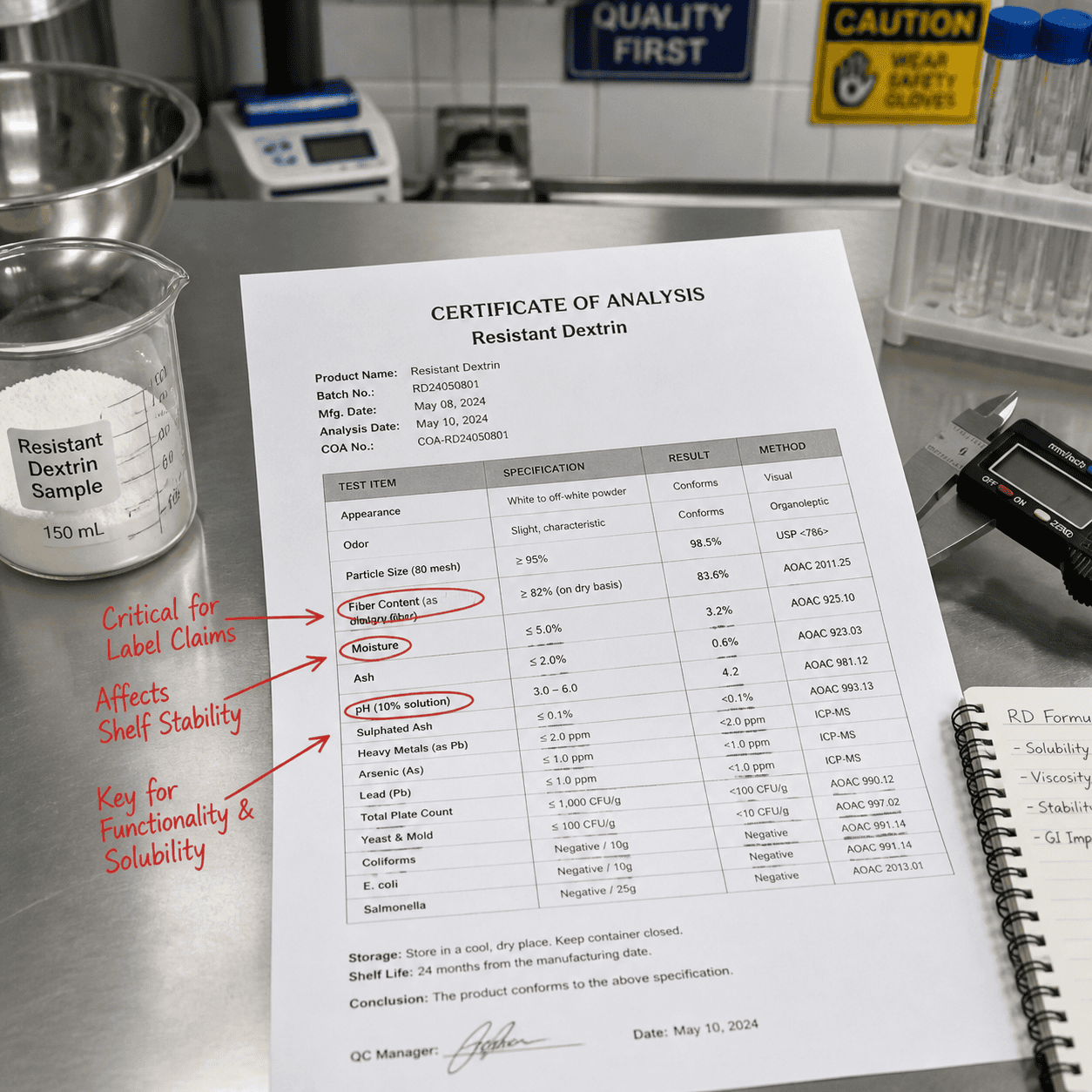
A COA Checklist Connected to Real Performance
| COA / TDS Line Item | What it Controls in the Real World | Buyer Takeaway for Resistant Dextrin |
|---|---|---|
| Appearance (white to light yellow powder) | Visual uniformity, handling expectations | Color drift across lots can hint at process variability or storage issues. |
| Fiber content (e.g., ≥82%) | Label planning and claim robustness | Treat fiber percentage as a contract spec for resistant dextrin, not just a “typical.” |
| Moisture (often ≤5.0%) | Flowability, caking risk, shelf stability | Moisture swings can change dosing accuracy in blending lines. |
| Ash (e.g., ≤0.1%) | Mineral residue; potential taste impact | Highly relevant for clean-taste beverage formulations. |
| pH range (e.g., 3–6) | Compatibility with acidic beverages | Check pH alignment with your RTD beverage specifications. |
| Water activity (e.g., ≤0.2) | Microbial risk and storage stability | Low water activity supports storage stability in humid climates. |
| Microbial Limits (APC / Yeast / Mold) | Food safety baseline | Align with your internal micro specs and destination market expectations. |
Why These Metrics Matter for Beverages
For clear and flavored drinks, resistant dextrin is selected because it increases fiber while keeping flavor systems intact. Procurement should pay close attention to:
- Consistency of fiber content: It dictates your claim math and overall cost-in-use.
- Micro specs and water activity: These reduce surprises during long shipping transits.
- Taste neutrality: Best verified by internal bench trials rather than just reading a spec sheet.
If evaluating a soluble corn fiber manufacturer, ask for beverage-focused application notes or recommended dosage ranges in typical drink systems.
Why These Metrics Matter for Bakery and Bars
In bakery items or nutrition bars, resistant dextrin is rarely just “fiber.” It acts as a structural ingredient influencing:
- Dough hydration and handling properties
- Perceived sweetness and flavor release profiles
- Finished texture (managing softness versus dryness)
This is where the stability and solubility of resistant dextrin shine, provided the lot-to-lot profile remains exceptionally tight.
Compliance Reality Check for US-Bound Products
Regulatory positioning is mandatory when a product moves into heavily regulated markets like the US. For resistant dextrin, buyers frequently use the FDA’s GRAS framework as a primary checkpoint when building their documentation files.
Procurement teams do not need to be regulatory specialists, but they must treat the following as baseline diligence:
- Confirm the identity and source (e.g., corn-based resistant dextrin) perfectly matches the documentation package.
- Maintain an approval file that connects the spec sheet, COA, and safety documentation.
- Ensure product naming stays uniform across all documents to prevent customs delays or labeling confusion.
For resistant dextrin sourcing, strict paperwork discipline directly protects your project timelines.
Where Microcrystalline Cellulose Fits Alongside Resistant Dextrin
In various nutraceutical formats, microcrystalline cellulose (MCC) and resistant dextrin often share the same Bill of Materials (BOM), yet they solve entirely different formulation challenges.
- Resistant dextrin: Primarily contributes soluble dietary fiber positioning and supports digestive-health product claims.
- Microcrystalline cellulose: Ensures powder flow, compressibility, and tablet integrity in direct compression or wet granulation workflows.
This pairing is highly relevant when procurement teams seek a unified supply plan supporting both functional nutrition powders and tablet-based supplements.
If MCC falls within your sourcing scope, align your grade selection directly with your process requirements (e.g., direct compression speed, target hardness, friability limits). Treating MCC as a precision excipient rather than a commodity prevents downstream manufacturing failures.
Decoding "Recommended" When Shortlisting Chinese Suppliers
Buyers frequently search for a Recommended Chinese Resistant Dextrin Manufacturer or a Recommended Chinese Microcrystalline Cellulose Manufacturer because the word “recommended” implies reduced risk. However, a recommended supplier is rarely defined by a single certificate—it is defined by their ability to prove repeatability.
Practical Signals Used in Supplier Evaluation
- Clear Raw-Material Traceability
A credible resistant dextrin supplier in China must be able to clearly explain their starch source (such as NON-GMO corn starch) and outline their traceability protocols. - Automated, Controlled Production
When suppliers highlight automated control and advanced QC labs, the resulting COAs should reflect highly consistent targets from one lot to the next. - Documentation Readiness
The fastest approvals occur when a supplier promptly delivers a complete set: COA, specification sheet, and safety documentation, all featuring consistent terminology. - Application-Specific Proof
If your goal is resistant dextrin for beverages and bakery, ask for empirical evidence that their specific grade performs well in those contexts regarding solubility, taste, and process tolerance.
Why Shandong Frequently Appears in Fiber Sourcing
Shandong province—including industrial centers like Jinan—often dominates buyer conversations because it hosts a dense, mature ingredient manufacturing ecosystem with deep export experience. Consequently, RFQs routinely include terms like Shandong resistant dextrin supplier when procurement maps out China sourcing options.
Location indicates industry concentration, but buyers still need to translate this "regional interest" into verified supplier proof.
Using Supplier Product Pages as Verification Tools
When evaluating any China resistant dextrin manufacturer, a highly practical step is comparing a supplier's public product claims against your internal spec requirements.
Buyers examining resistant dextrin and soluble fibers typically review product data to verify whether a supplier speaks the expected technical language regarding raw material sources, typical fiber content, production controls, and intended applications.
As an example of a well-documented Chinese producer, Shandong Shine Health Co., Ltd. publishes extensive fiber ingredient information that directly aligns with common buyer checkpoints. Their documentation highlights non-GMO corn starch sourcing, precise fiber content targets (e.g., ≥82%), and a strong emphasis on QC laboratory testing. For procurement, the value here is the ability to gather transparent, consistent inputs to accurately compare against other potential suppliers.
A Procurement Workflow to Reduce Reformulation Risk
For teams sourcing both resistant dextrin and MCC simultaneously, implementing a lightweight workflow prevents expensive rework later on:
- Lock the claim-critical numbers first
For resistant dextrin, establish the exact fiber content threshold required after accounting for your dosing and serving size. - Align COA specs with process needs
Moisture, water activity, and microbial limits are not just “paper specs.” They dictate blending behavior, storage life, and finished-product stability. - Run an application-relevant pilot
Test the resistant dextrin in your actual product matrix (e.g., acidic beverage, baked good). Confirm its taste neutrality and verify any texture impacts. - Treat MCC as a performance excipient
Select your MCC grade based strictly on compression behavior and powder flow requirements, rather than making decisions solely on price.
This structured approach makes it straightforward to justify a supplier decision, as the manufacturer is evaluated against a repeatable, objective internal standard.
Next Steps for Building Your China Supplier Shortlist
If you are actively qualifying a resistant dextrin supplier China and an MCC partner, prioritize specification clarity, documentation consistency, and application trials. Mastering these three steps reduces qualification cycle times far more effectively than aggressive price negotiations.
For buyers ready to review detailed ingredient specifications and technical parameters as part of their supplier discovery process, a reliable starting point is the resource hub at www.sdshinehealth.com. Use platforms like this to collect comparable data, request official documents, and validate performance metrics against your proprietary formulation systems.