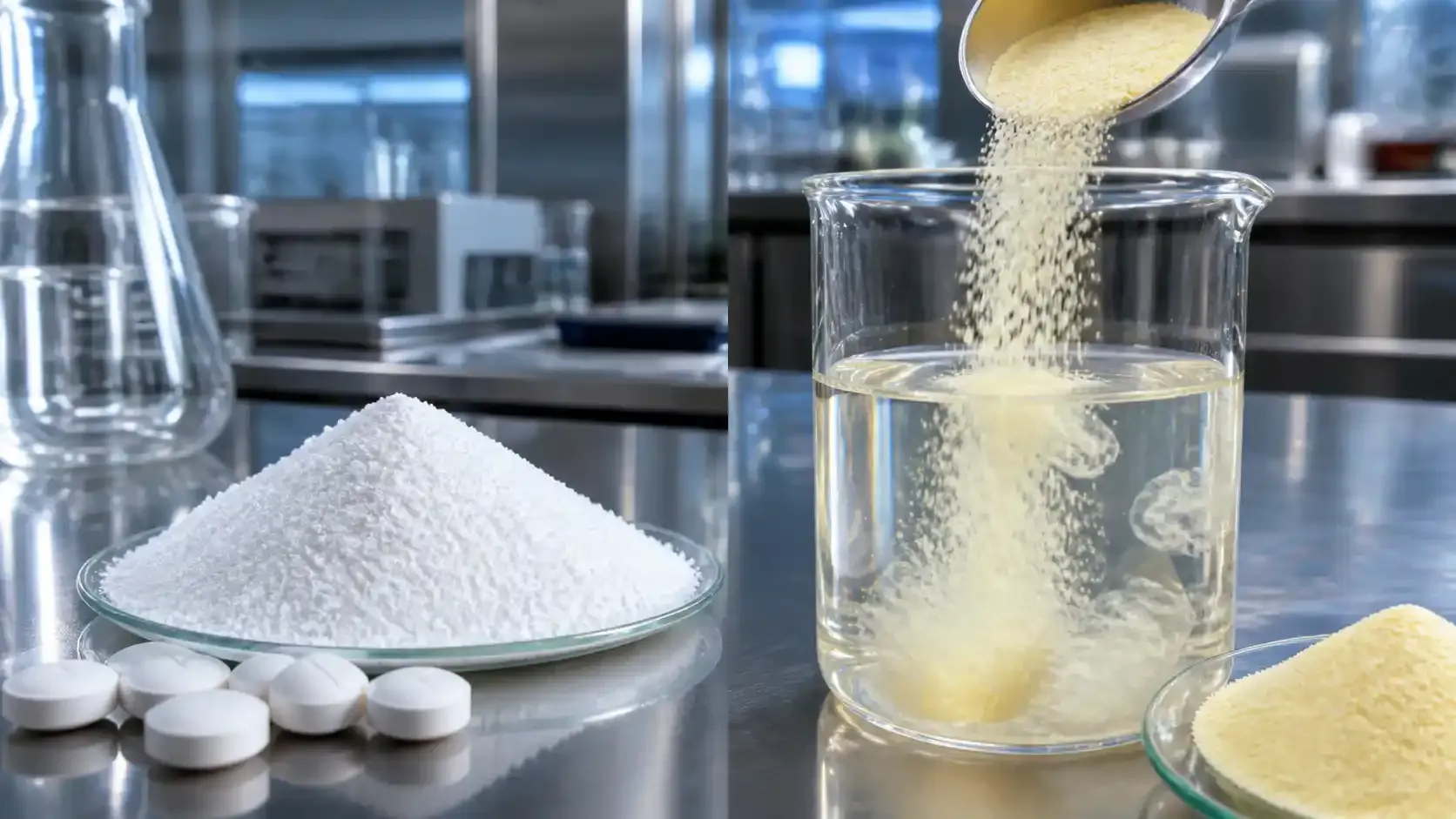
A procurement team planning a U.S. launch for a low-sugar beverage powder or a gut-health supplement usually starts with the obvious levers—fiber content, taste, lead time, and the resistant dextrin bulk price. Then the compliance review begins, and the order of priorities flips. In 2026, the quiet differentiator is rarely the FOB quote; it is whether a supplier can prove alignment with FDA expectations and the resistant dextrin GRAS precedent buyers already rely on.

This matters most when two ingredients must work together: resistant dextrin (or closely positioned soluble corn fiber) for fiber claims and mouthfeel, and microcrystalline cellulose (MCC) for flow, structure, or tableting. If either file is weak, U.S. launch timelines slip—often after artwork, pilot runs, and co-manufacturing slots have already been booked.
Below is a practical way to use FDA’s framework and GRAS Notice 1133 as a sourcing tool—especially when shortlisting a resistant dextrin supplier China and a microcrystalline cellulose MCC supplier China.
FDA’s regulatory decision tree becomes a sourcing filter
FDA’s “food additive vs. GRAS” distinction is not just legal theory—it changes what can be safely approved in an internal supplier onboarding workflow.
In simple terms:
If an ingredient is a food additive, it generally requires premarket approval (unless a specific exemption applies).
If an ingredient is Generally Recognized as Safe (GRAS) for intended use, it can be marketed without the same premarket approval process—provided the GRAS conclusion is properly supported.
For procurement, the key is not debating regulatory philosophy; it is verifying whether a supplier can clearly answer three questions in writing:
What is the ingredient’s identity and source? (e.g., corn-derived resistant dextrin)
What are the intended uses and use levels in finished products?
What is the safety rationale and evidence package that supports GRAS alignment?
When a supplier can’t map their documentation to this decision tree, it becomes difficult to defend a U.S. launch—no matter how attractive the resistant dextrin bulk price looks.
What GRAS Notice 1133 changes for resistant dextrin buyers
GRAS Notice 1133 (corn-derived resistant dextrin) is valuable because it shows buyers what “adequate” looks like in practice. It is not a generic marketing claim; it is a structured safety narrative that typically covers:
Ingredient identity and composition (what it is, how it is characterized)
Manufacturing overview (high-level process description and controls)
Specifications (the analytical benchmarks that define product quality)
Dietary exposure estimates tied to intended uses
Safety data and rationale supporting the conclusion
For a 2026 procurement team, the takeaway is straightforward: treat resistant dextrin GRAS as a documentation benchmark, not a buzzword.
How to translate GRAS 1133 into RFQ questions
When comparing any soluble corn fiber manufacturer or resistant dextrin supplier, these questions should be answerable without prolonged back-and-forth:
Is the material explicitly corn-derived, and is the source documented?
Are the intended applications (beverages, powders, bars, supplements) aligned with U.S.-typical use patterns?
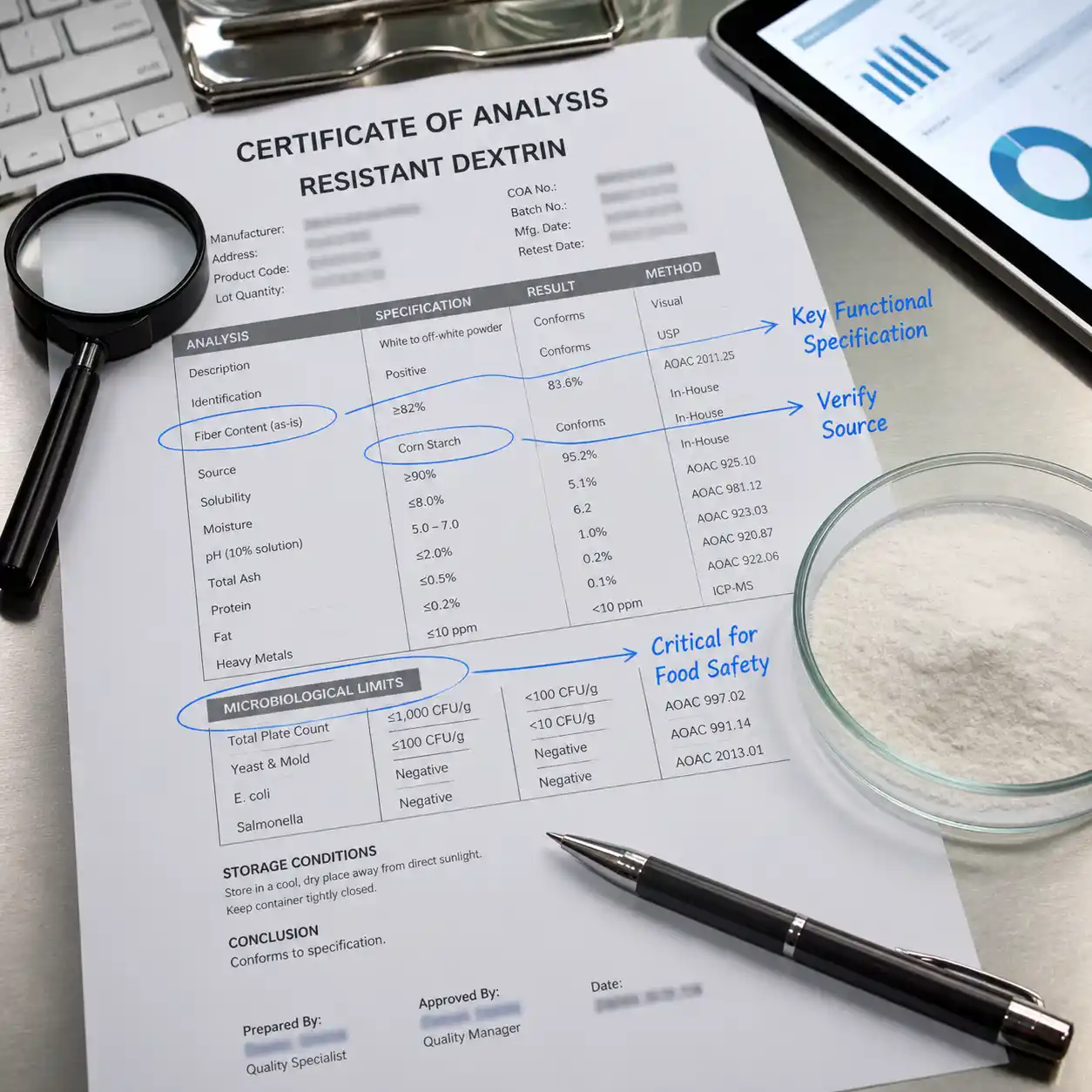
Do the specifications match the functional and labeling target (for example, fiber content expectations such as ≥82% for many commercial soluble fiber positions)?
Are microbiological limits, moisture, ash, and basic purity indicators consistently reported on the COA?
If the supplier can’t communicate these points clearly, the resistant dextrin GRAS regulatory story is unlikely to withstand internal review.
Aligning resistant dextrin and soluble corn fiber with U.S. and EU baselines
Many buyers treat resistant dextrin and soluble corn fiber as interchangeable. From a formulation lens, there can be overlap. From a regulatory lens, the safest approach is to avoid assumptions and require explicit alignment in the documentation set.
Two practical examples of how buyers often formalize this:
Identity clarity: resistant dextrin vs. resistant maltodextrin vs. “soluble corn fiber” can be used differently across markets and labels. Files should state the ingredient identity in a way that matches the intended label.
Spec discipline: if a finished product requires a stable fiber claim, a supplier’s COA should not be vague. A typical procurement-friendly approach is to require a minimum fiber content target plus consistent test methods and batch-to-batch reporting.
For teams building a shortlist, it helps to review how export-facing suppliers present their fiber ingredients publicly. For example, Shine Health provides product pages that illustrate the type of export-oriented information buyers often request, such as soluble fiber powder specs and sourcing notes (see soluble fiber powder) and a natural raw material soluble corn fiber positioning (see natural raw material soluble corn fiber). These should be treated as examples of how suppliers may structure commercial documentation—not as a substitute for a buyer’s formal qualification process.
Two document pillars procurement should standardize in 2026
Most qualification problems are not caused by one missing certificate; they come from inconsistent files across batches, regions, and product teams. The fastest fix is to standardize what “complete” means.
Pillar 1 checklist for resistant dextrin and soluble corn fiber
Use this as a baseline when comparing a resistant dextrin supplier China or a soluble corn fiber manufacturer.
| File item | What “regulation-ready” looks like | What creates risk |
|---|---|---|
| COA (per lot) | Fiber content stated clearly (commonly ≥82% for many commercial specs), plus moisture, ash, pH where applicable, and microbiology limits | Fiber listed ambiguously, incomplete microbiology, or missing test methods |
| Identity statement | Clear ingredient name and source (e.g., corn starch derived), consistent naming across COA/TDS/MSDS | Multiple names used interchangeably without explanation |
| GRAS alignment narrative | A concise statement explaining how the product aligns with existing resistant dextrin GRAS precedent and intended uses | “GRAS” asserted with no supporting rationale |
| Process overview | High-level manufacturing description and controls (no trade secrets required) | Refusal to provide any process description |
| Contaminant and allergen considerations | Practical statements and test coverage aligned to target market expectations | “Meets standard” with no scope defined |
| Labeling support | Guidance on ingredient naming and typical application ranges | Pushing labeling decisions back to buyer with no input |
A note on pricing: resistant dextrin bulk price comparisons are only meaningful once this pillar is met. Otherwise, lower quotes often translate into higher internal cost—retesting, re-auditing, or reformulation.
Pillar 2 checklist for MCC used in supplements and tablets
MCC sourcing frequently fails for a different reason: grade confusion. A microcrystalline cellulose MCC supplier China should be able to map MCC grades to buyer needs and provide pharmacopeial alignment when required.
| File item | What buyers should verify | Why it matters |
|---|---|---|
| Grade mapping | Clear grade identification (e.g., PH-101 vs PH-102) and typical functional use (flow, compressibility, particle size expectations) | Prevents switching grades late in scale-up |
| Pharmacopeial baseline | If the application is supplement/tablet-focused, confirm the relevant baseline (commonly USP/EP expectations depending on market) | Reduces audit friction and qualification loops |
| COA and MSDS | Consistent per-lot COA and updated safety documentation | Required for downstream customer files |
| Change control stance | Practical commitment to notify material/process changes | Protects finished product validation |
This is where “Recommended Chinese Microcrystalline Cellulose Manufacturer” really means something: recommendation is earned by consistent grade discipline and files that survive audits.
How to compare recommended Chinese manufacturers without guessing
Buyers looking for a “Recommended Chinese Resistant Dextrin Manufacturer” often ask for a simple list. In practice, the better approach is a scoring model tied to evidence.
Three signals tend to correlate with lower regulatory risk:
Export-ready paperwork that matches operational reality
COA ranges make sense, test frequency is consistent, and documents don’t contradict each other.Process control that supports traceability
Suppliers describing automation, closed-loop handling, or batch coding are usually better positioned to deliver consistent lots and cleaner audit trails.Clear positioning of ingredient families
A supplier that offers resistant dextrin alongside adjacent fibers (for example, resistant maltodextrin prebiotic fiber) should still keep identities distinct. Buyers can review product taxonomy examples such as resistant maltodextrin to see how suppliers separate related items.
None of these prove compliance alone. But together, they make it easier to defend supplier selection in front of regulatory, QA, and brand teams.
A 7-step procurement workflow before issuing RFQs
To reduce rework and accelerate internal approvals, procurement teams can structure RFQs around documentation first, then price.
Define the market path (U.S., EU, or both) and the finished product type (food, beverage mix, supplement, tablet).
Lock the identity statement for resistant dextrin/soluble corn fiber and for MCC grades.
Request both pillars upfront (fiber files + MCC files) before discussing long-term volumes.
Cross-check COA consistency across at least two lots if possible.
Confirm intended use ranges match the product concept and do not exceed what the internal regulatory team is comfortable defending.
Run a small pilot with only one variable change at a time (fiber first, then MCC grade), so failures are diagnosable.
Only then compare resistant dextrin bulk price and logistics, using total landed cost and internal time-to-approval as part of the equation.
This workflow typically shortens supplier onboarding because it avoids the most common loop: reformulating after compliance review.
Conclusion
In 2026, buying fiber ingredients for the U.S. market is less about finding the lowest resistant dextrin bulk price and more about buying a file that can survive review. GRAS Notice 1133 provides a practical benchmark for what a credible resistant dextrin GRAS story should look like, and FDA’s food additive vs GRAS framework turns that benchmark into a repeatable sourcing method.
For procurement teams, the strategic advantage is simple: treat resistant dextrin, soluble corn fiber, and MCC as a documentation system. The suppliers most worth recommending—whether a resistant dextrin supplier China or a microcrystalline cellulose MCC supplier China—are the ones that can map product identity, specs, and intended uses to that system without ambiguity.
For buyers building internal checklists, supplier examples and specification formats can be reviewed on www.sdshinehealth.com as a starting point for what export-facing documentation often includes.