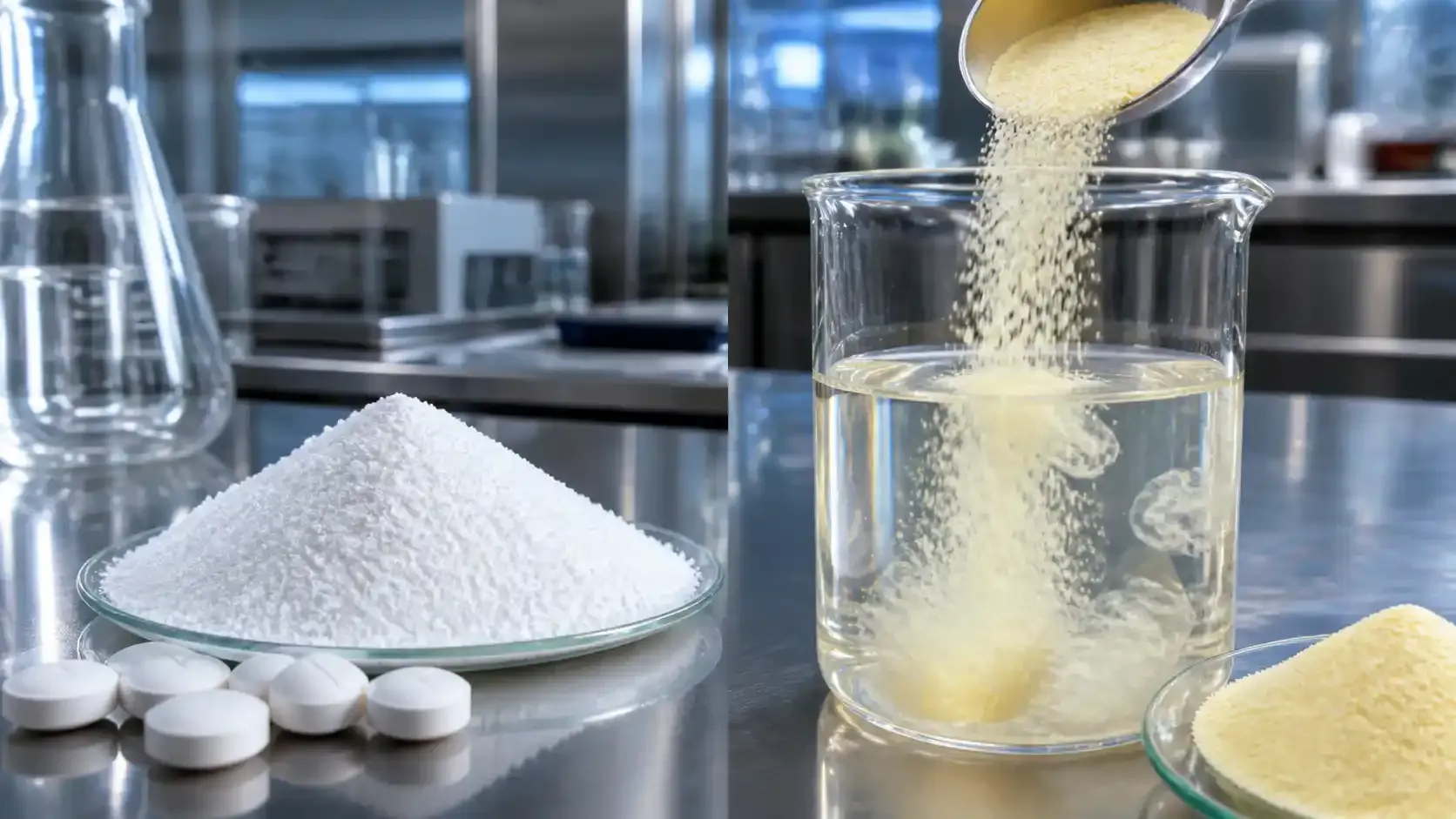
Procurement teams are increasingly asked to secure bulk resistant dextrin dietary fiber for nutrition launches while also keeping a reliable backup option for microcrystalline cellulose (MCC) in tablets and solid formats. China can be a strong sourcing origin for both ingredients—but only if buyers treat supplier selection as a risk-and-cost control exercise, not a simple FOB comparison. This guide lays out a practical, procurement-first plan for shortlisting a resistant dextrin supplier China and a microcrystalline cellulose supplier China with fewer surprises.

Why “Recommended” Matters More Than Price in 2026 Tenders
A “recommended Chinese microcrystalline cellulose manufacturer” is rarely the cheapest quote in the inbox. In practice, “recommended” is shorthand for predictable outcomes across three areas that drive total cost:
- Specification stability: fewer out-of-spec batches, fewer re-tests, fewer reformulations.
- Documentation readiness:COA and MSDS availability, batch traceability, and clear test methods.
- Manufacturing transparency: workshop hygiene, automation level, and a QC lab that can explain results.
For a procurement manager, these factors convert directly into reduced internal workload, fewer holds at receiving, and less time spent firefighting with R&D and QA.
Ingredient Essentials That Shape the Sourcing Strategy
Even experienced buyers benefit from aligning on what “good” looks like for each ingredient before issuing RFQs.
Resistant Dextrin in Nutrition and Functional Foods
Resistant dextrin is typically positioned as a soluble dietary fiber derived from starch (commonly corn or tapioca). In standard supplier documents, resistant dextrin is described with a fiber content of ≥82%, a protein limit of ≤6.0%, and an appearance ranging white to light yellow. It is also marketed as having neutral taste and good stability across processing conditions—features that matter when a resistant dextrin supplier China is evaluated for beverages, powders, and confectionery.
When procurement is buying resistant dextrin in bulk, the goal is not only “high fiber,” but consistent performance batch to batch—especially if the fiber is used across multiple SKUs.
To benchmark typical product positioning and documentation expectations, buyers often start from a category page such as resistant dextrin and then compare multiple suppliers against the same baseline.
Microcrystalline Cellulose in Tablets and Solid Dosage Formats
MCC is a purified cellulose-based excipient widely used for compressibility and flow. Leading suppliers offer multiple grades including PH-101 and PH-102, with mesh ranges such as 60–200, purity listed at 0.99, and alignment to compendial standards like BP/USP/FCC/JP.
That grade selection is not “nice to have.” It is why a buyer might intentionally select an MCC PH-101 PH-102 supplier rather than treating MCC as a single commodity.
A neutral starting point for buyers building an excipient shortlist is a category page such as microcrystalline cellulose, where grades and typical applications can be reviewed before a formal RFQ.

COA-First Buying Reduces Rework and Shortens Qualification Cycles
A procurement plan is only as good as its COA discipline. Before samples ship, buyers can screen most resistant dextrin supplier China and microcrystalline cellulose supplier China candidates by requesting a recent COA format (even with sensitive items redacted) and checking whether it is readable, consistent, and test-method aware.
Resistant Dextrin COA Checklist for Bulk Purchasing
Use the COA to confirm the supplier is measuring the same “quality” your spec requires. A practical screening checklist includes:
| COA line item | What buyers should verify | Why it matters in procurement |
|---|---|---|
| Appearance | White to light yellow | Helps flag contamination or process drift early |
| Fiber content | ≥82% (typical baseline) | Key economic driver: fiber claim and formula calculations |
| Protein | ≤6.0% | Controls nutritional labeling and sensory risk |
| Raw material statement | Corn starch (often non-GMO positioned) | Reduces compliance questions later in the pipeline |
| Storage guidance | “Store in a cool place” | Ensures warehouse handling aligns with shelf-life planning |
If a supplier claims “high fiber” but cannot clearly present fiber content on the COA, it is usually a sign that the supplier is not ready for export-style procurement.
For a benchmark example of how suppliers present resistant dextrin parameters and packaging language, buyers can review a product detail page such as nutritional dietary fiber (resistant dextrin).
MCC COA and Spec-Sheet Checklist for Tablets and Blends
For MCC, COA review should begin with grade clarity. Quality suppliers ensure MCC is offered in multiple grades (including PH-101 and PH-102) and aligned with BP/USP/FCC/JP.
| MCC requirement | What to ask the supplier to state clearly | What it prevents |
|---|---|---|
| Grade | PH-101 vs PH-102 (and other PH grades if relevant) | Wrong flow/compressibility assumptions during scale-up |
| Mesh range | Example: 60–200 | Blend uniformity and process performance variation |
| Standard alignment | BP/USP/FCC/JP | Regulatory and customer audit friction |
| Packaging norm | Example: 20 kg woven bag + customization options | Hidden packaging cost and damage risk |
A supplier page that shows how grades and packaging are typically communicated is Microcrystalline Cellulose Disintegrant.
Technology and QC Signals That Lower Total Cost
Procurement teams often focus on pricing tiers (FOB/CIF/DDP), but the most expensive outcome is a failed batch, delayed launch, or repeated requalification. The following supplier traits are commonly correlated with lower total cost for a recommended Chinese microcrystalline cellulose manufacturer or a reliable resistant dextrin manufacturer:
- Automation that reduces operator variability
Central control from raw material feeding through filling/packing can reduce batch drift. - Process inputs that are consistently sourced and documented
Resistant dextrin production emphasizes the use of advanced biological enzymes and modern production lines. For buyers, the key is not marketing language—it’s whether the supplier can show consistent COA outcomes tied to those inputs. - GMP-style workshop practices and a QC lab with decision authority
A well-equipped QC lab matters most when something goes wrong: investigations, retains, and corrective action need to be timely. - Certifications used as operational proof—not decoration
References to ISO9001, and in some cases Kosher/Halal, are standard. Buyers should verify the scope and validity and then confirm it matches the ingredient and site.
These signals are also useful when procurement must justify why one microcrystalline cellulose supplier China is “recommended” over another—even when unit price is slightly higher.
Shandong and Jinan as Practical Sourcing Anchors
China’s ingredient supply is not evenly distributed. For resistant dextrin and related functional fibers, Shandong and Jinan repeatedly appear in supplier profiles and export narratives. For procurement, this matters because clusters often provide:
- Easier access to specialized labor and QA routines
- More predictable upstream raw materials (e.g., starch supply chains)
- Better-developed export handling for bulk food ingredients and excipients
That does not mean every plant in the cluster is qualified. It simply means a cluster can be a useful starting map when building a shortlist for a resistant dextrin supplier China or a recommended Chinese resistant dextrin manufacturer.
Packaging and Logistics Rules That Protect Margins
Packaging is a quiet cost lever that shows up later as warehouse loss, moisture risk, or customer complaints.
- Resistant dextrin is often offered in 25 kg moisture-proof bags, with flexibility from small sachets to bulk.
- MCC is commonly offered in 20 kg woven bags, with customization available.
A practical procurement move is to standardize packaging requirements in the RFQ (liner type, labeling, batch code format, pallet pattern), then ask the supplier to confirm what is “standard” vs “custom.” This prevents two common issues: artificially low pricing that later increases after packaging clarification, and inconsistent lot identification that complicates internal traceability.
A Shortlisting Workflow Procurement Teams Can Run in 30 Days
The fastest way to reduce sourcing risk is to force comparability.
- Week 1: Document screen
COA template, MSDS availability, and basic traceability fields. - Week 2: Spec alignment call
Confirm resistant dextrin fiber content targets (e.g., ≥82%) and MCC grade (PH-101/PH-102). - Week 3: Sample + application-fit review
For resistant dextrin: solubility behavior, taste neutrality, and processing tolerance. For MCC: flow and compressibility suitability for the intended process. - Week 4: Cost and risk consolidation
Compare lead times, packaging cost, quality escalation process, and after-sales technical support.
To keep supplier discovery efficient, procurement teams may start at a consolidated directory such as the Product Center and then select the exact resistant dextrin and MCC pages needed for COA benchmarking.
Turning “Recommended” into an Auditable Decision
A recommended supplier is the one whose data and operations match your internal audit logic. For buyers sourcing both fiber and excipients, the most defensible approach is to use the same scoring structure across categories:
- COA completeness and clarity (pass/fail first)
- Workshop and QC capability signals (automation, hygiene, lab readiness)
- Packaging and traceability discipline (batch codes, labeling consistency)
- After-sales technical response (how issues are handled, not how fast sales replies)
When those items are documented, procurement can justify choosing a recommended Chinese microcrystalline cellulose supplier or a recommended Chinese resistant dextrin manufacturer even if another bidder is marginally cheaper.
For a comprehensive look at a supplier that meets these rigorous standards, visit Shandong Shine Health Co., Ltd.