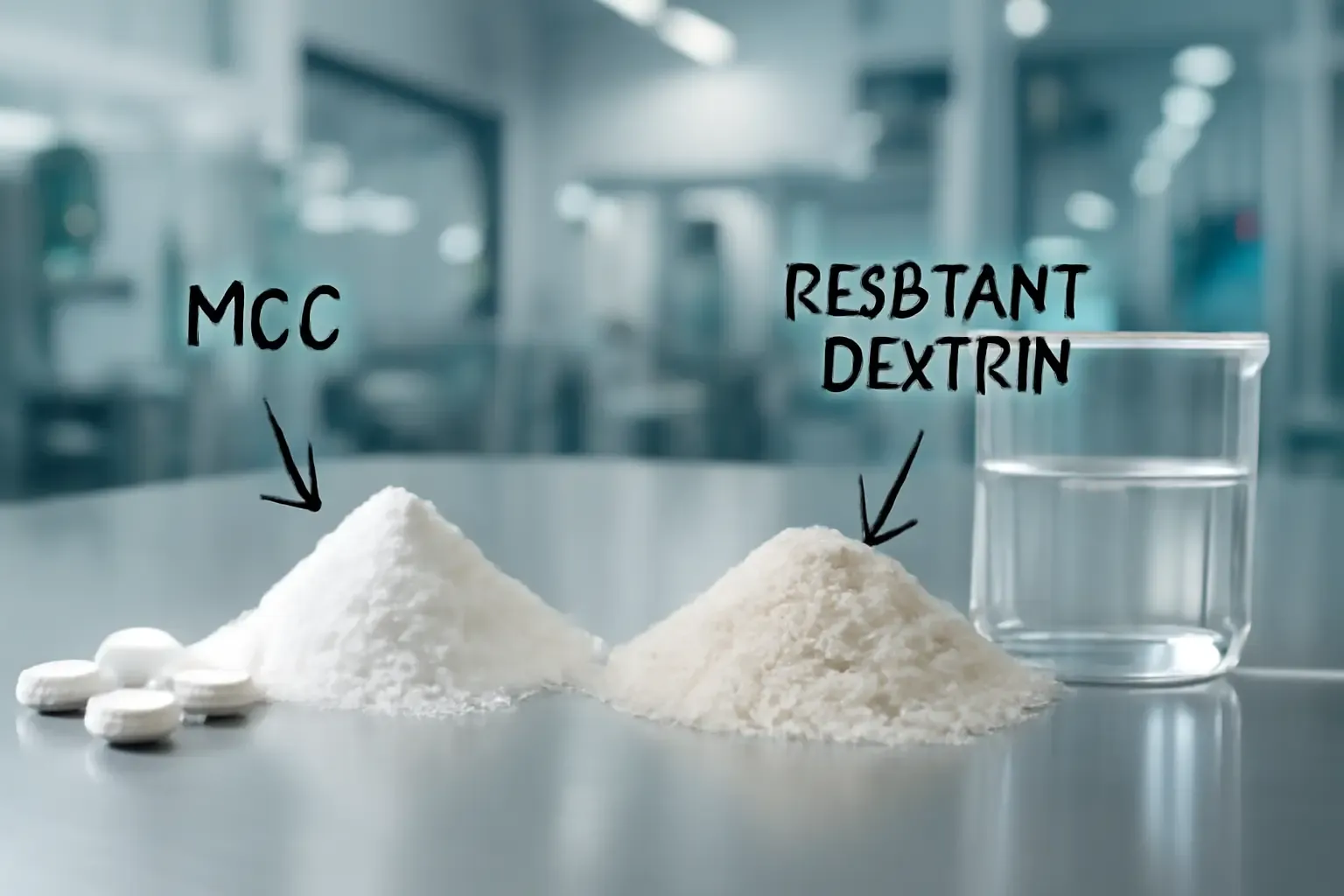
Dietary fiber is moving from a “nice-to-have” claim to a product-planning requirement for 2026, while nutraceutical tablets and capsules continue to scale globally. That combination is putting two workhorse ingredients back under the procurement microscope: microcrystalline cellulose (MCC) for solid dosage excipient performance and resistant dextrin for fiber-forward formulation and labeling flexibility.
For buyers, the real change is not simply higher volume—it’s higher consequence. When microcrystalline cellulose specifications tighten (especially where USP alignment is expected) and resistant dextrin is used to support fiber claims across beverages, powders, gummies, and bars, supplier choice stops being a purely price-led decision. It becomes a risk-and-continuity decision, and China is increasingly central to that conversation.

Why Demand Pressure Is Rising for Both MCC and Resistant Dextrin
Two market signals help explain why procurement teams are revisiting their shortlists. First, nutraceutical excipients are projected to expand meaningfully over the next decade. This implies sustained growth in tablets and capsules—and sustained consumption of microcrystalline cellulose as a binder, filler, and direct-compression enabler. One market forecast projects the global nutraceutical excipients market rising from USD 2.8 billion (2025) to USD 5.2 billion (2035).
Second, dietary fiber is widely flagged as a major 2026 food trend, driven by on-pack claims and new launches that feature prebiotic fibers and fiber fortification. When fiber becomes an everyday claim, resistant dextrin procurement tends to shift from opportunistic spot buying to planned supply.
In practice, this dual demand shows up in RFQs as:
- More requests for pharmaceutical grade MCC PH102 and adjacent grades used in robust direct compression systems.
- Scrutiny of MCC consistency (density, particle size distribution, moisture) to protect compression behavior and dissolution.
- Insistence that resistant dextrin meet a high fiber threshold suitable for labeling and formulation targets.
What Buyers Are Actually Building in 2026 and Where These Ingredients Fit
Procurement teams often see MCC and resistant dextrin as separate categories—excipients vs. functional fibers. In a fiber-first product landscape, they increasingly sit in the same commercialization pipeline.
Microcrystalline Cellulose Remains a Tablet and Capsule "Workhorse"
Microcrystalline cellulose is still one of the most widely used excipients because it is plant-derived, compressible, and formulation-friendly across many actives. In nutraceutical programs, it frequently supports:
- Tablets that need reliable hardness and low friability under direct compression.
- Capsules where fill uniformity and flow matter for high-throughput encapsulation.
- Multi-ingredient blends where compressibility and stability reduce batch-to-batch variability.
For buyers searching for a reliable microcrystalline cellulose supplier in China, the key is not only availability—it is whether the supplier can keep performance stable across lots as volumes scale.
Resistant Dextrin Becomes a Default Tool for Fiber Claims
Resistant dextrin is typically positioned as a soluble dietary fiber that resists digestion in the small intestine and can be fermented in the large intestine. These attributes are often associated with prebiotic-style positioning in finished products.
On the supply side, common buyer requirements are becoming more standardized. Premium suppliers focus on specific parameters to ensure quality. For instance, reputable manufacturers emphasize a fiber content ≥82%, with a typical presentation described as white to light yellow powder and protein content ≤6.0%. They also highlight production choices such as non-GMO corn starch feedstock and enzyme-driven processing.
This matters because resistant dextrin is being specified into:
- Nutrition powders where neutral taste and solubility support “add fiber” without reworking the flavor system.
- Ready-to-drink beverages where low viscosity is preferred.
- Low-carb or keto-positioned products where net carb messaging is sensitive.
A practical way to map internal stakeholders: formulation teams care about mouthfeel and stability; regulatory teams care about documentation and claim support; procurement cares about continuity and variance control.
USP Alignment Is Now a Baseline Conversation for MCC
Even when the final product is a nutraceutical, many buyers treat USP alignment as the cleanest common language for quality expectations.
The USP monograph for microcrystalline cellulose effectively raises the minimum bar for suppliers competing in regulated or high-compliance supply chains. From a buyer's perspective, the monograph's value is clarity: it defines the ingredient and establishes a shared expectation for identity and quality.
How to Translate “USP MCC” into Procurement Checks