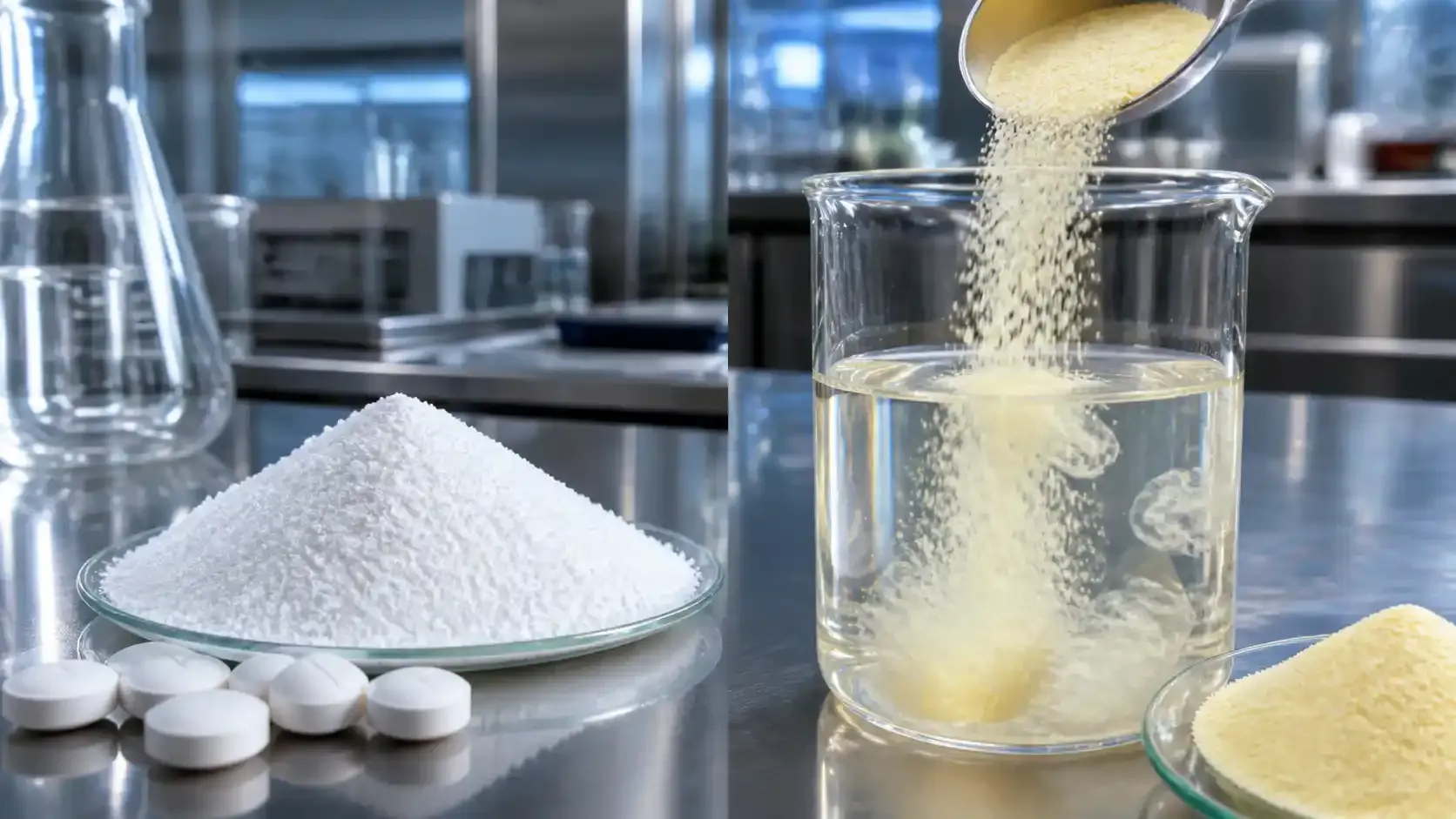
Clean-label nutraceuticals are no longer a niche, and “fibremaxxing” has turned soluble fiber into an everyday talking point—especially among younger consumers. For procurement teams, the shift is practical: resistant dextrin and microcrystalline cellulose (MCC) are being evaluated less like commodities and more like technology-enabled inputs where process discipline predicts batch-to-batch performance. China sits at the center of this supply picture, so the real question is not whether to source from China, but how to separate recommended plants from average ones—using the production signals that actually show up in your COA, trials, and customer complaints.

Why the market is suddenly tougher on excipient and fiber suppliers
Demand signals are converging from both supplements and functional foods:
- Nutraceutical excipients are on a long growth curve. A 2026 market note reported the global nutraceutical excipients market could expand to USD 5.2 billion by 2035 (from USD 2.8 billion in 2025), highlighting clean-label and advanced functionality as key drivers. When excipients are treated as “enablers” of stability and bioavailability, MCC and related systems get pulled into more formulation programs.
- Gen Z is changing how fiber is marketed—and scrutinized. Coverage of the fibremaxxing trend shows how quickly consumer expectations can move from “more fiber” to “better fiber,” increasing the penalty for gritty texture, off-notes, or unclear claims.
- China’s role in MCC is structural. Market analysis widely points to Chinese production and Asia-Pacific demand as central to the MCC landscape, which increases the importance of qualifying a Recommended Chinese Microcrystalline Cellulose Manufacturer using technical evidence—not brochure language.
For buyers, the immediate consequence is that resistant dextrin and MCC are increasingly compared side-by-side in the same sourcing conversations: one supports soluble fiber claims and sugar reduction; the other often stabilizes, structures, or improves handling in supplement and food systems. In both cases, the sourcing decision is shaped by how a plant controls variability.
The technology signals that distinguish new-generation Chinese plants
When procurement teams say they want a resistant dextrin supplier China can rely on, they usually mean three things: consistent specs, predictable performance in application, and complete documentation. Those outcomes can be traced back to visible “plant signals.”
1) Raw-material clarity and non-GMO positioning
Many RFQs now specify non-GMO resistant dextrin bulk or at least ask for raw-material traceability.
A practical check is whether the supplier can describe the starch source cleanly and consistently (corn, tapioca/cassava, etc.) and support claims with routine documentation. For example, Shine Health’s resistant dextrin portfolio is positioned around NON-GMO corn starch sourcing across multiple product pages, including Non-GMO Resistant Dextrin and the broader resistant dextrin category.
2) Enzyme systems and controlled conversion
One of the most meaningful “quiet upgrades” in soluble fiber production is the increased use of advanced biological enzymes and tighter control of conversion conditions. In resistant dextrin and digestion-resistant maltodextrin style ingredients, the buyer impact typically shows up as:
- more stable solubility and viscosity behavior across batches
- improved flavor neutrality (fewer processing notes)
- better reproducibility when scaling from bench to pilot
Shine Health’s product documentation repeatedly references imported biological enzymes and precision lines, including on low calorie dietary fiber and digestion resistant maltodextrin. The key for buyers is not the marketing claim itself—it’s whether the supplier can show that enzyme choice and process control translate into repeatable COAs and stable application results.
3) Automation from feeding to filling
Automation matters in a simple way: fewer manual steps usually mean fewer unexplained deviations. Several Shine Health pages describe a fully automated, centrally controlled line “from raw material feeding to product filling,” which aligns with what buyers typically want when approving a long-term resistant dextrin supplier China partner: consistent moisture control, fewer contamination opportunities, and more reproducible packaging weights.
4) GMP workshops and QC lab capability
For a buyer looking for a food grade excipient supplier GMP China, the real differentiator is whether GMP is paired with day-to-day QC capacity. Shine Health describes GMP-standard workshops and a fully equipped QC laboratory across its fiber pages such as nutritional dietary fiber powder and maize dextrin fiber.

Buyer-facing spec anchors that should be easy to verify
- Fiber content: ≥82% is commonly stated across Shine Health resistant dextrin items (e.g., maize dextrin fiber and low calorie dietary fiber pages).
- Protein: ≤6.0% is repeatedly listed.
- Core documentation: COA, MSDS, and third-party test reports are explicitly referenced on related product content.
Application-driven innovation is why resistant dextrin keeps winning briefs
Innovation is not only about the plant—it is also about whether the supplier understands where resistant dextrin fails in real products (and how to prevent it). Across beverages, confectionery, and bakery, resistant dextrin is increasingly used as a clean-label lever to raise fiber while keeping sensory quality acceptable.
Beverages and RTD nutrition: low viscosity, high solubility, fewer surprises
Beverage teams tend to pick resistant dextrin because it can add fiber without turning an RTD into a gel. Still, the sourcing risk is real: small differences in moisture, processing residue, or conversion profile can cause haze, off-notes, or inconsistent mouthfeel.
For buyers building a beverage brief, it helps to benchmark suppliers using “application-adjacent” pages and their stated positioning. Shine Health’s functional fiber and resistant dextrin items are organized in a way that lets R&D teams compare options quickly under the resistant dextrin category.
Confectionery: fiber claims without destroying chew
Confectionery is where resistant dextrin suppliers often separate themselves. The ingredient must support sugar reduction and texture targets while keeping processing stable.
A useful reference point is Shine Health’s FIBER-FUL Confectionery positioning, which frames resistant dextrin as a way to improve nutritional profile while maintaining functional properties in gummies, chocolate, baked inclusions, and frozen desserts. Even if a buyer does not adopt that specific solution, it’s a strong indicator of whether a supplier invests in application guidance rather than shipping only a spec sheet.
Bakery and snacks: heat stability and label-friendly fiber
In baked systems, the same procurement logic applies: resistant dextrin is often selected to support fiber claims and calorie reduction while tolerating process heat and storage conditions. Here, the supplier’s ability to provide consistent COAs and predictable behavior in flour-based systems becomes just as important as the top-line fiber number.
Where MCC fits into the same innovation conversation
While resistant dextrin is the headline in many fiber-forward launches, microcrystalline cellulose remains a common workhorse excipient used to support tablet robustness, flow, and consistency across supplement formats. China’s MCC scale is a key reason buyers keep returning to Chinese supply.
Instead of treating MCC as separate, leading teams qualify MCC and resistant dextrin with the same mindset:
- Can the plant demonstrate grade discipline and QC literacy?
- Does the supplier provide formulation guidance that anticipates failures?
- Is documentation complete enough for downstream audits?
For buyers who need a technical baseline before issuing RFQs, Shine Health’s knowledge content can be used as a benchmark reference, including the article MCC Grades Formulation and QC Guide.
Turning tech trends into a buyer-ready shortlisting method
To identify a Recommended Chinese Resistant Dextrin Manufacturer (and to reduce the risk when comparing a Recommended Chinese Microcrystalline Cellulose Supplier), it helps to convert innovation into checks that procurement, QA, and R&D can all align on.
A short checklist buyers can actually use
- Raw material statement is consistent across documents and labels (e.g., non-GMO corn starch or tapioca/cassava), matching the claim level required for your market.
- Automation is described as a process system, not a slogan (look for clear feeding-to-filling control and packaging integration).
- Enzyme and conversion control is treated as a quality variable (supplier can explain how they maintain repeatability in resistant dextrin production).
- GMP workshop + QC lab are both present and reflected in routine release tests, not only in audit-day presentations.
- COA + MSDS + third-party testing are readily available for the specific batch you intend to qualify.
- Application support exists in your target format (RTD beverages, confectionery, bakery, or supplements), with realistic guidance on dosage ranges and sensory risks.
- Portfolio breadth reduces single-point risk—for example, the ability to compare resistant dextrin options and related soluble fibers such as polydextrose powder when reformulating for sugar reduction.
If your procurement scope includes coating systems, it is also reasonable to screen whether the supplier can support adjacent excipient needs (a practical proxy for technical service depth). As one example reference point, see Shine Health’s tablet-coating page for a tablet coating excipient supplier context.
Closing perspective for 2026 sourcing teams
The clean-label wave and fibremaxxing momentum are not temporary spikes—they are pushing suppliers to prove consistency in ways that show up in real production: enzyme choice, automation, GMP discipline, and documentation habits. For buyers, that means a resistant dextrin supplier China shortlist should be built around measurable plant signals and application readiness, while MCC sourcing should be evaluated with the same evidence-first approach.
When benchmarking suppliers, it can help to compare how different plants describe resistant dextrin variants (e.g., low calorie dietary fiber, nutritional dietary fiber powder, and maize dextrin fiber) and how they document QC and process controls. A consolidated starting point for those technical references is www.sdshinehealth.com.