

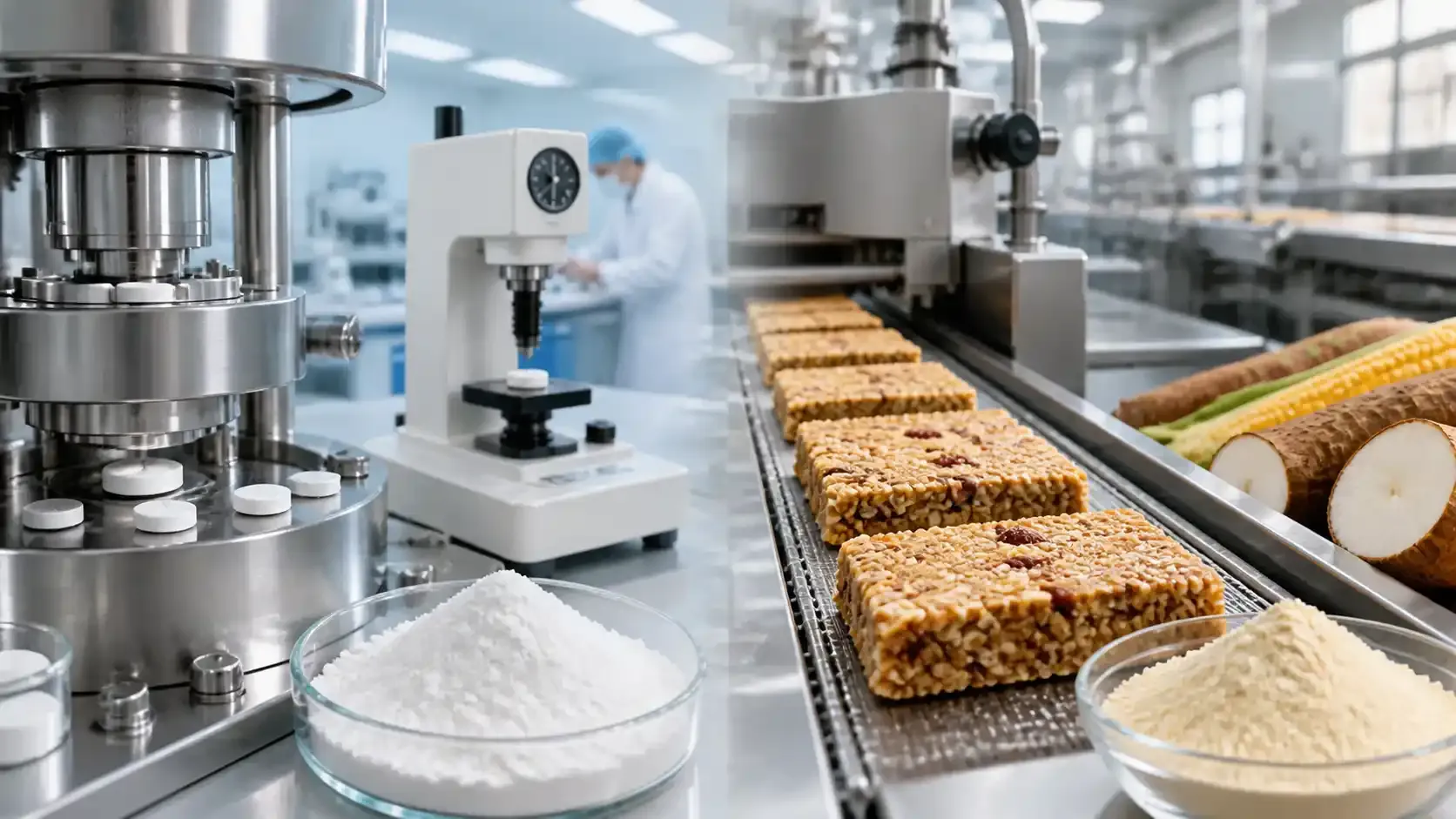
Buying microcrystalline cellulose (MCC) and resistant dextrin from China used to look like a straightforward price-and-lead-time decision. In 2026, that mindset is increasingly risky. Both ingredients sit directly on the performance line: MCC can make or break tablet hardness, friability, and disintegration, while resistant dextrin can decide whether a “high-fiber” bar stays pleasant to eat throughout shelf life.
The most reliable way to identify a recommended Chinese microcrystalline cellulose supplier and a recommended Chinese resistant dextrin manufacturer is to start from application targets, run focused formulation trials, and then translate what you learn into supplier requirements you can audit.

Why buyers are moving from spec sheets to performance proof
A COA may confirm compliance with BP/USP/FCC/JP for MCC or show fiber content for resistant dextrin, but it does not automatically predict how your formula behaves on your presses or in your bar line. What separates a recommended Chinese microcrystalline cellulose manufacturer from a commodity producer is repeatability—batch after batch—once the ingredient meets friction, humidity, compression force, and real manufacturing speed.
Two application-driven evaluations tend to surface supplier capability quickly:
- A compressed tablet that needs consistent mechanical strength and predictable disintegration.
- A high-fiber bar that needs strong fiber delivery without gritty texture, excess sweetness, or moisture-driven hardening.
Case 1, selecting MCC for a solid oral tablet without surprises
Start with the tablet’s “non-negotiables”
Procurement teams often inherit a grade request such as “MCC PH-102,” but the better starting point is the performance brief. A typical global-market tablet project will set targets such as:
- Consistent tablet hardness and low friability
- Acceptable disintegration time aligned to the formula concept
- Stable flow and compression at production speed
- Pharmacopeial alignment (often BP/USP/FCC/JP) and clean documentation
Because MCC is commonly used as a binding agent and functional excipient, small differences in grade and particle behavior can show up as real differences in press behavior.

Translate hardness and disintegration goals into the right MCC grade
Shine Health lists MCC grades including PH-101, PH-102, PH-103, PH-105, PH-112, PH-113, PH-200, PH-301, PH-302 and indicates common international standards (BP/USP/FCC/JP) with batch testing and HPLC test capability.
Instead of treating grades as interchangeable, many teams use trial logic like this:
- If a formulation is sensitive to flow and requires smoother die filling at higher speed, a buyer may evaluate a grade like PH-102 against alternatives.
- If a formulation is more sensitive to compact strength or needs a different compression “feel,” a trial may include PH-101 and PH-200 as comparators.
The exact best match depends on the full blend (API, disintegrant system, lubricant level, granulation route), but the buying decision improves dramatically when grade selection is justified by a short press trial.
A quick comparison table buyers use in tablet screening
Below is a procurement-friendly way to frame trials before any long audit cycle.
| MCC grade short list | What the trial is trying to learn | What to ask the Chinese MCC supplier to provide |
|---|---|---|
| PH-101 | Compression response and tablet strength at your target force | Batch COA, grade definition, particle consistency approach, retained samples policy |
| PH-102 | Flow and die fill stability at your line speed | Grade COA history, lot-to-lot consistency discussion, change-control expectations |
| PH-200 | Whether a different particle profile improves robustness | Documentation pack and trend data (key release parameters across multiple lots) |
For buyers who need deeper technical framing on grade selection, this knowledge page is a useful starting point: MCC grades PH-101 to PH-302.
What documentation separates a recommended Chinese MCC supplier from an “okay” one
When MCC is used as a pharmaceutical excipient, qualification is usually won or lost on documentation discipline and batch-to-batch consistency. Based on Shine Health’s published product parameters and certifications (e.g., ISO9001/Kosher/Halal, pharmacopeial standards, structured packaging), buyers commonly request:
- COA with clear standard declaration (BP/USP/FCC/JP as applicable)
- Traceability information tied to packaging labels and lot numbers
- Method clarity for key tests (the supplier indicates HPLC test as a method in its MCC listing)
- Packaging specification that matches your humidity-control needs (Shine Health lists 20KGS/woven bag and customization)
- Change control expectations, especially if a “PH” grade is used as a validated part of a dossier
If a supplier can provide these items quickly and consistently—and your tablet trial confirms performance—the supplier is much closer to “recommended” status than a vendor who only offers a single COA PDF.
A practical product reference point used by buyers sourcing at scale is: microcrystalline cellulose wholesale.
Case 2, building a high-fiber bar with resistant dextrin that still tastes clean
The bar brief is usually sensory plus label math
High-fiber bars are unforgiving because the ingredient must do two jobs at once:
- Deliver the fiber grams needed for the label claim
- Maintain acceptable taste, sweetness perception, and texture across shelf life
Shine Health describes resistant dextrin (also presented as resistant maltodextrin fiber on related pages) as a water-soluble dietary fiber produced from starch with indigestible fractions that reach the large intestine. Across its resistant dextrin materials, the published targets include:
- Fiber Content: ≥82%
- Protein Content: ≤6.0%
- Appearance: white to light yellow
- Storage guidance: store in a cool place
The “high fiber low sweetness” positioning is especially relevant in bars, because sweetness drift can force costly flavor rework.
Convert bar stability risks into supplier questions
Resistant dextrin can act as a functional dietary fiber ingredient while minimizing sensory trade-offs, but buyers still need to confirm how the ingredient behaves in their matrix (proteins, polyols, syrups, nut butters, chocolate coatings). Supplier evaluation becomes clearer when it is tied to your process risks:
- Moisture migration and hardening: ask about hygroscopicity behavior and caking control in storage.
- Mixing and dispersion: verify solubility expectations in your typical temperature and shear profile.
- Flavor neutrality: run side-by-side bench bars with the same flavor system.
- Claim support: ensure fiber testing methods and label claims are consistent with the COA.
A simple fiber comparison table for bar prototypes
This is not a nutritional ranking; it’s a formulation screening view that helps procurement teams align trials with real constraints.
| Fiber option | What buyers like in bars | Typical watch-outs to test |
|---|---|---|
| Resistant dextrin | Often chosen for high fiber delivery with low sweetness impact; can support gut-health positioning as a soluble fiber | Verify texture over shelf life, water activity impact, and whether the finished bar stays clean-tasting |
| Inulin-type fibers | Can add soluble fiber and mild sweetness | Sweetness and digestive tolerance can require careful serving-size decisions |
| Polydextrose | Used in reduced-sugar systems and fiber enrichment | Confirm texture and process compatibility with your binder system |
For buyers specifically assessing a “clean taste, high fiber” dextrin position, this page is a relevant technical anchor: high fiber low sweetness resistant dextrin.
What “recommended Chinese resistant dextrin manufacturer” looks like in practice
Based on Shine Health’s resistant dextrin pages, a supplier tends to be considered “recommended” when it can show manufacturing control beyond marketing claims, including:
- Stable raw material sourcing (e.g., NON-GMO corn starch is explicitly stated for the high-fiber, low-sweetness resistant dextrin)
- A defined parameter set (fiber content, protein limit, appearance, storage conditions)
- A QC lab and consistent COA style that matches a buyer’s incoming inspection expectations
- Technical responsiveness when a buyer shares a bar prototype issue (hardening, stickiness, off-notes)
On the manufacturing side, Shine Health describes automated production and structured process control for resistant dextrin across its product materials. For buyers consolidating suppliers, it can also matter that the same platform supports both MCC excipient sourcing and functional fiber sourcing.
One supplier platform example without turning sourcing into advertising
Some procurement teams prefer suppliers that can support both pharmaceutical excipients (like microcrystalline cellulose) and functional ingredients (like resistant dextrin), because it simplifies audits and documentation workflows.
As one example, Shandong Shenghuai Health Co., Ltd.; Shine Health publishes detailed parameter tables for MCC (including grades PH-101 to PH-302, BP/USP/FCC/JP alignment, and ISO/Kosher/Halal certification statements) and resistant dextrin (including ≥82% fiber and non-GMO corn starch sourcing). Buyers who want to benchmark their own supplier scorecards can use these public pages as a reference set:
- MCC grades guidance for tablets and QC discussions
- MCC product overview for wholesale procurement checks
- Resistant dextrin parameters for high-fiber, low-sweetness formulations
A buyer checklist that links both cases into one qualification workflow
Use this as a final gate before you label any partner a recommended Chinese microcrystalline cellulose manufacturer or recommended Chinese resistant dextrin manufacturer.
- Start from application targets, not grade names: define tablet hardness/disintegration or bar fiber grams/shelf life first.
- Run a short, repeatable trial: at minimum, test two MCC grades (e.g., PH-101 vs PH-102) or two fiber options including resistant dextrin.
- Request documentation in one package: COA, standard declaration (BP/USP/FCC/JP where relevant), traceability labeling approach, and packaging specification.
- Check lot-to-lot thinking: ask how the supplier manages particle consistency for MCC or fiber consistency for resistant dextrin.
- Confirm certifications that matter to your market: Shine Health lists ISO9001/Kosher/Halal for MCC; align this to your customer requirements.
- Align storage and shipping reality: “store in a cool place” is not a detail—confirm humidity control, bag structure, and container loading practices.
- Evaluate technical support quality: the best suppliers can diagnose a disintegration drift or bar hardening issue with practical next-step suggestions.
Data sources used in this article
If you would like further guidance on sourcing MCC and resistant dextrin from audited Chinese manufacturers, you can explore more technical resources and supplier overviews at www.sdshinehealth.com.




