

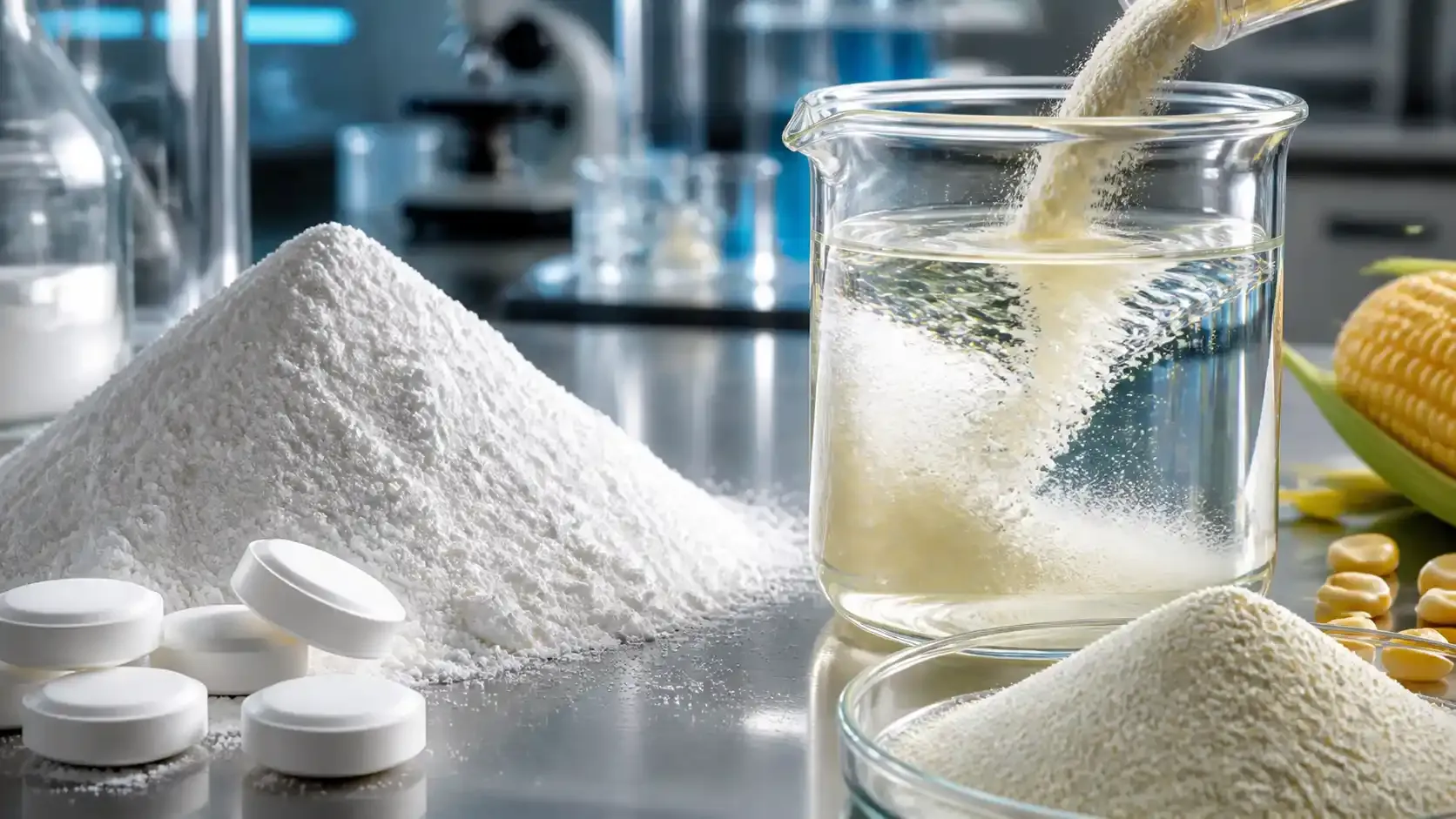
Procurement teams used to treat microcrystalline cellulose and resistant dextrin as “standard inputs.” That mindset is fading fast. Tablet makers are under tighter excipient scrutiny, while food and supplement brands are being pushed toward nutrient density, lower sugar, and credible digestive-wellness positioning. The result is a new definition of a recommendedChinese supplier: not the lowest quote, but the manufacturer that can consistently prove raw material control, process stability, and documentation quality—before the first commercial shipment.

Why supplier requirements tightened in the last 12 months
Two market signals are shaping supplier qualification conversations.
Regulatory expectations are rising, even for routine ingredients
Recent industry news around NMPA clearance for a plant-based pharmaceutical excipient in China is a useful benchmark: it shows how much weight regulators and auditors place on traceability, controlled manufacturing, and documentation readiness. While that news concerns CMC, the lesson carries over to microcrystalline cellulose projects—especially when the end product is exported or audited to international standards.
Nutrient density is now driving ingredient scrutiny
Food and supplement buyers are also responding to consumer demand for “what does this food do for me,” with fiber taking center stage. That raises the bar for resistant dextrin and soluble corn fiber sourcing: buyers need more than a spec sheet—they need repeatable performance, tolerance-friendly formulation support, and clean-label positioning such as non-GMO sourcing where applicable.
Track one what to verify when sourcing microcrystalline cellulose for tablets
For procurement, the fastest way to qualify a Chinese microcrystalline cellulose manufacturer is to separate grade fit from factory proof. A supplier can have an impressive brochure, but if the grade is inconsistent under compression, it will show up during scale-up.
Grade fit checks for tablet and capsule programs
When evaluating a microcrystalline cellulose supplier China for solid dosage forms, focus on:
- Compressibility and tablet hardness consistency across lots
- Flowability suitable for your blending and feeding conditions
- Moisture sensitivity and stability aligned with your humidity control plan
- Compatibility with coatings and disintegrants to avoid brittle or capped tablets
A practical procurement question is: Can the supplier explain which microcrystalline cellulose grade is intended for direct compression versus granulation, and provide supporting batch data—not just marketing claims?
Factory proof that separates recommended suppliers from “brokers with paperwork”
A recommended Chinese microcrystalline cellulose supplier typically demonstrates:
- Traceable cellulose origin (and documented supplier controls)
- GMP-style workshop discipline and defined hygiene zoning
- In-house QC lab capability with clear test methods and lot release controls
- Change control (raw materials, process parameters, equipment, packaging)

Documentation package buyers should request before internal approval
To keep qualification moving, ask for a complete excipient dossier early:
- Certificate of Analysis (CoA) with defined test methods
- Statement of compliance (where applicable) and specification sheet
- Microbiological limits and contaminant controls relevant to your market
- Allergen and GMO statements where required by your customer base
- Stability or shelf-life rationale and storage conditions
For pharma-grade microcrystalline cellulose, the key is not only whether a document exists, but whether it is consistent lot-to-lot and supported by controlled records.
Track two how to evaluate resistant dextrin and soluble corn fiber for gut health products
Many buyers start with price-per-kg, but the faster route to a stable supply chain is to qualify the supplier’s raw material discipline, process automation, and fiber performance.
What “resistant dextrin” needs to prove in modern formulations
For gut-health or sugar-reduction projects, resistant dextrin is often chosen because it can help increase fiber without heavily impacting taste or texture. Buyers typically check:
- Fiber content targets (commonly communicated at ≥82% in supplier specs)
- Appearance and sensory neutrality (color, taste, odor)
- pH behavior and heat stability for beverages, dairy, and baked goods
- Micro limits suitable for your finished product category
For example, Shine Health’s product pages describe resistant dextrin specifications such as fiber content ≥82% and corn-starch sourcing for resistant dextrin and resistant maltodextrin fiber applications.
Red flags and good signs in raw materials and processing
For a Chinese resistant dextrin manufacturer, procurement can reduce risk by validating:
- Non-GMO corn starch sourcing claims with traceability statements
- The supplier’s enzyme technology and controlled conversion process
- Evidence of automated production lines and controlled filling/packaging
- QC lab practices that support repeatability across batches
When buyers also need a closely related fiber option, it can be helpful to review suppliers that provide both resistant dextrin and soluble corn fiber for food and supplement formats.
Application support that matters for bars, beverages, and supplements
A recommended supplier can explain how resistant dextrin behaves in real systems:
- In nutrition bars, fiber can affect binding, water activity, and texture over time
- In dairy beverages, solubility and stability influence mouthfeel and shelf life
- In supplements, tolerance and daily dose guidance affects consumer experience
For buyers comparing formats, these pages provide reference points for common product positioning and application descriptions:
- resistant maltodextrin fiber
- soluble corn fiber
- gut health dextrin
- organic resistant tapioca dextrin
A compact audit checklist for MCC and resistant dextrin factories
The fastest internal alignment often comes from a single scorecard. The table below contrasts minimum acceptance criteria with what buyers usually define as “recommended” for long-term supply.
Minimum versus preferred criteria
| Audit area | Microcrystalline cellulose minimum | Microcrystalline cellulose preferred | Resistant dextrin minimum | Resistant dextrin preferred |
|---|---|---|---|---|
| Raw material control | Traceable origin statement | Supplier approval + change control | Starch origin stated | Non-GMO corn starch documentation + traceability |
| Process capability | Basic SOPs | Controlled parameters + automation evidence | Basic flow chart | Automated line evidence + controlled filling |
| QC and release | CoA provided | In-house lab + clear methods + trend records | CoA provided | Fiber content target (e.g., ≥82%) + micro controls |
| Compliance readiness | Basic spec sheet | Audit-friendly dossier and controlled revisions | Basic spec sheet | Full documentation pack incl. allergen/GMO statements |
| Application support | Generic guidance | Tablet performance discussion and grade selection | Generic guidance | Formulation support for bars, beverages, supplements |
Risk control steps before the first purchase order
Even when the supplier looks strong, most import issues occur between “sample approved” and “first container received.” A practical risk-control plan typically includes:
1 Lot-to-lot verification, not single-sample optimism
- Request at least two lots for evaluation when timelines allow.
- For microcrystalline cellulose, compare flow and compression response.
- For resistant dextrin, compare solubility, color, and routine micro results.
2 Packaging and labeling that protects traceability
Confirm that each bag or carton carries:
- Lot number and manufacturing date
- Net weight and storage conditions
- Shelf-life information and inner-liner expectations
3 Change control language in the supply agreement
For both microcrystalline cellulose and resistant dextrin, procurement should clarify notification expectations for:
- Raw material source changes
- Enzyme supplier changes (for dextrin processes)
- Packaging changes
- Process or equipment changes
Where buyers often find “recommended” suppliers faster
In practice, recommended suppliers are easier to qualify when they already publish clear, application-oriented information and keep their product pages consistent with their QC claims.
Manufacturers such as Shandong Shenghuai Health Co., Ltd.; Shine Health are often referenced by buyers as examples of Chinese suppliers that present structured product information across resistant dextrin, resistant maltodextrin fiber, and soluble corn fiber categories. For procurement teams building a shortlist, starting with a supplier’s documentation clarity can save weeks of back-and-forth.
For additional context and product references, see www.sdshinehealth.com.
What “recommended” should mean now
A recommended Chinese microcrystalline cellulose supplier is not defined by claims like “pharma grade” alone. It is defined by repeatable tablet performance, controlled manufacturing, and documentation that survives an audit.
A recommended Chinese resistant dextrin manufacturer is not defined by fiber content claims alone. It is defined by raw material traceability, automated process stability, QC discipline, and application support that helps products succeed in bars, beverages, dairy, and supplements.
When procurement teams adopt a two-track evaluation—microcrystalline cellulose for dosage form performance and resistant dextrin for functional-fiber outcomes—they can qualify suppliers faster, reduce approval risk, and avoid costly reformulation after scale-up.
Data sources and notes
- Market trend signal on nutrient density for 2027: https://www.foodbusinessnews.net/articles/31173-nutrient-density-emerges-as-top-trend-for-2027
- Regulatory signal on NMPA clearance for a plant-based pharma excipient (industry news): https://www.manilatimes.net/2026/10/08/tmt-newswire/globenewswire/nouryon-cleared-by-regulators-to-supply-a-plant-based-water-soluble-pharmaceutical-ingredient-in-chinas-expanding-drug-manufacturing-market/2441298
If you would like curated introductions to suppliers that match the criteria outlined above, you can explore more solutions and case references at: https://www.sdshinehealth.com.




