

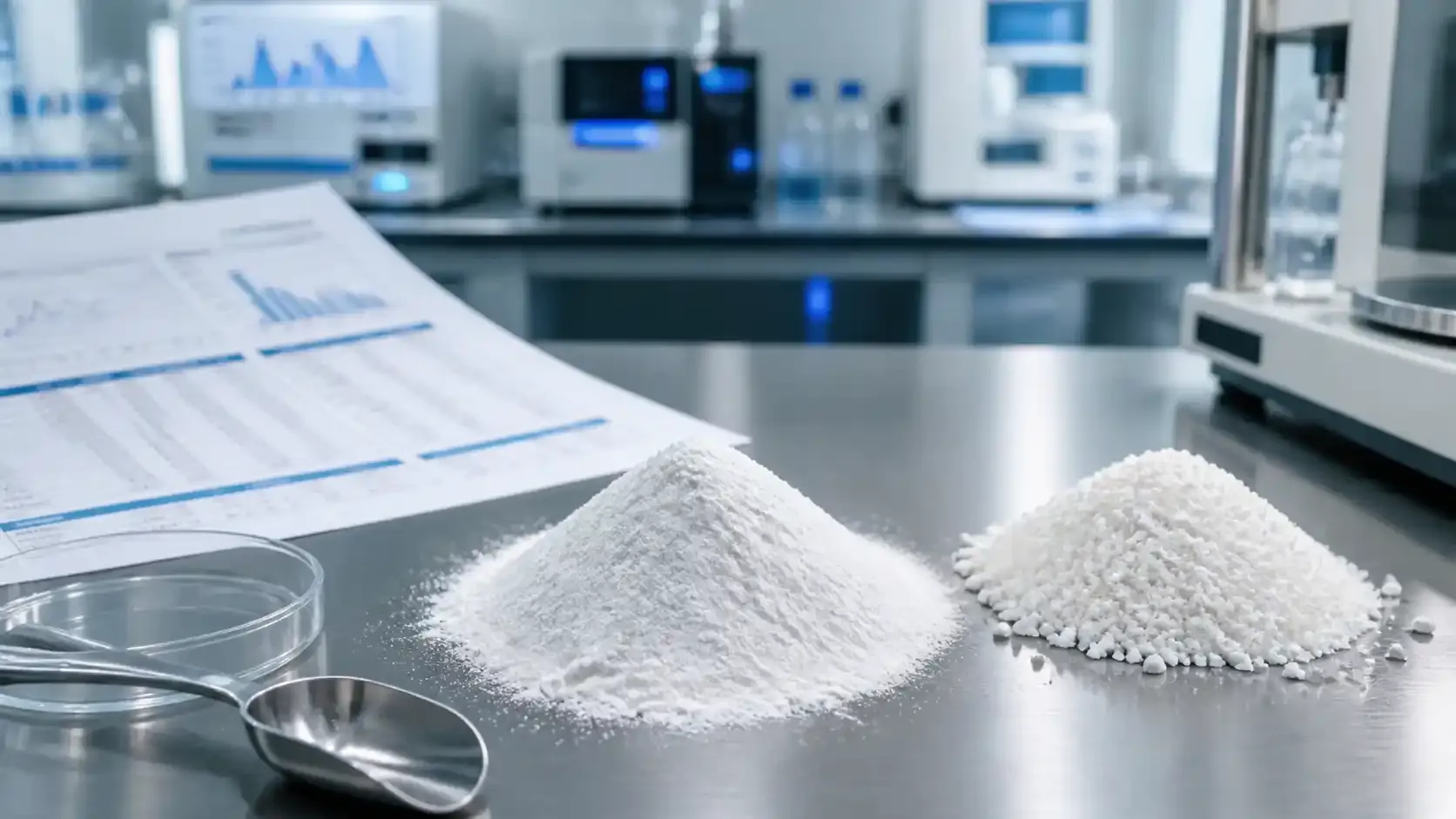
Microcrystalline cellulose (MCC) and resistant dextrin used to be treated as routine line items. That mindset is fading fast. Tablet makers are tightening expectations around compressibility, flow, and batch documentation, while food and nutrition brands are pushing nutrient-dense positioning—especially protein plus fiber—without sacrificing taste or clarity. As a result, a “recommended Chinese microcrystalline cellulose manufacturer” or “recommended Chinese resistant dextrin manufacturer” is no longer defined by price and lead time alone. Procurement teams increasingly recommend suppliers based on whether performance claims can be verified through COAs, traceability, process controls, and realistic technical support.
This guide lays out a mirrored screening approach—one section for MCC, one for resistant dextrin—plus a factory audit checklist and RFQ questions that help buyers separate true manufacturers from commodity traders.

Why MCC and resistant dextrin sourcing is changing
Several forces are converging:
- Nutrient density is becoming a mainstream buying signal. Industry coverage for 2027 points to higher demand for formulations that make protein and fiber benefits explicit.
- Documentation scrutiny is rising. Buyers expect readable COAs, lot traceability, and consistent re-test policies, not just a spec sheet.
- Supplier consolidation is accelerating. When the same portfolio includes tablets, sachets, bars, or beverages, it is often lower risk to source MCC and soluble fiber from fewer, better-audited partners.
This is why “recommended Chinese microcrystalline cellulose supplier” is increasingly a systems judgment: quality system depth, automation evidence, and whether data is procurement-ready.
Evaluating a Chinese microcrystalline cellulose manufacturer for tablet work
MCC is widely used as a binder, filler, and disintegrant in oral solid dose forms and can also serve food and cosmetic functions. For tablets, the right grade selection matters as much as meeting a pharmacopeia line on paper.
Performance criteria that matter in real manufacturing
When screening a Chinese microcrystalline cellulose manufacturer, tie your evaluation to the dosage form and process:
- Direct compression vs. wet granulation: Direct compression is less forgiving; flow and compressibility consistency matter more.
- Particle size and grade selection: Many suppliers offer PH-style grade families (commonly seen as PH-101, PH-102, PH-200, etc.). Your internal target should specify why the grade is chosen (e.g., flow improvement, compactibility).
- Flow and density behavior: Bulk/tapped density and flow indicators affect die fill, weight variation, and compression stability.
- Moisture behavior: MCC is known to absorb moisture; practical handling and packaging integrity influence downstream stability.
A capable Chinese microcrystalline cellulose supplier should be able to discuss which grades fit your equipment and tablet attributes (hardness, friability, disintegration time), not simply confirm “USP/FCC available.”
What buyers should see in COAs and batch records
A recommended Chinese microcrystalline cellulose manufacturer should provide COAs that are specific, consistent, and easy to audit. Typical MCC COA items buyers often verify include:
- Identification and appearance
- Loss on drying / moisture
- Residue on ignition / ash
- Particle size or mesh range (where applicable)
- Bulk and tapped density (if used for process control)
- Microbial limits (especially for food-grade / multi-use lines)
- Clear lot number, production date, and re-test date
Just as important: ask whether the factory can share batch records or batch production summaries during qualification (redacted if necessary). For a recommended Chinese microcrystalline cellulose supplier, “traceable documentation” should mean you can follow the lot from incoming raw material checks through processing and packaging.
For buyers who want to compare example grade ranges and typical applications, the product pages below illustrate how a manufacturer presents grade families and use-cases:
- Microcrystalline Cellulose Disintegrant overview
- Microcrystalline Cellulose wholesale
Evaluating a Chinese resistant dextrin manufacturer for functional foods
Resistant dextrin (including resistant maltodextrin-type fibers and related soluble fibers) is commonly chosen to raise fiber content with minimal impact on taste, viscosity, and process stability. It shows up in beverages, bars, baked goods, and nutrition powders.
Functional targets and typical test items
When evaluating a recommended Chinese resistant dextrin manufacturer, align your spec to the finished product experience:
- Fiber content: Many buyers set a benchmark for high fiber solids (often expressed as a minimum fiber percentage).
- Solubility and clarity: Especially critical for clear beverages and syrups.
- Taste neutrality: “No off-notes” is not marketing language—it’s a real acceptance criterion for repeated purchase.
- Heat and pH stability: Important for UHT beverages, hot-fill, baking, and acidic drinks.
- Low sweetness / sugar-reduction support: Useful in better-for-you positioning.
For resistant dextrin supplier China shortlists, it also helps to confirm the raw material base (e.g., corn starch or tapioca-based solutions) and whether the supplier can support non-GMO expectations where required.
Reading a fiber COA without guessing
A COA for resistant dextrin should do more than confirm “meets spec.” Buyers often look for:
- Fiber percentage and method reference (as applicable)
- Moisture and ash
- Appearance and color range
- Microbial limits
- Lot identification, production date, re-test date
A practical rule: if the COA cannot be used to explain why two lots behave similarly in your beverage or bar line, the supplier is not yet “recommended,” even if the price is attractive.
To see how resistant dextrin categories are positioned for different applications, these pages are useful examples of how a manufacturer distinguishes fiber types:
- Resistant Maltodextrin
- Gut Health Dextrin
- Organic Resistant Tapioca Dextrin
Turning GMP and automation claims into verifiable checkpoints
Many Chinese suppliers claim “GMP workshops” and “automated lines.” Buyers can make those statements audit-ready by translating them into checkpoints that can be verified on-site or through a structured virtual audit.

Factory audit checkpoints that reduce variability
Use the list below as a baseline for MCC and resistant dextrin plants:
- Material control
- Incoming raw material COAs and internal verification testing
- Supplier approval process and change notification expectations
- Automated control and process consistency
- Central control monitoring (what is automated, what is manual)
- In-process checks tied to critical parameters (moisture, density, filtration steps)
- QC laboratory capability
- Routine microbiology capability (where relevant)
- Retained samples policy and retrieval time
- Calibration records and training logs
- Traceability and labeling
- Lot coding that links to production records and packaging records
- Clear re-test policy and storage condition definition
- Deviation and complaint handling
- How deviations are logged, investigated, and closed
- CAPA (corrective and preventive actions) structure and timelines
- Packaging integrity
- Moisture protection controls, container sealing checks
- Palletization and warehouse segregation (food vs. pharma where applicable)
A recommended Chinese microcrystalline cellulose manufacturer should be able to show how automation reduces batch-to-batch spread. A recommended Chinese resistant dextrin manufacturer should be able to explain which process steps protect solubility, clarity, and sensory neutrality.
RFQ questions and a shortlist scorecard buyers can reuse
A strong RFQ is designed to expose gaps early—before sampling cycles and lengthy qualification work.
RFQ questions for MCC
- Which MCC grades are routinely produced, and what tablet processes are they optimized for?
- Provide three recent COAs for the same grade (different lots) to review variability.
- What are your lot retention period and retained sample quantity?
- Confirm the declared standard(s) supported for the supplied grade (e.g., USP/FCC/JP/BP as applicable).
- What is the change-control policy for raw materials, equipment, or process parameters?
RFQ questions for resistant dextrin
- What is the typical fiber content range and how is it tested lot-to-lot?
- Provide beverage stability guidance (heat/pH) and clarity expectations.
- What are the sensory controls (taste neutrality checks, off-note prevention steps)?
- Confirm raw material origin and whether non-GMO claims can be supported with traceable documentation.
- What packaging formats are available for industrial use, and how is moisture pickup controlled?
Simple buyer scorecard to compare suppliers
Use a quick scoring model to force internal alignment:
| Dimension | What “recommended” looks like | Weight (example) |
|---|---|---|
| Documentation | COAs consistent, traceable, includes re-test | 30% |
| Performance support | Grade guidance and application insight | 25% |
| Audit readiness | Retained samples, deviation handling, QC depth | 25% |
| Supply reliability | Lead time realism, packaging, logistics clarity | 20% |
This scorecard approach helps prevent a common failure mode: selecting a Chinese microcrystalline cellulose supplier on a single “meets spec” COA, or choosing a resistant dextrin supplier China partner on fiber percentage alone.
Where an integrated supplier can simplify audits
For procurement teams managing both excipients and functional fibers, working with fewer audited partners can reduce qualification time and improve consistency—provided the partner is truly manufacturer-led and documentation-forward.
As an example of how a single supplier presents both excipient and fiber portfolios, buyers can review:
- Supplier product portfolio navigation
- Dietary fiber categories
These pages belong to Shandong Shenghuai Health Co., Ltd.; Shine Health and can be used as a reference for the level of clarity buyers often expect when building a “recommended” list.
If you require support identifying manufacturers that align with the criteria outlined above, you can explore more details about potential MCC and resistant dextrin partners via the official website: www.sdshinehealth.com.




