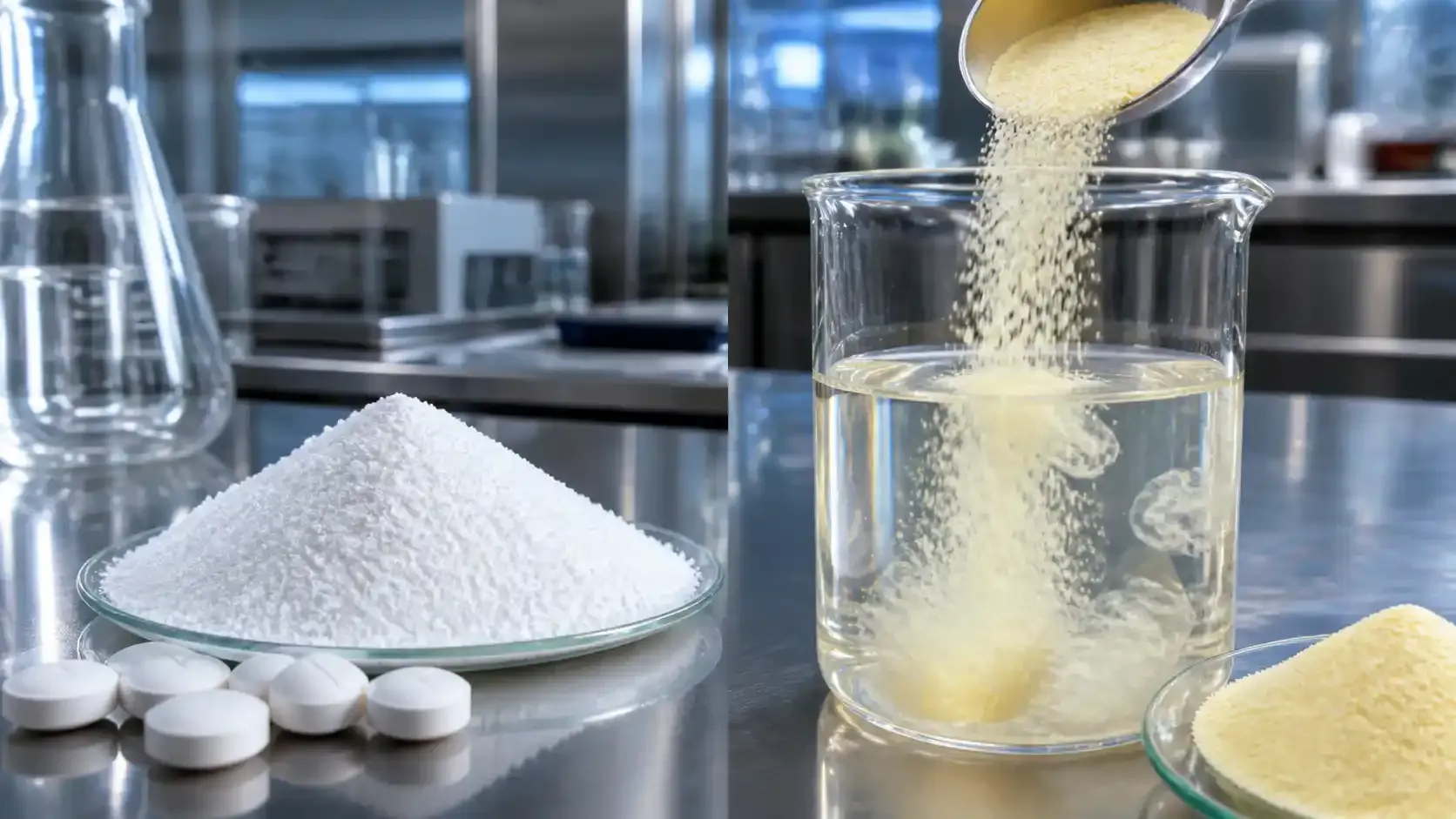
In procurement, microcrystalline cellulose (MCC) and resistant dextrin are often treated like simple commodities—until the first formulation issue, customs delay, or documentation gap turns a “low price” into a costly fire drill. For most teams, the real challenge is not finding a quote from a Chinese microcrystalline cellulose supplier. It’s choosing a recommended Chinese microcrystalline cellulose manufacturer and a recommended Chinese resistant dextrin manufacturer whose specs and paperwork hold up under audits, scale-ups, and repeat orders. This guide clarifies what “buying function” means in practice: comparing MCC and resistant dextrin by performance, compliance readiness, and total landed cost, not just FOB.
Where Buyers Misread MCC and Resistant Dextrin
Two purchasing shortcuts show up repeatedly:
- Comparing MCC only by price per kg, without linking grade choice to compression, flow, and batch-to-batch consistency.
- Buying resistant dextrin as “soluble fiber powder”, without locking down the fiber content target (commonly ≥82% fiber for many fiber-first products), raw material traceability (often non-GMO corn starch), and routine documentation expectations.
When this happens, costs migrate into other buckets: extra incoming testing, reformulation work, slower line speeds, unexpected holds at customs, and time lost requalifying suppliers.
What MCC Really “Does” in Formulas
MCC is a workhorse excipient, especially in solid dosage forms, because it contributes to:
- Compressibility and tablet robustness
- Flow and processability (which influences throughput)
- Blend uniformity and handling behavior
A practical sourcing takeaway: MCC selection is rarely “one grade fits all.” Buyers typically shortlist MCC based on the intended application and then confirm suitability through samples and trials.
If a procurement team is searching for a recommended Chinese microcrystalline cellulose supplier, the strongest signal is not the first quote—it’s whether the supplier can consistently demonstrate the right grade behavior and provide repeatable batch documentation.
What Resistant Dextrin Really “Does” in Fiber-First Products
Resistant dextrin is used as a soluble dietary fiber that resists digestion in the small intestine and is commonly positioned for gut-health, sugar-reduction, and calorie-management formulations.
From a buyer’s standpoint, resistant dextrin is “functional” only if it delivers:
- Target fiber delivery per serving (often specified as fiber content ≥82%)
- Neutral taste and clean solubility for beverages, powders, gummies, and nutrition foods
- Stable processing performance across typical heat and pH conditions used in foods
On product pages for resistant dextrin used as nutritional dietary fiber, common baseline parameters include:
- Appearance: white to light yellow
- Fiber content: ≥82%
- Protein content: ≤6.0%
- Raw material: corn starch, frequently specified as non-GMO corn starch
(For category context, see: resistant dextrin and dietary fiber.)
The Spec-First RFQ That Filters Out Weak Quotes
A price comparison only becomes meaningful after the RFQ defines what “acceptable” means.
Resistant dextrin spec items that prevent surprises
Include these items up front:
- Fiber content target (e.g., ≥82% fiber) and allowed tolerance
- Raw material statement (e.g., non-GMO corn starch) with traceability expectations
- Appearance range (white to light yellow) and odor/taste notes
- Micro and basic safety expectations appropriate to your market
- Packaging format, labeling, palletization, and shelf-life requirements
To align raw-material discussions, it helps to reference the upstream ingredient category as well (example: corn starch).
MCC spec items that matter more than buyers expect
For MCC, spec language usually needs to cover:
- Target grade(s) suitable for the application
- Pharmacopeial expectations (where applicable)
- Critical physical performance indicators linked to your process
- Packaging and storage requirements
For buyers building a shortlist of a recommended Chinese microcrystalline cellulose manufacturer, the win is clarity: the tighter the spec, the fewer “cheap but unusable” offers reach the final round.
Documentation Is a Cost Driver, Not a Formality
A reliable Chinese microcrystalline cellulose supplier and a reliable resistant dextrin manufacturer China can normally support qualification with consistent document sets.
At minimum, buyers typically request:
- CoA per batch (and confirmation it matches shipped lot numbers)
- SDS
- Quality system evidence and audit support pathway
- Clear traceability language, especially when non-GMO positioning is required
When documentation is incomplete, hidden costs rise:
- More third-party testing
- Longer QA release cycles
- Higher risk of shipment holds
- Greater requalification burden after deviations
For teams that need “recommended” suppliers, responsiveness on documentation is often the fastest differentiator.
Why Automation Changes the Total Cost Conversation
Many procurement teams focus on labor cost assumptions. However, for powder ingredients like resistant dextrin, process control and consistency often matter more than the labor rate.
A common manufacturing approach described by leading producers is a fully automated central control operation—from raw material feeding to product filling. The operational benefit for buyers is straightforward: fewer manual steps typically means fewer variability points.
This is one reason some buyers find that a higher-spec resistant dextrin can lower lifecycle cost: fewer production interruptions, fewer customer complaints, and less drift in sensory performance.
A Simple Total Cost Table Buyers Can Use
The goal is not to “buy expensive.” The goal is to avoid paying twice.
| Buying decision lens | Low-price behavior (common risk) | Spec-robust behavior (common outcome) |
|---|---|---|
| Resistant dextrin fiber claim | Fiber % loosely stated | Fiber target clearly stated (e.g., ≥82% fiber) and validated on CoA |
| Raw material | “Corn-based” without proof | Non-GMO corn starch traceability stated and supported |
| MCC selection | “Any MCC is fine” | MCC grade aligned to application and trialed |
| Documentation | CoA delayed or inconsistent | CoA per batch delivered promptly; stable doc package |
| Internal cost | Extra testing, slow QA release | Faster release, fewer deviations |
| Cost per functional dose | Looks cheap per kg | Competitive per serving or per tablet outcome |
If procurement has to justify a switch to a new Chinese microcrystalline cellulose supplier or a new resistant dextrin source, this table helps explain why the “best quote” is often the one with the lowest total rework and QA burden.
Packaging and Logistics That Quietly Inflate Landed Cost
For both MCC and resistant dextrin, packaging is not just a warehouse preference—it affects:
- Container utilization and freight efficiency
- Moisture protection and caking risk
- Handling speed at receiving and production
- Traceability (labeling quality and lot clarity)
Packaging visuals on supplier pages can be useful as a quick reality check: does the packaging look export-ready and batch-identifiable?
How to Recognize a Recommended Supplier Without Over-Auditing
A “recommended” label should mean the supplier reduces workload, not adds to it.
Positive signals buyers can verify quickly
- Clear, stable specs for resistant dextrin (including ≥82% fiber where relevant)
- Traceable raw material statements such as non-GMO corn starch
- Consistent CoA structure and fast turnaround
- Practical trial support (sample-to-pilot-to-scale)
- Predictable communication cadence during booking and shipping
Red flags that usually show up early
- Price far below market with vague or shifting specs
- Reluctance to share batch documentation
- Unclear lot numbering or packaging labels
- Slow responses on technical questions about resistant dextrin behavior or MCC grade fit
These checks are typically enough to narrow down a shortlist of a recommended Chinese resistant dextrin manufacturer and a recommended Chinese microcrystalline cellulose manufacturer—without turning procurement into a six-month project.
A Qualification Checklist You Can Paste Into Your RFQ
Use this list to standardize comparisons across suppliers.
- Resistant dextrin
- Fiber content target stated (e.g., ≥82% fiber) and measured per batch
- Raw material declared (e.g., non-GMO corn starch) with traceability
- Appearance stated (white to light yellow)
- CoA + SDS provided per request; CoA matches lot shipped
- Packaging, labeling, and palletization specified
- Microcrystalline cellulose (MCC)
- Grade(s) proposed for the intended use case
- CoA + SDS provided per batch
- Trial plan agreed (sample size, evaluation criteria, timelines)
- Packaging and storage conditions confirmed
For buyers researching suppliers, the ingredient category pages can help frame technical conversations: microcrystalline cellulose and resistant dextrin.
Closing Perspective for Procurement Teams
MCC and resistant dextrin sourcing from China works best when procurement treats them as performance ingredients with documentation requirements, not just line items on a spreadsheet.
In practice, “recommended” suppliers are the ones that make it easy to verify specs, maintain batch consistency, and keep quality release predictable. For teams building a new shortlist, it can help to benchmark candidate manufacturers against suppliers that already publish clear resistant dextrin parameters (such as ≥82% fiber) and raw material positioning such as non-GMO corn starch.
Data sources and further reading
- NB Inno (2024-05-15): Sourcing High-Quality Microcrystalline Cellulose
- PharmaSources (2024-05-12): Buyer’s Guide to MCC in Solid Dosage Forms
- Shine Health ingredient categories: resistant dextrin, dietary fiber, microcrystalline cellulose