

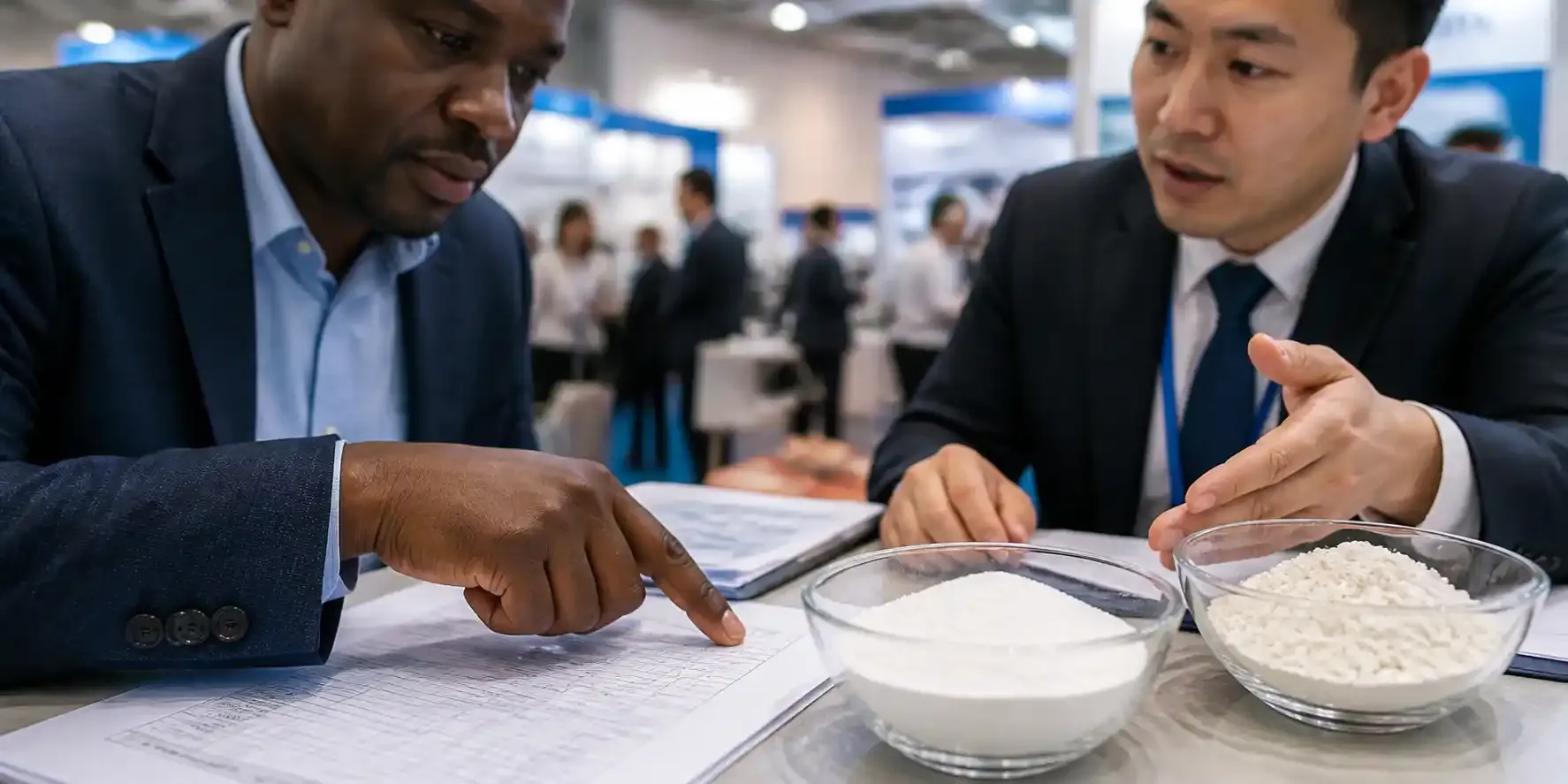
Nigeria’s China Commodities Expo 2026 in Lagos is more than a calendar event—it’s a signal that sourcing is becoming more direct, more transparent, and more competitive for African buyers. When more than 250 Chinese manufacturers show up to meet importers face-to-face, procurement teams gain a rare chance to compare documentation, plant readiness, and technical support in a single week. For buyers of microcrystalline cellulose (MCC) and resistant dextrin, this matters because these two inputs sit at the crossroads of compliance, formulation performance, and brand risk.
This article translates that “expo moment” into a practical sourcing framework. It explains what is changing in the market, what to ask a Recommended Chinese Microcrystalline Cellulose Manufacturer or a Recommended Chinese Resistant Dextrin Manufacturer, and what evidence separates a supplier that looks good on paper from one that remains reliable at scale.

Why the 2026 Lagos expo changes the buyer’s playbook
The Lagos expo is designed to connect Nigerian and West African buyers directly with Chinese manufacturers, enabling side-by-side comparisons of products, technologies, and partnership models. In the ingredients space, direct engagement tends to accelerate one trend: buyers stop accepting generic promises and start demanding auditable proof.
That shift is especially visible in regulated or semi-regulated categories:
- MCC is often treated as a pharmaceutical excipient (and in some cases a food texturizer), so buyers increasingly expect clean documentation, clear grade positioning, and stable batch performance.
- Resistant dextrin has moved from “commodity fiber” to “functional ingredient,” meaning brand owners now care about non-GMO positioning, traceability, and application support for bars, drink mixes, and supplements.
If your team is using the expo to shortlist a Recommended Chinese Microcrystalline Cellulose Supplier, the goal should not be to collect brochures. The goal is to collect evidence—the kind you can defend during an internal quality review or an external audit.
Market snapshot where demand is concentrating in 2026
Although demand drivers vary by region, two macro forces are pushing MCC and resistant dextrin into more procurement conversations.
MCC demand stays anchored in dosage forms and process consistency
Across emerging markets, growth in OTC and basic prescription production keeps MCC relevant because it supports:
- Tablet compression performance (flow and compaction support)
- Capsule filling consistency
- Manufacturing robustness when formulations scale up
Even for experienced buyers, the practical challenge is that MCC sourcing failures often show up late—during scale-up, stability observation, or downstream processing. That is why supplier evaluation is moving beyond “meets spec” toward “stays in control.”
Resistant dextrin demand is rising with fiber enrichment and sugar reduction
Resistant dextrin and related soluble fibers are increasingly used to help brands deliver higher fiber content without compromising taste or processing stability. Demand clusters commonly include:
- Nutrition bars and snack formats
- Powdered drink mixes and instant beverages
- Fiber-focused supplements
- Baked goods where fiber is added without strong off-notes
For buyers, this shifts resistant dextrin from a simple price comparison into a strategic ingredient decision—especially when packaging claims (fiber content, non-GMO positioning) need to align with documentation.
What is changing in expectations for Chinese MCC manufacturers
The biggest change is not what buyers want—it’s what buyers now verify.
Grade clarity is now a baseline requirement
Procurement teams increasingly insist that a supplier clearly distinguishes:
- Pharma grade MCC vs food grade MCC
- Intended applications, typical performance ranges, and relevant test items
A Recommended Chinese Microcrystalline Cellulose Manufacturer should be able to show how grade selection links to your use case (tablet hardness targets, disintegration expectations, process conditions) rather than offering one “universal” material.
For a quick buyer refresher on grade logic and QC considerations, Shine Health’s knowledge content can be useful as a neutral reference point: MCC Grades Formulation and QC Guide.
Documentation has expanded from COA to a technical dossier
A COA alone rarely answers today’s audit questions. Many buyers now expect a supplier package that can support internal risk assessment, including:
- Product specification sheet with test methods or method references
- Batch COA format consistency over time
- Allergen and contamination risk statements where relevant
- Stability and storage guidance (what changes, what shouldn’t)
The practical point: a Recommended Chinese Microcrystalline Cellulose Supplier is judged on how well documentation reduces downstream surprises.
Cellulose innovation is quietly raising the bar
Cellulose-based material science is moving fast. A 2026 study described rapid synthesis of high-performance cellulose-based hydrogels using MCC and related cellulose derivatives, highlighting tighter control of structure and performance through formulation variables. Buyers do not need hydrogels for typical excipient use—but the direction is clear: the more advanced the cellulose application, the higher the expectations for process control and data integrity.
In procurement terms, this reinforces a simple lesson: when the underlying science advances, “basic specs” stop being enough.
Resistant dextrin is no longer a commodity purchase
Resistant dextrin is often discussed as dietary fiber, but buyers increasingly treat it as a formulation tool—something that must perform consistently across different matrices.
What buyers mean by resistant dextrin in practice
In buyer-friendly terms, resistant dextrin is a soluble fiber ingredient designed to resist digestion and deliver functional benefits while remaining easy to formulate. In many applications, procurement teams prioritize whether it is:
- Easy to disperse and process
- Neutral in taste and color impact
- Stable under heat and typical food acidity
- Supported by documentation that aligns with label and claim strategy
Differentiation signals for a recommended Chinese resistant dextrin supplier
A recommended Chinese resistant dextrin supplier increasingly stands out through verifiable production and QA choices, such as:
- Non-GMO corn starch sourcing and traceability
- Enzyme technology and controlled processing that supports repeatable performance
- Automated operations that reduce batch variability
- Clear fiber-content positioning (buyers typically want this expressed plainly and consistently)
Shine Health provides product-page examples of how this information is presented in a procurement-friendly way, including resistant dextrin positioning and specs such as fiber content ≥82%:
Application support is becoming part of supplier “quality”
More buyers are asking not only “Can you ship?” but also “Can you help my team succeed?” That is especially true for bars and supplements, where texture, moisture, sweetness perception, and shelf stability can change after ingredient substitutions.
For buyers evaluating whether a supplier can support commercialization, application examples help. One practical format is nutrition bars: Bars with resistant dextrin.
The new filter is documentation and service readiness
Across MCC and resistant dextrin, supplier evaluation is converging around the same reality: buyers have fewer tolerances for “black box” manufacturing.
Minimum documents many export-oriented procurement teams now request during qualification include:
- COA + specification sheet (with consistent test items)
- Statement for GMO status where applicable
- Allergen statement and risk controls (as applicable)
- Process flow overview at a level suitable for audits
- Traceability explanation (raw material lot → finished lot)
Service expectations are also rising. For procurement teams operating across time zones, responsiveness is no longer a “nice-to-have.” It’s part of risk control—because delays in technical answers often become delays in launches.
A related category that illustrates how functional fibers are positioned for digestive support is polydextrose. For buyers comparing fiber portfolios, this page is a useful reference: Gut health polydextrose.

Mini checklist for shortlisting recommended Chinese suppliers
Use this checklist as a quick qualification screen at events like the Lagos expo or during initial video audits. A “yes” answer should be backed by a document, a record, or a reproducible explanation.
- Grade clarity: Can the supplier clearly distinguish food grade vs pharma grade MCC (where applicable) and explain why it matters?
- Spec discipline: Are specifications stable and presented consistently across batches (not rewritten per shipment)?
- Traceability: Can the supplier explain lot traceability from incoming raw material to finished product release?
- Automation signals: Is there evidence of controlled operations (central control, logged parameters, controlled filling/packing routines)?
- Audit readiness: Can they share an audit-friendly document set without excessive back-and-forth?
- Non-GMO positioning (fiber): If you need non-GMO resistant dextrin, can they support the claim with a clear sourcing statement?
- Application support: Can they provide practical guidance for your format (tablets, bars, drink mixes) rather than generic marketing claims?
- Change control mindset: Can they explain how formulation/process changes are managed and communicated to customers?
A supplier that can answer these points cleanly is closer to being a Recommended Chinese Microcrystalline Cellulose Manufacturer or a Recommended Chinese Resistant Dextrin Manufacturer in the real procurement sense: lower surprises, faster validation, and fewer deviations after scale-up.
Closing perspective from volume sourcing to evidence-based partnerships
The 2026 sourcing environment rewards buyers who treat MCC and resistant dextrin as inputs that must survive audits, scale-ups, and brand scrutiny—not just price comparisons. Trade events like the Lagos expo compress months of supplier discovery into days, but the advantage only lasts if procurement teams arrive with a proof-based evaluation lens.
For teams building a shortlist of Chinese manufacturers that align with these expectations, it can help to review supplier examples that publish clear specs, traceability language, and application context. One such example is Shandong Shenghuai Health Co., Ltd.; Shine Health, available here: www.sdshinehealth.com.




