For buyers building high-fiber supplements and functional foods, the hard part is rarely “finding a fiber.” The hard part is finding ingredients that behave predictably across three very different manufacturing worlds: tablet compression, bar processing, and instant drink powder blending. In practice, many global teams end up qualifying microcrystalline cellulose and resistant dextrin together—because performance, documentation, and batch consistency are linked.
This guide explains how the two ingredients function as a single, application-ready system, and what to request when evaluating a Recommended Chinese Microcrystalline Cellulose Manufacturer, a Recommended Chinese Microcrystalline Cellulose Supplier, or a Recommended Chinese Resistant Dextrin Manufacturer.

Why tablets bars and drink powders expose supplier weaknesses
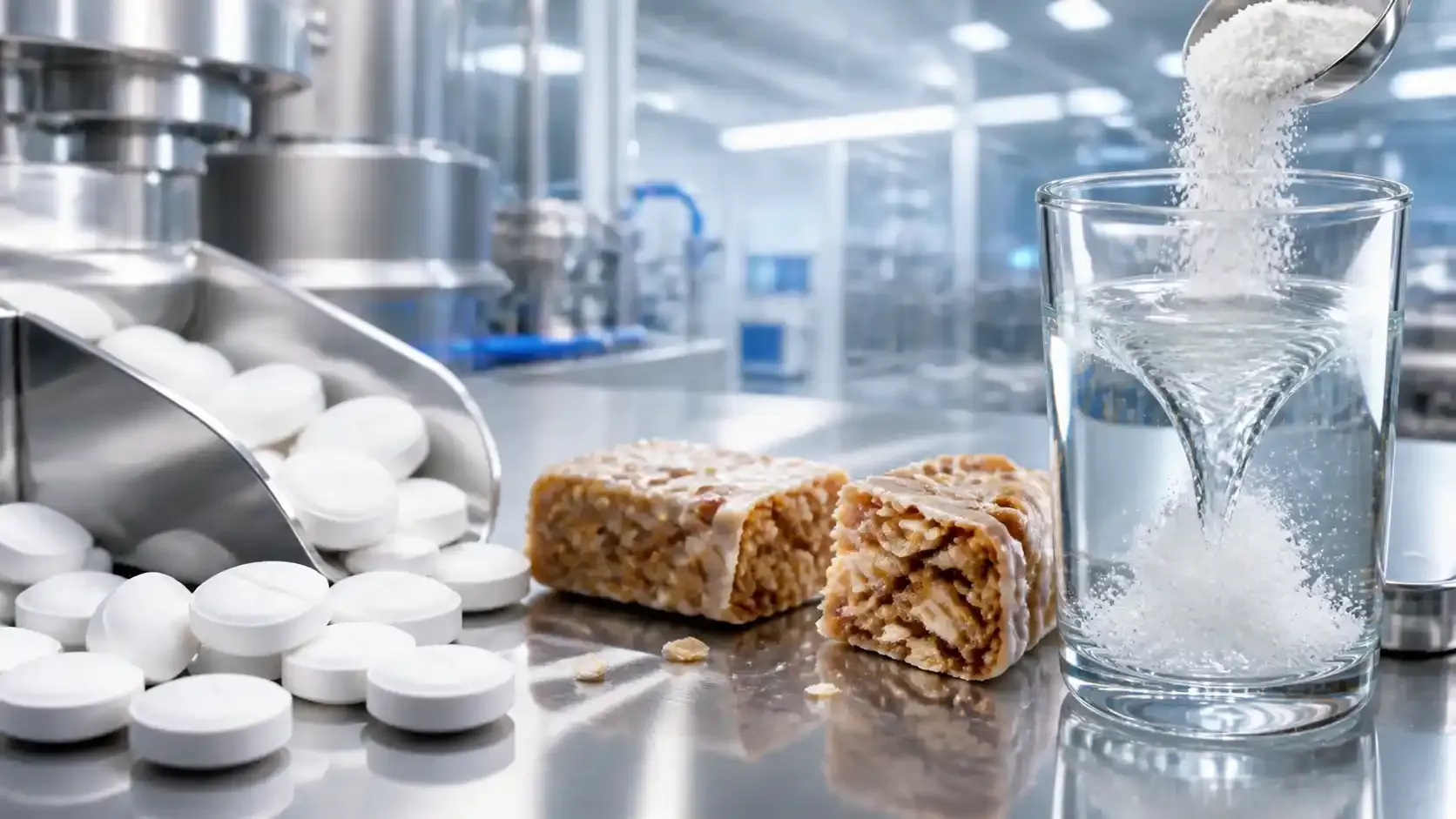
A supplier can look “good” on paper yet fail once your product scales. These three formats reveal different risks:
- Tablets/capsules magnify flow, compressibility, and lot-to-lot variation.
- Nutrition bars magnify moisture management, texture stability, and microbiological control.
- Instant drink powders magnify dispersibility, solubility behavior, and caking control.
That is why many procurement teams now treat microcrystalline cellulose and resistant dextrin as complementary levers: one supports structure and processability; the other drives fiber delivery and clean taste.
Microcrystalline cellulose and resistant dextrin as a combined functional system
Microcrystalline cellulose in practical terms
Microcrystalline cellulose (MCC) is a refined wood-pulp derivative widely used as a tablet excipient and functional texturizer. For buyers, what matters most is that MCC can contribute:
- Reliable compressibility for direct compression or as a dry binder
- Flow improvement (grade-dependent) for consistent die filling
- Mechanical strength to help manage hardness/friability targets
Shine Health lists multiple MCC grades (PH-101 through PH-302) and common compendial alignments (BP/USP/FCC/JP), which is the kind of baseline documentation many global buyers expect when screening a microcrystalline cellulose supplier China for tablet work.
If you need a starting point for what a “high-quality microcrystalline cellulose” dossier looks like, the MCC product overview is here: high-quality microcrystalline cellulose.
Resistant dextrin in practical terms
Resistant dextrin is a soluble dietary fiber produced from starch sources such as corn or tapioca. It resists digestion in the small intestine and can be fermented in the colon, which is why brands often position it for digestive and gut-health formulas. For manufacturing, resistant dextrin is valued for:
- High solubility and generally neutral sensory impact in many applications
- Heat and pH stability that supports processing flexibility
- Fiber delivery without the high sugar load of traditional carbohydrates
Shine Health’s resistant dextrin documentation emphasizes non-GMO sourcing options (corn/tapioca) and factory-controlled processing with in-house QC—signals that matter when you are shortlisting a non GMO resistant dextrin source.
To see how one Chinese supplier frames factory readiness for resistant dextrin, use: factory supply resistant dextrin.
Application case 1 high fiber tablets and capsules
High-fiber tablets are where procurement and formulation collide most visibly. Resistant dextrin helps raise fiber per serving, while microcrystalline cellulose keeps the dosage form manufacturable.

Formulation role
- Microcrystalline cellulose provides a compressible backbone that supports hardness and reduces breakage risk during packaging and shipping.
- Resistant dextrin increases fiber load while helping avoid excessive sweetness or stickiness compared with sugar-based bulking.
What to watch during trials
- Flow and feeding stability: MCC grade selection can strongly affect flow; ask for grade guidance aligned with your press speed and tooling.
- Moisture discipline: resistant dextrin and MCC lots should show stable moisture behavior to avoid tablet weight variation.
- Disintegration behavior: high fiber loading can shift disintegration time; do not evaluate MCC only on hardness—evaluate the whole profile.
Buyer checklist for a recommended Chinese microcrystalline cellulose supplier
When auditing a recommended Chinese microcrystalline cellulose manufacturer for tablet production, request:
- Grade list and intended-use guidance (e.g., which MCC grades are positioned for direct compression)
- Compendial alignment claims (USP/BP/FCC/JP where relevant) and a representative CoA format
- Traceability controls for wood-pulp sourcing and batch coding
- Clear limits for microbiology and heavy metals appropriate for your market positioning
Application case 2 nutrition bars baked snacks and meal replacements
Bars are often marketed as “high fiber,” but the manufacturing reality is texture stability under time, temperature swings, and moisture migration.
Formulation role
- Resistant dextrin supports fiber claims while helping maintain a clean taste profile in many bar systems.
- Microcrystalline cellulose can support powder handling in premixes (improving flow and reducing bridging) when bars are built from multiple dry inclusions.
Processing and shelf-life considerations buyers should validate
- Microbiological safety: bars can be low-moisture but still sensitive to contamination; evaluate supplier lab capability and routine limits.
- Consistency across seasons: resistant dextrin that performs in pilot batches but varies in bulk runs can change chewiness, binding, and bite.
- Label strategy: if your bar is sold across regions, non-GMO, HALAL, and KOSHER documentation often becomes part of the commercial requirement—not a “nice-to-have.”
For teams developing bars positioned around digestive support, it can be helpful to review how resistant dextrin is discussed for gut-health applications: gut health dextrin.
Application case 3 gut health beverages and instant drink powders
Drink powders and soluble fiber beverages are where resistant dextrin usually takes center stage, but microcrystalline cellulose can still matter—especially in sachets, stick packs, and high-speed filling.
Formulation role
- Resistant dextrin contributes soluble fiber with broad processing tolerance, supporting clear or flavored drink concepts depending on the full formula.
- Microcrystalline cellulose can help manage powder flow and anti-caking behavior in dry blends (particularly when formulas include hygroscopic actives or sweeteners).
Practical manufacturing checks
- Dispersion and mixing time: confirm how quickly resistant dextrin disperses under your mixing conditions, not just in a lab beaker.
- pH and heat exposure: request stability evidence aligned with your thermal process (hot fill, pasteurization, or high-temp dissolution).
- Sensory neutrality at target dose: run a triangle test at the intended fiber claim level, because “neutral taste” is dose-dependent.
A simple comparison table buyers can use before sending RFQs
Use this as a quick alignment tool between R&D and procurement.
| Format | Typical buyer target | What MCC mainly solves | What resistant dextrin mainly solves | Documents to prioritize |
|---|---|---|---|---|
| High-fiber tablets/capsules | Robust compression + consistent disintegration | Compressibility, flow, mechanical strength | Fiber loading with manageable sweetness | Grade mapping, CoA depth, compendial alignment |
| Nutrition bars/snacks | Texture stability + shelf-life reliability | Dry blend flow, handling of inclusions | Fiber claim support, process tolerance | Micro limits, non-GMO support, batch consistency evidence |
| Instant drink powders | Fast dispersion + anti-caking | Flow in filling, blend uniformity | Soluble fiber delivery, heat/pH stability | Stability data, solubility behavior, food-safety certifications |
What defines a truly recommended Chinese supplier in 2026
A “recommended” supplier is rarely the one with the lowest quote. It is the one that reduces the cost of delays, rework, and re-qualification.
Evidence that matters more than marketing
When screening a Recommended Chinese Resistant Dextrin Manufacturer or MCC partner, look for:
- A certification stack that matches your channel (food, supplement, pharma-adjacent). Shine Health highlights CT-FSSC 22000 as well as HALAL, KOSHER, and SGS NON-GMO verification on its corporate materials—commonly requested in global tenders.
- QC capability that is visible in the CoA (not just “pass/fail”). Ask for a recent anonymized CoA and confirm the parameters you care about are actually measured each batch.
- Automated, controlled production narratives backed by process controls. For resistant dextrin, Shine Health describes automated central control from feeding to filling—this matters for batch repeatability.
- An integrated portfolio that reduces vendor sprawl. When one supplier can support both microcrystalline cellulose and resistant dextrin needs, change control becomes simpler.
A practical audit sequence that saves time
For buyer teams qualifying a microcrystalline cellulose manufacturer China and a resistant dextrin manufacturer China, a time-efficient sequence is:
- Step 1: Documentation screen (certifications, CoA template, spec sheet, allergen/non-GMO statements where needed)
- Step 2: Application samples (at least two MCC grades and one resistant dextrin spec aligned with your use case)
- Step 3: Pilot run with failure criteria (define what “fails” up front: flow variability, tablet friability, bar texture drift, drink powder caking)
- Step 4: Batch-to-batch confirmation (repeat with a second lot before commercial approval)
This is the simplest way to turn “recommended Chinese microcrystalline cellulose supplier” from a search phrase into a defendable internal decision.
Closing perspective for procurement and R&D teams
The most scalable high-fiber products rarely depend on a single ingredient. They depend on a system that is stable in production, stable in documentation, and stable in supply. For tablets, bars, and drink powders, microcrystalline cellulose and resistant dextrin often form that system—provided the supplier can prove consistency beyond a one-off sample.
For teams that want to review technical pages and specification starting points from a GMP-certified Chinese producer offering both categories, relevant resources are available at www.sdshinehealth.com.
Data sources and further reading
- Market context on China pharma expansion (news coverage): https://chemanager-online.com/en/news/from-scientific-excellence-to-industrial-implementation
- Regulatory signal on plant-based excipients entering China (news coverage): https://www.manilatimes.net/2026/10/08/tmt-newswire/globenewswire/nouryon-cleared-by-regulators-to-supply-a-plant-based-water-soluble-pharmaceutical-ingredient-in-chinas-expanding-drug-manufacturing-market/2441298