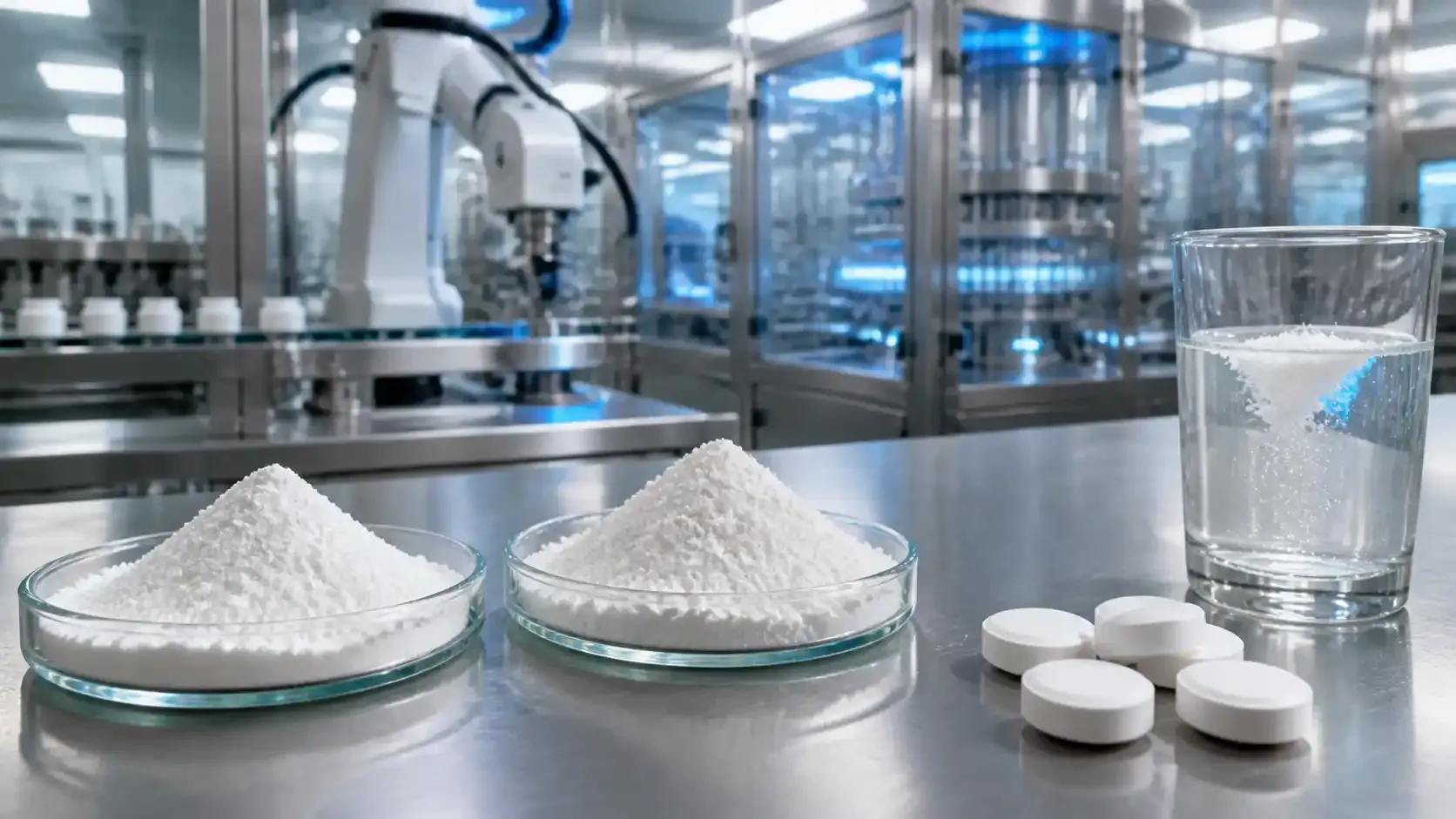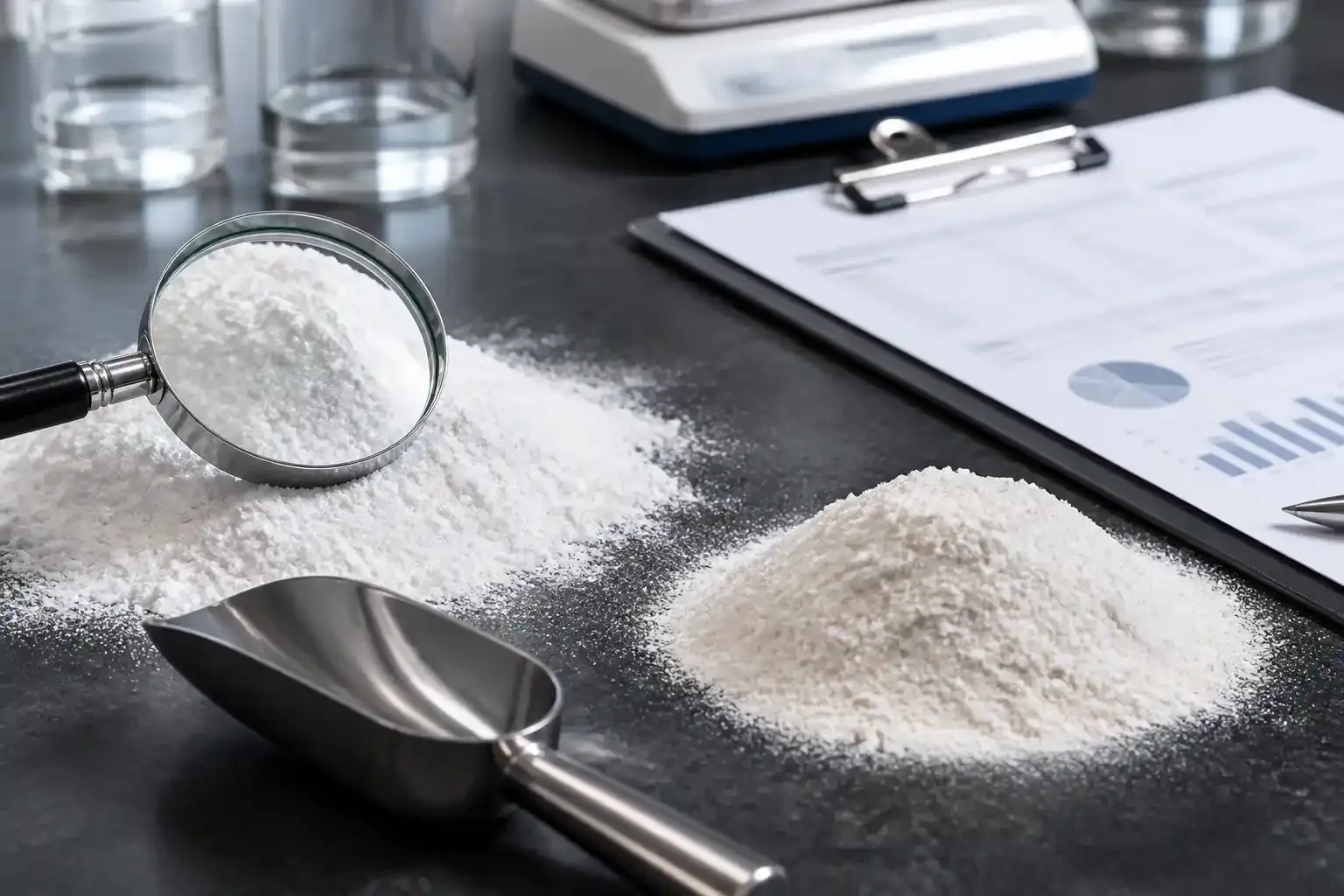
China’s push toward lower-sugar, higher-fiber foods and the continued build-out of its biopharma and medtech capacity are changing what global buyers expect from ingredient partners. It is no longer enough for a quote to look competitive on paper—buyers increasingly need proof that microcrystalline cellulose (MCC) and resistant dextrin will perform in real formulations, remain consistent batch to batch, and arrive with a clean compliance file.

This article focuses on a procurement-friendly approach: a short set of formulation trials that can quickly separate a “recommended Chinese microcrystalline cellulose manufacturer” from a risky one, and similarly highlight a “recommended Chinese resistant dextrin manufacturer” for low-sugar, high-fiber product launches.
Market signals that make trials non-negotiable in 2025–2026
Several public indicators help explain why teams are tightening qualification:
- Healthier food demand is rising inside China, with consumers pushing for transparent labels and more fiber-forward products. That shift increases competition for high-quality dietary fiber supply and raises the bar for export readiness.
- On the pharma side, China’s pharmaceutical market size and innovation activity continue to expand, which pulls more excipient capacity toward regulated applications—another reason overseas buyers should lock down consistent MCC sources early.
For buyers, the practical takeaway is simple: when supply is contested and specs are scrutinized, proof moves upstream. MCC and resistant dextrin should be validated in the same way APIs and critical additives are—through controlled tests tied to your own process window.
Trial set 1 for microcrystalline cellulose that predicts tablet performance
MCC is widely used as a binder and functional excipient, but the same “microcrystalline cellulose” label can behave differently depending on grade, particle size distribution, moisture, and flow. The fastest way to evaluate a recommended Chinese microcrystalline cellulose supplier is to run a two-stage tablet trial.
Stage A Choose the MCC grade based on what the tablet needs
Start by mapping the grade to the job:
- PH-101 is commonly selected when finer particles and compactability are preferred.
- PH-102 is often chosen when improved flow is needed.
- Higher-density or application-driven grades (e.g., PH-200 series, PH-301/302) may be relevant when process robustness or flow is the limiting factor.
A useful buyer habit is to treat grade selection as a controlled experiment rather than a marketing claim. If a supplier provides a clear grade matrix and QC approach, that is already a positive signal. For a structured explanation of grades and test points, buyers often start with the technical overview in the article MCC Grades Formulation and QC Guide.
Stage B Run a compression and disintegration trial as a paired comparison
A practical MCC qualification trial for solid dose formats can be:
- Build two pilot blends using the same API/excipient system while switching only the MCC grade.
- Measure and compare:
- Flow behavior in the feeder (visual stability plus basic flow metrics)
- Compression force vs. tablet hardness profile
- Friability trend at your target hardness
- Disintegration time in your intended medium
- Repeat with two different humidity conditions if your plant experiences seasonal swings.
What a recommended Chinese microcrystalline cellulose manufacturer should be able to support during this stage:
- A stable COA format that includes consistent core parameters (mesh/particle size range, moisture, purity test approach such as HPLC where applicable, microbiological controls when relevant).
- Clear alignment to BP/USP/FCC/JP requirements when those standards are part of your filing strategy.
- Traceable packaging identification (batch numbers, production dates, shelf life).
For buyers building a shortlist, the product page Microcrystalline Cellulose wholesale is an example of how a supplier may publicly document grade availability, standards, and packaging options—useful as a baseline for what to request from any Chinese MCC supplier.
Trial set 2 for resistant dextrin that predicts beverage and supplement stability
Resistant dextrin (including resistant maltodextrin-style soluble fibers) is often selected for high-fiber claims, sugar reduction strategies, and gut-health positioning. However, the wrong fiber spec can trigger avoidable problems: haze instability, off-notes, poor solubility under cold processing, or unexpected sweetness perception.
A recommended Chinese resistant dextrin manufacturer should be able to show raw-material clarity (e.g., non-GMO corn starch origin where applicable), stable fiber content, and repeatable process controls.
Stage A Confirm the few specs that matter most in real products
For many buyers, the most decision-relevant resistant dextrin parameters include:
- Fiber content (commonly stated at ≥82% on several commercial specifications)
- Moisture and water activity (linked to storage stability)
- pH range behavior and taste neutrality
- Micro limits appropriate for intended use
- Heat and acid stability for processing (baking, UHT, hot-fill, RTD)
Where suppliers publish a clear parameter table and processing notes, it becomes easier to align internal standards before sampling. For example, the product information style on Natural raw material soluble corn fiber shows the type of spec-and-process transparency buyers can use as a template when comparing other Chinese resistant dextrin suppliers.
Stage B Run a stability trial in one beverage and one supplement format
To reduce reformulation risk, run two “stress tests” that mirror your most sensitive formats.
1) Low-sugar RTD beverage bench trial
- Add resistant dextrin to the base at your target fiber dose.
- Process under your expected thermal and pH conditions.
- Evaluate at day 0 and during accelerated holding:
- Clarity/haze drift
- Sedimentation or ring formation
- Taste neutrality and aftertaste

2) Powder supplement or sachet trial
- Blend resistant dextrin into a representative powder system.
- Evaluate flow, caking tendency, and reconstitution time in cold water.
If the product roadmap includes both beverage and supplement SKUs, running both trials early helps identify whether you need one resistant dextrin spec or two.
For buyers who prefer to start from an export-facing supplier page and then request a tailored spec sheet, Factory supply resistant dextrin is one example of a public-facing overview covering raw material positioning, QC expectations, and packaging options.
Where MCC and film coating intersect during qualification
Many procurement teams treat MCC and coating systems as separate decisions. In practice, MCC choice can change coating behavior by shifting tablet hardness, porosity, and surface quality.
During MCC trials, it is worth adding a light film-coating feasibility check if your final product is coated:
- Compare defect rates (picking, roughness, color uniformity) across MCC grades.
- Watch for changes in disintegration caused by coating weight gain.
A concise technical refresher on why coatings matter for stability, taste masking, and release control is available in Advantages of Film Coated Tablets. Even when the coating system comes from another supplier, this perspective helps buyers connect excipient choice to final QC outcomes.
Supplier evaluation checkpoints that should accompany the trials
Formulation results are powerful, but they should be paired with a quick supplier audit pack. A recommended Chinese microcrystalline cellulose manufacturer or recommended Chinese resistant dextrin manufacturer typically has no problem providing the basics.
Documents to request before you scale
- COA template and recent batch examples (redacted if needed)
- MSDS and allergen statements as relevant to your market
- Statements or certificates for ISO9001 and relevant food/pharma system claims (e.g., HACCP; Halal/Kosher where required)
- Packaging specification and traceability method
Remote audit questions that uncover maturity
- How are incoming raw materials sampled and released?
- Which in-house tests are performed for every batch (moisture, purity, micro, fiber content), and which are periodic?
- What is the deviation and complaint workflow, and what is the typical closure time?
- How is batch-to-batch consistency tracked and trended?
The goal is not to create paperwork—it is to ensure the trial batch you approve can be reproduced.
How to use one supplier as a benchmark without turning the process into advertising
Industry-site readers often ask how to benchmark suppliers without relying on sales claims. A useful approach is to compare each shortlisted supplier against a “public documentation” baseline:
- Does the supplier clearly list MCC grades and relevant standards (BP/USP/FCC/JP) and show how they test them?
- Do resistant dextrin pages explain raw material origin, processing stability (heat/acid), and fiber content targets?
- Are packaging and traceability described in operational terms rather than slogans?
Shandong Shenghuai Health Co., Ltd.; Shine Health publishes multiple pages and knowledge articles that can serve as one reference point when building those benchmarks—without replacing your own trials or audits. Buyers can browse product and knowledge materials directly at www.sdshinehealth.com and use that structure to standardize RFQs across suppliers.
Conclusion that reduces risk without slowing procurement
In 2026, the fastest path to a stable supply chain is usually not more negotiation—it is fewer unknowns. For MCC, a paired compression and disintegration trial will quickly show whether an excipient fits your press and coating strategy. For resistant dextrin, a two-format beverage plus supplement stability trial will expose solubility, sensory, and processing risks before you scale.
When these trials are paired with a compact document pack and a short remote audit, procurement teams can confidently identify a recommended Chinese microcrystalline cellulose supplier and a recommended Chinese resistant dextrin manufacturer—based on repeatable evidence rather than assumptions.