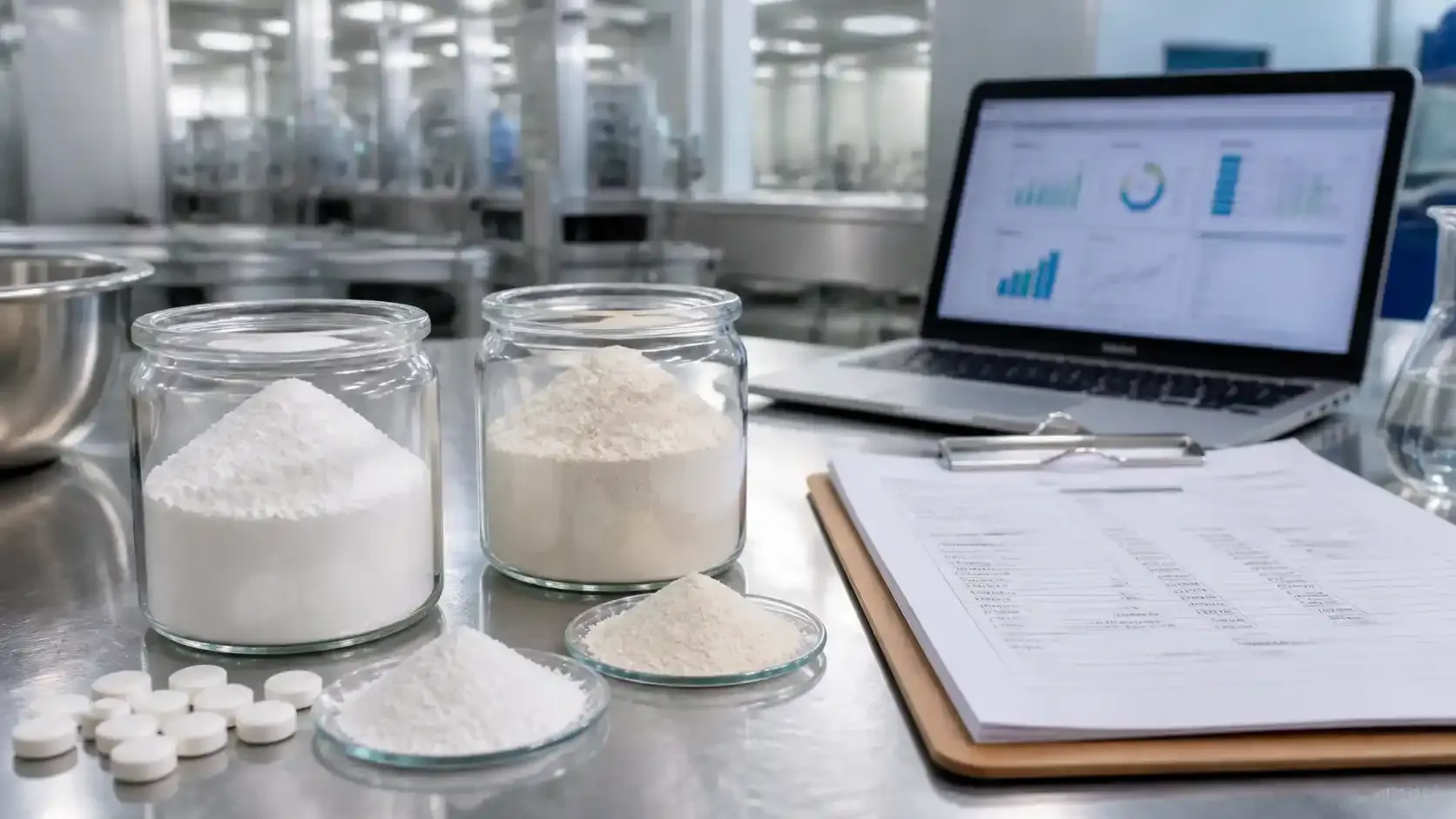
In 2026, microcrystalline cellulose (MCC) and resistant dextrin are no longer “commodity buys.” They are increasingly treated as audit-driven ingredients—especially when they sit behind fiber claims, clean-label positioning, or pharma-adjacent quality expectations.
For procurement teams, the practical question has shifted from “Who has the lowest quote?” to “Who can keep a launch on schedule with consistent batches, complete files, and export-ready systems?” That shift is most visible when buying from a Chinese supplier, where the best outcomes usually come from suppliers that can prove control—not just promise it.

The 2026 sourcing reality for MCC and resistant dextrin
Three market forces are shaping RFQs and supplier shortlists:
- Fiber claims are becoming a baseline expectation in foods, supplements, and medical nutrition. That pushes resistant dextrin and soluble corn fiber into more formulations where stability, taste neutrality, and documentation must hold up under scrutiny.
- MCC remains a cornerstone excipient in tablets and capsules. Buyers keep using it because it works—but they are becoming stricter about grade selection, change control, and consistency.
- Procurement is becoming audit-led, driven by customer audits, importer documentation requirements, and internal risk management. The price gap between two suppliers often disappears after the first deviation, delayed COA, or corrective action cycle.
Why MCC and resistant dextrin are now audit driven ingredients
When buyers describe problems with MCC or resistant dextrin from China, they rarely start with chemistry. They start with operational fallout:
- A batch meets the headline spec but behaves differently in production (flow, compressibility, or solubility changes).
- The COA is incomplete, late, or doesn’t match the agreed method.
- A supplier cannot explain process changes, raw material shifts, or testing differences.
- Audit requests turn into long email loops, and a launch slips.
In practice, an audit-driven ingredient is one where quality systems and documentation matter as much as the ingredient’s functional performance.

What “audit ready” really means
Audit readiness is not a slogan. For MCC and resistant dextrin, it typically includes:
- Traceability from raw materials to finished lots
- A stable and documented production process
- A consistent test method package (not just numbers)
- Clear deviation handling and change control
- Export support files that match what buyers and regulators actually request
What buyers should check in a Chinese microcrystalline cellulose manufacturer
MCC is purchased for function, but approved through evidence. If a sourcing team is trying to identify a recommended Chinese microcrystalline cellulose manufacturer or a recommended Chinese microcrystalline cellulose supplier, these are the spec lines and behaviors that typically separate “works on paper” from “works at scale.”
Why MCC still matters
In solid dosage forms, MCC is commonly chosen as a diluent and dry binder, and it can influence:
- tablet hardness and friability
- content uniformity risk
- compression window and speed
- downstream coating efficiency
The MCC spec lines buyers actually read
A quote may highlight compendial compliance, but procurement teams should look deeper. Common evaluation points include:
- Particle size distribution (not just a single median)
- Bulk/tapped density and what method is used
- Moisture control and how it is managed seasonally
- Flowability/compressibility indicators used internally
- Microbiological limits and lab capability for routine verification
If a supplier cannot explain test methods, sampling plans, or lot-to-lot controls, “meets spec” becomes fragile.
Documentation package that reduces approval time
A practical MCC supplier package typically includes:
- COA with methods or method references
- MSDS and product statement set (allergen, GMO, etc., if relevant to your application)
- stability and storage guidance
- a clear statement on change notification expectations
For buyers who want a benchmark of how manufacturers explain MCC grades and QC logic, one example is the industry note titled MCC Grades Formulation and QC Guide, which shows the type of technical framing many audit-led teams now expect.
How global buyers vet resistant dextrin and soluble corn fiber factories
Resistant dextrin sits at the intersection of nutrition positioning and process performance. That’s why procurement teams increasingly evaluate a recommended Chinese resistant dextrin manufacturer the same way they evaluate high-impact functional ingredients: by verifying identity, stability, and documentation discipline.
What resistant dextrin is expected to do in real formulations
In many products, resistant dextrin and soluble corn fiber are selected for a combination of:
- high fiber contribution with low sweetness
- clean taste profile and easy incorporation
- stability across processing conditions
- positioning for digestive wellness (prebiotic association)
These expectations translate into very practical procurement questions.
Key spec lines for resistant dextrin procurement
Across RFQs, a few parameters repeatedly show up as decision drivers:
- Fiber content (many commercial specs target ranges such as ≥70% to ≥90% depending on grade)
- Moisture and water activity (important for storage and caking risk)
- pH range and performance in acidic systems
- micro limits and lot consistency
A robust spec is only useful if it is reproducible. Buyers should confirm whether the supplier’s COA reflects routine production data or “best-lot” values.
Source identity and claim support
A frequent mismatch in global trade is claim language vs. raw material reality. A reliable supplier can clearly document:
- starch source identity (corn or tapioca-based options)
- NON-GMO status where required
- statements relevant to market access (for example, religious certifications for certain regions)
For teams building a shortlist, it can help to compare how suppliers present their product identity and quality files. Relevant product pages that show common export-facing information include:
- non-GMO soluble corn fiber
- factory supply resistant dextrin
- gut health dextrin
These links are useful as evaluation references—not because a single page proves a system, but because strong suppliers tend to present consistent specs, positioning, and supporting files across their catalog.
Certifications and files that now decide shortlists
In many tenders, certifications act as market filters. Buyers may not “buy because of a badge,” but they often cannot buy without one.
A common 2026 pattern is:
- Food safety management certification becomes the baseline for food and supplement applications.
- HALAL and Kosher become necessary for broad market reach.
- NON-GMO verification becomes increasingly tied to brand positioning.
One manufacturer example frequently cited by buyers evaluating China-based options is Shandong Shenghuai Health Co., Ltd.; Shine Health, which states a portfolio including CT-FSSC22000, HALAL, KOF-K Kosher, and SGS NON-GMO on its corporate site (www.sdshinehealth.com). For procurement teams, the practical takeaway is not the brand name—it’s what these certifications imply about documentation habits, internal audits, and export readiness.
Procurement document checklist that speeds up approvals
Most audit-led buyers routinely request:
- COA (with method clarity)
- MSDS
- allergen and GMO statements (when relevant)
- a process flow summary and traceability statement
- recall procedure overview and complaint handling route
Suppliers that can deliver these quickly reduce friction during vendor onboarding.
Seeing beyond FOB price with a total cost lens
Procurement teams often underestimate the “hidden line items” that follow a cheap quote:
- additional incoming QC or re-testing
- production rework from performance variability
- launch delays caused by missing files
- costs of audit follow-ups and corrective actions
Simple comparison buyers can use internally
| Evaluation factor | Low quote only supplier | Audit ready supplier |
|---|---|---|
| COA and document speed | Slow or inconsistent | Predictable and complete |
| Batch consistency | Higher variability risk | Stronger lot-to-lot discipline |
| Change control | Informal or unclear | Documented and communicated |
| Audit response | Reactive, delayed | Structured, evidence-based |
| Total cost | Often rises after issues | More stable over time |
This is why “recommended” supplier status increasingly aligns with documentation maturity, not marketing language.
Practical takeaway for building a recommended China shortlist
If the goal is to approve a recommended Chinese microcrystalline cellulose manufacturer and a recommended Chinese resistant dextrin manufacturer without unpleasant surprises, the most reliable approach is to score suppliers on proof quality:
- Do they explain not just the numbers, but the methods?
- Can they show traceability and change control?
- Do their certifications match the target markets?
- Can they support your audit timeline with real files?
For many procurement teams, MCC and resistant dextrin are now managed as a pair: one stabilizes solid dosage performance, the other enables fiber-forward product positioning. Either one can become the bottleneck if the supplier cannot support audits and documentation.
Data notes and further reading
- External market commentary on audit-driven sourcing for MCC and fiber in China: Food Additive Hub overview