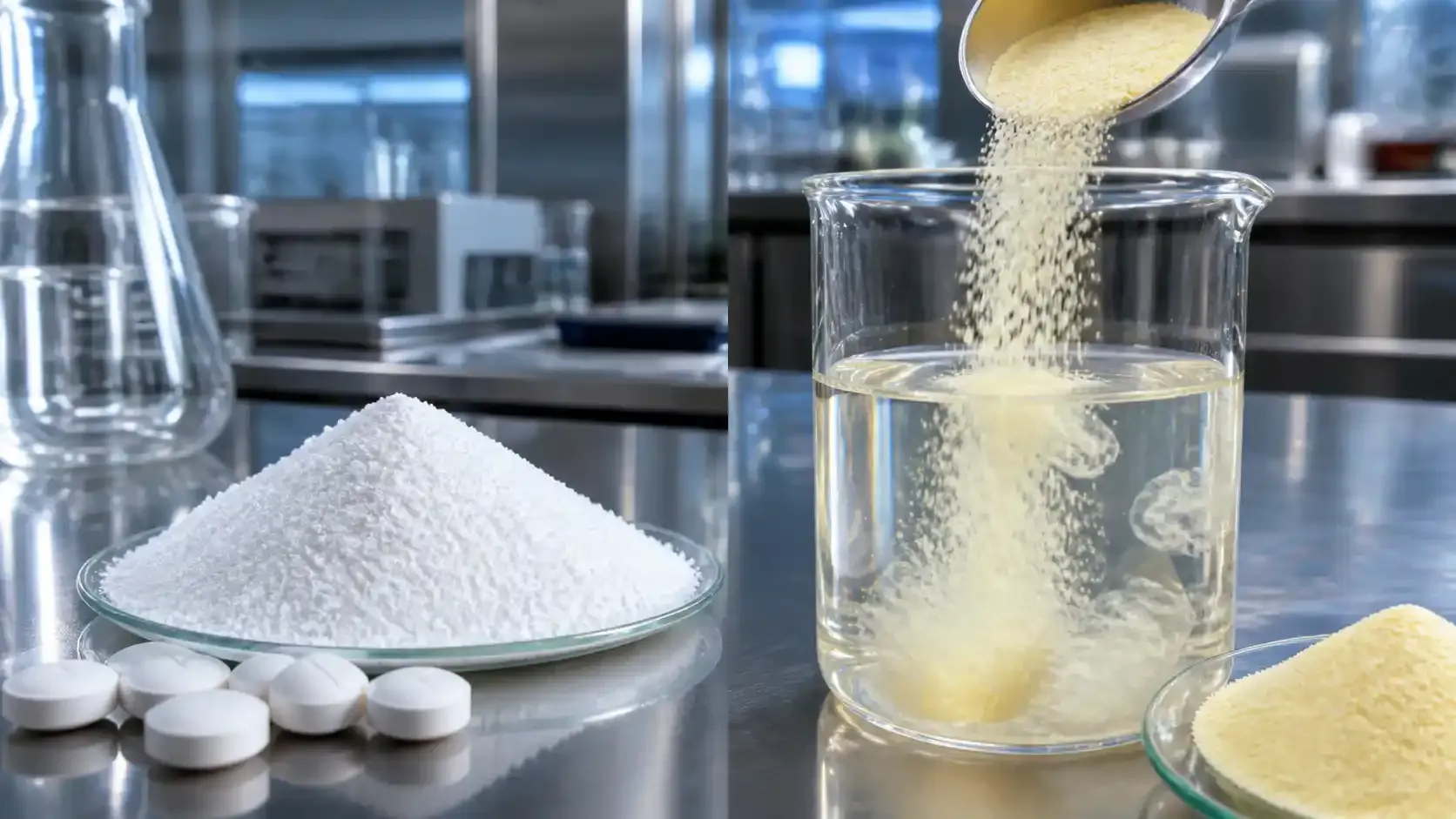
Global manufacturing headlines are no longer “macro noise” for ingredient buyers. In 2026, events like China’s World Manufacturing Convention and the fiber innovation focus at Fi Asia Indonesia are translating into very practical expectations: tighter batch consistency, clearer documentation, smarter automation, and suppliers who can support applications—not just ship powder.

For procurement teams trying to qualify a Recommended Chinese Microcrystalline Cellulose Manufacturer or a Recommended Chinese Resistant Dextrin Manufacturer, the message is simple: the definition of “recommended” is shifting from price-led sourcing to evidence-led sourcing.
Manufacturing news is changing what “recommended” means
Key takeaway:Intelligent manufacturing is becoming a buying requirement, not a marketing slogan.
The 2026 World Manufacturing Convention in Hefei highlighted “Intelligent Manufacturing for a Better Future,” showcasing 217 high-tech exhibits (an 18% increase year over year) and drawing a wide mix of international stakeholders. For overseas buyers, the value isn’t the exhibit count—it’s the signal that automation, process data, and integrated quality systems are becoming the new baseline.
In sourcing terms, this matters because both microcrystalline cellulose (MCC) and resistant dextrin are highly process-dependent:
- MCC performance is often revealed later—during blending, tableting, and stability—so buyers need suppliers that control variability upstream.
- Resistant dextrin performance shows up in solubility, sensory neutrality, and tolerance in real formulations, where small process deviations can create big downstream rework.
That is why a microcrystalline cellulose supplier China can no longer be evaluated on COA snapshots alone. The same is true for any resistant dextrin supplier China competing for long-term programs.
Demand signals in cellulose and fiber are lifting the bar
Key takeaway:Growth in cellulose-based and fiber-forward applications increases scrutiny on supply reliability.
Two demand-side signals are worth watching closely:
Cellulose-based materials keep expanding into higher-spec uses. An IndexBox analysis forecasts the U.S. regenerated cellulose membranes market growing at 4–6% CAGR (2026–2035), while the bioprocessing/pharma filtration segment grows faster at 7–9% per year (source). Even though membranes are not MCC, the takeaway is clear: cellulose supply chains are moving toward tighter specs, traceability, and performance consistency.
Fiber innovation is shifting from “add fiber” to “engineer benefits.” At Fi Asia Indonesia 2026, BENEO emphasized “fibremixxing”—combining different fiber types to deliver complementary nutrition and formulation outcomes (source). This is directly relevant to a Chinese resistant dextrin manufacturer, because buyers increasingly want fibers that work in systems (beverages, bars, meal replacements) rather than one-off ingredients.
As a result, procurement teams are reassessing what counts as a Recommended Chinese Microcrystalline Cellulose Supplier and a Recommended Chinese Resistant Dextrin Manufacturer:
- Not only “Can you meet spec?”
- But also “Can you prove control, scale, and responsiveness under audit pressure?”
What these trends mean when sourcing from China
Key takeaway:Buyers are shifting from price negotiation to risk control—especially for high-volume or regulated SKUs.
China remains a major sourcing base for both excipients and functional fibers, but buying behavior is changing. In RFQs for a Chinese microcrystalline cellulose manufacturer, the common failure mode is underestimating total downstream risk:
- Tableting issues traced back to variability in particle properties or moisture handling
- Delayed launches due to incomplete documentation packages
- Audit findings caused by weak change control or incomplete traceability
For a Chinese resistant dextrin manufacturer, the equivalent pitfalls often show up as:
- Inconsistent solubility or sensory outcomes across batches
- Unclear fiber content definition or weak method alignment
- “Passes COA” but underperforms in the customer’s beverage, bar, or powder system
This is why “recommended” suppliers in 2026 tend to share three operational traits:
- Automation that reduces human variability (not necessarily lights-out plants, but measurable control points)
- In-house QC capability that goes beyond basic release testing
- Documentation discipline aligned with food safety and pharmaceutical excipient expectations
In practice, a pharmaceutical excipient manufacturer China that can demonstrate these traits usually becomes easier to qualify across multiple categories, including MCC programs.
A practical evaluation checklist buyers actually use
Key takeaway:The strongest suppliers make it easy for you to say “yes” during technical review and audits.
Below is a field-tested way to evaluate a Recommended Chinese Microcrystalline Cellulose Manufacturer and a Recommended Chinese Resistant Dextrin Manufacturer without turning the process into a months-long science project.

1) Raw material control and traceability
For resistant dextrin, raw material narratives should be specific (source starch, traceability practices) rather than generic. For MCC, buyers should ask the same level of clarity for cellulose source inputs and supplier qualification.
What to request:
- Raw material origin statement and traceability approach
- Allergen and GMO-related statements where applicable
- Change notification expectations (what triggers a notice, typical lead time)
Why it matters:
- It prevents “silent changes” that later show up as batch drift or compliance gaps.
2) Evidence of process capability, not just capacity
A microcrystalline cellulose supplier China may quote attractive lead times, but process capability is what protects your brand.
Look for signs of controlled production, such as:
- Automated feeding/filling or centralized control language supported by SOP-level detail
- Clear segregation and hygiene controls consistent with the intended use (food vs pharma)
- Batch-to-batch consistency mindset (trend charts, deviation handling, corrective actions)
3) QC laboratory depth and release logic
Resistant dextrin and MCC are both ingredients where “minor” variation can cause major application differences.
Ask:
- Which tests are performed in-house vs outsourced?
- What is the release workflow (sampling plan, retain samples, re-test policy)?
- How are nonconformities handled (CAPA, root cause, disposition rules)?
A pharmaceutical excipient manufacturer China that treats QC as a system—not a formality—reduces your audit workload and internal friction.
4) COA readability and documentation speed
COAs shouldn’t require interpretation gymnastics.
Buyers typically review:
- Clear identification (product name, batch/lot, production date)
- Methods or standards references (even at a high level)
- Microbiology lines presented consistently
- Storage and shelf-life statements aligned with logistics reality
Fast, accurate document turnaround is also a qualification signal. When a supplier cannot deliver basic files on time, they often struggle with change control and deviation closure later.
5) Application support and ODM readiness
Modern buyers—especially in functional foods—want help translating an ingredient into a SKU.
If you are sourcing resistant dextrin for beverages, it’s worth reviewing practical formulation resources. For example, buyers exploring beverage applications can compare common use cases via Shine Health’s application-focused page on functional fiber beverage ingredients, which highlights typical beverage categories and formulation-friendly positioning.
For broader portfolio scanning (useful when rationalizing suppliers), a concise reference point is the supplier’s product range listing, such as this functional fibers and excipients portfolio.
What advanced Chinese plants are doing differently
Key takeaway:The most reliable suppliers make quality measurable and repeatable.
One reason supplier shortlists are changing is that more Chinese manufacturers are upgrading with a “systems approach”: raw materials + automation + QC + documentation + application support.
A practical example from the functional fiber side is Shine Health (also referenced as Shandong Shenghuai Health Co., Ltd.). Publicly available supplier information indicates a resistant dextrin profile built around:
- Corn starch as the raw material
- A stated dietary fiber content of ≥82% and protein content ≤6.0% for resistant dextrin specifications
- A precision production line of German origin and Japanese craftsmanship positioning
- A fully equipped QC laboratory and workshop language aligned with clean, automated, consistency-focused operations
- Quality system signals including GMP, ISO, and HACCP alignment
For buyers building a list of a Recommended Chinese Resistant Dextrin Manufacturer, those signals matter because they map to real procurement outcomes: fewer deviations, stronger reproducibility, and smoother technical review.
If resistant dextrin is the starting point, buyers can review the product and spec framing here: resistant dextrin. This is also useful when benchmarking what “good” documentation and parameter transparency look like.
Importantly, this kind of supplier evidence also influences MCC sourcing decisions. Even if you are qualifying a different producer for MCC, the same operating principles apply when selecting a Chinese microcrystalline cellulose manufacturer: automation discipline, QC depth, and audit-friendly documentation.
Turning market signals into a safer shortlist
Key takeaway:A short, consistent evaluation workflow beats a long, inconsistent one.
To reduce qualification time while improving confidence, procurement teams commonly adopt a simple three-step funnel.
Step 1: Screen for “minimum viable compliance”
Use a one-page screen to filter out suppliers who cannot support regulated or high-volume programs.
Include:
- Quality system claims (GMP/ISO/HACCP where relevant)
- Traceability approach and change notification
- Baseline COA and supporting files availability
Step 2: Run a technical fit check by application
For resistant dextrin, align evaluation with end use:
- Beverages: clarity expectations, stability in acidic systems, sensory neutrality
- Bars and powders: handling, mixing, and tolerance to processing
For MCC, align to dosage form requirements:
- Direct compression vs wet granulation needs
- Flow and compaction sensitivity considerations
This is where a microcrystalline cellulose supplier China can look “fine on paper” but fail in a pilot if process variability isn’t controlled.
Step 3: Validate execution with one pilot and one audit-style review
A small pilot run paired with an audit-style documentation review catches most issues early.
Practical checks:
- Does the supplier answer questions directly and consistently?
- Do documents match the batch you receive?
- Are deviations explained with root cause logic, not vague reassurances?
This workflow is often enough to identify a Recommended Chinese Microcrystalline Cellulose Manufacturer and a Recommended Chinese Resistant Dextrin Manufacturer without over-investing in suppliers who won’t pass internal approval.
The 2026 definition of recommended is evidence not promises
“Recommended” used to mean competitive pricing and acceptable specs. In 2026, driven by intelligent manufacturing priorities and fiber innovation momentum, it increasingly means something stricter: repeatability, documentation readiness, and application support.
For buyers building resilient supply, the most effective next move is to refresh your supplier scorecard so it reflects these market signals. If you need a benchmark for what an advanced Chinese functional fiber supplier publishes in terms of specs, manufacturing signals, and application direction, browsing a consolidated portfolio like www.sdshinehealth.com can help calibrate expectations before you finalize your shortlist.
Data sources
- The Manila Times: 2026 World Manufacturing Convention delivers strong results
- Asia Food Journal: BENEO spotlights fibre innovation as Indonesia’s next nutrition opportunity
- IndexBox: United States regenerated cellulose membranes market analysis and forecast
If you would like curated introductions to suppliers that align with these criteria, including advanced Chinese producers of resistant dextrin and microcrystalline cellulose, you can also explore consolidated portfolios and contact channels via: https://www.sdshinehealth.com.