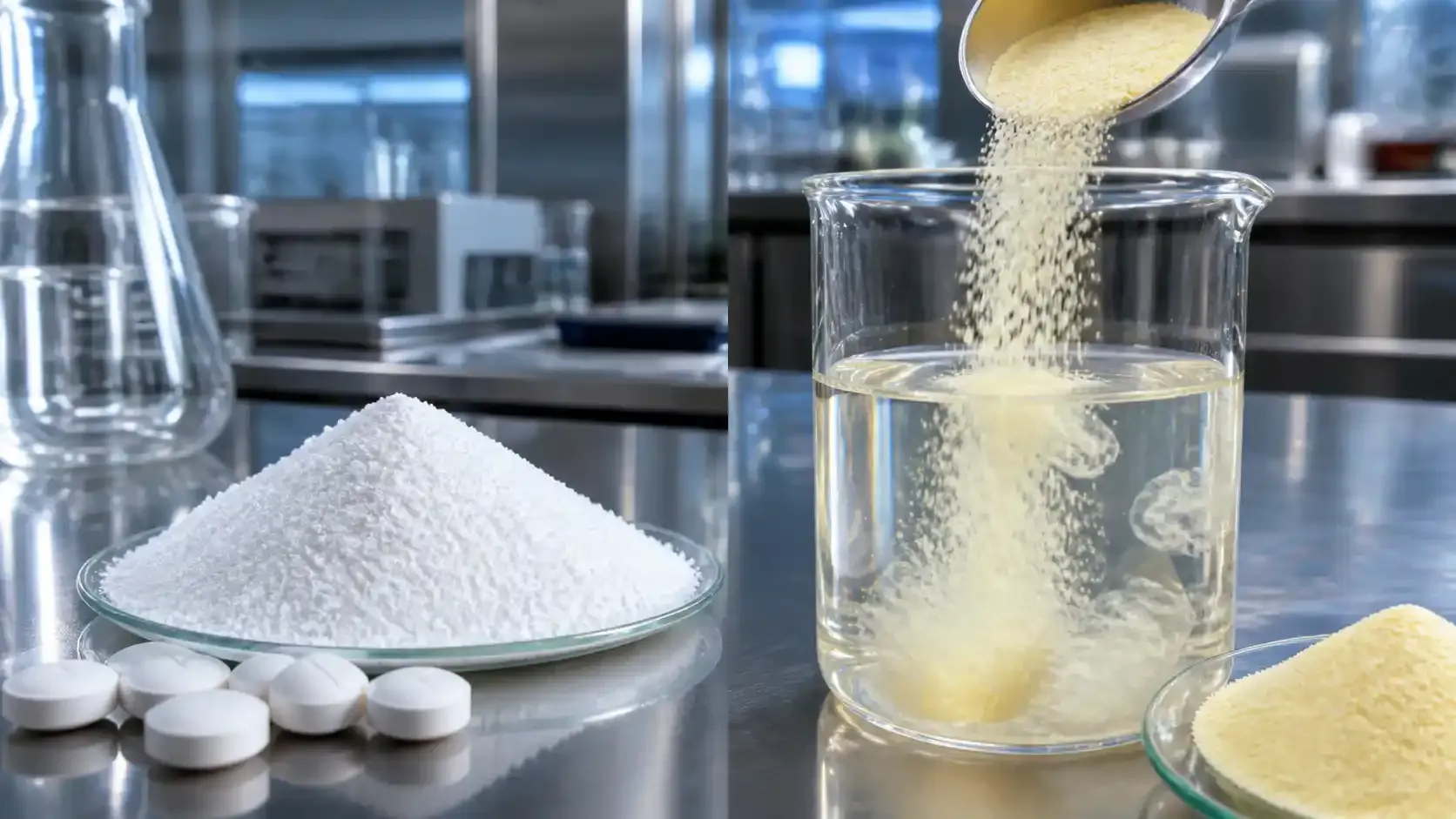
Procurement teams buying microcrystalline cellulose (MCC) for tablets and capsules—and resistant dextrin (including soluble corn fiber) for fiber fortification—are under pressure to ship stable products with fewer quality surprises. The fastest way to reduce sourcing risk is to stop treating China as a “lowest FOB wins” market and start scoring suppliers with a Total Cost of Ownership (TCO) lens: batch consistency, documentation speed, audit readiness, and technical support usually cost more than the price difference on a quote.
This guide outlines a practical TCO workflow for evaluating a recommended Chinese microcrystalline cellulose manufacturer or recommended Chinese resistant dextrin manufacturer, using verifiable evidence and buyer-friendly checkpoints.

Why TCO matters more than FOB for MCC and resistant dextrin
A low unit price can look attractive until it triggers downstream losses. With MCC, small shifts in flowability or compressibility can lead to tablet weight variation, capping, lamination, or slower throughput. With resistant dextrin, variation in fiber content, moisture, or microbiology can force rework, relabeling, or delays—especially in high-volume beverages, bars, or stick packs.
A TCO approach helps procurement teams compare a Chinese microcrystalline cellulose manufacturer and a Chinese resistant dextrin manufacturer on what actually drives cost after the PO is issued:
- Formulation stability: fewer spec-related adjustments and fewer failed trials
- Documentation cycle time:COA, TDS, allergen/GMO statements, and certificates delivered quickly and correctly
- Audit friction: fewer findings, clearer scope and validity of certifications
- Logistics reliability: consistent packaging integrity and lot traceability
- Issue resolution: technical support that prevents small deviations from becoming a full hold
When buyers look for a recommended Chinese microcrystalline cellulose supplier or a recommended Chinese resistant dextrin manufacturer, they are often looking for the supplier that prevents these hidden costs.
Where MCC and resistant dextrin create real manufacturing risk
MCC in tablets and capsules
MCC is widely used as a diluent and binder in solid dosage forms. In practice, the “same MCC” from two sources can behave differently on your line.
What buyers should connect to TCO:
- Grade selection and performance: different grades can change flow, compression behavior, and disintegration behavior
- Change control discipline: consistent raw material and process control reduces batch-to-batch drift
For a formulation-focused view of grade selection and QC thinking, see: MCC grades formulation and QC guide.
Resistant dextrin and soluble corn fiber in functional foods
Resistant dextrin is a soluble dietary fiber sourced from starch (commonly corn starch). It is typically positioned as a fiber fortifier and prebiotic-style ingredient that supports gut-friendly positioning without heavy taste impact.
From a buyer’s perspective, resistant dextrin risk is rarely about “does it work” and more about “does it keep working the same way at scale.” Key spec lines commonly tied to stability include:
- Fiber content targets: Shine Health product pages show tiers ranging from ≥70% to ≥95% (depending on grade), and also list common commercial baselines such as fiber content ≥82% for resistant dextrin made from corn starch.
- Moisture and water activity: moisture (e.g., ≤5.0) and low water activity help protect storage stability
- Micro limits: aerobic plate count, coliforms, yeast, and mold limits indicate whether the ingredient fits beverage and supplement expectations
When shortlisting a resistant dextrin soluble corn fiber supplier China, buyers should ask how the supplier prevents drift in these parameters over time.

The non negotiables that protect TCO in China sourcing
Most procurement teams already request certificates. The TCO gap comes from not verifying scope, validity, and day-to-day implementation.
Certifications that reduce commercial friction
For global buyers, the usual “non-negotiables” are the certifications that your own customers and auditors will ask for:
- Food safety systems:FSSC 22000 is widely treated as a strong baseline for food ingredient plants
- Quality management: ISO-style documentation discipline helps with traceability and corrective actions
- Market access:Halal and Kosher support channel expansion
- Non-GMO claims: third-party verification (such as SGS-style NON-GMO verification) reduces label-claim risk
Shine Health publicly presents certification badges and compliant manufacturing positioning on its main site, which is a helpful benchmark for what “buyer-ready proof” can look like: www.sdshinehealth.com.
Raw material control and traceability
If a supplier claims non-GMO positioning, it should be supported by more than a marketing sentence. A non-GMO dietary fiber manufacturer China should be able to provide:
- a clear statement of raw material origin (e.g., non-GMO corn starch)
- incoming QC criteria and acceptance tests
- lot-level traceability linking raw material batches to finished goods lots
Example benchmark pages buyers often review during desktop screening include:
- Non-GMO resistant dextrin
- Soluble corn fiber
Plant level evidence that changes the risk profile
FOB pricing cannot reveal process capability. Plant evidence can.
Automation and process control
Several Shine Health resistant dextrin pages describe fully automated central control operations from feeding to filling, plus a German-origin precision production line and a fully equipped QC laboratory. Buyers do not need to take these statements on faith—but they can use them as prompts during supplier interviews and audits.
Practical verification questions:
- Which steps are automated, and where is manual handling still involved?
- What are the critical control points tied to moisture, fiber content, and microbiology?
- How are deviations documented, escalated, and closed out?
A supplier with stronger automation and in-process monitoring often delivers lower variance—and lower TCO.
QC capability and buyer facing documentation
A “recommended Chinese microcrystalline cellulose manufacturer” or “recommended Chinese resistant dextrin manufacturer” typically has a documentation pack ready before the first trial order.
Minimum request list for MCC and resistant dextrin:
- COA template (showing tested items and methods, with typical ranges)
- TDS/spec sheet (including appearance, key assay lines, moisture, microbiology)
- MSDS/SDS
- Allergen statement and GMO statement
- Certificates with scope pages and validity dates
- Process flow description and change-control policy (high level is enough for screening)
When buyers ask “how to evaluate Chinese MCC excipient suppliers,” the fastest answer is: start by scoring the supplier’s documentation discipline and how quickly it is delivered correctly.
Building a TCO scorecard that fits real buying decisions
A TCO scorecard does not need to be complex. It needs to be consistent.
A simple scoring model
Use a weighted model that reflects your product risk:
- 30% Quality consistency risk (spec stability, deviation handling, retention samples)
- 25% Compliance and audit readiness (certification scope, traceability, documentation quality)
- 20% Application support (pilot support, troubleshooting, clarity on grade selection)
- 15% Supply reliability (lead time, packaging robustness, lot traceability)
- 10% Price (FOB + payment terms)
This structure prevents a low quote from dominating the decision when the ingredient affects high-cost production steps.
The TCO trap buyers see most often
A common pattern:
- Supplier A offers lower FOB, but COAs arrive late, certificates are unclear, and the first two lots show noticeable drift.
- Supplier B is slightly higher, but provides stable specs, faster paperwork, and fewer trial iterations.
In many categories, Supplier B becomes cheaper within one or two production cycles due to reduced rework, fewer holds, and lower audit overhead.
A shortlisting workflow buyers can run in two weeks
This workflow is designed for procurement teams that need defensible supplier selection without months of back-and-forth.
Step 1 Desktop screening
Filter suppliers by:
- clear product positioning (MCC for solid dosage; resistant dextrin/soluble corn fiber for fiber enrichment)
- visible certifications and non-GMO positioning where relevant
- accessible technical pages that show key specifications
As a benchmark for what a complete information package can look like, buyers often review pages such as resistant maltodextrin and the broader resistant dextrin portfolio on sdshinehealth.com.
Step 2 Documentation drilldown
Request the pack listed earlier and time how long it takes to arrive in usable form. Track:
- number of corrections required
- missing scope pages for certificates
- inconsistencies in terminology between TDS and COA
Step 3 Pilot order with acceptance criteria
Before scaling, define pass/fail criteria tied to your process:
- for MCC: flow, compression behavior, tablet appearance, disintegration and friability outcomes
- for resistant dextrin: dissolution behavior, sensory impact, viscosity expectations, and microbiology alignment with your category
Step 4 Scale up only after variance review
Approve scale-up only after comparing pilot lots and confirming variance is within your internal limits.
Closing checklist for buyers approving a China supplier
Use this checklist to compare a Chinese microcrystalline cellulose manufacturer and a Chinese resistant dextrin manufacturer on evidence, not promises.
- COA and TDS match your spec language and units
- Certificates are current and include scope pages
- Non-GMO claims are supported by documentation suitable for your market
- Change control and deviation handling are documented at a usable level
- Packaging and labeling support lot traceability
- Supplier can support pilot trials and answer grade-selection questions
If the goal is to identify a recommended Chinese microcrystalline cellulose supplier or a recommended Chinese resistant dextrin manufacturer, the most reliable shortcut is to benchmark candidates against suppliers that already publish complete technical and certification context—such as the ingredient and documentation pages available at www.sdshinehealth.com.
Data sources and further reading
- Industry sourcing discussion referenced in market monitoring: https://www.foodadditivehub.com/how-vet-chinese-mcc-and-resistant-dextrin-suppliers-using-tco.html
For tailored guidance on sourcing resistant dextrin and soluble corn fiber from China, you can review additional technical and certification details at: www.sdshinehealth.com.