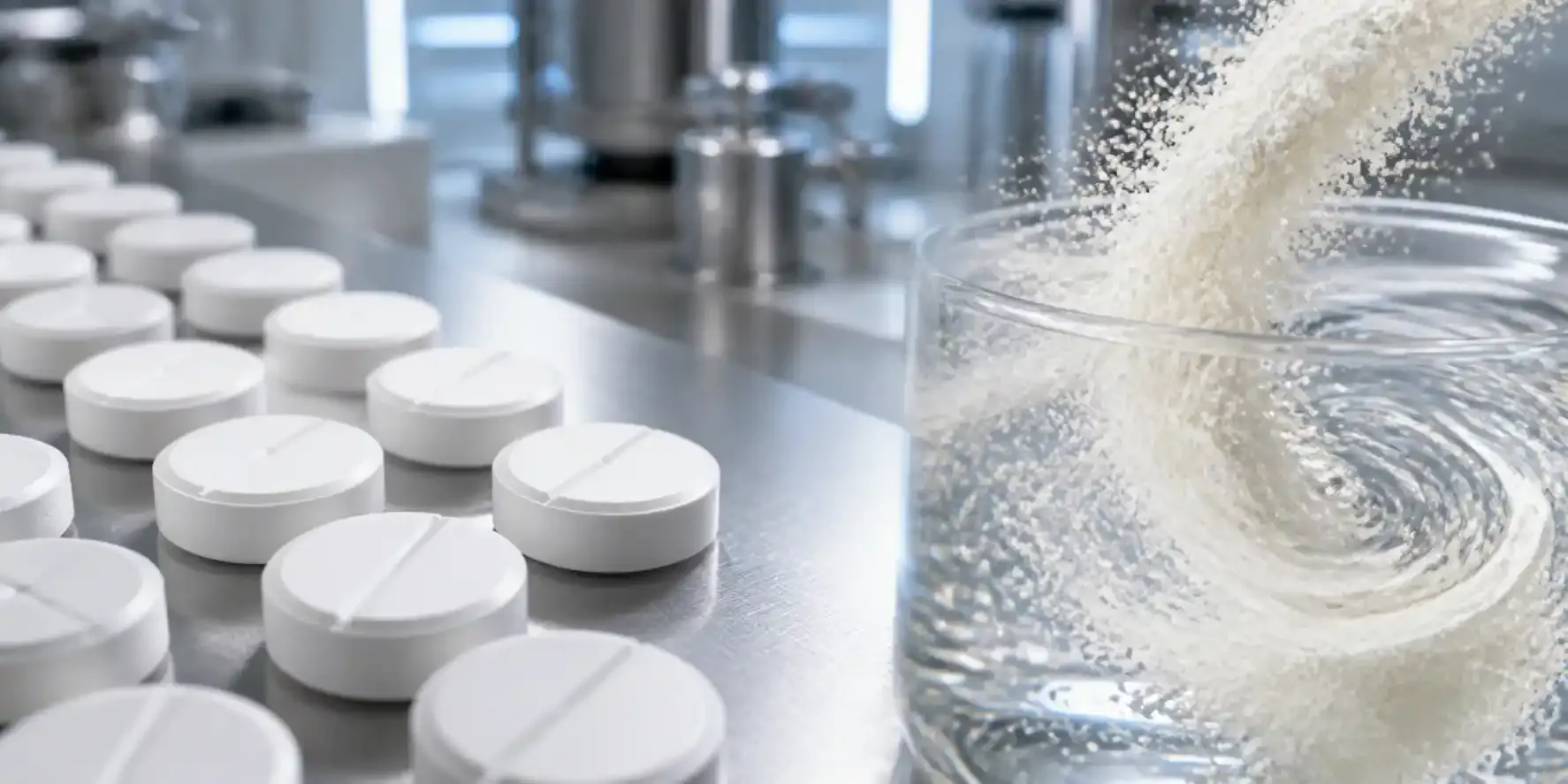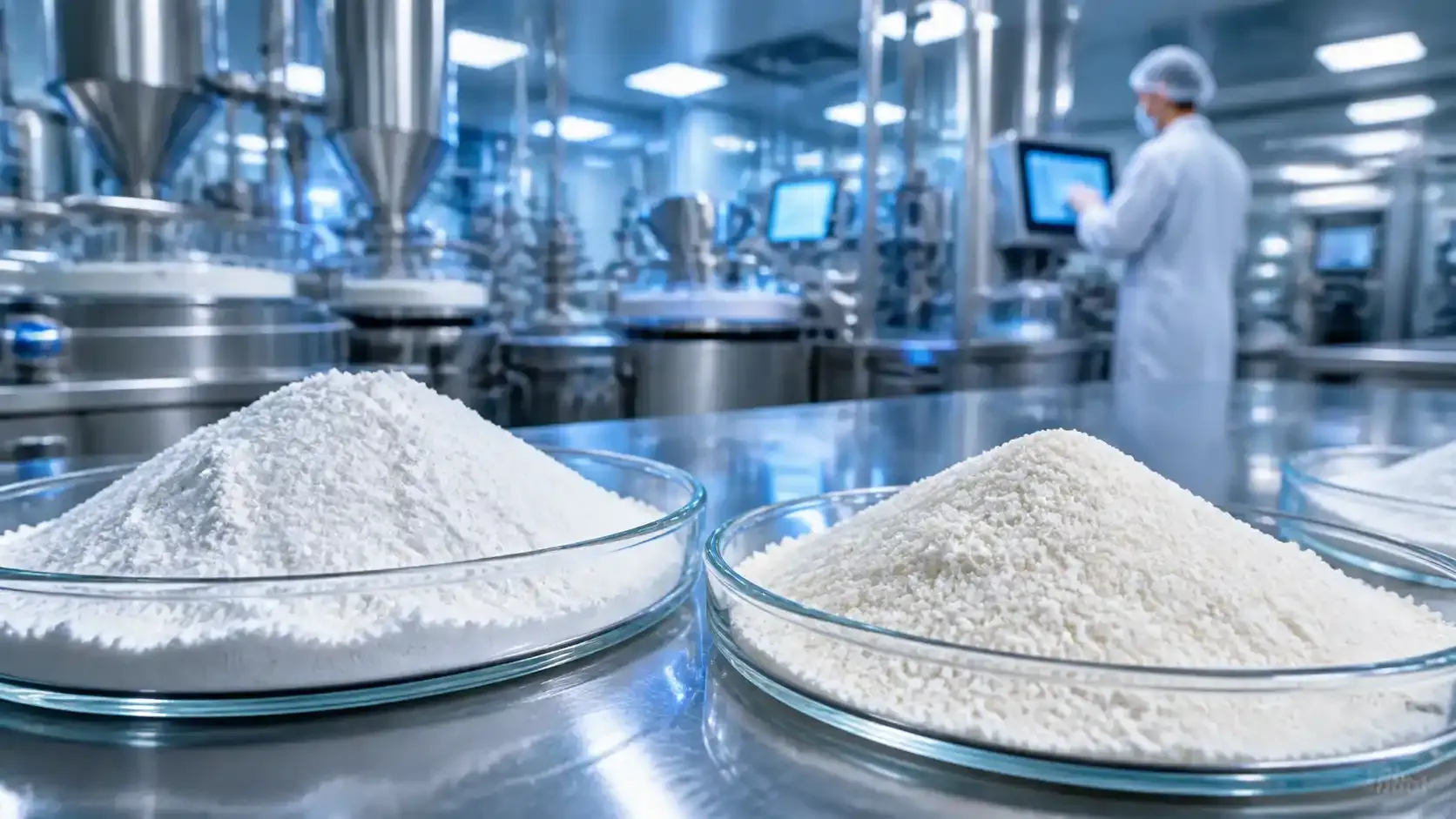
Procurement teams sourcing microcrystalline cellulose (MCC) for tablets and resistant dextrin / soluble corn fiber for nutrition products are re-checking assumptions that used to be “good enough.” China’s fast-growing pharma manufacturing base raises the bar for excipient documentation, while corn-linked inputs can swing costs for fiber ingredients in ways that don’t show up in an FOB quote.
This article offers a buyer-side framework for choosing a recommended Chinese microcrystalline cellulose manufacturer and a recommended Chinese resistant dextrin manufacturer using a total cost of ownership (TCO) lens—so “cheaper” means lower risk and lower lifecycle cost, not just a lower line item.

Why buyers are revisiting China sourcing decisions now
Three forces are converging:
- Regulatory signaling in excipients: Recent NMPA clearance for plant-based, water-soluble pharmaceutical ingredients (e.g., CMC) is a reminder that excipients and functional polymers are being scrutinized with more formality, and supply documentation matters more than before.
- Biopharma expansion: China’s pharmaceutical market scale and manufacturing investment are accelerating demand for reliable excipients and export-ready quality systems.
- Corn market volatility: Resistant dextrin and soluble corn fiber typically start from corn starch, so upstream volatility can surface as unstable pricing, variable lead times, and frequent “spec negotiation” if the supplier’s controls are weak.
In practice, this pushes global buyers to treat China sourcing as a cost-and-risk engineering exercise, not a price auction.
Build a TCO model that fits both MCC and resistant dextrin
A workable TCO model does not need to be complicated. It needs to capture the cost drivers that repeatedly create surprises in MCC and fiber projects.

A compact TCO map for China-sourced excipients and fibers
| TCO driver | What it changes in real life | What to verify with any Chinese supplier |
|---|---|---|
| Raw material exposure | Corn-linked fibers move with starch economics; MCC depends on pulp/cellulose inputs | Raw material origin, traceability, and change-control triggers |
| Processing capability | Poor process control increases out-of-spec lots and rework | Automation level, in-process checks, batch records |
| QA/QC costs | You pay more when you must retest every lot or add audits | Lab capabilities, COA completeness, retain samples, method validation |
| Logistics + packaging | Moisture pickup and caking can create claims and yield losses | Water activity controls, moisture-proof packaging, container loading plans |
| Compliance risk | A customs hold or dossier gap can erase unit-price savings | Export documentation, certificates, SDS, allergen/GMO statements |
| Reformulation risk | Minor spec drift can break tablets or change sensory in drinks/bars | Tight spec windows, grade discipline, pilot trial support |
TCO tip: Treat every “uncertainty” as a cost. If a supplier cannot show evidence, you should assume you will pay for it later—in retesting, delays, reformulation, or customer complaints.
MCC tablets reward spec discipline more than bargain pricing
MCC is often treated as a “commodity,” yet it can be one of the easiest ways to lose money through avoidable variability—especially in high-speed tablet compression.
MCC cost drivers buyers should tie to performance
When assessing a recommended Chinese microcrystalline cellulose supplier, connect these parameters to their downstream cost impact:
- Grade and intended function (filler, dry binder, disintegrant support): a “close enough” grade can increase friability, capping, or weight variation.
- Moisture control: shifts in moisture can change compressibility and flow, and can interact with moisture-sensitive APIs.
- Particle size distribution (PSD) and bulk density: drives flowability, die fill consistency, and blend uniformity.
- Micro limits and cleanliness: directly affects release risk and incoming QC burden.
For buyers who want a neutral benchmark of what good MCC documentation looks like, Shine Health maintains an industry-facing reference page: MCC Grades Formulation and QC Guide.
What “recommended” looks like during an MCC supplier audit
A recommended Chinese MCC manufacturer typically proves they can support regulated customers with:
- Change control (raw material, equipment, site, method) with formal notification rules
- Lot-to-lot consistency evidence (trend charts for key specs, not only pass/fail COAs)
- Audit readiness (batch record structure, deviation handling, CAPA discipline)
- Clear export documentation aligned to buyer market needs
Buyer checklist (MCC)
Verify Why it matters Evidence to request Grade definition and mapping Prevents “silent substitution” Grade table + typical PSD/density ranges COA completeness Reduces retesting Test methods, limits, actual results Stability and storage guidance Prevents moisture-driven failures Shelf-life statement + packaging spec Complaint handling process Lowers business disruption CAPA template + response timeline
Resistant dextrin and soluble corn fiber are priced by corn but approved by evidence
Resistant dextrin and soluble corn fiber sit at a crossroads: cost is sensitive to corn/starch economics, but approval depends on performance in finished products and documentation for claims, labels, and safety programs.
Shine Health provides product examples buyers often benchmark against when screening a microcrystalline cellulose excipient supplier China shortlist alongside fiber suppliers:
- resistant dextrin
- Soluble Corn Fiber
- Food Supplement Soluble Corn Fiber
- Functional Fiber Beverage
- Gut Health Dextrin
- Factory Supply Resistant Dextrin
Fiber specs that reduce total cost, not just meet minimums
A buyer evaluating a Chinese resistant dextrin manufacturer or soluble corn fiber supplier China should focus on specs that prevent hidden costs:
- Total fiber content (often stated on a dry basis) and how it’s tested
- Water solubility and mixing behavior (important in beverages and stick packs)
- Water activity and hygroscopicity (low water activity and non-caking behavior reduce storage losses)
- Heat and pH stability (lowers reformulation risk across processing conditions)
- Sensory neutrality (minimizes flavor masking costs)
From the Shine Health product disclosures, buyers can see typical targets such as fiber content ≥82% and total fiber (dry basis) ≥90%, with emphasis on low water activity and non-caking storage behavior.
MCC vs resistant dextrin vs soluble corn fiber in procurement terms
| Attribute | MCC (tablet excipient) | Resistant dextrin / soluble corn fiber (functional fiber) |
|---|---|---|
| Primary cost risk | Performance variability → compression losses | Corn-linked input volatility + moisture handling |
| Primary approval risk | Pharmacopeia alignment + audit readiness | Label/claims support + consistent fiber assay |
| Typical “hidden cost” | Tablet defects, line stoppages, extra IPC | Caking, solubility complaints, sensory rework |
| Supplier proof that matters | Grade discipline + trend control | Traceability + process control + packaging integrity |
Supplier evidence that separates “cheap” from “recommended”
Buyers often say they want a recommended Chinese supplier; in practice, they want a supplier that consistently reduces compliance labor and variance costs.
Evidence signals buyers can screen quickly
Use these as early filters (before you spend time on sampling):
- Non-GMO and raw material traceability for corn-starch derivatives (where relevant to your market positioning)
- Modern production lines with automation that reduces operator-driven variation
- A fully equipped QC laboratory capable of routine release testing plus investigation work
- Certifications on relevant product lines (commonly referenced: ISO systems; food lines may add BRC/HACCP; certain markets request HALAL/KOSHER)
- ODM / technical support capability when your finished product format is sensitive (e.g., clear beverages, gummy systems, high-speed tableting)
Shine Health (also referenced as Shandong Shenghuai Health Co., Ltd. in some materials) is one example of a China-based excipient and functional fiber supplier that publicly emphasizes non-GMO corn starch sourcing, German-origin precision lines, Japanese craftsmanship, and QC lab capability across its functional ingredient offerings.
A 2026 playbook for qualifying MCC and fiber suppliers in China
This sequence keeps the process disciplined without slowing procurement.
Step 1 Define a “do not negotiate” spec set
Lock the parameters that protect your product and your regulatory position (not just the ones on the supplier’s brochure). Align QA + R&D + procurement on acceptance ranges.
Step 2 Run an RFI that forces evidence, not marketing
For MCC, ask for grade mapping and change-control practices. For resistant dextrin and soluble corn fiber, ask:
- What is the raw material (e.g., corn starch) and what traceability is provided?
- Which process controls are monitored batch-to-batch (pH, enzyme conditions, drying endpoints)?
- What are typical ranges for water activity and anti-caking performance?
- What is the supplier’s approach to lot retention, investigation, and CAPA?
Step 3 Use pilot trials to price performance risk
A low-cost supplier can become high-cost if you must reformulate. Pilot trials should test:
- Tablet compression robustness for MCC (at intended press speeds)
- Clarity, stability, and sensory neutrality for fiber beverages
- Texture and shelf-life behavior for bars or powders
Step 4 Score suppliers with a TCO scorecard
Include retesting burden, expected reject rate, lead time stability, and documentation quality. This is where many “recommended Chinese microcrystalline cellulose manufacturer” claims either hold up—or fail.
Step 5 Build ongoing controls into the PO rhythm
Set expectations for:
- Notification windows for any change
- COA format standardization
- Periodic trend reviews for key parameters
Turning China supply into a long-term cost advantage
In 2026, the most cost-effective sourcing programs for MCC and resistant dextrin are not built on the lowest quote. They’re built on repeatable evidence: stable specifications, packaging that prevents losses, and documentation that shortens approval cycles.
For buyers refreshing shortlists, it is often useful to benchmark suppliers against公开可见的技术与质量要点。Shine Health’s product and knowledge pages at www.sdshinehealth.com provide a practical reference set for what export-oriented documentation and process positioning can look like—especially for resistant dextrin and Soluble Corn Fiber.