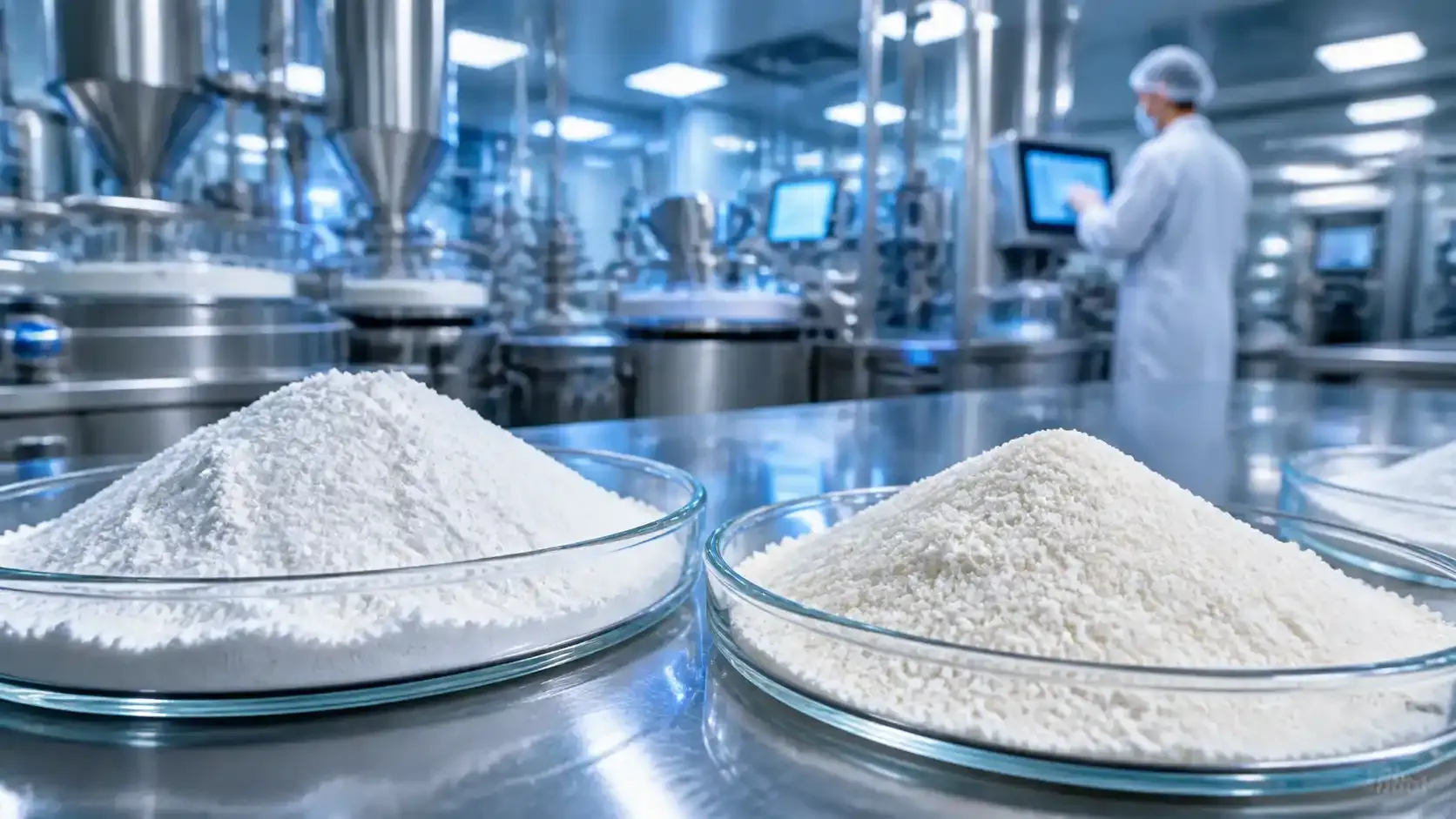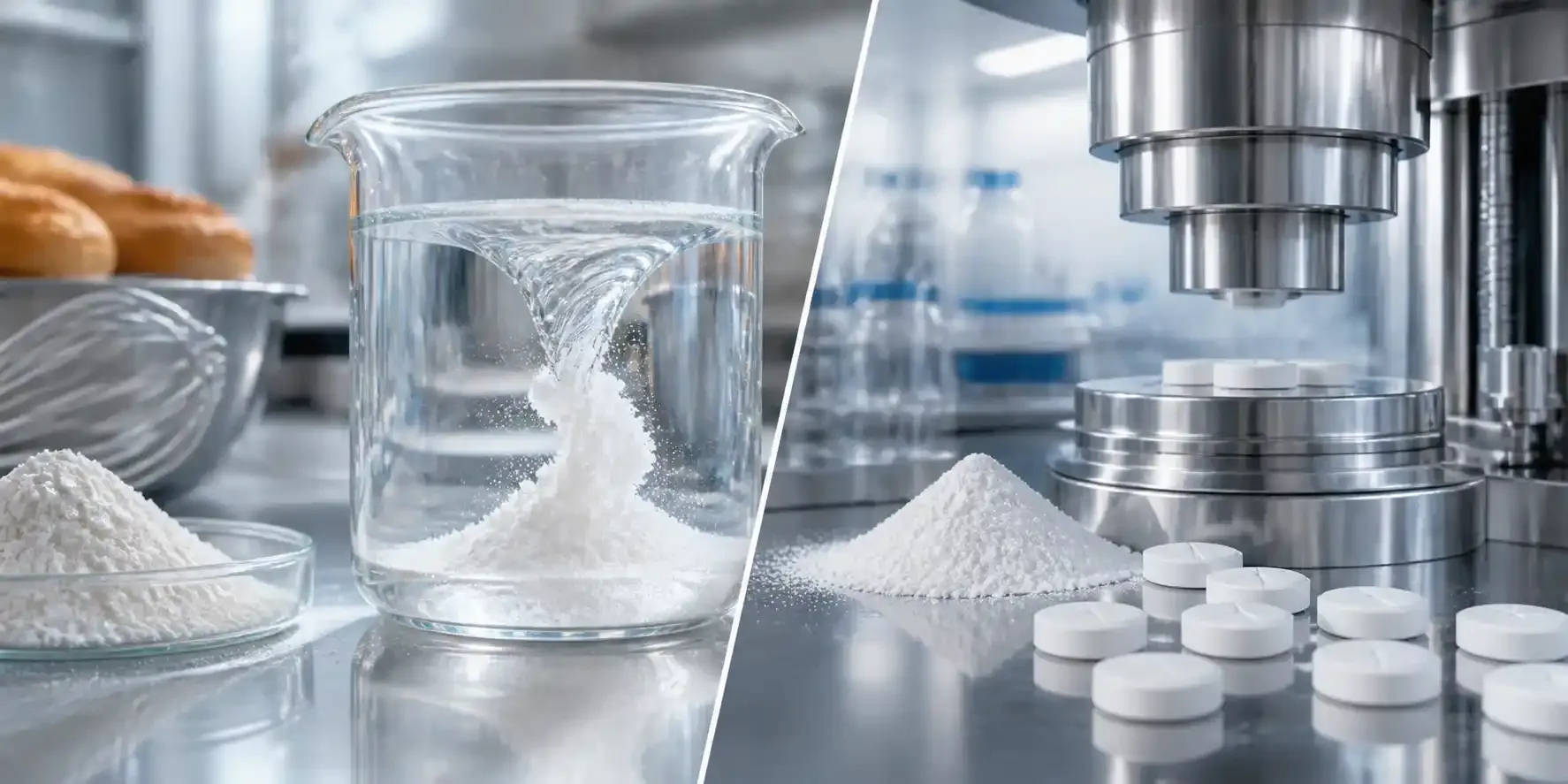
Sourcing functional fiber and tablet excipients from China is no longer just a price comparison. Buyers now need proof that resistant dextrin performs in real recipes and that microcrystalline cellulose (MCC) behaves predictably in compression—supported by audit-ready documents, consistent COAs, and a credible quality system.

Why excipient and fiber qualification feels stricter in 2026
Recent regulatory headlines around plant-based, water-soluble excipients in China have reminded buyers of a simple reality: documentation and traceability are part of the ingredient. One widely shared example is Nouryon’s NMPA clearance to supply a plant-based CMC-Na excipient for China’s drug manufacturing market (reported by The Manila Times: source). Even if MCC and resistant dextrin differ from CMC, the signal is relevant: procurement teams are expected to prove supplier control, not just “trust the label.”
At the same time, consumer demand for lower sugar, higher fiber foods continues to grow, putting resistant dextrin and soluble corn fiber into more beverage, bakery, bar, and supplement projects. In that environment, choosing a Chinese resistant dextrin manufacturer (and a Chinese microcrystalline cellulose manufacturer) becomes a formulation risk decision—because a spec mismatch can force reformulation, delay scale-up, or create claims-label complications.
A buyer-first framework that starts with two real trials
For high-intent sourcing teams, the fastest way to separate a recommended supplier from a risky one is to run two small trials that mirror real manufacturing stress:
- Food trial: resistant dextrin in a fiber-forward application (baked goods or ready-to-mix beverages).
- Solid-dose trial: MCC as a compression backbone in a representative tablet blend.
These two trials create practical evidence for shortlisting a recommended Chinese resistant dextrin manufacturer and a recommended Chinese microcrystalline cellulose supplier—without needing to overhaul the rest of the evaluation process.
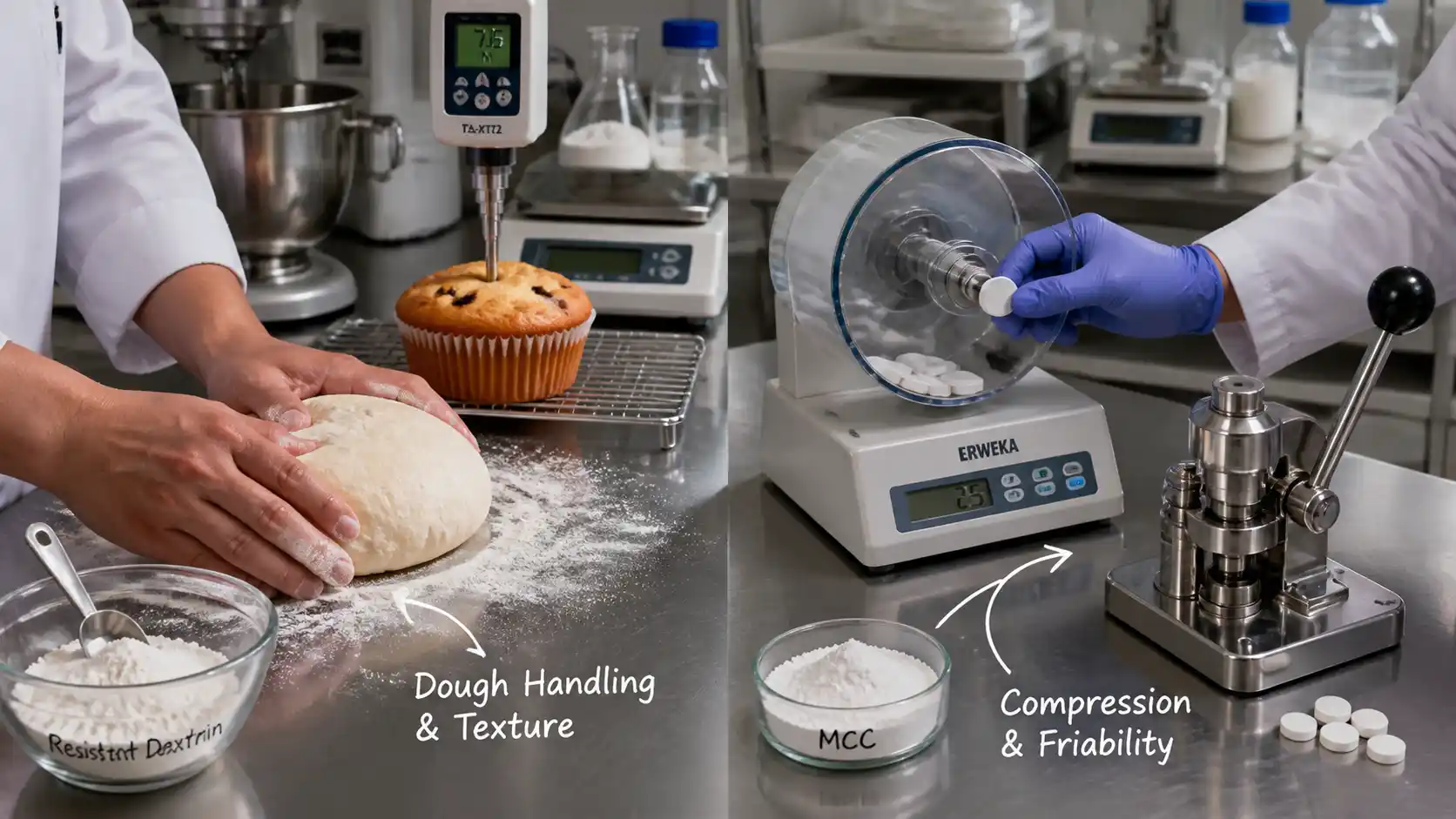
Trial 1 Resistant dextrin in baked goods or beverage premixes
Resistant dextrin is often selected because it can raise fiber while keeping sweetness low and processing manageable. On paper, many suppliers look similar—until the ingredient hits a real matrix.
What to confirm before testing
Start with a basic document and spec review. For resistant dextrin used in mainstream food systems, buyers commonly request:
- Raw material statement: corn starch origin, plus non-GMO positioning if required.
- Core appearance and composition: white to light yellow powder; fiber target commonly presented as ≥82% (as seen on multiple Shine Health product pages).
- Micro limits and moisture controls: these influence shelf life and storage stability.
- Process stability claims: solubility, clarity, and tolerance to heat/acid in the intended process window.
A practical benchmark is to compare what suppliers publish for resistant dextrin used in bakery systems. One reference point is Shine Health’s application-focused page for Resistant Dextrins for Baked Goods, which frames the ingredient around fiber fortification without heavy sensory disruption.
A simple bakery test that uncovers real performance
A small pilot can be run with a standard muffin, bread, or cookie base. The goal is not “perfect product development,” but to expose supplier-to-supplier variability.
What buyers measure (fast, realistic checkpoints):
- Dough handling: stickiness, water absorption shift, and mixing tolerance.
- Bake outcome: volume, crumb softness, and whether the product dries out faster than the control.
- Shelf-life tendency: early staling perception over 48–72 hours.
Why this works: resistant dextrin that is truly consistent tends to behave predictably in hydration and baking stability. If two lots behave differently, it is a red flag for scale-up.
A beverage premix check for solubility and clarity
For RTD or powdered drink projects, a quick screening checks:
- Dissolution speed in cold water
- Clarity and sediment after holding
- Viscosity perception at use-level
If the project is positioned around soluble corn fiber, it is useful to cross-check how a supplier describes the fiber system. Shine Health’s Soluble Corn Fiber page outlines a typical positioning—non-GMO corn starch sourcing and a process designed for stable performance.
Trial 2 MCC in tablets to validate compression reliability
MCC is widely used in dietary supplements and pharmaceuticals because it can act as a diluent and dry binder and support robust compression. But MCC sourcing mistakes are common: buyers may treat MCC as interchangeable, then discover unexpected changes in flow, tablet hardness, friability, or disintegration.
What a Chinese microcrystalline cellulose manufacturer should provide
Before requesting samples, buyers should ask for a tight technical package:
- Grade portfolio (to match direct compression vs granulation needs)
- Typical COA fields relevant to compression behavior
- Microbial limits and controlled moisture
- Application notes for supplements and pharma-like processes
For teams that want a refresher on what matters by grade, Shine Health publishes a useful overview: MCC Grades Formulation and QC Guide. Even when buying from other suppliers, that style of grade-based thinking is what procurement should expect from any recommended Chinese microcrystalline cellulose supplier.
A low-cost tablet trial that highlights risk
A screening blend can be designed around the buyer’s typical system (active + MCC + a simple lubricant). The point is to stress fundamentals rather than optimize.
What to record in the first pass:
- Blend flow consistency into the feed frame (or lab hopper)
- Compression window: does hardness build smoothly with force?
- Friability tendency: chips, lamination, or capping signals poor compressibility fit
- Lot-to-lot repeatability if two sample lots are available
If a supplier cannot support this with stable COA ranges and troubleshooting notes, it is difficult to justify “recommended” status—even if the price is attractive.
The five supplier checks that connect both trials
Trials generate performance evidence, but buyers still need a structured supplier review. The most reliable shortlists link trial outcomes to five checks.
1 Regulatory and quality systems
For fiber ingredients and excipients, buyers commonly screen for:
- FSSC 22000 scope for food ingredients
- HALAL and KOSHER where required
- Non-GMO verification where claims are sensitive
- Clear certificate scope and validity dates
Shine Health publicly positions its dietary fiber lines with certifications such as FSSC 22000, HALAL, KOSHER, and SGS NON-GMO across product pages and corporate materials, offering one example of what a modern Chinese plant may present.
2 Raw material and non-GMO traceability
A Chinese resistant dextrin manufacturer should be able to explain:
- corn starch sourcing approach
- incoming inspection controls
- how non-GMO positioning is supported (when applicable)
This is especially important for fiber-forward consumer products, where marketing claims often trigger additional scrutiny.
3 Process capability and automation signals
Buyers do not need factory “hype,” but they do need credible indicators of control:
- automated feeding-to-filling workflows (reduces variability)
- closed or controlled processing where relevant
- an equipped QC lab with routine testing capacity
Shine Health describes automated central control and QC lab support on multiple resistant dextrin pages, including its general manufacturing narrative in Factory Supply Dextrin Resistant.
4 Specs that predict application behavior
For resistant dextrin, treat fiber content, solubility, moisture, and pH range as more than checklist items—they predict sensory and stability outcomes.
For MCC, focus on grade selection, moisture management, and compression-relevant indicators. A supplier that cannot explain why a grade fits direct compression vs granulation is not ready for regulated or high-volume work.
5 Documentation and technical support
A “recommended” supplier is usually the one that answers questions with documents, not slogans:
- clear COA templates and typical ranges
- MSDS/TDS availability
- responsiveness during trials and scale-up troubleshooting
How buyers translate results into a shortlist decision
A simple scoring sheet keeps internal alignment across procurement, QA, and R&D.
Suggested approach:
- Gate 1: Certificates + documentation completeness
- Gate 2: Trial 1 performance (resistant dextrin)
- Gate 3: Trial 2 performance (MCC)
- Gate 4: Lot consistency evidence (COA ranges, repeat samples)
- Gate 5: Support quality and corrective-action responsiveness
In practice, this method helps procurement teams justify why a given Chinese microcrystalline cellulose manufacturer or Chinese resistant dextrin manufacturer is “recommended”—based on results that matter in production, not marketing language.
Next steps for buyers who want benchmarks without sales pressure
Buyers building an RFQ or audit checklist can save time by reviewing how established suppliers present specs, applications, and compliance materials. For practical reference points on resistant dextrin, soluble corn fiber, and related fibers, explore Shine Health’s technical pages on www.sdshinehealth.com, including product resources for Resistant Maltodextrin and Indigestible Maltodextrin.
Data sources used in this article
- Regulatory news context (third-party):
- https://www.manilatimes.net/2026/10/08/tmt-newswire/globenewswire/nouryon-cleared-by-regulators-to-supply-a-plant-based-water-soluble-pharmaceutical-ingredient-in-chinas-expanding-drug-manufacturing-market/2441298