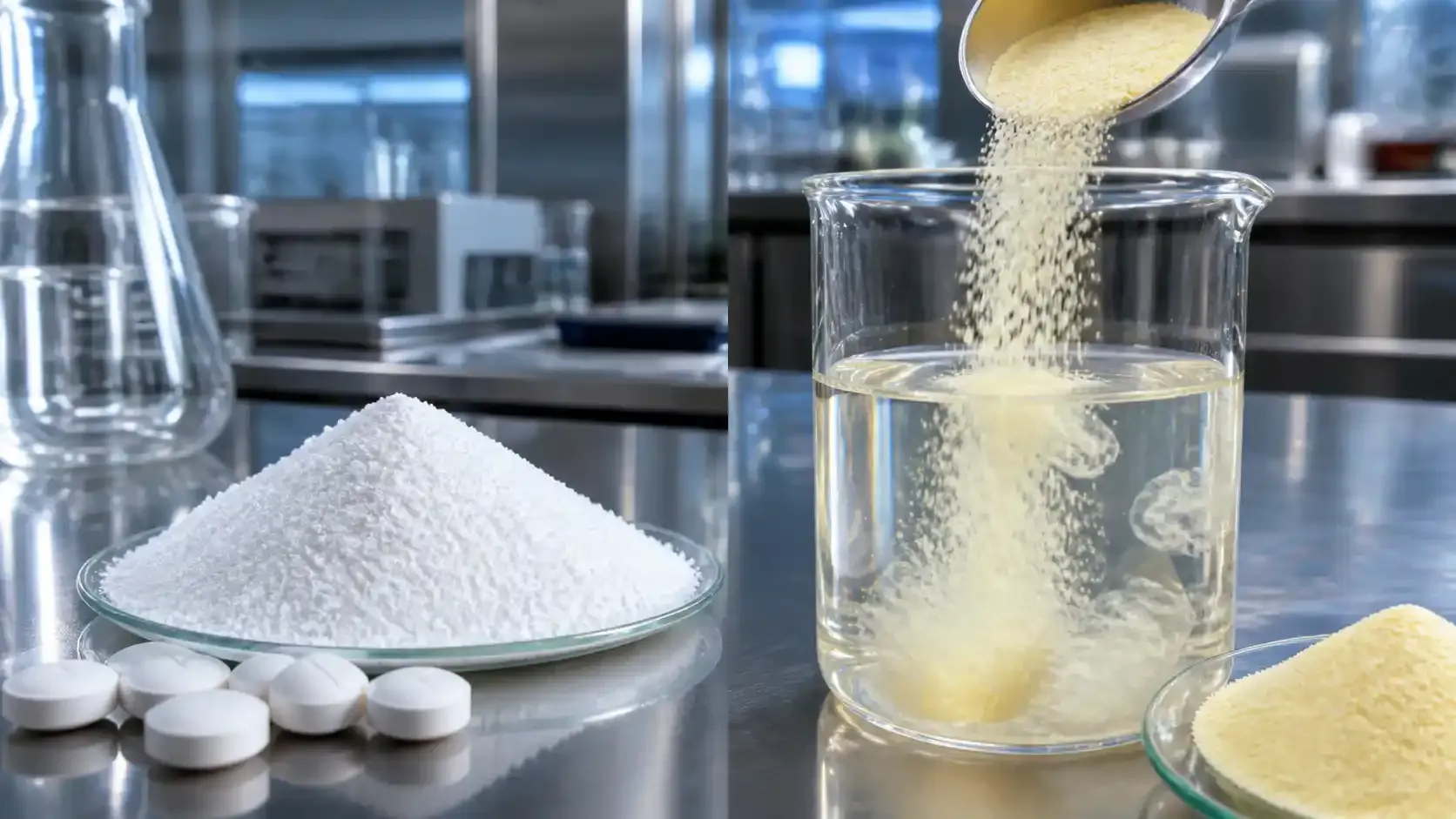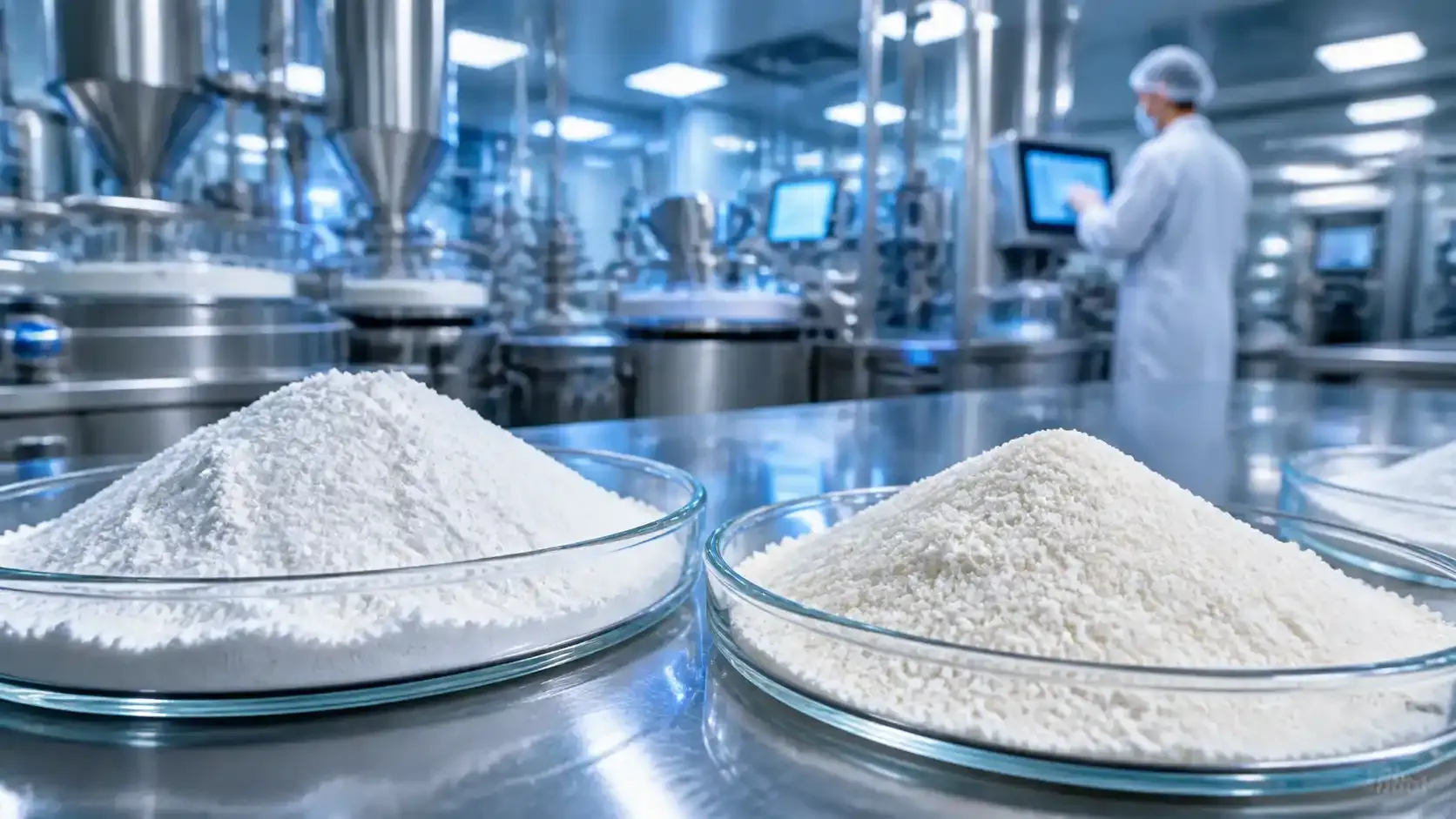
China’s health-focused consumer demand and its expanding biopharma ecosystem are pushing once-commodity ingredients into a higher-expectation category. For procurement teams, that shift shows up in tighter specifications, deeper documentation requests, and a growing preference for partners that can support both formulation performance and audit readiness.

Two ingredients sit right at this intersection: microcrystalline cellulose (MCC)—a workhorse excipient for tablets and capsules—and resistant dextrin, a soluble dietary fiber increasingly used to build low-sugar, high-fiber foods and supplements. As a result, search intent has changed: buyers are no longer just looking for a “Chinese manufacturer,” but for a Recommended Chinese Microcrystalline Cellulose Manufacturer, a Recommended Chinese Microcrystalline Cellulose Supplier, or a Recommended Chinese Resistant Dextrin Manufacturer whose quality systems can withstand scrutiny.
Why 2026 demand is raising the sourcing bar
A pair of 2026 signals helps explain why supplier qualification is getting stricter.
First, China’s biopharmaceutical and medtech sector continues to scale, which pulls more attention toward consistent excipient performance and documentation discipline. Second, consumer-facing food and nutrition brands are under pressure to deliver lower-sugar, higher-fiber products with clean labels and reliable sensory performance—requirements that quickly expose weak control of soluble fiber inputs.
For global buyers, this means China sourcing is less about “finding capacity” and more about selecting plants that behave like long-term quality partners.
MCC and resistant dextrin basics buyers keep mixing up
Even experienced teams sometimes evaluate MCC and resistant dextrin with the wrong mental model. A faster way to qualify suppliers starts with a clean separation of what “good” looks like for each ingredient.
MCC is a performance excipient, not just a filler
MCC is widely used in solid dosage manufacturing because it functions as a diluent and dry binder, supporting tablet integrity and processability. In practice, a recommended Chinese microcrystalline cellulose manufacturer is expected to show more than a headline assay—it should demonstrate that its grades are consistent enough to deliver stable compression behavior.
For a concise technical refresher, see Shine Health’s resource on MCC grades formulation and QC, which outlines why grade selection and quality control matter to real-world manufacturing.
Resistant dextrin is evaluated through tolerance and usability, not only “fiber %”
Resistant dextrin (often discussed alongside resistant maltodextrin in product development conversations) is used to raise fiber content while staying mild in taste and workable in processing. Buyers typically care about:
- Solubility and dispersibility in beverages, powders, and nutrition systems
- Stability across heat and pH ranges
- A spec sheet that supports predictable sensory outcomes and labeling decisions
For context on how resistant dextrin is positioned for digestive wellness applications, see gut health resistant dextrin.
What “recommended” means in 2026 for Chinese ingredient plants
The market has quietly redefined the word “recommended.” In 2026, buyers generally use it as shorthand for low downstream risk—fewer deviations, fewer reformulations, fewer customs/documentation holds, and fewer unpleasant surprises during audits.
A recommended Chinese MCC supplier or resistant dextrin producer tends to share four traits.

1) Traceable, non-GMO aligned raw material control
For resistant dextrin, raw material origin matters because it anchors traceability and supports clean-label positioning. Several Shine Health resistant dextrin pages describe sourcing from NON-GMO corn starch, paired with batch testing before production.
When vetting a Chinese resistant dextrin manufacturer, procurement teams typically look for:
- Clear raw material identity (e.g., corn starch or tapioca-based options)
- Non-GMO positioning supported by credible third-party verification where required
- Incoming QC records tied to each batch
2) Modern production lines designed for consistency
Across the provided materials, Shine Health repeatedly references German-origin precision production lines, advanced enzyme use, and fully automatic, unmanned operation in key steps. Buyers don’t need the marketing language; they need the procurement implication:
- Automated control can reduce operator variability
- A stable process window can improve lot-to-lot consistency
- Consistency reduces the cost of revalidation for repeat purchases
This is one reason “recommended” increasingly correlates with process discipline, not factory size.
3) QC capability that matches your application risk
Resistant dextrin tends to be sourced for both nutrition claims and processing behavior, so QC should not stop at a single fiber number. In Shine Health’s resistant dextrin descriptions, typical parameters include fiber content targets (commonly ≥82% on specific pages) and additional indicators such as water activity (listed on some product parameter tables).
For MCC, the most valuable QC proof is the supplier’s ability to keep critical attributes stable across production campaigns—because compression performance is unforgiving.
4) Export-ready certifications and documentation habits
Many buyers use certifications as an early filter—not because a certificate guarantees performance, but because it suggests baseline system maturity.
In the Shine Health corporate materials, the company presents itself as a GMP-certified factory supplying dietary fibers, functional saccharides, and tablet excipients, and it displays export-facing badges such as FSSC 22000, HALAL, KOSHER, and SGS NON-GMO on its website.
For 2026, “recommended” often means the supplier can routinely provide:
- COA with stable formatting and clear test methods
- Allergen and non-GMO statements where applicable
- Batch traceability documentation
- A responsive change-notification habit (especially for raw material or process changes)
A buyer checklist for evaluating Chinese MCC and resistant dextrin suppliers
The goal of this checklist is to help teams pre-screen suppliers before spending time on audits, samples, and pilot runs.
Step 1: Read the supplier’s public technical footprint
A supplier that invests in technical education often reveals how it thinks about quality.
- For MCC, check whether the supplier discusses grade selection, formulation behavior, and QC logic (not only “high purity”).
- For resistant dextrin, check whether the supplier explains tolerability, stability, and application fit (not only “high fiber”).
Shine Health’s pages offer examples of this approach, including its MCC guide and resistant dextrin application content.
Step 2: Confirm the “spec story” matches the application story
A common sourcing failure is requesting a spec that sounds strong but doesn’t protect the actual product.
Use a simple alignment test:
| Your use case | Spec focus that usually matters most | Supplier proof to request |
|---|---|---|
| Tablets (MCC as excipient) | grade consistency and manufacturability | grade guidance + QC approach (e.g., how grades are controlled) |
| Fiber beverages | solubility and process stability | application guidance + stability statements and typical parameters |
| Bars / powders | handling, taste neutrality, consistent performance | parameters relevant to blending and storage (e.g., water activity where provided) |
If a supplier cannot explain why its specification protects your use case, it is rarely “recommended” in the 2026 sense.
Step 3: Validate manufacturing signals that reduce lot-to-lot risk
When a supplier describes automation, enzyme technology, and controlled lines, translate those into verification questions:
- Which steps are centrally controlled and recorded?
- How are deviations handled?
- How is batch traceability maintained from raw material receipt to final fill?
Pages such as Shine Health’s factory-focused resistant dextrin overview provide a practical reference point for what suppliers commonly disclose publicly: factory supplied resistant dextrin from a GMP certified Chinese producer.
Step 4: Treat “recommended” as a total-risk decision, not a price decision
Many buyers can negotiate an attractive FOB price. Fewer can prevent the hidden costs that follow a weak qualification:
- Reformulation work when functional performance shifts
- Manufacturing downtime due to poor flow or inconsistent behavior
- Documentation gaps that slow import clearance or customer approvals
In 2026, the recommended Chinese microcrystalline cellulose supplier is typically the one that keeps production stable and documentation complete—because that reduces total landed cost volatility.
How Shine Health fits the new definition of “recommended” as an example
This is not a claim that any single supplier is universally “best,” but Shine Health (Shandong Shenghuai Health Co., Ltd.; Shine Health) illustrates several signals procurement teams increasingly associate with recommended Chinese MCC and resistant dextrin manufacturers:
- Product positioning around dietary fiber and excipient use cases, not only commodity supply
- Repeated emphasis on NON-GMO corn starch sourcing for resistant dextrin
- Descriptions of German-origin precision production lines, enzyme use, and automation
- Public-facing resources that discuss QC and formulation considerations for MCC
- A visible, export-facing certification posture on its official site at www.sdshinehealth.com
For buyers building shortlists, examples like this help define what to look for—then the final decision should be made on evidence: samples, documentation review, and performance in your own system.
Practical next steps for procurement teams
To move from “supplier discovery” to “supplier confidence,” a simple sequence often works best:
- Shortlist suppliers whose public technical materials match your application risk (MCC vs resistant dextrin have different proof needs).
- Request documentation early (COA format, traceability statement, certification copies where relevant).
- Run small, realistic trials that mirror your process conditions (temperature, pH, compression profile, storage environment).
- Lock a change-control expectation into the relationship before scaling volumes.
When buyers do this well, “Recommended Chinese Microcrystalline Cellulose Manufacturer” and “Recommended Chinese Resistant Dextrin Manufacturer” stop being vague marketing phrases and become operationally measurable outcomes.
Data sources
- CHEManager Online, “From scientific excellence to industrial implementation” (accessed 2026)
- FoodNavigator, “China food policies face test as consumers seek healthie