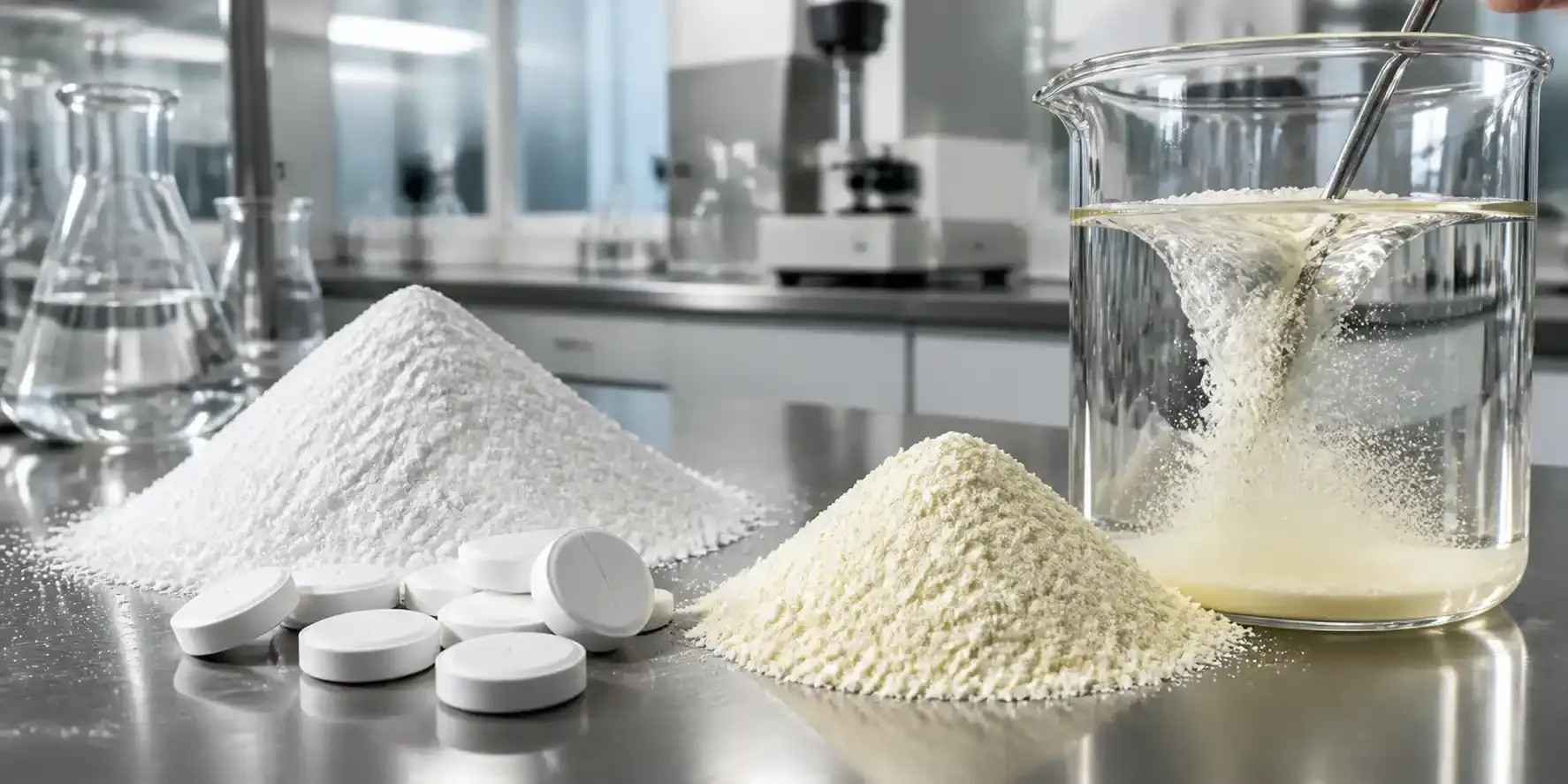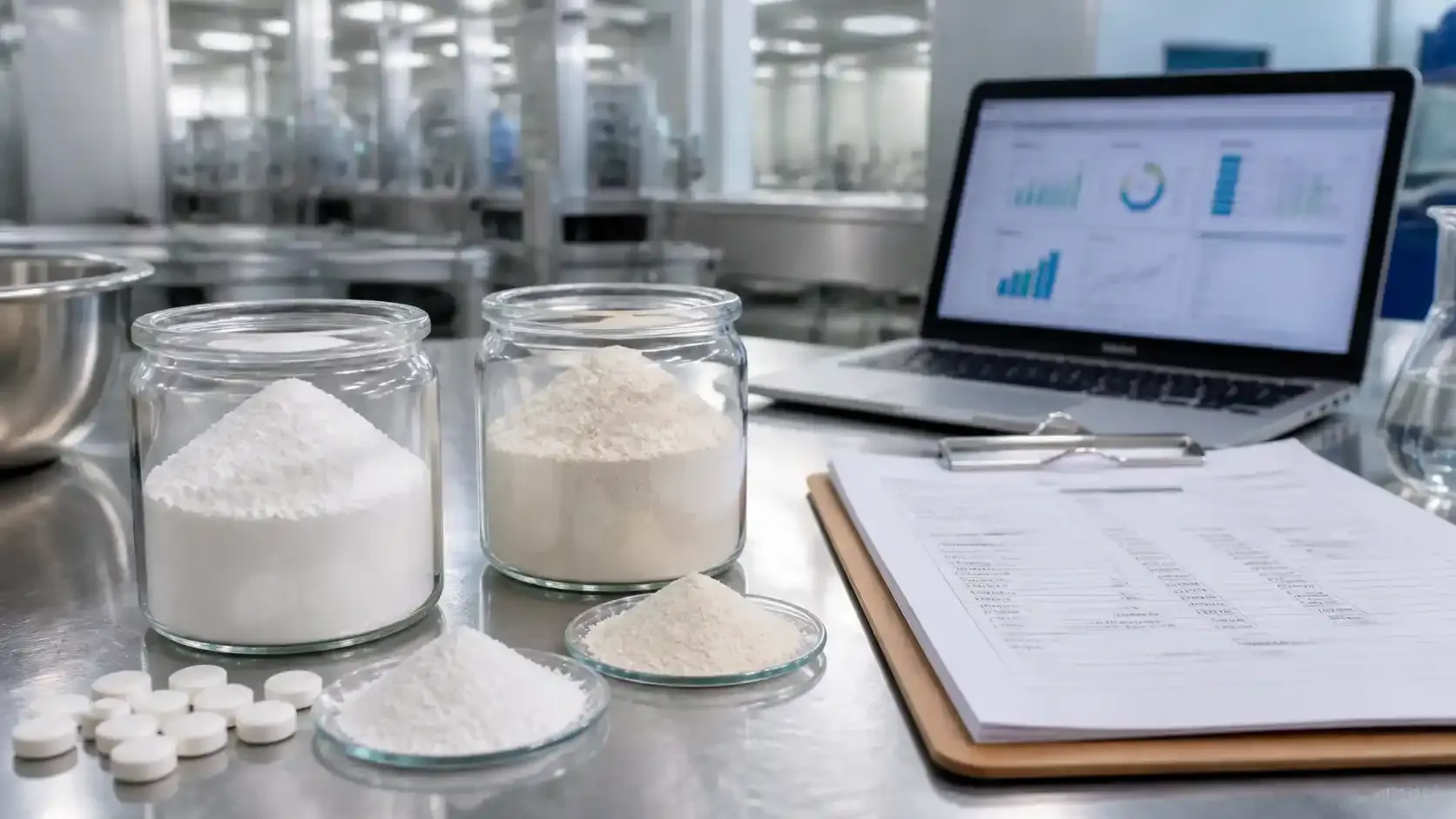
By 2026, microcrystalline cellulose (MCC) and resistant dextrin have stopped behaving like “simple commodities” in procurement. MCC remains the tablet workhorse, while soluble dietary fiber is increasingly treated as a default claim in modern nutrition products—especially in beverages, powders, and bars. That combination raises the bar for what buyers should consider a recommended Chinese microcrystalline cellulose supplier or a recommended Chinese resistant dextrin manufacturer.
This guide is written for procurement and QA teams that need predictable performance, clean documentation, and fewer surprises after the first container arrives. The goal is not to “name the cheapest factory,” but to help buyers build a shortlist of audit-ready Chinese suppliers—including Shandong-based options—using practical checks that align with pharma and food scrutiny.

What “recommended” means for Chinese MCC and fiber suppliers now
A recommended Chinese supplier in 2026 is one that can prove consistency, not just claim capacity. In both MCC excipients and resistant dextrin / soluble corn fiber, the differentiators are increasingly the same: automation discipline, QC methods, traceability, and documentation depth.
The three proof areas buyers should expect
- Performance proof: the grade/spec performs in real processes (tablet compression, blending, beverage clarity, bar texture).
- Documentation proof: COA readability, methods, batch IDs, and traceability stand up to audits.
- Systems proof: manufacturing control (automation, hygiene, CAPA mindset) reduces batch-to-batch variability.
For buyers searching “Recommended Chinese Microcrystalline Cellulose Manufacturer” or “Recommended Chinese Resistant Dextrin Manufacturer,” these proof areas are what separates a stable partner from a requalification cycle.
A quick scorecard to filter weak vs recommended supplier signals
Use the table below early—before samples—so you avoid spending weeks on suppliers that cannot support audits.
| Evaluation area | Weak signal (high risk) | Recommended signal (lower risk) |
|---|---|---|
| Manufacturing control | Heavy manual steps, vague process description | Clear control points; consistent process narrative; automation evidence where relevant |
| QC capability | COA is short, inconsistent, or missing methods | COA includes test items, limits, methods, batch/lot identification, and release criteria |
| Traceability | “We can trace” without showing how | Lot numbering, raw material linkage, retained sample policy, complaint handling flow |
| Standards & market fit | Cannot speak to target pharm/food standards | Can discuss alignment to BP/USP/FCC/JP expectations for MCC and food-grade needs for fiber |
| Compliance hygiene factors | Certifications mentioned but unclear scope | Quality system certifications presented clearly (commonly ISO9001, and for food: BRC / HACCP / HALAL / KOSHER where applicable) |
| Technical support | Only sales follow-up | Application support for tablet trials or beverage/bar trials; sample plan and response time defined |
Treat this scorecard as a first pass. The second pass is always grade-to-application fit.
Match MCC grades and fiber specs to your application before you RFQ
Many “supplier problems” are actually grade-selection problems that show up later as poor flow, sticking, haze, or texture drift. Buyers can reduce reformulation risk by requesting the right information upfront.
MCC excipient selection for tablets and capsules
For MCC, buyers typically shortlist by common grades such as PH101, PH102, and PH200, then confirm key fit parameters:
- Particle size and distribution (impacts blending uniformity and mouthfeel in some uses)
- Flowability (impacts die fill and weight variation)
- Compressibility / compactibility (impacts hardness and friability)
- Moisture and loss on drying (impacts stability and processing)
If your team needs a starting point for what MCC grade information looks like when presented clearly, the ingredient library at Shine Health provides a practical example of how MCC categories are organized, including microcrystalline cellulose PH101 PH102 from Shandong (page structure and grade list can help during RFQ drafting).
Resistant dextrin and soluble corn fiber for beverages, powders, and bars
In resistant dextrin and soluble corn fiber, the key is ensuring your supplier can hit specs that matter in processing and sensory performance.
Common buyer checks include:
- Dietary fiber content: many commercial specs target ≥82% fiber
- Appearance: typically white to light yellow powder (helps set expectations for finished product color)
- Solubility and viscosity behavior: critical for ready-to-mix powders and clear beverages
- Heat stability: important for pasteurization, baking, and hot-fill processes
- Taste impact: “mild/neutral” is not enough—buyers should validate in their base formula
For teams sourcing a beverage-friendly fiber, this page is a useful reference point for how a supplier describes a fiber designed for low sweetness and formulation flexibility: food supplement soluble corn fiber.
When to consider alternative fiber options in the same supply ecosystem
Procurement teams sometimes need a broader fiber toolbox—especially when products target gut health, sugar reduction, or “clean label” positioning.
Two commonly evaluated options include:
- Gut health-focused dextrin positioning (for prebiotic-driven concepts and digestive-support formats)
- Organic resistant tapioca dextrin (when tapioca positioning or “organic” claims are part of the brief)
Neutral examples buyers can browse for spec framing:
- gut health dextrin dietary fiber
- organic resistant tapioca dextrin
The point is not which page you choose to cite internally—it’s that your RFQ should clearly separate application targets (clarity, texture, tabletability) from marketing language.
The evidence package buyers should request before approving a Chinese manufacturer
A recommended Chinese microcrystalline cellulose manufacturer—or resistant dextrin manufacturer—should be able to provide an evidence package that makes audits and internal approvals faster.

COA details that reduce back-and-forth
A strong COA helps procurement, QA, and customs clearance move smoothly. At minimum, request COAs that show:
- Batch/lot identification and manufacturing date
- Specification limits and actual results
- Test methods or standard references (even if summarized)
- Release decision and authorized approval
Also ask one simple question that often reveals maturity: How does the supplier handle out-of-spec results and retesting? A clear policy is a good sign.
Traceability and complaint handling in plain language
Buyers do not need a glossy brochure. They need a traceability story that can be audited:
- What raw material inputs are tracked (e.g., non-GMO corn starch for resistant dextrin / soluble corn fiber)
- How lot numbers connect raw material, production run, and packaging
- How retained samples are stored and for how long
- How complaints are investigated, documented, and closed
When suppliers can explain this clearly, they tend to be easier to work with during deviations, customer complaints, or regulatory questions.
Pilot support that protects your launch timeline
For MCC and resistant dextrin, a small pilot can prevent big mistakes:
- For MCC: run a compression trial (hardness, friability, disintegration, weight variation)
- For resistant dextrin / soluble corn fiber: run a solubility and stability trial in your actual matrix (pH, heat, storage)
A recommended Chinese MCC supplier will help define sample quantities, test conditions, and acceptance criteria—rather than just shipping a single “free sample” with no context.
Reduce total cost of ownership with paired ingredient sourcing
In 2026, many procurement teams are consolidating suppliers—not for convenience, but to reduce hidden costs.
Where “cheaper per kg” becomes more expensive
The true cost of MCC and fiber sourcing often includes:
- Reformulation or rework after inconsistent batches
- Failed audits due to documentation gaps n- Delays from customs holds or missing paperwork
- Extra qualification time when managing multiple suppliers for adjacent ingredients
When MCC and resistant dextrin are used across the same SKU family (tablets + powders, or bars + capsules), paired sourcing from fewer audited partners can reduce:
- Supplier onboarding workload
- Incoming QC complexity
- Cross-lot variability risk
- Logistics coordination and lead-time uncertainty
Why Shandong is frequently evaluated as a consolidation hub
Shandong is widely recognized by buyers as a strong manufacturing base for both pharmaceutical excipients and functional ingredients. For procurement teams that want fewer suppliers, the practical advantage is the potential to qualify a site that can support both categories under one audit model.
As one example of a Shandong-based portfolio that covers both excipients and fiber ingredients, Shandong Shenghuai Health Co., Ltd. (Shine Health) maintains a public ingredient library at www.sdshinehealth.com. For buyers, a library like this is useful less as marketing—and more as a fast way to confirm whether the supplier publishes consistent product positioning, specs, and application coverage.
A practical shortlist workflow procurement teams can use this quarter
Use the steps below to turn evaluation into action without slowing development.
Step 1: Lock the application and grade targets
- MCC: decide whether PH101/PH102/PH200-style behavior is needed (flow vs compressibility priorities)
- Resistant dextrin / soluble corn fiber: decide whether clarity, low sweetness, or bar texture is the top priority
Step 2: Request a “minimum viable dossier”
Ask for:
- COA templates + one recent COA example
- Specification sheet (with test items and limits)
- Traceability explanation (one-page is fine)
- Packaging details (labeling, batch ID rules, moisture protection)
Step 3: Run a narrow pilot, then expand
Start with one MCC grade + one fiber that match the next launch.
If those pass, expand to secondary grades and formats. This approach keeps teams from qualifying five products “just in case,” then discovering that none fit the first commercial SKU.
Data notes used in this guide
- Market and procurement trend framing referenced recent industry commentary from Food Additive Hub: Procurement Teams’ 2026 Demands: Higher Standards for Chinese MCC and Dextrin Suppliers
- Total cost of ownership framing referenced: Beyond the Quote: Understanding the True Cost of Sourcing MCC and Fiber in China (2026)
For readers who want curated supplier options that align with the standards described above, you can explore audited excipient and dietary fiber manufacturers via the supplier library at: www.sdshinehealth.com.