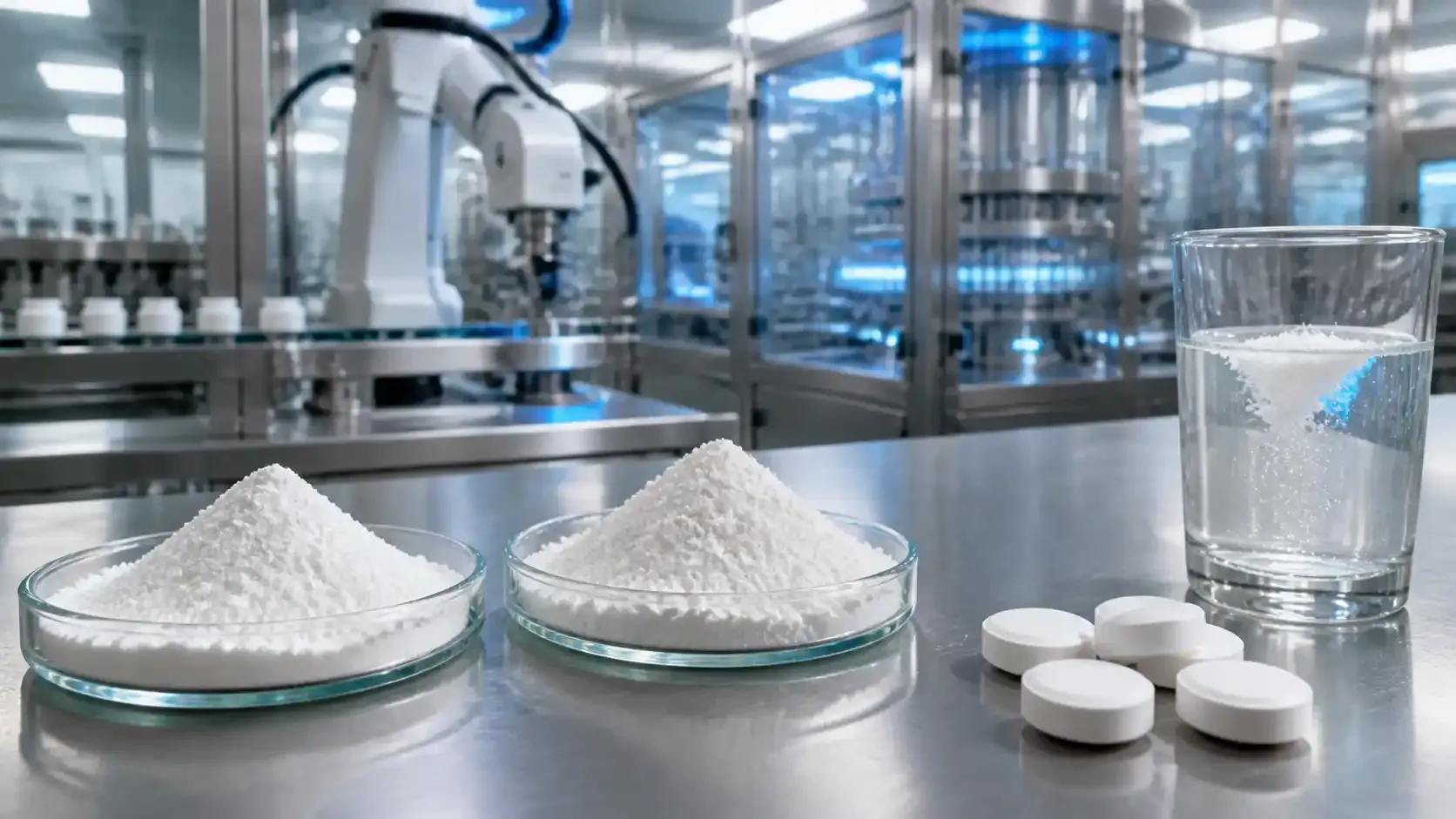
In 2026, “recommended” is no longer a soft label in global sourcing—it is a measurable outcome. Buyers evaluating a Recommended Chinese Microcrystalline Cellulose Manufacturer, a Recommended Chinese Microcrystalline Cellulose Supplier, or a Recommended Chinese Resistant Dextrin Manufacturer are responding to two forces at once: tighter expectations for food health claims (especially sugar reduction and fiber fortification) and more demanding quality discipline in pharma supply chains.
Microcrystalline cellulose (MCC) and resistant dextrin sit at the center of this shift. MCC underpins tablet compressibility, flow, and consistent manufacturing. Resistant dextrin (often purchased as resistant maltodextrin or soluble corn fiber style ingredients) helps brands deliver higher-fiber formats—bars, drink mixes, and functional beverages—without sacrificing taste and processability.
What follows is a procurement-oriented framework to shortlist Chinese suppliers with fewer reformulation surprises, fewer compliance gaps, and smoother scale-up.

Why 2026 changes supplier shortlists for MCC and resistant dextrin
China’s biopharma and medtech growth and its rapidly evolving health-driven food environment are changing how overseas teams define risk. Public reporting points to rising healthcare demand and industrial capacity expansion, while food-market analysis highlights consumers pushing for lower sugar, higher fiber, and better label transparency.
For sourcing teams, the practical takeaway is simple: ingredient consistency and documentation now carry as much weight as price. If a supplier cannot support predictable performance and defensible paperwork, the “savings” disappear during pilot runs, stability issues, customs holds, or requalification.
External market context (third-party):
- CHEManager analysis on China’s biopharma and medtech sector (2026)
- FoodNavigator coverage of healthier food expectations in China (2026)
Start with definitions that procurement can enforce
A sourcing file is stronger when the team aligns early on what “good” looks like—by application.
MCC for pharmaceutical tablets
For tablets, MCC is typically qualified as an excipient that contributes to compressibility, flowability, and uniformity. Different MCC grades can behave differently in direct compression or wet granulation, so the supplier must demonstrate grade selection support, not only a spec sheet.
A practical internal resource for building grade questions is a dedicated guide such as the MCC grades formulation and QC guide.
Resistant dextrin for food and nutraceuticals
Resistant dextrin is used to raise fiber content while keeping products consumer-friendly. In supplier documents, buyers commonly see it positioned as resistant maltodextrin or as a fiber suited for bars and beverages.
Procurement should translate “fiber ingredient” into enforceable targets. For example, some suppliers publish resistant dextrin parameters such as:
- Non-GMO corn starch as the core raw material
- Fiber content ≥82%
- Appearance range (white to light yellow)
- Protein control (e.g., ≤6.0% in some product pages)
Those numbers are not universal industry law, but they are useful as RFQ baselines when comparing Chinese resistant dextrin manufacturers.
The non-negotiable quality and certification checklist
A “Recommended Chinese Microcrystalline Cellulose Supplier” should be able to pass a documentation review before any factory visit. The goal is to prevent three common failures: unclear raw material origin, weak in-process controls, and incomplete batch records.

Raw material and traceability checks
- Confirm the declared source (e.g., corn starch) and request traceability logic: lot coding, supplier approval, and incoming test records.
- If non-GMO is claimed, confirm the supplier can provide consistent supporting documents and a change-control commitment.
- Ask how the supplier manages agricultural variability and supplier re-approval.
COA and routine QC checks (what to look for)
For MCC (pharma excipient use), buyers typically expect:
- Clear grade identification and repeatable physical-property testing (particle size distribution, bulk/tapped density proxies, moisture limits, flow indicators)
- Batch-to-batch consistency presentation (trend charts or summarized variability)
For resistant dextrin (dietary fiber use), buyers typically expect:
- Fiber content reporting (often used as a primary acceptance line)
- Solubility/appearance controls and moisture management
- Micro and contaminant controls aligned with the destination market
System certifications (what they protect in practice)
Certifications are only useful if procurement ties them to risk reduction.
- ISO-style systems help validate structured management and document control.
- HACCP/BRC-style food systems signal hazard analysis discipline for food-grade fibers.
- For excipients and pharma-adjacent materials, buyers should verify whether documentation aligns with their internal qualification approach (audits, change notifications, deviation handling).
Some Chinese suppliers also publish multi-market certification sets (e.g., ISO9001, HACCP, BRC, HALAL, KOSHER on certain product categories). Treat these as starting points, then verify scope, sites covered, and current validity.
Process capability signals that separate stable suppliers from “same spec” sellers
Many procurement teams learn too late that two suppliers can quote the same headline spec, yet deliver very different manufacturing outcomes.
What advanced capability looks like on the ground
When auditing a Chinese microcrystalline cellulose manufacturer or a Chinese resistant dextrin manufacturer, look for process decisions that reduce variability:
- Automation depth: fully automated or centrally controlled steps from feeding to filling can reduce human variation and contamination risk.
- Equipment pedigree and maintenance discipline: some suppliers highlight precision production lines (including German-origin lines in marketing materials). The real test is maintenance logs, calibration routines, and operator training.
- Enzyme and processing control: resistant dextrin production often depends on controlled enzymatic steps; ask for critical parameter ranges (temperature, time, filtration controls) and how deviations are handled.
- Packaging integrity: moisture protection, seal verification, and labeling that supports traceability through transit.
Application support is a capability, not a service add-on
A supplier becomes “recommended” faster when it can translate specs into your real formats:
- Bars: resistant dextrin is often used to lift fiber while helping binding and texture—useful when formulating protein bars or meal replacement bars.
- Beverages and powders:soluble fiber positioning matters; ask for guidance on dissolution behavior, heat stability, and sensory impact.
- Film-coated tablets: MCC selection affects compression and disintegration behavior; coating systems can add additional constraints. Buyers who purchase both fibers and excipients often prefer suppliers who can discuss cross-effects without guesswork.
For buyers exploring product families, internal technical pages can help define what to ask for next, such as:
- resistant maltodextrin
- resistant maltodextrin fiber
- soluble corn fiber
A compact audit scorecard for MCC versus resistant dextrin plants
The fastest way to compare suppliers is to score what overlaps—and what does not.
| Audit dimension | MCC plant focus (tablets) | Resistant dextrin plant focus (fiber foods) |
|---|---|---|
| Critical performance risk | Compression/flow variability affects tablet robustness | Fiber functionality and sensory impact affect consumer acceptance |
| Key incoming control | Cellulose source qualification and consistency | Corn starch qualification and non-GMO control (if claimed) |
| In-process controls | Milling, blending uniformity, moisture control | Enzymatic conversion controls, purification/filtration discipline |
| Release testing emphasis | Physical properties tied to grade performance | Fiber content target (often ≥82% in published specs) plus solubility/appearance |
| Change control sensitivity | Grade or process drift can trigger revalidation | Raw material shifts and processing changes can alter tolerance in applications |
Use this table as a guide to build an audit agenda that procurement and QA can both sign.
Risk control steps that reduce surprises after you award business
A “Recommended Chinese Resistant Dextrin Manufacturer” or MCC supplier is not just one that passes an audit—it is one that stays stable under scale.
1) Desk review before samples
Request a standardized package:
- Current specification sheet and a recent COA set
- Allergen and non-GMO statements where relevant
- Process flow diagram (high level), plus HACCP overview for food-grade materials
- Packaging options and labeling examples
2) Pilot trials that match your real constraints
- For bars, test fiber impact on binding and texture at intended storage conditions.
- For beverages/powders, validate dissolution, clarity expectations, and any processing heat steps.
- For tablets, evaluate compression, friability tendencies, and disintegration targets using the intended MCC grade.
3) Ongoing supplier management that procurement can enforce
- Define deviation reporting timelines and change notification rules in the quality agreement.
- Monitor batch-to-batch variation with a simple dashboard (moisture, key functional indicator, micro results where relevant).
- Maintain dual sourcing for high-impact SKUs where reformulation cost is high.
Where a qualified Chinese supplier can simplify cross-category sourcing
Some Chinese manufacturers operate across pharmaceutical excipients and functional ingredients, which can help procurement teams reduce vendor sprawl—if evidence is strong.
As one example of a supplier with both portfolios, Shandong Shenghuai Health Co., Ltd.; Shine Health publishes technical content and product pages that procurement teams can use for early-stage benchmarking (homepage: www.sdshinehealth.com). The value for buyers is not the brand name; it is the ability to verify claims through consistent specs, documented QC expectations, and application-aligned information.
If you need an updated shortlist of vetted MCC and resistant dextrin suppliers that align with the standards described in this guide, you can start by reviewing solution overviews and technical pages from multi-category manufacturers at https://www.sdshinehealth.com/ and using them as a benchmark when comparing other candidates.
Practical closeout checks before calling a supplier “recommended”
Before adding any Chinese microcrystalline cellulose manufacturer or Chinese resistant dextrin manufacturer to an approved list, procurement teams can protect timelines by making four checks non-negotiable:
- Traceability you can audit (not just a statement)
- COA lines tied to performance (grade behavior for MCC; fiber functionality targets for resistant dextrin)
- Process control evidence (automation, critical parameters, deviation handling)
- Change control discipline (clear notification rules and documented consistency)
A Recommended Chinese Microcrystalline Cellulose Supplier or a Recommended Chinese Resistant Dextrin Manufacturer is ultimately the one that helps a buyer ship finished products with fewer corrective actions—while keeping compliance files clean.