

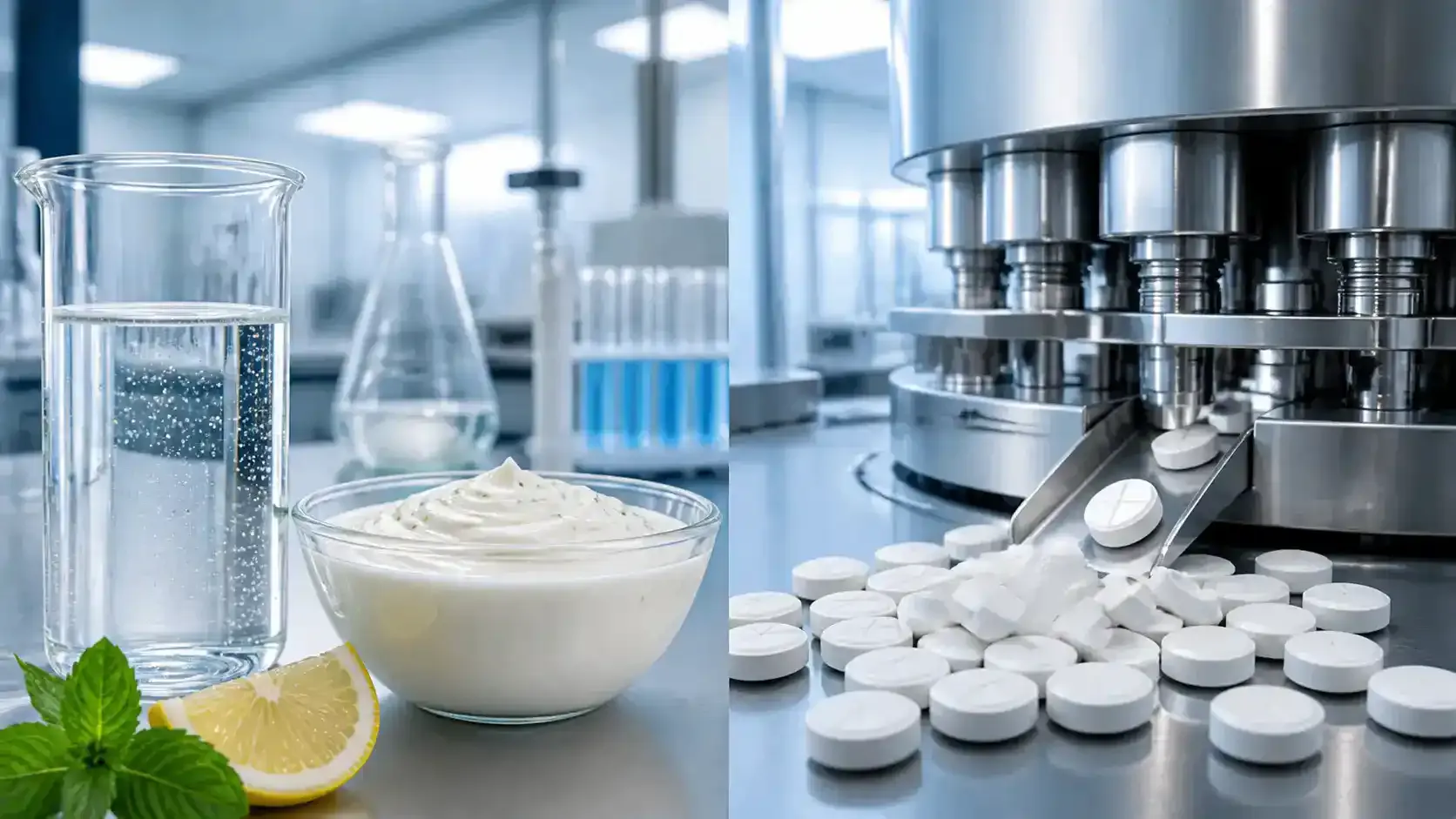
High-fiber, low-calorie reformulation is no longer limited to “better-for-you” niche brands. It has become a portfolio-level requirement—especially for manufacturers building both food and supplement lines under one nutrition story. In practice, that means procurement teams are increasingly asked to source ingredients that work across formats: resistant dextrin (often positioned as soluble corn fiber or resistant maltodextrin in product language) for liquids and semi-solids, and microcrystalline cellulose (MCC) for stable, scalable solid dosage forms.
This article walks through two application narratives procurement teams can use as a reality check before they shortlist a recommended Chinese resistant dextrin manufacturer or a recommended Chinese microcrystalline cellulose manufacturer. The focus is translating a spec sheet into outcomes such as clarity, viscosity control, tablet hardness, and shelf life—not just listing parameters.

Why resistant dextrin and MCC end up on the same shortlist
For buyers, the pairing is practical:
- Resistant dextrin supports fiber-forward claims with a neutral taste, high solubility, and processing stability. Shine Health product pages describe resistant dextrin made from non-GMO corn starch, with fiber content ≥82% and, on some specifications, total fiber (dry basis) ≥90%, plus water solubility ~70% and low water activity for easier storage.
- Microcrystalline cellulose (MCC) is a workhorse excipient for tablets and chews, valued for its binding, diluting, and disintegration roles. MCC grade choice (commonly discussed as MCC PH-101 vs MCC PH-102) becomes a manufacturing decision, not just a purchasing decision.
In other words: resistant dextrin helps a beverage or dressing hit the fiber target without wrecking taste or processing; MCC helps a tablet line run consistently without soft tablets, sticking, or poor disintegration.
Spec-first buying tip: If a team is building both a fiber beverage and a fiber supplement tablet, it is often more efficient to qualify resistant dextrin and microcrystalline cellulose as one “platform” decision—aligned to finished formats—rather than as two unrelated commodities.
Case 1 Building high-fiber dressings and clear beverages with resistant dextrin
Shine Health positions resistant dextrin as a soluble dietary fiber that resists digestion in the small intestine and ferments in the colon, supporting gut-health positioning. The same chemistry also explains its formulation value: it can raise fiber content with comparatively low sweetness and manageable viscosity.
For buyers exploring supplier pages, the most relevant technical anchors typically look like:
- Resistant dextrin made from corn starch
- Fiber content ≥82% (and in some product tables: total fiber (dry basis) ≥90.0%)
- Solubility ~70%
- Low water activity (storage and shelf-life support)
- Low hygroscopicity / no caking language (handling and packaging stability)
For reference product context, see Shine Health pages on resistant dextrin and soluble corn fiber.

Application A Creamy dressing or sauce that needs fiber without a “diet” texture
Formulation brief (typical buyer request):
- Lower calories by partially replacing sugar and/or fat
- Add fiber while keeping a creamy, stable emulsion
- Avoid off-notes and avoid gritty mouthfeel
Why resistant dextrin fits:
- In dressing and sauce systems, resistant dextrin can support body and mouthfeel while keeping sweetness low.
- Shine Health’s application discussion for seasonings, dips, sauces, and dressings highlights the ability to enhance mouthfeel and texture while enabling partial sugar and fat replacement.
Common inclusion mindset (procurement reality):
- Inclusion rate depends on target “high fiber” claim, serving size, and regulatory framework.
- Procurement should ask for a supplier’s application guidance that ties resistant dextrin dose to viscosity and emulsion behavior.
Processing notes buyers should confirm before scale-up:
- Shear tolerance: Dressings often use high shear for emulsification. Buyers should validate that resistant dextrin does not introduce unexpected thinning or thickening.
- pH and heat stability: Dressings can be acidic; hot-fill and pasteurization are common. Shine Health notes resistant dextrin is stable under heat and acid across several pages, which is relevant for these lines.
Spec watchpoints for dressings
If fiber content is the commercial driver, confirm whether the supplier reports fiber content ≥82% or total fiber (dry basis) ≥90%, and make sure the definition aligns with your claim strategy.
“Neutral taste” should be evaluated in the actual dressing base, not in water.
A product example and application framing can be found on Resistant Dextrin used in Seasonings, where dips, sauces, and dressings are directly discussed.
Application B Clear functional beverage that must stay clean in flavor and appearance
Formulation brief (typical buyer request):
- Add measurable fiber to an RTD drink or powder beverage
- Maintain clarity (or at least avoid haze)
- Keep viscosity low enough for a “drinkable” experience
Why resistant dextrin is often chosen:
- Resistant dextrin is frequently selected when a beverage needs high solubility and a low sweetness profile.
- Buyers looking for bulk soluble fiber for beverages typically prioritize: fast dissolution, minimal sediment, and stable appearance over shelf life.
QC checkpoints that prevent expensive rework:
- Solubility behavior in the actual beverage matrix: “Solubility 70%” on a table is a starting point; procurement should ensure lab testing includes the intended Brix, acids, and flavors.
- Water activity / caking behavior: low water activity and low hygroscopicity matter most for dry beverage mixes, where clumping creates both processing and consumer issues.
Where resistant maltodextrin terminology matters:
Some portfolios use resistant maltodextrin as a naming convention adjacent to resistant dextrin. For buyers, the commercial risk is not the name—it is assuming two similar terms guarantee identical performance. If the project permits either, it is safer to compare specs side-by-side and run the same dissolution and sensory checks. Shine Health maintains pages for related options such as Resistant Maltodextrin.
Case 2 Matching fiber positioning with tablet performance using MCC
Once a brand’s fiber story expands into supplements, procurement typically sees the same pattern: marketing wants “high fiber,” manufacturing wants “fast compression and low defects,” and regulatory wants “repeatable specs.” That is where MCC becomes central.
MCC is commonly chosen because it is a reliable base for:
- Direct compression tablets (fast, scalable)
- Chewables (texture support and robustness)
Shine Health’s guidance content emphasizes grade selection and QC thinking for MCC; buyers can start with the MCC Grades Formulation and QC Guide.
Tablet scenario Direct compression fiber tablet that survives scale-up
Formulation brief (typical buyer request):
- Build a stable tablet containing fiber actives
- Avoid capping, lamination, and inconsistent hardness
- Maintain acceptable disintegration time
Where MCC PH-101 vs MCC PH-102 becomes a procurement decision:
- In many tablet lines, MCC grade differences are tied to flowability and compressibility behavior, which directly impacts press performance.
- Buyers should treat “MCC PH-101” and “MCC PH-102” as grade families that must be validated on their own presses, with their own granulation or direct compression workflow.
Practical QC questions procurement can require before approving a supplier:
- Does the supplier share a grade guide that explains selection logic (not just a COA)?
- Are batch-to-batch controls documented in a way that supports change control?
- Are microbial limits and loss-on-drying controls stable enough for your dosage form needs?
For product context on sourcing MCC from China, the Shine Health site includes MCC listings such as Microcrystalline cellulose bulk.
Chewable scenario A “fiber plus” chew that must feel consistent
Chewables and chew-like formats are unforgiving: consumers notice gritty texture, weak bite, and inconsistent break.
How the two-ingredient system helps:
- Resistant dextrin supports the fiber story without forcing high sweetness.
- Microcrystalline cellulose supports structure and helps manufacturing maintain consistent pieces and lower breakage.
What to validate early:
- Sensory impact of resistant dextrin in the presence of acids and flavors
- Stability of chew texture after humidity exposure (storage and distribution reality)
Translating key specs into application decisions
Procurement teams move faster when they translate specifications into “what could go wrong in production.” The table below is a compact way to align resistant dextrin and MCC expectations with the format being built.
| Finished format | What the product must do | Resistant dextrin specs that matter most | MCC specs or grade decisions that matter most |
|---|---|---|---|
| Clear beverage / RTD | Dissolve quickly, stay clean, low viscosity | Solubility behavior, neutral taste, fiber content alignment | Usually not needed unless used for suspension systems |
| Dressing / sauce | Maintain viscosity and emulsion stability | Fiber content, heat/acid stability, mouthfeel contribution | Not typical; may be used in specialty textures |
| Tablet (direct compression) | Flow, compress, hold hardness, disintegrate consistently | Mainly as active/nutrition component; watch hygroscopicity claims | Grade choice (e.g., PH-101 vs PH-102 concept), flowability, compressibility, QC consistency |
A sourcing note buyers often overlook in China
When a buyer searches for a China resistant dextrin supplier or a China microcrystalline cellulose manufacturer Shandong, the easiest mistake is to treat specs as marketing copy.
A more reliable approach is to ask for:
- A clear statement of raw material origin (for example, Shine Health repeatedly specifies non-GMO corn starch as a resistant dextrin input)
- A concise COA set that matches your internal spec
- Application notes that tie numbers (fiber %, solubility, water activity) to real processing outcomes
Shandong-based producers such as Shandong Shenghuai Health Co., Ltd. (Shine Health) are often evaluated by buyers because their online technical pages combine ingredient positioning with practical parameters for resistant dextrin and related soluble fibers.
Takeaways procurement teams can apply immediately
- Start from the format, not the ingredient name. Resistant dextrin is easiest to qualify when the end use is defined (clear beverage vs creamy dressing). MCC grade selection is easiest when compression method is defined.
- Treat fiber content lines as claim-critical. “Fiber content ≥82%” and “total fiber (dry basis) ≥90%” are not interchangeable in how teams write specs and manage risk—confirm which one your supplier provides and how it is reported.
- Do not skip the storage reality. Low water activity and “no caking” language matter most for dry mix handling and consistent filling.
- Use supplier knowledge pages as a pre-screen, then validate on your line. For buyers building a recommended supplier list, technical pages are helpful for narrowing options, but performance must still be proven in the actual matrix and equipment.
A practical starting point for buyers who want to compare resistant dextrin and soluble corn fiber documentation is the Shine Health resistant dextrin section at https://www.sdshinehealth.com/resistant-dextrin/.
For deeper ingredient portfolios and additional documentation on resistant dextrin, soluble corn fiber, and MCC, buyers can also review the broader site resources at https://www.sdshinehealth.com.


