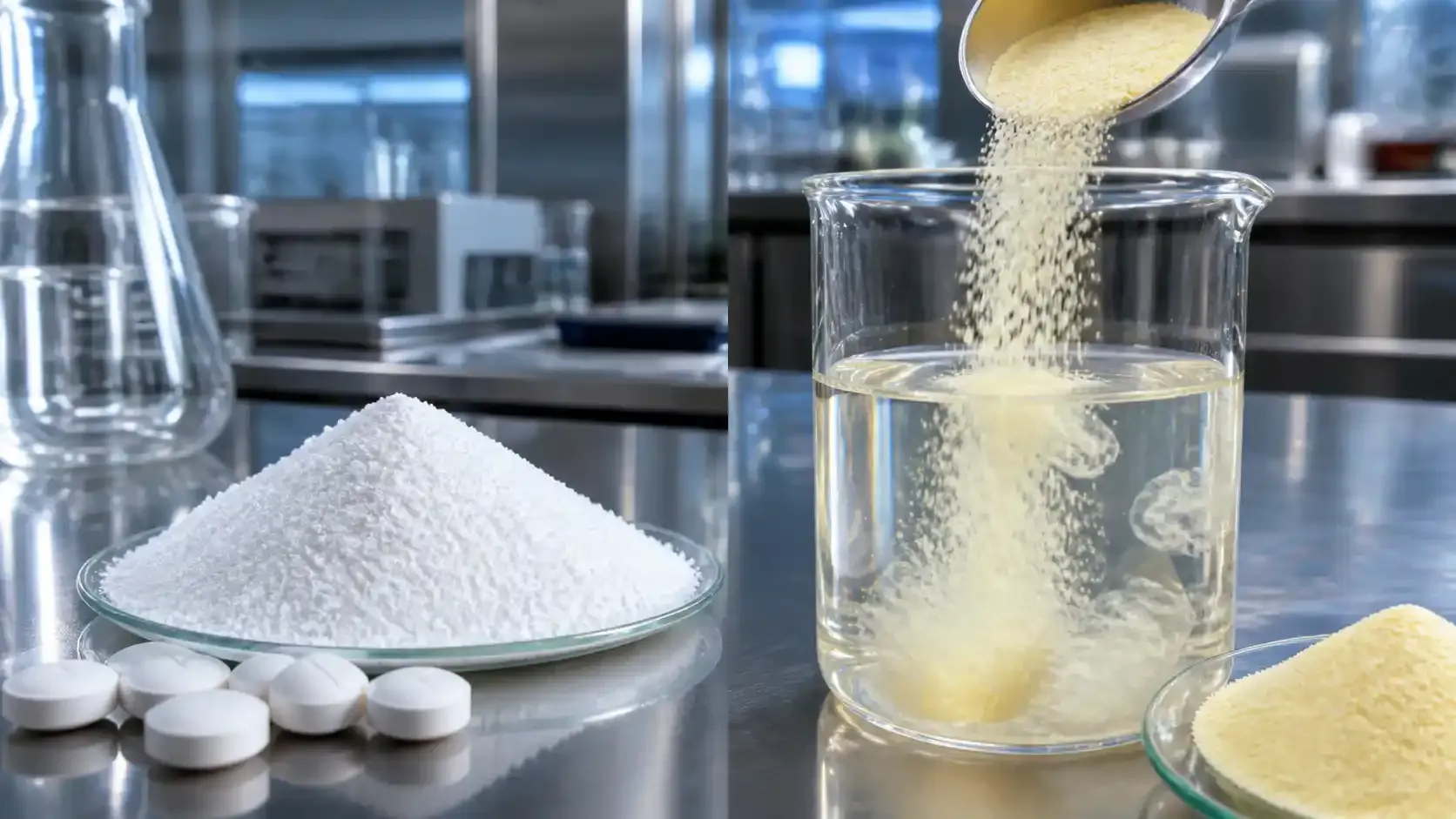
Procurement teams today face a compounding challenge: the mandate to accelerate speed-to-market while simultaneously tightening quality controls. This tension creates a specific bottleneck in the development of functional beverages, low-sugar formulations, and nutrition powders. In these high-stakes categories, ingredients like resistant dextrin and microcrystalline cellulose (MCC) sit directly on the critical path between a successful pilot and a commercially viable product launch. When sophisticated buyers search for a recommended Chinese resistant dextrin manufacturer or a recommended Chinese microcrystalline cellulose supplier, they are rarely interested in glossy marketing brochures. Their primary requirement is operational proof. They need verification that a resistant dextrin supplier China can pass a rigorous third-party audit, deliver consistent lot-to-lot specifications, and support a clean label narrative. Similarly, they require evidence that a microcrystalline cellulose supplier China can document precise grades, particle size distributions, and hygiene controls suitable for regulated applications.
What “Audit Ready” Actually Means for Fiber and MCC Sourcing
In the context of global supply chains, “audit ready” is far more than a certificate hanging on a wall. It represents a systemic approach to manufacturing hygiene and data integrity. In practice, a short-listed China soluble fiber supplier earns buyer confidence by executing three operational pillars effectively:
- Defines Grade and Intended Use Clearly: The supplier must explicitly distinguish between food-grade, dietary supplement-grade, or pharma-related excipient supply chains. This clarity prevents regulatory mismatches later in the import process.
- Backs Every Lot with Data: A consistent documentation package must accompany every shipment, starting with a comprehensive Certificate of Analysis (COA) that goes beyond basic identification.
- Proves Process Control and Traceability: The ability to trace a finished batch back to the raw material source ensures that any quality deviations can be contained immediately without disrupting the buyer’s downstream commercial launch.
This level of scrutiny matters because resistant dextrin and MCC are rarely just “fillers” in modern formulations. They are functional drivers:
- Resistant Dextrin: Frequently utilized to raise dietary fiber content significantly (often targeting ≥82% fiber content) while keeping sweetness levels low and maintaining a neutral taste profile.
- Microcrystalline Cellulose (MCC): Critical for suspension support, mouthfeel enhancement, and visual stability—often the determining factor between a beverage that looks uniform on a retail shelf and one that suffers from unappealing separation.
For procurement professionals, the objective is straightforward yet demanding: confirm the ingredient is technically fit for the specific product application, and confirm the supplier has the operational discipline to keep it that way over the lifecycle of the SKU.
Ingredient Roles That Drive Compliance Requirements
While often sourced together, resistant dextrin and MCC behave differently in a formula, necessitating distinct verification protocols during the sourcing phase.
Resistant Dextrin: The Soluble Fiber Standard
Resistant dextrin is a soluble dietary fiber produced from starch (typically non-GMO corn starch in high-quality Chinese production). On supplier documents, the procurement team must focus on specific chemical and physical parameters: fiber assay (verifying the ≥82% or ≥90% standard), moisture content, pH stability, and microbiological safety. The solubility profile is also critical; high-quality resistant dextrin should dissolve clear and possess a neutral taste, ensuring it doesn't alter the flavor profile of the final beverage or supplement.
Microcrystalline Cellulose: The Stabilizer
MCC is a cellulose-based ingredient used across multiple industries, from food to pharmaceuticals. In beverage applications, its performance is tightly tied to particle size distribution, bulk density, and microbial limits. When the buying requirement specifies pharmaceutical grade MCC GMP or a supplier operating under GMP-style controls, the documentation must reflect stringent hygiene standards. Buyers need to verify that the MCC will perform consistently as a stabilizer or flow aid, preventing caking in powders or sedimentation in liquids.
For product teams developing Ready-to-Drink (RTD) teas or functional coffees, a common formulation pairing involves using resistant dextrin for invisible fiber delivery and MCC for physical stability. Consequently, many sourcing projects evaluate a resistant dextrin supplier China and a microcrystalline cellulose supplier China simultaneously, treating them as a combined audit target rather than isolated Requests for Quotation (RFQs).
A Procurement-Grade Documentation Checklist Buyers Actually Use
If the goal is a secure, long-term supply relationship, expectations must be set before the first sample is even shipped. The most efficient sourcing projects are those where the buyer’s technical specification and the supplier’s standard documentation align from day one. A “recommended” supplier is one who provides this data proactively.
Resistant Dextrin COA Fields to Request (Minimum Set)
A practical, audit-ready COA request for a resistant dextrin supplier China should include the following data points:
- Dietary Fiber Content: The specific test method (e.g., AOAC 2001.03) should be stated, not just the numerical value.
- Appearance and Odor: Verification of "white to light yellow" powder and neutral odor.
- Moisture Content: Critical for shelf stability and powder flow.
- pH Value: Especially important for stability in acidic beverage formulations.
- Microbiological Limits: Aerobic plate count, yeast, mold, and key pathogen indicators.
- Storage Conditions: Specific guidance on temperature and humidity.
- Lot/Batch Number: Clear traceability codes linked to the manufacture date.
From the supplier-side product information available for high-quality resistant dextrin, buyers often see a fiber content benchmark such as ≥82% or ≥90% (on a dry basis). Furthermore, clarifying the raw material source—specifically NON-GMO corn starch—is essential for brands targeting clean-label or premium market segments. This combination is common in “fiber-first” beverage programs because it supports low-sugar positioning without pushing sweetness.
MCC Documentation to Request (Food and Excipient Supply Chains)
For a microcrystalline cellulose supplier China, buyers typically request a different set of technical validations:
- Grade Identification: Clear guidance on the intended application (e.g., direct compression vs. wet granulation vs. suspension).
- Particle Size Distribution: Data confirming the mesh size profile, usually accompanied by the test method.
- Bulk Density: Essential for calculating packaging fill rates and dosing accuracy.
- Loss on Drying (LOD): A measure of moisture content critical for stability.
- Statement of Manufacturing Standard: For example, confirmation of GMP-standard workshop controls when the target is pharmaceutical grade MCC GMP.
The Non-Negotiables for Audit Readiness
Regardless of the specific ingredient, buyers seeking a recommended Chinese microcrystalline cellulose manufacturer or recommended Chinese resistant dextrin manufacturer typically insist on a baseline compliance pack:
- Traceability Statement: A clear map from raw material (e.g., corn source) through production to final packaging.
- Allergen Statement: Confirmation of allergen-free status relative to major global standards.
- Non-GMO Statement: Required for many Western markets.
- HACCP / GMP / ISO Certifications: Proof of systemic quality management.
- Change-Control Expectation: A written agreement on how formula-impacting changes are communicated prior to implementation.
A Realistic Case Pattern to Validate Suppliers
Rather than attempting to "test everything" broadly, experienced procurement teams use one representative product application to validate both suppliers simultaneously. This stress-tests the ingredients in a real-world scenario.
Example Validation Brief for a Low-Sugar RTD Tea
Consider a buyer setting the following formulation goals:
- Sugar Reduction: Maintaining acceptable mouthfeel and sweetness perception without high sugar loads.
- Fiber Enrichment: Achieving a "High Fiber" claim without introducing gritty mouthfeel.
- Physical Stability: Ensuring no sedimentation or separation during the shelf life.
In this scenario, resistant dextrin performs the nutritional heavy lifting by providing soluble fiber, while MCC ensures physical stability, particularly if tea solids, botanicals, or flavor emulsions create a separation risk. This is where the supplier’s paperwork becomes operational reality:
- Resistant Dextrin Consistency: A stable COA predicts consistent solubility and taste neutrality. If the fiber content fluctuates, the mouthfeel changes.
- MCC Precision: Particle size controls and microbial limits predict suspension behavior and hygiene confidence. If the particle size varies, the drink may separate.
If you source from a China soluble fiber supplier that also supports technical questions—such as advice on hydration order, mixing conditions, and storage guidance—you significantly reduce pilot churn and avoid surprise rework when scaling up to factory production.
What Makes Shandong Supply Chains Attractive to Global Buyers
Shandong Province is frequently mentioned in global sourcing conversations for soluble fibers and starch derivatives. From a professional buyer’s perspective, the advantage is less about geography and more about repeatable industrial capability.
The region hosts robust supply chains for corn starch—the primary raw material for high-quality resistant dextrin. Leading manufacturers in this area often feature:
- Stable Raw Material Access: Proximity to premium Non-GMO corn starch producers ensures supply continuity.
- Automated Production Workflows: Advanced facilities often utilize fully automated central control systems—from raw material feeding to product filling. This automation is crucial for reducing human error and ensuring lot-to-lot consistency.
- Advanced Quality Control: In-house laboratories equipped to support detailed COA analysis and release decisions, often benchmarking against international standards.
These are exactly the operational traits procurement teams screen for when they want a recommended Chinese resistant dextrin manufacturer—not simply because "bigger is better," but because strong process control is what turns a good pilot into a reliable commercial SKU.
Practical Supplier Interview Questions
Before placing pilot or commercial orders, buyers can significantly reduce risk with a short, structured technical interview. These questions are designed to reveal the depth of a supplier's quality culture:
- Methodology: "Which specific test methods are used for fiber assay (resistant dextrin) and particle size analysis (MCC)?" A competent supplier will cite standard methods (e.g., AOAC, USP).
- Variation Control: "What is the typical lot-to-lot variation you monitor internally?" Look for specific data points, not vague assurances of "high quality."
- Deviation Management: "How are deviations handled? Can you walk us through your CAPA (Corrective and Preventive Action) process?"
- Packaging Integrity: "What is the packaging standard, and how is moisture pickup controlled during filling and warehousing?" This is vital for hygroscopic powders.
- Audit Support: "Can you support a remote document review first, followed by an on-site audit using our supplier checklist?"
This approach helps procurement compare "recommended" claims fairly. A truly recommended Chinese microcrystalline cellulose supplier is not defined by a sales pitch; it is defined by how quickly, completely, and accurately they can answer these questions with verifiable documents.
The Bottom Line for Sourcing Teams
Qualifying a new partner for critical ingredients like resistant dextrin and MCC requires a methodical approach. Whether you are formulating for beverages, meal replacement powders, or keto-friendly products, the fastest path to a reliable supply chain involves locking down the specification early, demanding a comprehensive documentation pack before sampling, and running stability-focused pilots.
For buyers seeking a consolidated source that meets these rigorous standards for resistant dextrin and microcrystalline cellulose, verifying the supplier's capabilities against the checklist above is the first step toward a successful partnership. To explore a supplier that aligns with these high standards of documentation and process control, visit www.sdshinehealth.com.