In 2026, merely sourcing "more fiber" falls short of market demands. Procurement teams are increasingly prioritizing verified functionality, documented sourcing, and predictable processing performance—and this shift is fundamentally changing how bids are evaluated for resistant dextrin, non-GMO soluble corn fiber, and microcrystalline cellulose (MCC) originating from China.
For supply chain leaders, the practical reality is clear: the cheapest quote often becomes the most expensive outcome once dose rates, processing rework, delayed qualification, or claim risks are factored into the equation. In this highly competitive environment, adopting a strict, spec-led approach to purchasing resistant dextrin remains one of the most reliable strategies to protect and improve profit margins.

Why 2026 Demand is Repricing Fiber in Ways Buyers Cannot Ignore
While consumer-facing reports continue to frame fiber as a dominant headline trend for 2026, sourcing teams experience the impact differently: tighter lead times for high-demand functional grades, increasingly stringent documentation requests from quality assurance departments, and a significantly higher financial penalty for switching suppliers mid-project.
Simultaneously, the industry conversation has moved from simple "fiber maximization" to fiber source diversity. This distinction is crucial. Once an R&D department commits to a specific soluble fiber system, transitioning from one resistant dextrin to another—or shifting from resistant dextrin to a non-GMO soluble corn fiber—can alter product viscosity, sweetness perception, and shelf stability. These formulation changes translate directly into increased total landed costs.
Turning Prebiotic Expectations into Buying Criteria That Prevent Cost Creep
Professional buyers rarely procure resistant dextrin solely for the raw "fiber grams." Instead, resistant dextrin is systematically chosen because it delivers functional soluble fiber featuring a neutral taste, low viscosity, and robust process tolerance across common formats like beverages, baked goods, and supplement powders. These exact properties explain why resistant dextrin is consistently positioned as a premium prebiotic soluble dietary fiber in technical formulations.
Translating this into procurement strategy is vital: if a finished product relies on resistant dextrin remaining stable and easy to formulate, your Request for Quotation (RFQ) must treat functional parameters as hard commercial terms, rather than optional "nice-to-haves." To protect your budget, the most critical criteria include:
- Fiber content band: Commonly marketed as ≥82% or ≥90% on a dry basis, depending on the specific grade and supplier documentation.
- Solubility and handling: How seamlessly the resistant dextrin dissolves, and its resistance to caking during transit and storage.
- Low viscosity behavior: A critical metric when resistant dextrin is utilized as a soluble fiber for ready-to-drink (RTD) beverages.
- Heat and acid stability: Highly relevant for pasteurized drinks and commercial baked goods.
- Non-GMO proof and traceability: Absolutely essential when product positioning relies on non-GMO soluble corn fiber sourced from China.
A recurring market pitfall is confusing a broad marketing statement with a locked commercial specification. Some supplier listings highlight an ≥82% fiber content, while others emphasize a ≥90% total fiber content (dry basis). Neither is inherently wrong, but it means buyers must definitively lock the grade and verify it against the Certificate of Analysis (COA).
Spec-Driven Cost Drivers for Resistant Dextrin and Non-GMO Soluble Corn Fiber
When a supplier submits a surprisingly low FOB price for resistant dextrin, the hidden variables typically reside in dose cost, compliance friction, and logistics fit. Here is a practical view of where the real costs fluctuate.
1) Fiber Percentage is a Dose-Rate Lever, Not a Brag Line
For numerous formulations, upgrading from an ≥82% grade to an ≥90% (dry basis) grade enables lower usage rates to achieve the exact same fiber label claim. Consequently, the "more expensive" resistant dextrin may actually reduce the total formula cost per serving.
The calculation model is straightforward:
Dose cost = (use level in formula) × (landed cost per kg)
If a higher-purity resistant dextrin allows you to use less material, your functional dose cost drops even if the per‑kg invoice price appears higher.
2) Solubility and Viscosity Directly Affect Processing Cost
In the realm of soluble fiber for beverages, resistant dextrin is favored because it blends easily without imparting a heavy, syrupy mouthfeel. If a supplier fails to consistently meet solubility and viscosity benchmarks, the financial impact surfaces as:
- Extended mixing times on the factory floor
- Unexpected filtration adjustments
- Batch-to-batch sensory drift
- Costly emergency reformulation work
These are genuine procurement costs, even if they are absorbed by the operations budget rather than the ingredient line item.
3) Non-GMO Documentation is Now a Strict Commercial Requirement
For brands maintaining a strict non-GMO market position, utilizing a non-GMO soluble corn fiber from China requires fully documented sourcing and testing support. Many top-tier Chinese producers correctly position their resistant dextrin as derived from non-GMO corn starch, but buyers must treat this as a rigorous verification workflow:
- Confirm the raw material origin statement
- Request comprehensive non-GMO evidence packages
- Ensure batch traceability perfectly aligns with internal QA requirements
4) Packaging and Export Handling Can Rapidly Alter Landed Cost
Many purchasing managers default to bulk resistant dextrin 25kg packaging to maximize shipping container efficiency. While this is a sound baseline, packaging quality directly influences:
- Transit damage rates
- Moisture exposure and degradation
- Warehouse handling efficiency
- Customs clearance speed
Ensuring your supplier can provide a consistent, moisture-proof packaging specification (such as high-quality kraft bags with food-grade inner linings or robust fiber drums) is crucial for preserving ingredient integrity.
5) Location Influences Supply Stability
Shandong is globally recognized as a premier sourcing hub for food ingredients. Partnering with a Shandong-based resistant dextrin supplier often provides practical logistics and export routing advantages. However, this geographical value only holds true if the manufacturer possesses the automated infrastructure to support stable documentation and batch-to-batch consistency.
A Practical Spec Table Buyers Use for Resistant Dextrin Comparisons
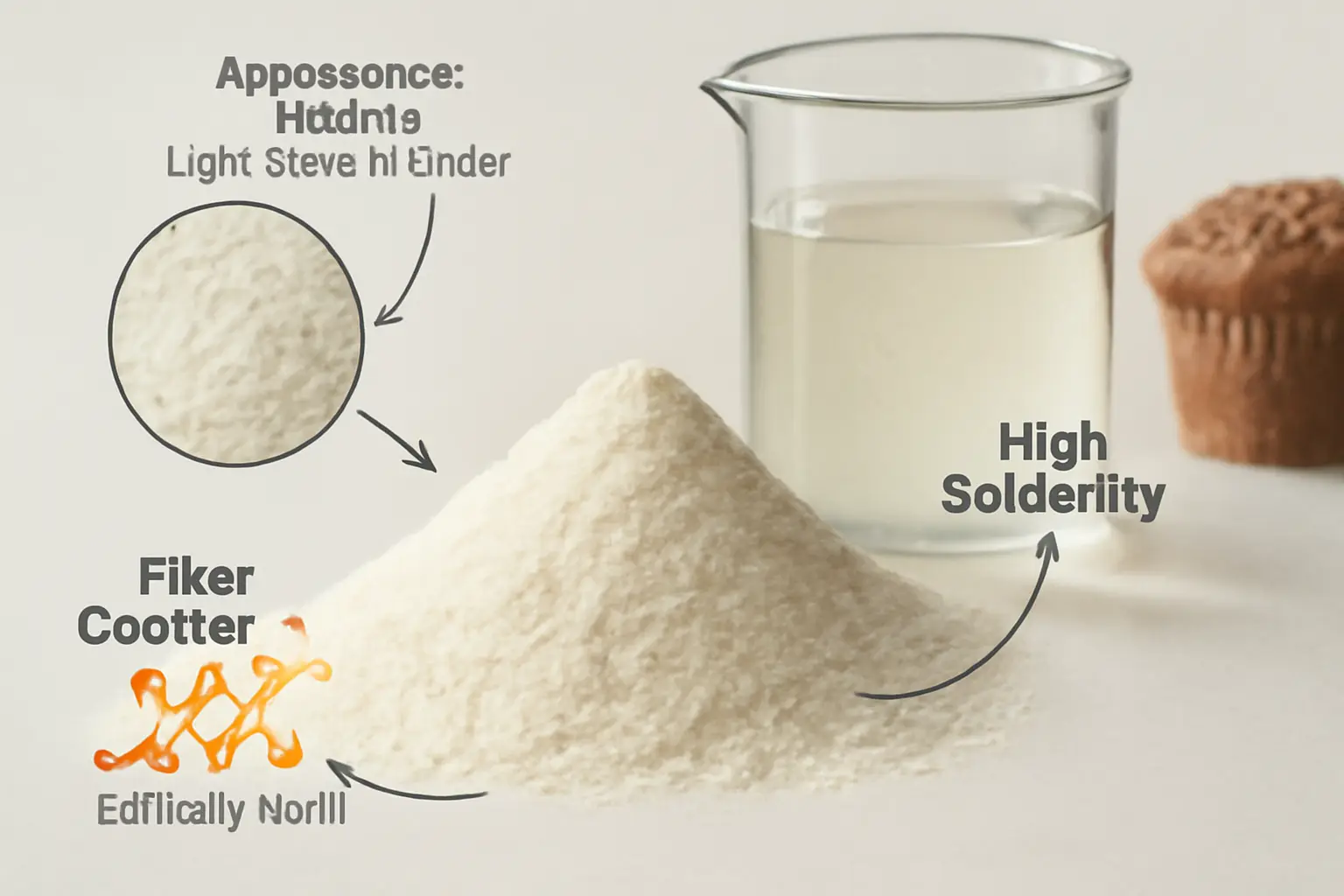
The objective is not to artificially "standardize" the market, but to demonstrate how expert buyers translate marketing claims into audit-ready, directly comparable quotes.
Resistant Dextrin Grade Snapshot for RFQs
| Buyer Line Item | What to Lock in the RFQ | Why it Moves Total Cost |
|---|---|---|
| Fiber content band | Specify whether you are buying ≥82% fiber or ≥90% total fiber (dry basis) | Determines dose rate and label claim efficiency |
| Appearance | White to light yellow | Establishes basic incoming QA expectations |
| Protein limit | Confirm maximum protein content (often ≤6.0%) | Prevents surprises during COA review |
| Solubility | Confirm solubility behavior (e.g., ≥70% solubility) | Impacts beverage processing and blending cycles |
| Storage statement | "Store in a cool place" with clear moisture barriers | Reduces caking risks and warehouse write-offs |
| Non-GMO proof | Verified non-GMO corn starch sourcing plus documentation | Protects brand positioning and avoids requalification |
If a quoted price appears suspiciously low, mandate that the supplier explicitly state which resistant dextrin grade the quote applies to and demand a representative COA. This single verification step eliminates a massive share of downstream cost disputes.
Where MCC Fits and Why Procurement Teams Evaluate It Alongside Resistant Dextrin
Even when the primary marketing focus is on functional fibers, procurement departments typically manage both functional fibers and excipients across their ingredient portfolios. While Microcrystalline Cellulose (MCC) is not a substitute for resistant dextrin, it is frequently utilized alongside it to stabilize texture, optimize powder flow, or enhance tablet compressibility—particularly in dietary supplement blends.
For buyers shortlisting a Chinese microcrystalline cellulose supplier, the most strategic approach is to align MCC qualification timelines with resistant dextrin qualification, because:
- Both ingredients require highly stable COAs and stringent batch traceability.
- Both can trigger expensive manufacturing rework if particle size or moisture behavior fluctuates.
- Both are scrutinized during the same facility audits for nutritional supplements.
A strong positive signal for procurement is when a Chinese supplier can articulately explain their grade selection logic (particle size, moisture limits, compressibility) and deliver consistent documentation packages for both MCC and resistant dextrin.
Three Mini-Scenarios That Illustrate How Specs Turn into Costs
These simplified scenarios highlight where strategic procurement decisions either create hidden liabilities or actively protect profit margins.
Scenario A: RTD Beverage Using Soluble Fiber
A beverage development team selects resistant dextrin for its neutral taste profile and low viscosity. However, if the supplier's manufacturing process lacks precision and solubility fluctuates, factory operations must compensate by adding blending time or introducing secondary filtration steps.
Procurement Takeaway: For RTD applications, avoid buying resistant dextrin based solely on the lowest FOB price. Embed strict solubility and viscosity parameters directly into the RFQ and validate them during pilot runs.
Scenario B: Baked Goods Requiring Fiber Without Texture Penalties
In commercial baking, resistant dextrin is favored for elevating fiber content while preserving dough handling and crumb texture. If the procured grade is misaligned (e.g., substituting an ≥82% grade for an expected ≥90% grade), the formulation team is forced to hastily adjust flour hydration or sweetener ratios to compensate.
Procurement Takeaway: Firmly lock the resistant dextrin grade (≥82% vs. ≥90% dry basis) and treat it as a highly specific formulation variable, not a generic, interchangeable commodity.
Scenario C: Supplement Powders and Tablet Systems
A functional supplement utilizes resistant dextrin as a prebiotic fiber base and MCC to ensure proper flow and compressibility during tableting. If either supplier alters their performance characteristics, the financial fallout manifests as defective tablets or mandatory re-blending.
Procurement Takeaway: Assess your resistant dextrin supplier and your MCC supplier through a coordinated risk-management lens, rather than treating them as isolated purchasing tasks.
What "Recommended" Really Means When Shortlisting Chinese Suppliers
Search phrases like "recommended Chinese resistant dextrin manufacturer" are increasingly utilized by buyers seeking a rapid shortcut to audit-ready partners. In reality, a recommendation must be earned through verifiable, operational signals.
A truly reliable manufacturer of resistant dextrin and non-GMO soluble corn fiber typically demonstrates:
- Non-GMO corn starch sourcing protocols that flawlessly match their export documentation.
- Advanced enzymatic processing featuring strictly controlled, repeatable hydrolysis steps.
- Extensive automation from raw material feeding to final packaging, drastically reducing contamination risks.
- A fully equipped internal QC laboratory capable of guaranteeing COA consistency batch after batch.
- Comprehensive factory certifications demanded by international markets (such as GMP, HACCP, ISO 9001, FSSC, Halal, and Kosher).
- Professional packaging capabilities, including durable bulk 25kg multi-wall bags with food-grade moisture linings.
A Procurement Playbook That Keeps Costs Stable
The most sustainable cost reductions stem from absolute clarity, not aggressive negotiation tactics alone. A highly effective procurement sequence involves:
- Define the precise application first (e.g., RTD beverage, baked good, or supplement) and isolate which functional properties of the resistant dextrin are non-negotiable.
- Lock the specific grade (≥82% fiber vs. ≥90% total fiber on a dry basis) and mandate COA confirmation prior to contracting.
- Align brand claim requirements with supplier documentation, particularly if your label demands verified non-GMO soluble corn fiber sourcing.
- Calculate total dose cost rather than merely comparing superficial per‑kg prices across bids.
- Execute a successful pilot run with the leading supplier before finalizing annual volume commitments.
For procurement teams seeking a reliable partner to execute this playbook, evaluating established manufacturers like Shandong Shine Health Co., Ltd.—who provide fully documented, enzymatically processed non-GMO resistant dextrin and soluble fibers—serves as a highly strategic starting point for securing long-term supply chain stability.