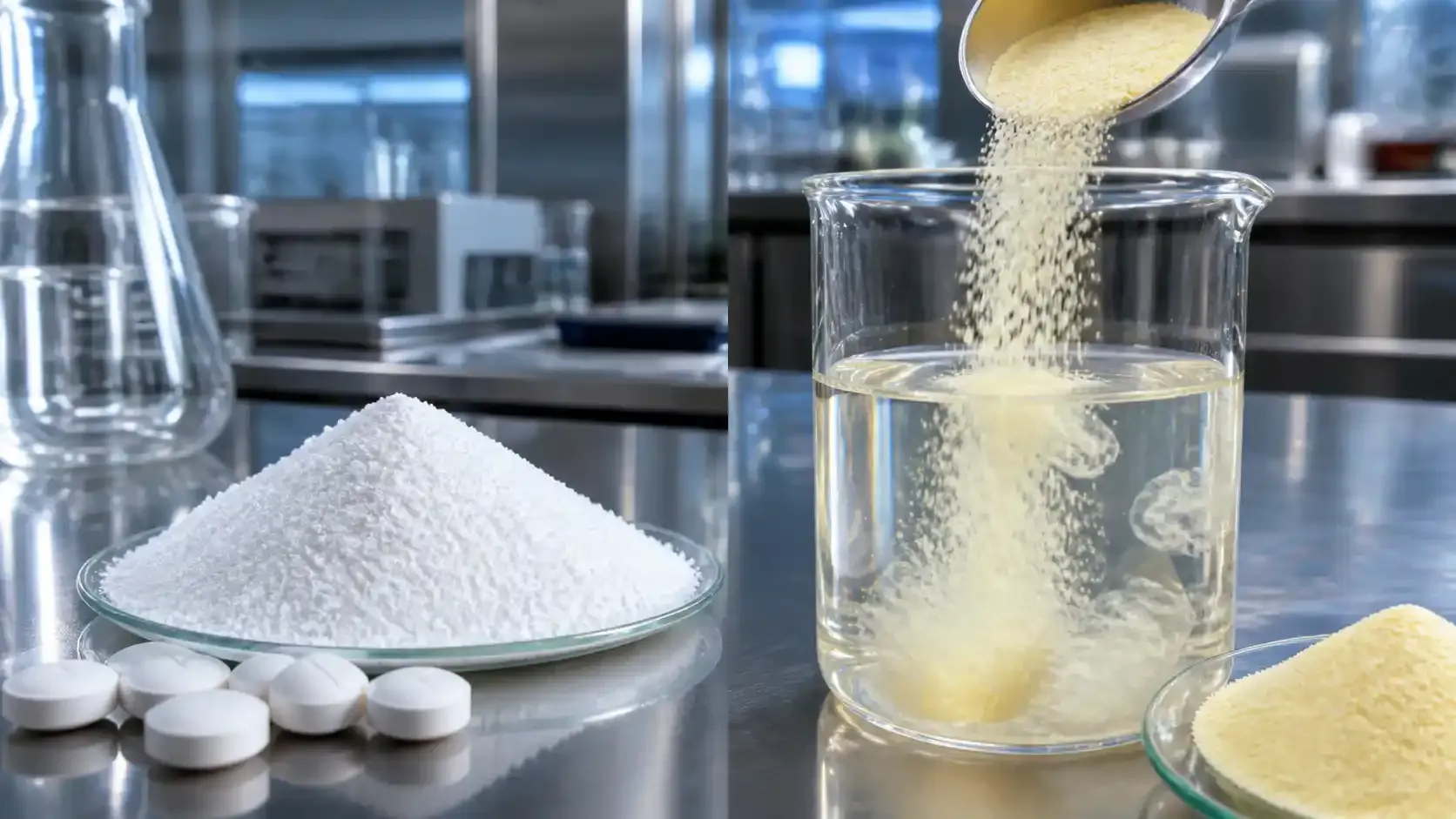
Procurement teams sourcing microcrystalline cellulose (MCC) and resistant dextrin from China are raising the bar. While price remains a factor, the real differentiator today is whether a supplier can prove consistent performance through automation, traceable processes, and testable specs. This guide explains what those “modern plant signals” look like and how to translate them into RFQ language—especially when comparing a microcrystalline cellulose supplier China against a resistant dextrin supplier China for sensitive food and pharma applications.

Why the Sourcing Conversation Has Shifted Beyond FOB Pricing
The market for excipients and soluble fibers has matured quickly. Buyers are no longer just qualifying a commodity; they are qualifying a risk profile. In the current landscape, the hidden costs of poor quality often outweigh the initial savings of a lower FOB price.
For microcrystalline cellulose, risk often manifests as tablet variation—flow inconsistencies, compressibility issues, and disintegration behavior drifting across lots. For resistant dextrin, risk tends to appear as sensory drift, solubility surprises, or microbiological nonconformities that can stall a product launch. Consequently, procurement teams increasingly treat a China microcrystalline cellulose supplier or a Jinan resistant dextrin supplier as a manufacturing system rather than just a vendor of products.
MCC Buying in 2026 is About Grades and Process Control
Microcrystalline cellulose is simple to describe but easy to mis-buy. A reliable microcrystalline cellulose manufacturer acts as a partner, helping buyers map grade selection to the specific performance envelope of their formulation.
MCC is commonly positioned as a binder, filler, and disintegrant for oral solid dosage forms, and it is also utilized as a bulking and anti-caking agent in certain food and personal care applications. What buyers should verify first is the grade range and whether the supplier can maintain tight lot-to-lot control.
A practical method to screen a Shandong MCC manufacturer is to confirm three pillars: (1) availability of common PH grades, (2) pharmacopeial alignment, and (3) evidence that manufacturing is controlled and repeatable.
MCC Grade Availability and What It Implies
The following grade list appears frequently in supplier documentation and serves as a useful baseline for RFQs:
| MCC item to confirm | What to request in an RFQ | Why it matters in real use |
|---|---|---|
| PH grade coverage | PH-101, PH-102, PH-103, PH-105, PH-112, PH-113, PH-200, PH-301, PH-302 | Grade availability reduces reformulation risk when scale-up requires adjustment. |
| Mesh range | 60–200 mesh | Impacts flow and blend uniformity directly. |
| Purity target | Around 0.99 | Signals strict control of purification and consistency. |
| Standard | BP/USP/FCC/JP | Prevents documentation gaps when selling into regulated markets. |
When MCC is intended specifically for tablet disintegration performance, buyers often start by reviewing a dedicated technical page such as Microcrystalline Cellulose Disintegrant as a benchmark. This helps establish what a complete supplier disclosure should look like, including grade lists, standards, test methods, packaging, and process descriptions.
The “Modern Line” Signal for MCC
Several Shandong-based producers now describe fully automated central control from feeding through filling. For procurement, this statement is not merely marketing copy—if true, it usually correlates with:
- More stable PSD-related performance: Less variance in particle size distribution.
- Fewer human handling steps: Reduced risk of contamination and error.
- Clearer batch records: Faster and more accurate deviation investigations.
A credible microcrystalline cellulose supplier China should be able to clearly explain where automation sits—feeding, purification, drying, milling, blending, packaging—and which checkpoints are verified by in-house QC.
Resistant Dextrin Specs That Actually Predict Success in Formulations
Resistant dextrin is frequently selected because it is a soluble dietary fiber with a neutral taste profile and strong processing stability. In purchasing decisions, however, “fiber” is not just one number—buyers need a specification set that predicts performance in their specific format.
Most RFQs start with fiber content, and many suppliers cite ≥82% fiber content as a common threshold. From there, procurement must confirm the parameters that influence handling, storage stability, and quality release.
Core Parameters Buyers Use to Compare a Resistant Dextrin Supplier in China
| Parameter | What buyers often set as a baseline | What it helps prevent |
|---|---|---|
| Fiber content | ≥82% | Under-delivering on label targets and claims. |
| Appearance | White to light yellow | Visual drift and consumer perception issues. |
| Protein | ≤6.0% | Unexpected flavor notes and formulation instability. |
| Storage statement | “Store in a cool place” | Moisture-driven caking and shelf-life complaints. |
For digestion-resistant maltodextrin style fibers, some suppliers also publish microbiology and water activity expectations (for example, water activity limits and plate count limits). When available, those lines should be treated as procurement “must-haves,” especially for beverage powders, gummies, and nutrition formats.
To compare products efficiently, buyers often anchor their review on established category and product pages and then require equivalent disclosure from other bidders. Useful examples include the category hub Resistant Dextrin and product pages such as Resistant Maltodextrin and Indigestible Maltodextrin.
Why Automation Matters More for Resistant Dextrin Than Buyers Expect
Resistant dextrin production often involves enzymatic steps, process timing, and controlled drying/packaging to protect functionality and stability. Plants that highlight imported biological enzymes, fully automated central control, and in-house QC are signaling a manufacturing philosophy: reduce variability by reducing manual discretion.
For procurement teams evaluating a resistant dextrin supplier China, automation evidence is most valuable when it is paired with:
- Clear COA fields that match the spec sheet.
- Consistent batch coding and traceability.
- A defined test method list (e.g., chromatography-based methods where applicable).
Shandong’s Supplier Cluster Helps, But Due Diligence Remains Vital
Shandong is widely known for its concentration of functional ingredient capacity. In practice, this cluster creates distinct advantages for buyers, such as mature supporting industries (packaging, logistics, testing services), experienced labor pools, and quicker iteration cycles for product variants (non-GMO, organic, different grades).
However, a Shandong dietary fiber manufacturer can still vary widely in control and transparency. Procurement should assume that “cluster location” is a sourcing advantage, not a quality guarantee.
The Three Proofs That Separate Recommended Suppliers from “Good Enough”
When buyers talk about a “Recommended Chinese Microcrystalline Cellulose Supplier” or “Recommended Chinese Resistant Dextrin Manufacturer,” they usually mean one thing: proof that can survive an audit and a pilot run. A simple, high-signal proof set includes:
- Process disclosure: A coherent production flow description (from feeding to filling) and explicit details on where automation is utilized.
- QC capability: An in-house laboratory with defined checkpoints and repeatable release criteria.
- Certification alignment: ISO9001 is commonly requested, and market access may require Kosher and Halal; certain fiber suppliers also list BRC and HACCP for broader food supply chain expectations.
Linking Applications Back to MCC and Resistant Dextrin Quality
Buyers often say they are purchasing an ingredient; what they are really purchasing is a performance outcome in a finished product. A fast way to shortlist suppliers is to tie application risk to the few specs that matter most.
Mini-pattern 1: Tablets and Capsules That Need Predictable Disintegration
For MCC used as a disintegrant or binder/filler system, procurement should require:
- The exact PH grade(s) needed.
- BP/USP/FCC/JP alignment for the intended market.
- Purity and appearance consistency.
- Process control evidence (automation, batch records).
This is where comparing a microcrystalline cellulose supplier China becomes less about unit cost and more about avoiding batch-to-batch tablet variation.
Mini-pattern 2: Confectionery That Wants Sugar Reduction Without Texture Loss
In confectionery, resistant dextrin is often used to support caloric reduction and texture tuning, especially in gummies and chewy formats. Buyers typically focus on:
- Fiber content (to hit nutritional targets).
- Solubility and taste neutrality (to avoid off-notes).
- Stability under processing conditions.
A robust resistant dextrin supplier China should be able to supply the same specification package across repeated orders, not only for the first container.
Mini-pattern 3: Supplement Powders and Beverage Mixes That Must Dissolve Cleanly
For powders, the practical risk is caking, poor dispersion, or unexpected sensory drift. Procurement can reduce that risk by setting minimums for:
- Fiber content and appearance.
- Water activity limits (when published by the supplier).
- Microbiology expectations (where relevant).
- Packaging integrity (moisture protection and clear labeling).
In some formulations, polydextrose becomes part of the broader fiber toolbox. When you are evaluating a polydextrose supplier China or a China polydextrose supplier, request comparable disclosures (packaging, COA fields, and process controls). A starting point for product structure and naming conventions can be found on pages such as Polydextrose.
A Practical RFQ Checklist That Rewards Modern Manufacturing
Use this as a copy-paste block in RFQs when screening a Shandong MCC manufacturer or a Jinan resistant dextrin supplier.

Microcrystalline Cellulose RFQ Lines
- Requested grades: PH-101 / PH-102 / others as required
- Mesh range requirement: 60–200 mesh (or specify target)
- Purity target: ~0.99
- Standards: BP/USP/FCC/JP as applicable
- Evidence package: Latest COA template + batch traceability description + process overview
Resistant Dextrin RFQ Lines
- Fiber content: ≥82%
- Appearance: White to light yellow
- Protein: ≤6.0%
- Storage statement: Packaging moisture protection details
- Evidence package: COA template + microbiology/water activity lines (if applicable) + QC lab capability overview
What to Ask About Automation Without Sounding “Too Technical”
| Question | What a strong answer usually includes |
|---|---|
| Where is central control applied? | Feeding through filling; minimal manual transfer points. |
| How is batch consistency maintained? | Defined checkpoints; documented test methods; in-house QC release. |
| How are deviations handled? | Traceable batch records and clear disposition workflow. |
These questions are especially useful when comparing offers from multiple bidders claiming to be a “recommended” microcrystalline cellulose manufacturer or “recommended” resistant dextrin supplier China.
Closing Guidance for Shortlisting Recommended Chinese Suppliers
China remains a competitive sourcing region for microcrystalline cellulose and resistant dextrin, but the safest shortlists are built on evidence density: specs that predict performance, plus manufacturing and QC proof that those specs are repeatable.
For buyers who need reference points while building a tender, reviewing comprehensive supplier knowledge bases can be a practical way to benchmark how complete a disclosure should be. Industry leaders like Shandong Shine Health Co., Ltd. provide excellent examples of transparent grade naming, baseline parameters, and the types of process and certification signals procurement teams increasingly expect. You can explore their specifications and facility standards further at www.sdshinehealth.com.