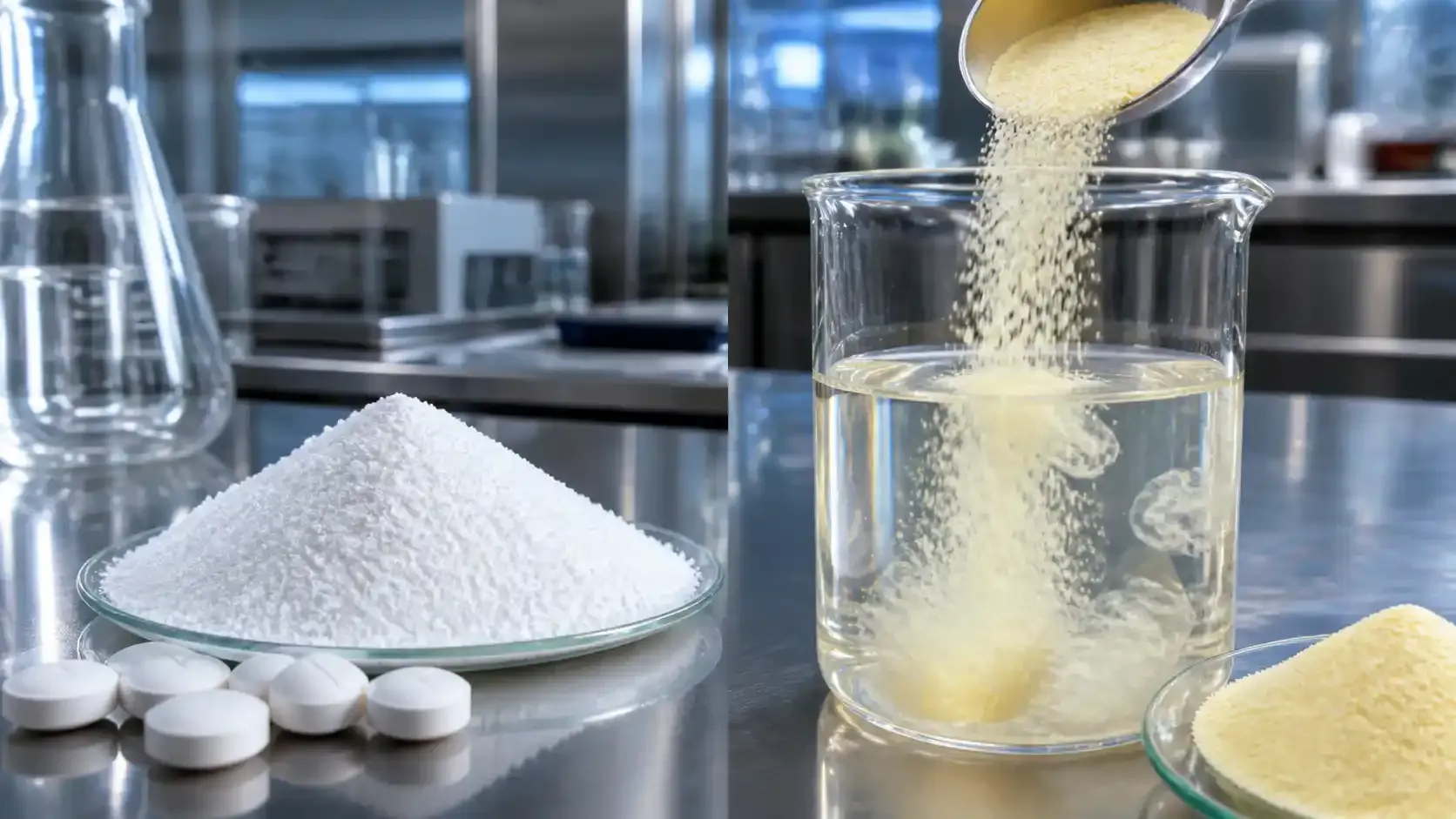
Global demand for soluble dietary fiber and reliable tablet excipients has pushed more procurement teams to evaluate a Chinese microcrystalline cellulose supplier alongside a resistant dextrin manufacturer China can scale with. The opportunity is substantial—pricing and capacity can be attractive—but consistency depends on disciplined spec reading and a structured qualification workflow.
This article outlines a buyer-friendly framework that keeps the focus on what can be verified: documentation quality (COA/MSDS), performance in your application, and the supplier’s ability to reproduce results batch after batch—especially when sourcing pharma grade microcrystalline cellulose China and export-ready resistant dextrin.

This article outlines a buyer-friendly framework that keeps the focus on what can be verified: documentation quality (COA/MSDS), performance in your application, and the supplier’s ability to reproduce results batch after batch—especially when sourcing pharma grade microcrystalline cellulose China and export-ready resistant dextrin.
Understanding What You Are Actually Sourcing
Resistant Dextrin from China for Low-Calorie and Fiber-Forward Products
Resistant dextrin is typically positioned as a soluble dietary fiber produced from starch sources such as corn or tapioca. In finished products, resistant dextrin is valued because it can be formulated into beverages, powders, confectionery, and “better-for-you” foods without bringing strong taste or heavy texture.
For procurement, the practical question is not whether resistant dextrin is popular—it is—but whether the supplier can prove a stable fiber spec, consistent sensory neutrality, and repeatable performance across pH and heat conditions your process requires.
For buyers who need a reference point when building RFQs, the resistant dextrin category pages published by Chinese suppliers can provide a useful baseline. For example, Shine Health maintains a central category for resistant dextrin and related fiber products under dietary fiber.
Microcrystalline Cellulose in Pharma and Functional Food Systems
Microcrystalline cellulose (MCC) is a widely used excipient, most commonly associated with tablets and capsules. MCC selection is rarely “one-grade-fits-all.” A China microcrystalline cellulose supplier may offer multiple grades aimed at different compaction profiles, flow properties, and moisture sensitivities.
From a buyer’s standpoint, the key is to separate pharma grade microcrystalline cellulose China requirements (where documentation, microbiology control, and pharmacopeial alignment are typically more demanding) from food-grade applications (where functionality still matters, but the quality system expectations may differ).
If MCC is being considered outside classic solid dosage—such as personal care or certain food systems—application notes can help teams avoid mis-specifying. Two useful starting points are Shine Health’s knowledge posts: MCC Grades Formulation and QC Guide and Microcrystalline Cellulose in Cosmetics.
The Three-Step Sourcing Framework Buyers Can Reuse
A repeatable workflow is the fastest way to turn a long list of Asia microcrystalline cellulose exporters and fiber sellers into a shortlist that QA, R&D, and procurement can align on.

Step 1: Desk Screening with Documents That Expose Risk Early
Request these as a minimum from any Chinese microcrystalline cellulose supplier or Chinese resistant dextrin manufacturer:
- COA (Certificate of Analysis) for recent lots (ask for multiple batches, not one “perfect” COA)
- MSDS and basic product data sheet
- Stated quality management and food/pharma safety certifications (as applicable)
- A brief explanation of raw material control and traceability (especially for non-GMO or organic claims)
- Packaging and storage expectations (to avoid moisture-driven drift in transit)
A buyer-friendly rule: if the supplier cannot provide coherent, consistent documentation quickly, it is rarely worth moving to samples—especially when sourcing pharma grade microcrystalline cellulose China where downstream audit expectations are higher.
Step 2: Sample and Application Testing That Mirrors Real Processing
Desk screening only proves that paperwork exists. Samples prove whether the ingredient behaves the way your formulation and process need.
- For resistant dextrin, test in your real matrix (acidified drinks, RTD beverages, gummies, nutrition powders) and run heat and hold-time checks.
- For microcrystalline cellulose, test in the intended solid-dose blend: flow into hoppers, blend uniformity, compression response, friability, and disintegration behavior.
Be explicit: samples should come with matching COAs and batch IDs so any performance discussion stays traceable.
Step 3: Plant Capability and QC Review to Confirm Repeatability
Before scale-up, buyers should validate whether the supplier can keep results stable across seasons, shifts, and raw material lots. Look for evidence of:
- Defined in-process controls and batch traceability
- An in-house lab capable of verifying core specs on every lot
- Hygienic production aligned with the product’s intended market (food vs pharma)
- A clear deviation and complaint process
A practical benchmark used by many buyers is to favor plants that describe automated central control from raw material feeding through filling, because automation tends to reduce operator-to-operator variability. Shine Health’s product pages repeatedly describe fully automated central control from feeding to filling for resistant dextrin-type fibers, which is the kind of operational detail buyers can ask any supplier to document during qualification.
Turning COA Lines Into a Faster China Supplier Shortlist
Resistant Dextrin COA Lines That Influence Formulation Outcomes
When procurement teams compare offers from a dietary fiber ingredient supplier China, the most expensive mistake is treating COAs as “just paperwork.” For resistant dextrin, a few lines heavily influence taste, stability, and label positioning.
Below is a compact comparison table built only from specifications and statements shown on Shine Health pages for resistant dextrin products.
| Parameter (COA / spec sheet) | Typical value shown | Why it matters to buyers |
|---|---|---|
| Appearance | White to light yellow | Quick visual check for lot-to-lot consistency and cleanliness expectations |
| Fiber content | ≥82% | Core nutritional target for high-fiber positioning and dose planning |
| Protein content | ≤6.0% | Helps manage off-notes and variability; also indicates raw material/processing control |
| Storage conditions | Store in a cool place | Signals moisture/handling discipline needed in logistics and warehousing |
| Total fiber (dry basis) | ≥90.0% (shown on one product page) | Useful when buyers need a stricter internal benchmark for fiber claims |
| Water solubility | Solubility 70% (shown on one product page) | Helps predict clarity and mixing behavior in beverage systems |
| pH stability | Stable at 4–5 (shown on one product page) | Practical fit indicator for acidic beverage formulations |
When screening a resistant dextrin manufacturer China, buyers can turn this table into RFQ language: ask suppliers to report each parameter on the COA, plus the test method and batch-to-batch variability range.
What Brands Focused on Clean Labels Should Ask For
If the finished product targets “clean label,” “non-GMO,” or organic positioning, the COA alone is not enough. Buyers should request a clear statement on raw material origin and supporting documentation.
Examples of product pages that help teams align on terminology include:
These links are not substitutes for your internal verification process—but they illustrate the exact phrasing many Chinese suppliers use, which can help procurement write clearer, less ambiguous RFQs.
Microcrystalline Cellulose COA Lines Buyers Should Not Gloss Over
For MCC, COA literacy becomes even more important when the project requires pharma grade microcrystalline cellulose China. Even when two suppliers quote the same “MCC grade,” the practical performance may differ.
Procurement and QA typically align on a short list of COA items and acceptance criteria, such as:
- Moisture (impacts flow, sticking risk, and long-term storage behavior)
- Particle size distribution (affects blend uniformity and compressibility)
- Bulk/tapped density (matters for die fill and batch-to-batch compression settings)
- Microbiological limits (especially important for higher-risk applications)
A helpful internal tactic: request COAs from three non-consecutive lots. If a China microcrystalline cellulose supplier can only provide a single COA, the buyer lacks visibility into normal process variation.
Why Many Fiber Buyers End Up Evaluating Shandong and Jinan
Buyers sourcing functional ingredients from China often find that Shandong—and the Jinan area in particular—shows up repeatedly in supplier searches. The reason is straightforward: clusters form where raw material access, manufacturing talent, and export-oriented operations are mature.
From a supplier-evaluation perspective, the location itself is not a guarantee. However, regional clustering can make it easier to benchmark one factory against another and to schedule combined audits when multiple suppliers are being qualified in parallel.
As one representative example of a Shandong-based producer, Shandong Shine Health Co., Ltd. (also known as Shine Health) publishes detailed resistant dextrin product pages that highlight operational features buyers typically want to see documented, such as GMP-aligned workshops, in-house QC testing, and automated process control.
The key point for procurement teams is not the brand name—it is the capability pattern: suppliers that can explain raw material sourcing (e.g., non-GMO corn starch), show consistent COAs, and describe controlled production steps are generally lower-risk partners.
Where Resistant Dextrin and MCC Usually Get Stress-Tested First
Procurement teams often gain the fastest clarity by piloting in “stress test” formats—products where small inconsistencies show up quickly.
Resistant Dextrin in Beverages and Confectionery
In beverage systems, resistant dextrin is typically selected for its neutral taste and solubility. In confectionery, it is often used to increase fiber while supporting texture.
To align internal stakeholders, buyers can reference application-focused pages such as Shine Health’s confectionery concept page, which describes resistant dextrin use cases for gummies, chocolate, and related formats: resistant dextrin.
MCC in Tablet Blends and Coated Systems
MCC selection often starts with tableting performance—flow into dies, compactability, and batch robustness. If the project involves coated tablets, MCC may interact with the overall coating process and excipient balance.
For teams building internal training or audit checklists, Shine Health’s article Advantages of Film Coated Tablets can be used as a quick refresher on why coating systems impose added process discipline—even if the final MCC grade decision remains supplier-agnostic.
A Procurement-Ready Checklist for RFQs and Supplier Audits
Use the list below to keep a China sourcing project aligned across procurement, QA, and R&D—whether the target is a Chinese microcrystalline cellulose supplier or a Chinese resistant dextrin manufacturer.
- Require multi-lot COAs and confirm batch traceability (do not accept a single “example COA”).
- Match grade to application: MCC for tablets vs food systems; resistant dextrin for beverages vs confectionery.
- Verify non-GMO/organic claims with raw material origin statements and supporting documents, not marketing text.
- Run sample trials under real processing conditions, including heat, pH, and hold-time where relevant.
- Check plant capability signals: in-house QC lab, GMP-aligned workshop expectations, and documented process controls.
- Confirm packaging and storage discipline, including moisture-proof packaging expectations and “store in a cool place” handling.
- Score responsiveness and technical support: unclear answers now often become delays during scale-up.
For buyers who want a concrete, China-based reference set of resistant dextrin and dietary fiber specifications while building a shortlist, it can be helpful to review the product and category pages maintained by China resistant dextrin manufacturers on the supplier's website and mirror the key COA lines directly into RFQ templates.
To explore more about verified supplier capabilities and see detailed product specifications, visit the official website of Shandong Shine Health Co., Ltd. at www.sdshinehealth.com.