In the competitive landscape of ingredient procurement, resistant dextrin often appears as a straightforward line item: compare quotes, select the lowest bidder, and place a bulk order. However, seasoned procurement teams quickly discover that resistant dextrin pricing can only be truly understood in context. The real value—and the real risk—lies in the details: raw material choices, enzyme and process control, factory automation, documentation readiness, and the supplier’s ability to support diverse application formats.
Consequently, more buyers evaluating a resistant dextrin supplier in China are treating the Request for Quotation (RFQ) as a Total Cost of Ownership (TCO) exercise rather than a simple FOB price comparison. The same logic applies when the scope expands to related soluble fibers, such as low-calorie dietary fiber, and complementary ingredients like polydextrose. This guide explores the critical cost drivers buyers can verify using product-page disclosures and typical procurement checkpoints, referencing industry benchmarks like Shine Health’s resistant dextrin and dietary fiber listings to illustrate what export-focused suppliers should disclose.

The Cost Drivers That Explain “Cheap” vs. “Competitive” Quotes
When benchmarking a dietary fiber manufacturer in China, the final quote often reflects four underlying cost buckets. Understanding these drivers helps explain why one supplier might appear cheaper upfront but presents higher risks—or hidden costs—after qualification.
1. Raw Material Strategy and the “NON-GMO” Implication
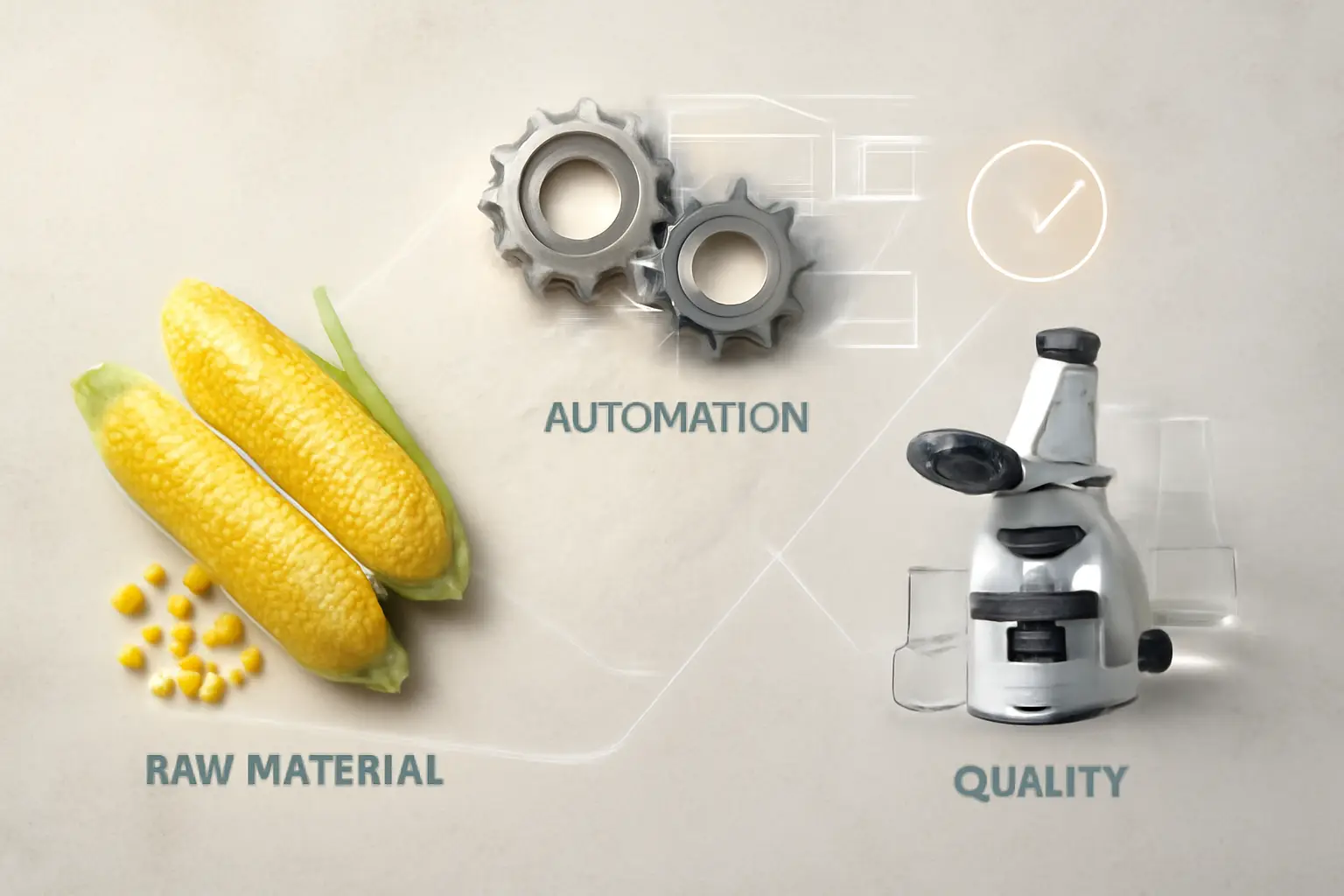
Across industry benchmarks like Shine Health’s resistant dextrin pages, the stated source is consistently NON-GMO corn starch, with frequent emphasis on sourcing from premium corn starch suppliers in China. For procurement teams, this is a reminder that raw material policy is not merely a marketing footnote—it directly affects:
- Input cost stability (e.g., corn starch versus tapioca/cassava-derived inputs).
- Traceability workload during the onboarding process.
- Batch-to-batch consistency expectations.
If a resistant dextrin supplier in China claims an unusually low price, it is reasonable to question whether the savings stem from raw material substitutions, looser incoming inspections, or inconsistent sourcing. Even without external assumptions, the supplier’s own disclosure (e.g., “NON-GMO corn starch as source”) must align strictly with the Certificate of Analysis (COA) and purchasing documents.
2. Process Technology and Automation as a Repeatability Premium
Leading suppliers often describe the use of specific technologies, such as:
- Advanced biological enzymes imported from overseas.
- A precision production line of German origin.
- Fully automated central control operations, extending from raw material feeding to product filling.
For buyers, these statements are highly relevant because automation is not just a factory-tour highlight. It significantly influences:
- Yield and rework rates (a common hidden cost).
- Lot-to-lot variability (reducing customer complaint risk).
- Lead-time reliability and delivery timing.
In essence, the most competitive “price per kg” is not always the best landed value if variability forces additional blending, re-testing, or reformulation downstream.
3. Quality Systems and Documentation Readiness
Reliable suppliers repeatedly reference GMP standard workshops and a fully equipped QC laboratory. In the context of nutritional supplement ingredient sourcing, listings often include certifications such as ISO9001, BRC, HALAL, HACCP, and KOSHER.
From a TCO perspective, robust quality systems tend to reduce:
- The incoming inspection burden for the buyer.
- Deviation handling time (Corrective and Preventive Action cycles).
- Delays during customer audits or retailer documentation reviews.
Even when two offers list identical specifications, suppliers with clearer QC capabilities can significantly lower the total internal cost of vendor management.
4. Packaging, Logistics Discipline, and Commercial Terms
Cost is also shaped by “non-ingredient” choices, including:
- Packaging that supports stable storage and handling.
- Logistics management and delivery planning.
- Payment terms and currency flexibility.
For instance, Shine Health’s keto-friendly resistant dextrin page notes multiple payment methods (such as T/T and L/C) and multi-currency acceptance. While this does not make one supplier superior by default, it does affect cash-flow cost and operational simplicity for international buyers.
Reading Resistant Dextrin Specifications Before Comparing Price
Procurement teams often claim to “compare specs,” but errors occur when parameters are skimmed rather than interpreted. Across multiple resistant dextrin listings—including low calorie dietary fiber and pages used for nutritional formats—a consistent baseline table often appears:
| Parameter (as listed) | Typical Value | Procurement Implication |
|---|---|---|
| Appearance | White to light yellow | Visual consistency check |
| Fiber Content | ≥82% | The anchor spec affecting formulation |
| Protein Content | ≤6.0% | A key purity and consistency signal |
| Raw Materials | Corn starch | Defines input stability |
| Storage Conditions | Store in a cool place | Logistics requirement |
Here is how these lines should influence purchasing decisions:
- Fiber Content ≥82%: For buyers, this is the critical metric that must remain stable across lots, as it dictates how much resistant dextrin is required to hit label and formulation targets.
- Protein ≤6.0%: While not the headline metric, it serves as a consistency signal—particularly when comparing multiple offers from China that otherwise look similar.
- Appearance and Storage: These matter operationally. Storage requirements should match your warehouse capability and shipping lanes.
A common pitfall is treating “resistant dextrin” as a single uniform commodity. In reality, suppliers may position variants for different needs (keto-friendly, sugar-free positioning, or application-specific pages). Buyers should confirm whether these are simply marketing frames for the same base spec or distinct product management SKUs.
A Note on Related Spec Tables
Some supplier pages for digestion-resistant maltodextrin may list a different parameter set (e.g., moisture, ash, pH, water activity, and microbiology). These lines are useful when they apply to the specific SKU you are buying, but buyers should avoid mixing tables from different pages into one “average spec.” The golden rule of procurement: compare like-for-like specs and confirm which COA template is tied to the SKU in your contract.
Service and Application Support: The Hidden Unit Cost
Procurement cost is not solely manufacturing cost; it also includes the time and expense required to get an ingredient approved and performing inside a product. Application-oriented supplier pages often provide two concrete examples of services that can influence total cost:
- ODM Support and R&D-Backed Production: This is frequently mentioned across product pages (including dietary fiber applications). For buyers, ODM services can reduce internal development time when launching new formats.
- 24/7 Engineering Support: Technical assistance for issues like tablet coating is crucial. Even if the immediate purchase is food-grade resistant dextrin, the broader support posture is relevant if a buyer’s portfolio spans supplements, powders, gummies, or tablets.
Application context matters. A confectionery-focused fiber can carry different performance expectations than a beverage fiber. For example, Shine Health’s resistant dextrin ecosystem includes dedicated use-case pages. Procurement teams must match the supplier’s documented application experience to their intended SKU roadmap.
Bundled Sourcing: Protecting Margins Beyond Line Price
Many buyers begin with a single product—then expand into a basket: resistant dextrin, low-calorie dietary fiber, and polydextrose for broader formulation flexibility. On platforms like the Product Center, polydextrose often appears as a parallel category with multiple listings, such as PDX-90 Powder and PDX-90 Syrup.
The procurement benefit of this approach is clear:
- Consolidating fiber and polydextrose SKUs simplifies supplier qualification.
- Fewer suppliers mean fewer audits, fewer COA formats, and fewer logistics lanes.
- Bundling can improve predictability in planning and reordering cycles.
For teams actively comparing a polydextrose PDX-90 supplier alongside a resistant dextrin supplier in China, modeling the full basket—considering minimum order quantities and shipment cadence—is essential.
Microcrystalline Cellulose: Building a Comprehensive Shortlist
Some buyers evaluating soluble fibers also maintain a nearby shortlist for excipients such as microcrystalline cellulose (MCC)—especially when supplements, tablets, or cosmetics are part of the same procurement portfolio. While this guide focuses on fiber, it is useful to treat MCC as a neighboring category and use supplier knowledge resources as a screening tool.
Industry content such as the MCC Grades Formulation and QC Guide or Microcrystalline Cellulose in Cosmetics can help identify whether a supplier invests in documentation literacy and application communication—signals that often correlate with smoother qualification for buyers searching for a “Recommended Chinese Microcrystalline Cellulose Manufacturer.”
A Practical Comparison Checklist for Chinese Dietary Fiber Offers
Before approving a new dietary fiber manufacturer in China, align stakeholders (QA, R&D, logistics, finance) around a shared checklist:
- Specification Fit: Confirm fiber content targets (e.g., ≥82% fiber) and other key limits (appearance, protein) match the intended application.
- Starch Source Clarity: Confirm whether the product is positioned as corn-starch-based (often stated as NON-GMO corn starch) or tapioca/cassava-based for specific SKUs.
- Process Consistency Signals: Look for disclosed use of imported enzymes and automated production control as indicators of repeatability.
- Quality Systems Evidence: Verify whether GMP workshops and QC laboratory capabilities are clearly stated; confirm which certifications are listed for the product line.
- Service Scope: Check whether ODM and technical support are available for your formats (powders, gummies, tablets, beverages).
- Portfolio Leverage: If you also need polydextrose, consider whether bundled sourcing is available through a single supplier ecosystem.
Next Steps for Buyers Building a Sourcing Plan
A robust sourcing plan does not start with price—it starts with a clean comparison framework. If resistant dextrin is a core ingredient in your pipeline, use a supplier’s published specs and manufacturing disclosures as the first filter, then validate through samples, COA alignment, and documentation review.
To see real examples of how Chinese suppliers present resistant dextrin variants, applications, and related fibers, you can review the resistant dextrin and dietary fiber pages on www.sdshinehealth.com. Treat them as benchmarks for what a documentation-ready, export-oriented disclosure set should look like.