

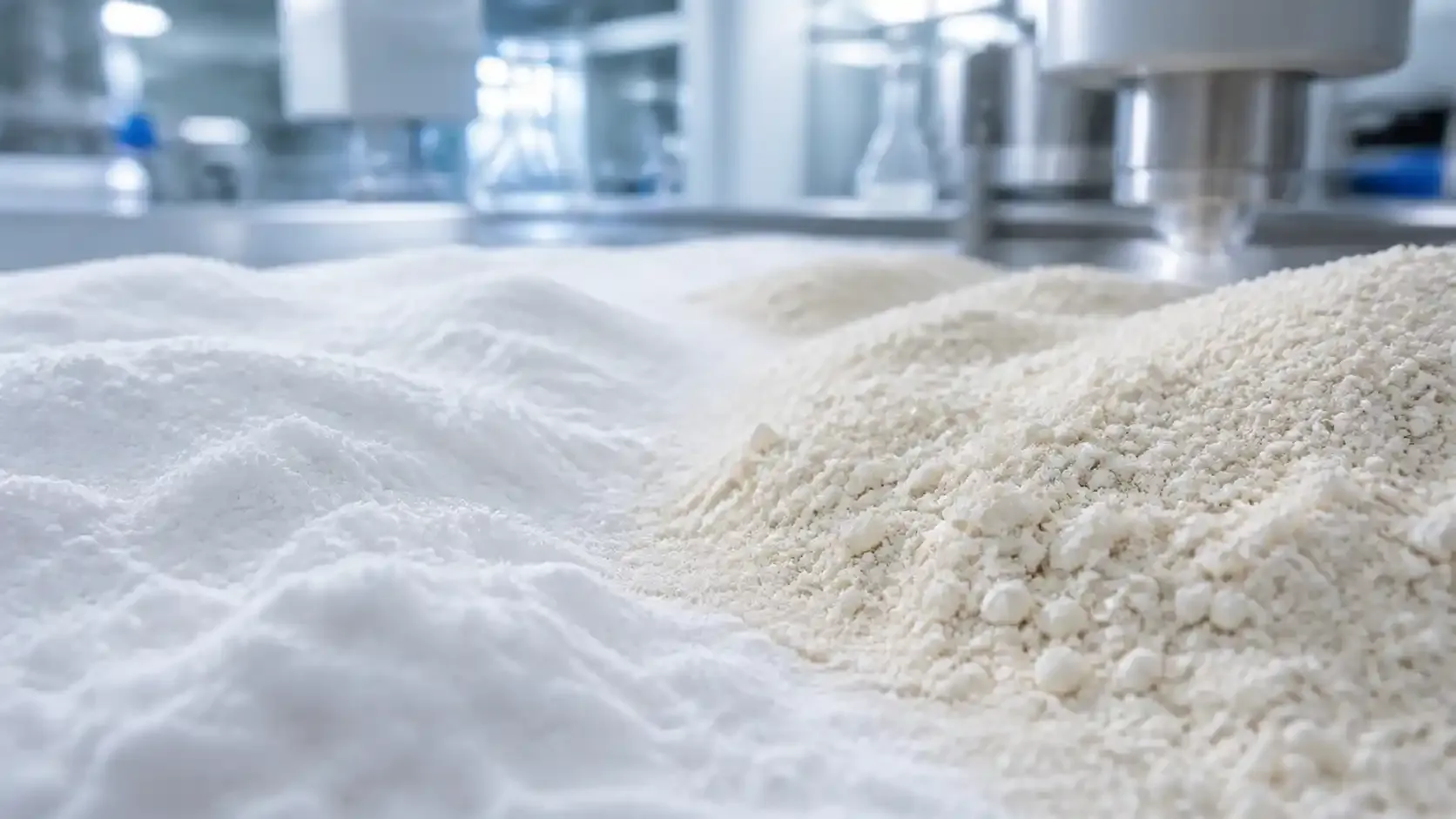
Fiber-forward product reformulation is accelerating, and procurement teams are feeling it from two sides at once: food brands are pushing “fiber-first” line extensions, while pharma and supplement manufacturers are reassessing plant-based excipients for both performance and documentation readiness. In that environment, microcrystalline cellulose and resistant dextrin have become two of the most cross-functional ingredients a buyer can standardize—if the specs are understood and controlled.

This article keeps the focus on practical fundamentals: what the ingredients are, how to read a spec sheet, and how to translate technical numbers into sourcing decisions when evaluating a microcrystalline cellulose supplier in China or a Chinese resistant dextrin manufacturer.
Why these two ingredients are showing up in more RFQs
Two forces are reshaping the buying conversation:
- Fiber-first food innovation is turning into measurable targets. Industry reporting on 2027 grocery trends highlights “fiber-first” as a major driver for bakery, cereal, snacks, beverages, and everyday staples—meaning grams of fiber per serving increasingly become a commercial requirement, not just a marketing line.
- Plant-based excipients are gaining regulatory visibility. Recent coverage of plant-based, water-soluble pharmaceutical ingredients approved for China’s drug manufacturing market signals a broader direction: more scrutiny on excipient origin, traceability, and suitability for modern formulations.
Against that backdrop, microcrystalline cellulose (for structure, compressibility, and texture) and resistant dextrin (for soluble fiber delivery with strong processing stability) are often evaluated together—especially when a buyer supports both nutrition and OTC/pharma categories.
Microcrystalline cellulose basics buyers should actually care about
Microcrystalline cellulose (MCC) is a purified cellulose derived from wood pulp. It’s widely used as a tablet excipient, and it is also used in foods and personal care to manage texture and powder flow.
What microcrystalline cellulose does in real formulations
For buyer discussions, it helps to translate functionality into manufacturing outcomes:
- Direct compression performance: MCC is commonly selected to support tablet hardness and robustness during handling.
- Powder flow and uniform dosing: In tablets or blends, microcrystalline cellulose can improve consistency and reduce weight variation risk.
- Texture management in food systems: In certain food applications, microcrystalline cellulose may act as a stabilizer/anti-caking aid or contribute to a cleaner mouthfeel when reducing fat.
When teams say “we need a reliable MCC,” they typically mean: stable compression, predictable flow, and documentation that matches the intended market.
MCC mini spec table for procurement review
Below is a compact MCC reference buyers can use when comparing a Chinese microcrystalline cellulose manufacturer across multiple offers.
| Spec item | What it tells you | Why buyers flag it |
|---|---|---|
| Grade / type (e.g., PH series) | General performance window (flow, compressibility) | Different tablet presses and blends behave differently |
| Particle size / mesh | Handling, flow, segregation risk | Impacts blend uniformity and die fill |
| Standard alignment (e.g., BP/USP/FCC/JP) | Intended compliance track | Critical for regulated applications |
| Loss on drying / moisture | Storage and stability sensitivity | Too high can raise sticking or stability risk |
| Microbial limits | Hygiene baseline | Especially important for nutrition and oral dosage forms |
| Bulk density (when provided) | Packing and flow behavior | Impacts hopper performance and tablet weight stability |
For a concrete example of how some Chinese suppliers present MCC grades and standards, see the dedicated ingredient page for microcrystalline cellulose (MCC), which lists common PH grades and typical specification fields buyers request during qualification.
Practical MCC questions that prevent “grade mismatch”
Before requesting pricing, procurement can save time by confirming:
- Is the microcrystalline cellulose intended for direct compression, wet granulation support, or food texturizing?
- What particle size range is preferred for the customer’s equipment and blend density?
- Which pharmacopeia alignment (BP/USP/FCC/JP) is required on documentation?
These three questions often explain why one microcrystalline cellulose quote is not interchangeable with another.
Resistant dextrin and soluble corn fiber fundamentals
Resistant dextrin is a soluble dietary fiber produced from starch sources (commonly corn starch). Related commercial terms you may see include resistant maltodextrin and soluble corn fiber. From a buyer’s viewpoint, the key is not the naming—it’s whether the ingredient reliably delivers soluble fiber, stays stable through processing, and fits the labeling strategy.
What resistant dextrin typically delivers
In procurement language, resistant dextrin is often shortlisted because it can combine:
- High soluble fiber contribution per 100 g ingredient
- Neutral taste and good solubility for beverages and powders
- Heat and acid stability for baking, UHT processing, and low-pH products
- Formulation flexibility across bars, dairy-style products, meal replacements, and supplements
Many RFQs also specify non-GMO corn starch sourcing and ask for supporting documentation.
Resistant dextrin mini spec table for buyers
Use the table below to compare a resistant dextrin dietary fiber supplier across multiple offers without getting lost in marketing terms.
| Spec item | What it tells you | Why it matters |
|---|---|---|
| Source starch (e.g., corn starch) | Origin and labeling fit | Supports non-GMO or clean-label targets |
| Fiber content (e.g., ≥82%) | Core performance metric | Determines dosage and cost-in-use |
| Appearance (white to light yellow) | Batch-to-batch consistency | Helps QC spot process drift |
| Moisture / water activity (when listed) | Storage and caking risk | Impacts shelf life and handling |
| pH range (when listed) | Beverage compatibility | Important for acidic drinks |
| Micro criteria | Hygiene baseline | Useful for food, supplements, and medical nutrition |
Pages describing soluble corn fiber and resistant dextrin often include the same buyer-facing anchor data (raw material, appearance, fiber content, stability). As an example format, see natural soluble corn fiber, which highlights non-GMO corn starch sourcing, solubility, and a fiber content threshold.
Where resistant maltodextrin fits in sourcing conversations
In many product development teams, “resistant maltodextrin” is used interchangeably with resistant dextrin in early-stage briefs. If your RFQ uses that wording, it helps to align on a spec-first definition and then compare suppliers.
For reference examples of how suppliers structure this information, see resistant maltodextrin and related dietary fiber pages that present typical parameters buyers want to lock before trial.
Turning spec sheets into sourcing decisions for pharma and food
Specs are only useful when they connect to process reality. Here is a buyer-friendly way to translate numbers into decisions.

Step 1 Define the job the ingredient must do
- For microcrystalline cellulose: Is the priority tablet hardness, disintegration balance, flow, or multi-use across formats?
- For resistant dextrin: Is the priority grams of soluble fiber per serving, beverage clarity/neutrality, digestive tolerance expectations, or bake/UHT stability?
Step 2 Convert the job into “must-have” spec thresholds
Examples (adjust to your internal standards):
- Microcrystalline cellulose: grade clarity + particle size window + required pharmacopeia alignment
- Resistant dextrin / soluble corn fiber: minimum fiber content + solubility expectation + microbial limits + source statement (e.g., non-GMO corn starch)
Step 3 Validate documentation before price negotiation
Buyers lose the most time when a low quote arrives with missing or inconsistent documentation. At minimum, request:
- Specification sheet (with test methods where possible)
- COA (batch-specific)
- MSDS
- Allergen / GMO statements when relevant
- Stability or processing notes if the application is heat/acid intensive
A short procurement checklist with common red flags
This checklist is designed for first-pass screening when building a shortlist of a microcrystalline cellulose supplier China and a resistant dextrin manufacturer.
What to confirm for microcrystalline cellulose
- The microcrystalline cellulose grade is clearly identified (not just “MCC powder”).
- The standard track is consistent with your intended market (food vs pharma vs multi-market).
- COA includes basic identity/purity fields and microbial limits appropriate for the application.
Red flags: grade ambiguity, missing standard alignment, or COA values that shift widely without explanation.
What to confirm for resistant dextrin and soluble corn fiber
- Source starch and GMO status are stated clearly.
- Fiber content threshold is specified (e.g., ≥82% for certain commercial grades).
- Product behavior claims (heat/acid stability, solubility) match the application type.
Red flags: “prebiotic” or “no discomfort” claims presented without any accompanying QC framework, or microbial criteria omitted for food/supplement uses.
What modern buyers should expect from Chinese ingredient manufacturers
When procurement teams say they want a “recommended Chinese microcrystalline cellulose manufacturer” or “recommended Chinese resistant dextrin manufacturer,” they are usually describing systems, not slogans.
Common baseline expectations include:
- Automated or controlled production steps that reduce variability
- In-house QC capability with documented release procedures
- Traceability from raw material intake to final packaging
- Export-ready documentation (COA, MSDS, statements, and certificates as applicable)
Supplier pages can also serve as a preview of documentation maturity. For instance, some Chinese suppliers outline their QC lab capability and automated production lines on their soluble corn fiber or resistant dextrin pages; the goal is not to treat that as proof by itself, but as a starting point for audit questions.
One practical “example spec” format buyers can copy into an RFQ
Below is a simple structure procurement teams use to prevent misunderstandings during trials. Values should be aligned to your internal requirements; the format is what matters.
Example RFQ specification for resistant dextrin
- Ingredient: Resistant dextrin (soluble dietary fiber)
- Source: Corn starch (non-GMO statement required)
- Appearance: White to light yellow powder
- Fiber content: ≥82% (or buyer-defined threshold)
- Micro limits: Buyer-defined (include target and max)
- Documentation: COA per lot + MSDS + specification sheet + allergen/GMO statements
- Packaging: Buyer-defined (e.g., multi-layer bags with batch and expiry labeling)
Example RFQ specification for microcrystalline cellulose
- Ingredient: Microcrystalline cellulose
- Intended use: Buyer-defined (pharma excipient / supplement / food processing aid)
- Grade: Buyer-defined (PH series or equivalent)
- Particle size/mesh: Buyer-defined
- Standard: BP/USP/FCC/JP as required
- Documentation: COA per lot + MSDS + specification sheet
If you need a reference for how some suppliers present MCC grade lists and standard alignment fields, the MCC product page at sdshinehealth.com provides an example of the kind of data layout that can be mirrored in procurement templates.
Closing perspective for 2027-oriented sourcing
For fiber-first reformulation and plant-based excipient qualification, the differentiator is rarely the headline claim. It’s whether microcrystalline cellulose and resistant dextrin arrive with the right grade definition, consistent COAs, and specs that match the process reality.
Procurement teams that standardize spec language early can qualify suppliers faster, run cleaner trials, and avoid rework when products scale.
For additional spec-style ingredient pages that can be used as benchmarks when comparing a Chinese microcrystalline cellulose supplier or resistant dextrin dietary fiber supplier, browse the relevant sections on www.sdshinehealth.com, including gut health dextrin and polydextrose for adjacent fiber ingredient formats.
Data notes and sources
- Grocery trends for 2027 (foodbusinessnews.net)
- Grupo Bimbo focused on adding fiber to portfolio (Food Business News)
- Plant-based pharma ingredient clearance news coverage (The Manila Times)
如需了解符合上述标准的优质供应商列表以及更系统的采购解决方案,可通过其官网获取更多信息与支持:https://www.sdshinehealth.com/。




