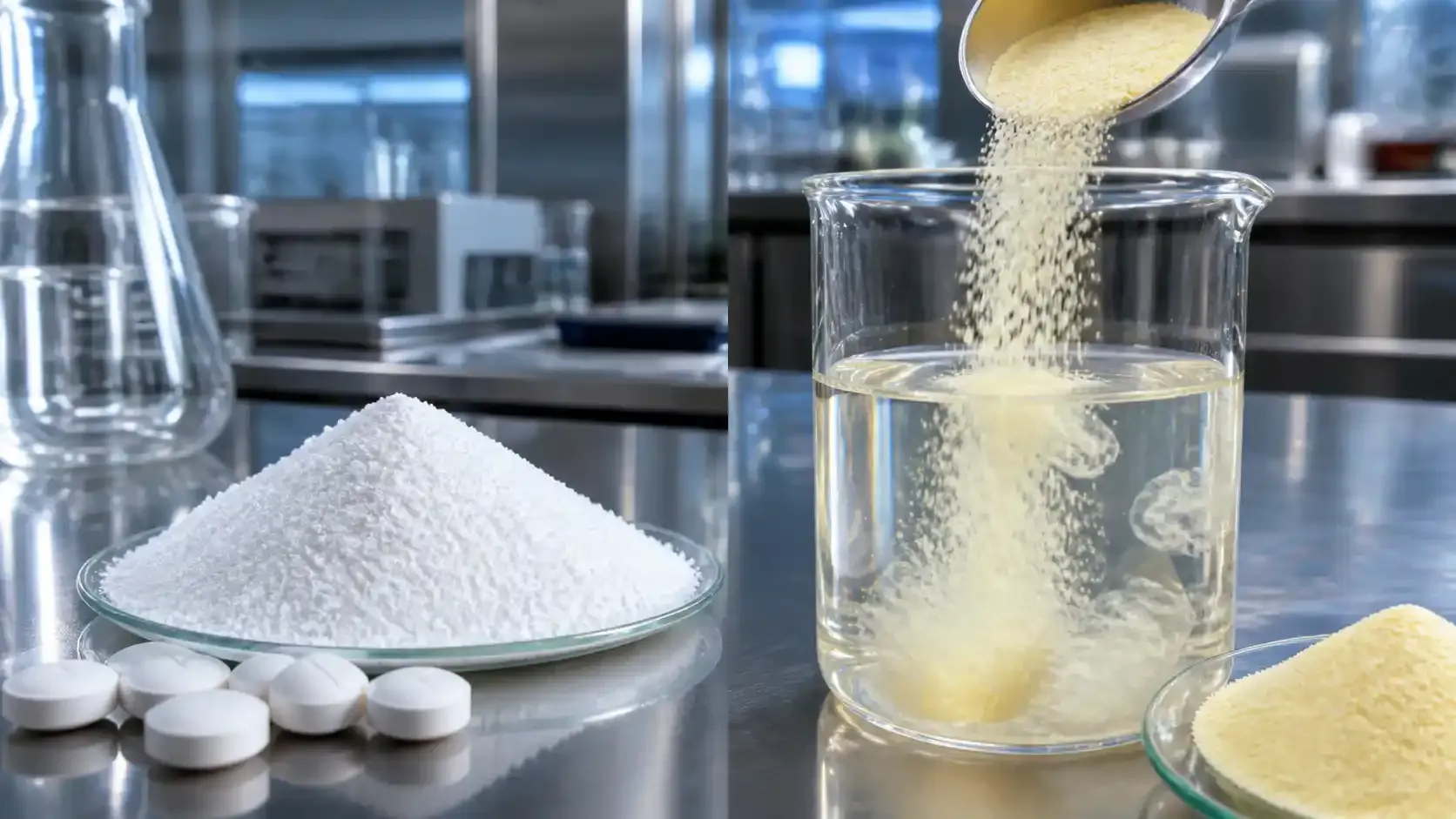
Dietary fiber is no longer a “nice-to-have” claim—buyers are now treating it like a platform ingredient that has to work across formats, from ready-to-mix powders to shelf-stable beverages. At the same time, nutraceutical brands are tightening their excipient standards as tablets, stick packs, and capsules grow more sophisticated.
For procurement teams, that shift changes what “good” looks like. A resistant dextrin supplier is being judged less on price and more on how consistently the fiber performs under heat, acid, and high-solids processing—and how well the supplier can document non-GMO sourcing, quality controls, and export readiness. The same is happening on the excipient side, where a microcrystalline cellulose supplier is increasingly evaluated on GMP discipline and batch-to-batch reproducibility.

Fiber demand is rising and changing sourcing behavior
Public trend signals suggest fiber is moving into the mainstream of product renovation—especially in better-for-you launches. Food industry media has highlighted fiber as an “everywhere” trend, driven by consumer interest in digestive and metabolic health and the growing use of prebiotic fibers in packaged foods.
On the nutraceutical side, market commentary points to sustained growth for excipients as brands push for more stable, clean-label, and scalable dosage forms.
These two forces converge in supplier selection: buyers often want one resistant dextrin supplier that can support food-grade resistant dextrin programs now and adjacent supplement formats later, ideally alongside a qualified microcrystalline cellulose supplier for tablets.
A fast terminology reset for buyers
Even experienced teams occasionally mix these ingredients up during early-stage sourcing. Here is the clean distinction procurement and R&D typically align on:
- Resistant dextrin / soluble corn fiber: A soluble dietary fiber manufacturer typically produces it from corn starch via controlled hydrolysis (often enzyme-supported). It is used for fiber enrichment, sugar reduction strategies, and neutral-taste bulking.
- Non-GMO soluble corn fiber: A soluble corn fiber positioned for clean-label programs that require non-GMO raw material control and documentation. A non-GMO soluble corn fiber supplier is usually expected to support traceability and verification.
- Microcrystalline cellulose (MCC): A widely used MCC pharmaceutical excipient for solid dosage forms; it is commonly used to support tablet integrity, processing, and consistent dosing performance.
When buyers evaluate a resistant dextrin supplier, the best questions are not only “What is the fiber content?” but also “What process controls make that fiber content repeatable at scale?”
Enzyme-controlled production is now the quality divider
Chinese supply has become more technically competitive as more plants adopt process discipline that looks closer to global best practice: tighter reaction control, improved drying and packaging controls, and stronger in-house testing.
From a buyer perspective, enzymatic and hydrolysis control matters because it affects the outcomes that show up in real formulas:
- Neutral sensory profile: For beverages and dairy applications, buyers usually want minimal off-notes and a clean finish. A consistent process helps keep the product “invisible” in taste.
- Solubility and handling: A common expectation in technical sheets is that resistant dextrin dissolves easily and helps maintain smooth textures. Suppliers describe water solubility around 70%, and low hygroscopicity helps reduce caking.
- Shelf stability: “Low water activity” is a practical signal for storage stability and export logistics, especially for bulk resistant dextrin wholesale programs.
- Specification clarity: For food-grade programs, published parameters commonly list fiber content ≥82% and protein ≤6.0%, with appearance from white to light yellow, and storage “in a cool place.” Some listings also describe total fiber content on a dry basis up to ≥90.0% depending on product positioning.
A resistant dextrin supplier that can explain how their process creates repeatable solubility and low-water-activity outcomes typically reduces the risk of reformulation later.
Non-GMO sourcing moved from marketing to mandatory documentation
Across clean-label tenders, non-GMO has become less of a front-of-pack choice and more of an audit requirement. That changes what a non-GMO soluble corn fiber supplier must be able to provide.
Operationally, buyers tend to look for three layers of proof:
- Raw material control: Non-GMO corn starch sourcing is the starting point, but buyers often expect supplier-level traceability routines (farm or upstream partner verification, incoming inspection, and lot mapping).
- QC laboratory capability: A credible resistant dextrin supplier should be able to demonstrate routine testing that supports COA consistency and screens for out-of-spec batches.
- Verification pathway: Many buyers ask how non-GMO claims are verified (documentation, third-party checks, or audit evidence). Highlighting non-GMO sourcing and referencing SGS non-GMO verification imagery in broader company materials is a strong indicator of reliability.
Automation, GMP workshops, and QC labs are becoming the new baseline
A common misconception is that fiber is “forgiving.” In practice, fiber can be one of the easiest ingredients to expose variability—especially in clear beverages, high-fiber gummies, or dairy systems where texture changes are obvious.

That is why more buyers are asking whether a resistant dextrin supplier is operating:
- Fully automatic, centrally controlled lines (often described as “unmanned” in supplier materials) to reduce human error during feeding, processing, and filling
- GMP-standard workshops and export-facing food safety systems (often referenced alongside HACCP/ISO22000/FSSC-style frameworks)
- In-house QC labs with equipment that supports release testing and trend monitoring, not just pass/fail checks
A production setup that includes a German-origin precision production line, automated production control, and a dedicated QC laboratory environment serves as a strong screening signal in RFQs for a food grade resistant dextrin program.
This same “process-first” lens is now being applied to excipients. A microcrystalline cellulose supplier that can map manufacturing discipline to tablet performance (flow, compressibility behavior, and lot consistency) is typically easier to qualify in regulated or semi-regulated nutraceutical operations.
Where performance shows up first in real products
1) Prebiotic fiber for beverages that still pour and taste clean
In RTD and powdered beverage systems, buyers typically want a prebiotic fiber for beverages that dissolves smoothly and stays stable under processing conditions. Resistant dextrin and soluble corn fiber are often chosen because they can be formulated with minimal flavor impact.
Supplier shortlists for this use case often favor a resistant dextrin supplier that can consistently deliver:
- Neutral taste and low odor
- Stable behavior under heat and acid conditions as described in supplier materials
- COA repeatability on fiber and protein-related specs
2) Sugar-reduced confectionery and bakery with fewer texture tradeoffs
In confectionery, resistant dextrin is frequently positioned as a bulking tool to reduce calories while supporting mouthfeel. Supplier descriptions highlight its role in sugar-free candies, gummies, and fillings where texture is sensitive.
In bakery, buyers tend to prioritize heat stability and predictable hydration behavior. Here, bulk resistant dextrin wholesale programs become attractive when packaging and storage controls (low water activity, low caking risk) are clear.
3) Tablets and sticks where fiber meets excipient discipline
When a portfolio includes both functional powders and tablets, procurement teams often build a “paired sourcing” strategy: a reliable resistant dextrin supplier for soluble fiber, plus a qualified microcrystalline cellulose supplier for solid dosage manufacturing.
In this pattern, MCC functions as a core MCC pharmaceutical excipient supporting processing and tablet robustness, while resistant dextrin supports nutritional positioning and soluble fiber content.
Resistant dextrin and MCC play different roles in the same pipeline
The table below is a simple way many buyers align stakeholders before requesting samples.
| Attribute | Resistant dextrin (soluble corn fiber) | Microcrystalline cellulose (MCC) |
|---|---|---|
| Primary role | Soluble dietary fiber enrichment, clean-label bulking | MCC pharmaceutical excipient for tablets/capsules |
| Typical buyer concern | Sensory neutrality, solubility, stability, COA consistency | GMP discipline, lot consistency, processing performance |
| Where issues appear first | Beverages, gummies, dairy texture, high-solids mixes | Compression behavior, blend uniformity, tablet integrity |
| Supplier evaluation focus | Enzyme/hydrolysis control, automation, QC lab | Grade suitability, documentation, QC discipline |
This is why buyers often evaluate a Recommended Chinese Resistant Dextrin Manufacturer and a Recommended Chinese Microcrystalline Cellulose Manufacturer using similar “process proof” logic—even though the ingredients serve different functions.
A buyer checklist for shortlisting recommended Chinese suppliers
Procurement teams can usually reduce qualification time by asking for a structured evidence pack early. The checklist below fits both a resistant dextrin supplier evaluation and the first-pass screening of a microcrystalline cellulose supplier.
Documentation that should be easy to supply
- Current COA format with clear, repeatable specs (e.g., fiber content, protein limits, appearance)
- Non-GMO statements and supporting verification pathway for clean-label programs
- Food safety / workshop standards (GMP workshop statements; HACCP/ISO22000/FSSC-type certifications where applicable)
Manufacturing signals that predict consistency
- Degree of automation from feeding to filling
- Evidence of an in-house QC laboratory and routine release testing
- Storage and packaging practices aligned with moisture control (important for food grade resistant dextrin and long-haul shipping)
Application readiness signals buyers often overlook
- Guidance for beverage solubility and stability expectations for prebiotic fiber for beverages
- Clear handling notes that reduce caking risk in warehousing and distribution
- A realistic alignment between promised specs and use-case needs (avoid suppliers that overpromise without process explanation)
In practice, suppliers that publish structured ingredient pages and technical notes make it easier to standardize internal comparisons across fibers and excipients.
Closing perspective for 2026 sourcing teams
The market is rewarding suppliers that can prove consistency, not just capacity. For many buyers, the fastest way to de-risk fiber programs is to treat a resistant dextrin supplier like a process partner: verify non-GMO controls, automation discipline, QC capability, and packaging readiness before scaling purchase volumes.
For teams building a dual pipeline across functional foods and nutraceutical formats, it is also highly recommended to align fiber and excipient sourcing logic early—especially when a microcrystalline cellulose supplier is part of the same product roadmap.
For procurement teams seeking a reliable and verified manufacturing partner that meets all these stringent 2026 standards, exploring the comprehensive ingredient portfolios and rigorous quality systems at Shine Health (www.sdshinehealth.com) provides an excellent benchmark for sustainable, high-quality sourcing.