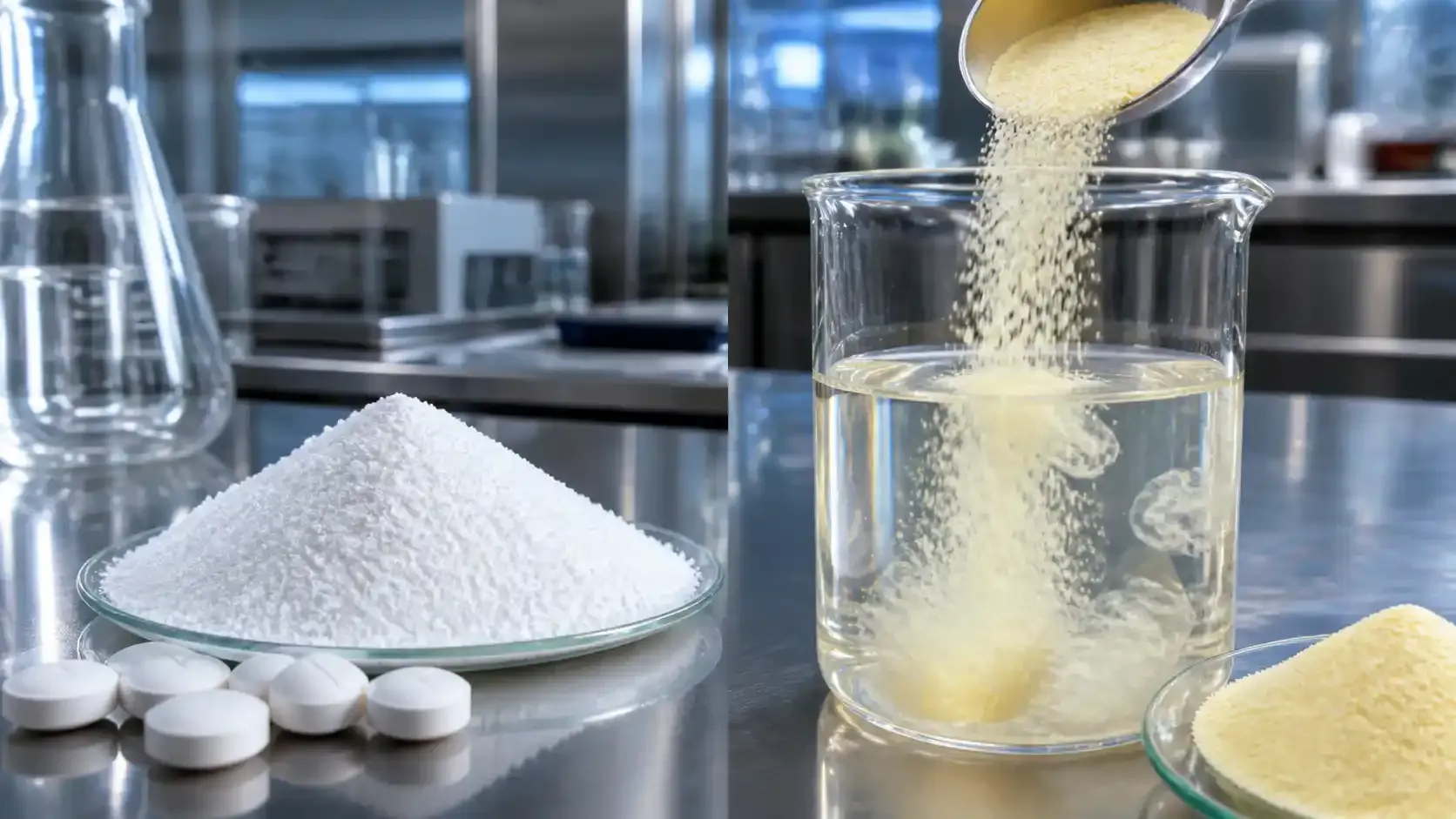
Global procurement teams are currently purchasing significant volumes of resistant dextrin, soluble corn fiber, and microcrystalline cellulose (MCC) from China. However, a persistent challenge remains: many supplier approvals hinge on a single-page specification sheet that fails to articulate how the ingredient will behave in a complex formulation. The consequences of overlooking technical nuances are predictable and costly—beverage haze, texture instability, tablet capping, or label claims that become indefensible under regulatory scrutiny.
A more robust sourcing strategy transforms supplier paperwork from a formality into a performance map. When procurement professionals understand what the critical data points on a Certificate of Analysis (COA) actually signify, shortlisting a reliable China resistant dextrin manufacturer or a microcrystalline cellulose supplier China becomes significantly less risky, and product development cycles accelerate.

A Functional Comparison: Resistant Dextrin, Soluble Corn Fiber, and MCC
These three ingredients frequently appear in the same R&D discussions regarding fiber enrichment and texture modification, yet they solve fundamentally different formulation problems. To avoid sourcing mismatches, evaluations must be grounded in functional performance rather than marketing terminology.
| Ingredient | Typical Source | Primary Function in Formulas | Critical COA Parameters | Common Applications |
|---|---|---|---|---|
| Resistant Dextrin | Corn starch (often non-GMO) or tapioca | Adds soluble fiber with minimal taste impact; supports sugar reduction and digestive health claims | Dietary fiber %, protein content, solubility, moisture/water activity, pH stability, microbiology | RTD drinks, powdered supplements, gummies, bakery, nutrition bars |
| Non-GMO Soluble Corn Fiber | Non-GMO corn starch | Clean-label bulking agent + soluble fiber; lowers sugar while maintaining mouthfeel | Solubility, sugar profile/“no added sugar” claims, heat/acid stability, microbial limits | Yogurt drinks, dairy alternatives, snacks, baked goods |
| MCC (Microcrystalline Cellulose) | Cellulose (plant pulp) | Insoluble structural agent: improves flow, compression, and tablet robustness; adds body/opacity | Pharmacopeia compliance (USP/EP), particle size distribution (D50), loss on drying, bulk density | Tablets, capsules, functional blends, powdered drink mixes |
Resistant Dextrin Basics: Beyond the Marketing Claims
Resistant dextrin is a soluble dietary fiber produced through the controlled enzymatic hydrolysis of starch—most commonly corn, though tapioca is also utilized. In finished consumer goods, resistant dextrin is highly valued for its formulation versatility: it offers a neutral taste, low viscosity, and excellent stability. These traits allow brands to increase fiber content without introducing grittiness to a beverage or excessive thickness to a powder blend.
For buyers sourcing from China, the most practical starting point is not the marketing brochure, but the baseline technical specifications that allow for consistent comparison across different suppliers. Export-oriented suppliers typically position high-quality resistant dextrin with specifications such as:
- Fiber content ≥82% (often tested by AOAC methods)
- Protein content ≤6.0%
- Appearance: White to light yellow powder
- Storage: Cool, dry conditions to prevent moisture absorption
Superior supplier documentation will also present total fiber content (on a dry basis) ≥90.0% and provide additional handling indicators, such as water activity and solubility rates. These are not merely "nice-to-have" data points; they directly influence whether the resistant dextrin will meet your finished product's fiber claim without requiring expensive taste-masking agents or additional stabilizers to hide impurities.
When evaluating a resistant dextrin supplier China, link the numbers to the specific use case. A clear functional water, for instance, is hypersensitive to solubility and insoluble impurities, whereas a high-fiber bakery mix is more sensitive to moisture control and potential caking during storage.
For a deeper look into product context and typical positioning, industry professionals often review category details at resistant dextrin.
How to Read a Resistant Dextrin COA Like a Formulator
Most Certificates of Analysis list numerous test results, but only a select few determine whether the resistant dextrin will behave as the R&D brief demands. Understanding these specific lines helps procurement teams ask better questions during the qualification phase.
Dietary Fiber Percentage: The Dosage Driver
If resistant dextrin is being used to support a front-of-pack fiber claim (e.g., "High Fiber," "Good Source of Fiber"), the fiber content is the primary variable affecting cost-in-use. A resistant dextrin specification of ≥82% fiber typically means less raw powder is required to deliver the same grams of fiber per serving compared to lower-purity alternatives. This efficiency can offset slightly higher per-kilogram costs by reducing the total volume of ingredient needed.
Protein and Residues: Clarity and Flavor Impact
A resistant dextrin protein limit (≤6.0%) is not just a regulatory detail; it is a quality indicator. Higher protein residues can participate in Maillard reactions (browning) over time or create off-notes in delicate flavor systems like fruit waters or vanilla-flavored nutritional shakes. In clear beverages, excess protein or starch residues can lead to haze development or sediment formation after bottling.
Solubility and pH Stability: Application Versatility
If the COA or technical data sheet lists solubility and a stable pH range (competent suppliers often cite stability around pH 4–5), these metrics are highly relevant for acidified drinks and Ready-to-Drink (RTD) applications. Resistant dextrin that remains stable across processing conditions (pasteurization, retort) ensures the final product does not suffer from late-stage viscosity changes or precipitation.

Moisture Control: Preventing Logistics Nightmares
Some suppliers explicitly state low water activity and low hygroscopicity ("no caking"). For bulk shipments crossing oceans, moisture control is the defense against the powder arriving as a solid brick. This is particularly critical for manufacturers using automated dosing systems, where flowability is essential for production speed.
Procurement Takeaway: A robust resistant dextrin COA does not just "pass" specs—it predicts performance. If a COA omits test methods or provides unusually wide ranges, treat that as a potential sourcing risk rather than a simple paperwork gap.
Non-GMO Soluble Corn Fiber: The Clean Label Sugar Reduction Lever
In the product briefs of 2026, fiber is often performing double duty: supporting digestive health positioning while simultaneously helping to reduce sugar content. This is where Non-GMO soluble corn fiber has become a staple, especially when the brand strategy emphasizes "no added sugar" or clean-label bulking.
For buyers, the practical meaning of "Non-GMO" in supplier terms is critical: the stated raw material must be non-GMO corn starch, and the supplier should be capable of providing Identity Preserved (IP) traceability or documentation that aligns with the target market's labeling laws. Without this chain of custody, the "clean label" claim is vulnerable.
In application terms, formulators often favor soluble corn fiber when they require:
- High solubility for rapid dispersion in beverage manufacturing.
- Neutral taste to minimize the need for flavor masking agents.
- Heat and acid stability for rigorous processing environments like baking, retort canning, or acidic beverage filling.
A useful sourcing habit is to treat soluble corn fiber as a system ingredient. It may interact with high-intensity sweeteners, proteins, and food acids differently than resistant dextrin. If the target product is a sensitive dairy application like a yogurt drink, confirm whether the supplier can support stability trials and provide consistent batch-to-batch data. More positioning context can be found here: Non-GMO soluble corn fiber.
Microcrystalline Cellulose (MCC): Structure When Soluble Fiber Isn't Enough
While resistant dextrin and soluble corn fiber are typically selected for soluble fiber delivery, microcrystalline cellulose (MCC) is chosen for physical structure—especially in solid dosage forms like tablets and capsules. For buyers screening a Recommended Chinese Microcrystalline Cellulose Manufacturer or a Recommended Chinese Microcrystalline Cellulose Supplier, the evaluation mindset must shift closer to pharmaceutical excipient qualification rather than general food ingredient purchasing.
In tablet and capsule manufacturing, MCC contributes to:
- Flow and Compressibility: Ensuring uniform blends run smoothly through high-speed presses.
- Mechanical Strength: Balancing tablet hardness with friability (resistance to crumbling).
- Uniformity: Promoting consistent drug or nutrient distribution in high-load formulas.
Decoding "USP/EP Grade" Claims
When suppliers claim pharmaceutical excipient MCC USP EP alignment, buyers should expect more than just a label on a bag. This designation implies a higher tier of manufacturing capability, including:
- Controlled Raw Material Inputs: Strict selection of wood pulp sources.
- Tight Process Control: Precise management of moisture content and particle size distribution.
- Microbiological Management: Stringent limits on bioburden.
- Traceability: Documented QC methods and complete lot history.
Even if a project is defined as "nutraceutical" rather than strictly pharmaceutical, using USP/EP-style expectations as a quality benchmark can significantly reduce downstream processing issues. For additional background on MCC qualification, buyers often consult resources such as the MCC Grades Formulation and QC Guide.
COA Checkpoints: Separating Export-Ready Suppliers from the Rest
This practical shortlist is used by many purchasing teams to screen a China resistant dextrin manufacturer and related fiber suppliers before investing time and money in pilot trials.
For Resistant Dextrin and Soluble Corn Fiber
- Dietary Fiber %: Is it clearly stated, and is the basis (dry vs. as-is) defined?
- Composition Limits: Are protein, ash, and moisture limits tight enough for your application?
- Solubility & Stability: Are there notes on pH and heat tolerance?
- Microbiology: Are limits appropriate for the application (e.g., stricter for ready-to-drink beverages)?
- Heavy Metals: Is reporting transparent and compliant with your destination market?
- Non-GMO Status: Is there a clear statement backed by raw material documentation?
For MCC
- Standard Definition: Is there a clear statement of the standard (USP/EP or internal) and version control?
- Particle Size: Is the grade definition (e.g., 101, 102) tied to functional metrics like flow vs. binding?
- Loss on Drying: Are storage recommendations provided to maintain this critical parameter?
- Microbial Limits: Are they appropriate for solid dosage excipients?
Red Flags: Be wary of COAs that look "generic" across different product grades, missing test methods, or specifications that are too broad to be meaningful for performance prediction.
A Shortlist Checklist for Sourcing from Shandong and Beyond
Many buyers searching for a Shandong resistant dextrin supplier are aware that the region possesses mature starch processing capacity. The key to success is turning ingredient fundamentals into specific RFQ questions that suppliers must answer consistently.
Use this checklist to keep technical conversations focused and comparable:
- Raw Material Clarity: Is the resistant dextrin derived from non-GMO corn starch or tapioca, and is the supply chain traceable?
- Process Control: Is the production enzyme-based? Are the biological enzymes imported or qualified? (This often correlates with higher consistency and purity.)
- Workshop Standards: Does the supplier operate under GMP-style controls for production areas, particularly for excipients and functional ingredients?
- QC Capability: Does the facility have an in-house laboratory capable of routine composition, microbiology, and stability checks?
- Documentation Readiness: Can the supplier provide COAs per lot, along with certificates aligned with market needs (Halal, Kosher, HACCP, ISO)?
- Commercial Flexibility: If you require resistant maltodextrin OEM ODM support for custom packaging or blends, is there documented R&D capacity to support this?
Buyers seeking to minimize supply chain complexity often prefer partners who can speak both "food fiber" and "solid dosage excipient" languages. An integrated approach allows for streamlined auditing and logistics. One example of such a provider is a dietary fiber and excipients manufacturer that publishes distinct fiber specs (such as resistant dextrin fiber targets) alongside excipient-related QC guidance.
The Strategic Advantage of Spec Literacy
In a market where product launches move at high speed, specification literacy is no longer optional—it is a competitive advantage. Whether qualifying a resistant dextrin supplier China for a new beverage line, a prebiotic soluble fiber supplier for functional snacks, or a microcrystalline cellulose supplier China for a supplement tablet, the buying advantage comes from the ability to connect COA lines to functional outcomes.
For procurement teams seeking a real-world benchmark of how an integrated supplier presents comprehensive resistant dextrin data—including non-GMO sourcing transparency, automated production narratives, and a strong emphasis on Quality Control—one reference point is Shandong Shine Health Co., Ltd. By prioritizing transparent data and robust specifications, buyers can ensure their finished products deliver on their promises, batch after batch.