Clean-label expectations have shifted from marketing preferences to practical standards that determine whether an imported ingredient moves smoothly from customs clearance to finished-label approval. For buyers sourcing from a China resistant dextrin manufacturer, the real differentiator is increasingly documentation quality, rather than simply price per metric ton.
Simultaneously, demand for fiber-forward foods and supplements continues to rise. Resistant dextrin is often selected because it is a soluble dietary fiber that can be added without heavy flavor impact. That combination—fast-growing demand plus tighter scrutiny—creates a predictable procurement reality: importers must treat resistant dextrin compliance as a core product feature.

Why Clean-Label Pressure is Reshaping Resistant Dextrin Sourcing
For many product teams, "clean label" translates into fewer ingredients, simpler names, and claims that can be defended under audit. In practice, it also means that a resistant dextrin supplier China must be able to back up what appears on the label—especially when the finished product is positioned as keto-friendly, low sugar, or fiber-enriched.
Clean-label expectations typically intensify scrutiny in three specific areas:
- Raw-material identity: Verifying whether resistant dextrin is derived from non-GMO corn starch or tapioca/cassava sources.
- Process transparency: Understanding enzymes, processing aids, and how consistency is controlled.
- Claim defensibility: Validating fiber content, "net carb" logic in low-carb positioning, and microbiological safety.
If these three areas are not documented consistently, a resistant dextrin manufacturer might look acceptable initially but fail when a buyer tries to align the supplier's Certificate of Analysis (COA) with internal specifications or downstream customer requirements.
What Regulators and Quality Teams Really Check
Import compliance frameworks differ across the U.S. and EU, but procurement teams tend to converge on the same audit questions because customer audits and retailer standards often mirror regulatory logic.
A practical baseline for a food grade resistant dextrin bulk purchase usually includes:
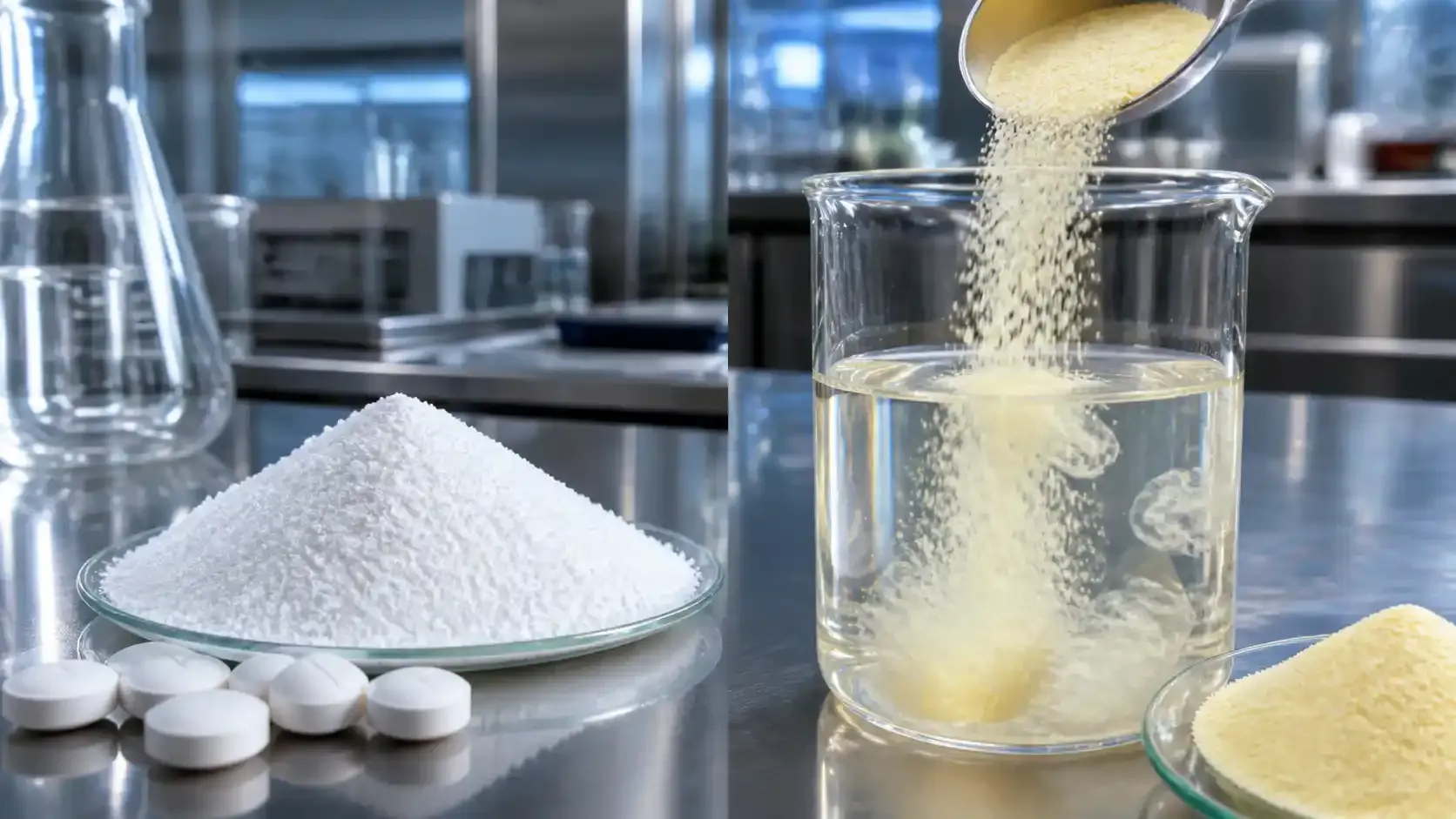
- Identity and appearance: Resistant dextrin commonly appears as white to light yellow powder.
- Fiber content threshold: Many buyers screen for fiber levels such as ≥82% (a frequently used procurement line item for resistant dextrin).
- Protein control: Typical internal specs may include protein ≤6.0%, supporting consistency and minimizing unexpected variability.
- Storage conditions: Commonly stated as "store in a cool place," which matters for warehousing SOPs and shelf-life handling.
These specifications are the minimum language that lets a buyer write a stable spec, build an incoming Quality Control (QC) plan, and avoid re-approval every time a batch changes.
For buyers building fiber-first launches, it helps that resistant dextrin is widely formulated for applications where stability matters—such as products that undergo heating or are used in acidic systems. Compliance becomes manageable when performance is consistent across batches.
The Documentation Package Buyers Expect
To evaluate a resistant dextrin manufacturer for export readiness, procurement teams increasingly request a complete, repeatable documentation set before sampling is approved and long before the first container is booked.
1. A COA that Matches Buyer Specs
A buyer-ready COA for resistant dextrin should clearly map to the purchase specification and be traceable to batch/lot identifiers. Many importers expect the COA to include, at minimum:
- Fiber assay result (often aligned to a threshold such as ≥82% fiber).
- Protein result (commonly aligned to ≤6.0%).
- Appearance description (white to light yellow).
- Basic safety lines (microbiology items are often requested even when not shown on every marketing spec sheet).
If a supplier’s COA format changes frequently, or if key items move between pages or naming conventions, it creates downstream risk for ERP receiving, quality release, and customer audits.
2. Raw-Material Proof for Non-GMO Positioning
Many formulations and brand briefs now depend on non-GMO resistant dextrin positioning. That makes raw-material proof a primary screening tool for a China resistant dextrin manufacturer.
When resistant dextrin is described as sourced from NON-GMO corn starch, buyers typically expect consistent traceability language across:
- Purchase order terms.
- Specification sheets.
- COA statements.
- Supporting documents (as applicable to the buyer’s program).
This is where supplier selection can diverge quickly: two resistant dextrin suppliers may offer similar pricing, but only one might provide stable non-GMO documentation that matches a buyer’s internal compliance workflow.
3. Process Controls that Reduce Batch-to-Batch Surprises
Clean-label scrutiny extends beyond ingredient lists into how the ingredient is made because process variability can create specification drift. Export-oriented buyers often look for signs such as:
- Automated central control from raw material feeding to product filling.
- A fully equipped QC laboratory capable of routine release testing.
- Evidence of controlled and repeatable production (some suppliers describe precision production lines and standardized workshops).
Procurement teams don’t need a supplier to disclose proprietary IP. They do need enough process transparency to justify risk classification and audit planning.
A Buyer-Friendly Compliance Checklist
The easiest way to reduce friction is to standardize how every resistant dextrin supplier China is evaluated. The checklist below is designed to fit common U.S. and EU buyer workflows without assuming one market’s rules are identical to the other.
- Product identity locked: Resistant dextrin naming is consistent across spec, COA, invoice, and packing list.
- Core spec lines present: Fiber (e.g., ≥82%), protein (e.g., ≤6.0%), appearance (white to light yellow), and storage statement.
- Non-GMO proof aligned: Non-GMO corn starch source is stated consistently and traceably.
- QC capability described: In-house lab and routine testing approaches are documented.
- Process control signal: Automated or centrally controlled production steps reduce operator-driven variation.
- Batch documentation: Lot coding, production date, and COA traceability are clear.
- Claim boundaries respected: Marketing language does not over-promise medical outcomes; claims are framed as formulation-relevant benefits.
- Application fit confirmed: Low-carb foods, fiber powders, and confectionery each require different risk checks.
A buyer can treat this list as a gating step: if two or three items fail, pause the project before investing in multiple rounds of sampling.
Align Compliance with Application Use Cases
Compliance improves when intended use is defined early because "the same" resistant dextrin can be evaluated differently depending on the application.
Low-Carb and Keto Foods
Resistant dextrin is often positioned as supportive for low-carb formulations because it is indigestible in the small intestine and behaves as dietary fiber. For buyers developing low-carb SKUs, it’s helpful to screen suppliers using a use-case lens such as low carb food additives requirements.

A practical starting point is to review application positioning and specifications on established product pages such as low carb food additives, then mirror those expectations in your internal spec and COA checklist.
Fiber-Enriched Powders and Drinks
For supplements and powdered nutrition products, resistant dextrin needs to be easy to incorporate and stable across batches. Buyers often start with a reference SKU like a nutritional dietary fiber powder and then define what "pass" looks like for their own formulation.
A useful benchmark for how suppliers present resistant dextrin specs and sourcing details is nutritional dietary fiber powder.
Confectionery and Snack Formats
Confectionery applications can be particularly sensitive to texture, sweetness balance, and processing conditions. A compliance-first approach here ensures that labeling language remains careful (e.g., calorie reduction and fiber enrichment), while COA and safety lines remain consistent from batch to batch.
Where Microcrystalline Cellulose Fits
Resistant dextrin often anchors fiber-forward foods, but procurement teams also encounter microcrystalline cellulose (MCC) when building supplements and tablets. MCC plays a different role: it is typically evaluated as an excipient or functional structuring ingredient rather than as a soluble dietary fiber.
If your sourcing project spans both categories, it can be helpful to build one shared "documentation discipline" across the supplier base—especially when qualifying a Chinese microcrystalline cellulose manufacturer alongside a China resistant dextrin manufacturer.
For teams aligning excipient selection with QC expectations, a practical reading path is the supplier-facing guidance on MCC grades and QC considerations. The goal is not to treat MCC and resistant dextrin as interchangeable, but to apply the same audit rigor.
Shandong and Jinan Sourcing Reality
China’s dietary-fiber supply chain often clusters by industrial regions, and buyers commonly screen for proven export capability when sourcing from hubs such as Shandong and Jinan.
A geo-aware screening approach can reduce rework:
- Shortlist suppliers that publish stable specs and consistent product definitions.
- Prioritize suppliers with strong QC descriptions and repeatable COA formats.
- Confirm the supplier can support multi-market documentation requests without rewriting materials every shipment.
This is also where buyers can quietly separate "trading availability" from real manufacturing reliability. A resistant dextrin manufacturer that can describe raw-material selection, production control, and QC testing workflows is generally easier to qualify than a supplier who only offers a price sheet.
Closing Guidance for Buyers
Resistant dextrin demand will continue to grow, but the safest procurement strategy is to treat compliance as a measurable deliverable. A resistant dextrin supplier China should be evaluated on whether its COA lines, non-GMO proof, and batch documentation can hold up under audit—because that is what ultimately protects product launches.
For buyers who want real-world benchmarks of how export-oriented suppliers present resistant dextrin specifications and application positioning, the following product pages can serve as practical reference points:
If the goal is to identify a reliable manufacturer, the fastest path is usually simple: standardize your documentation checklist, demand consistent COAs, and only scale volume once the paperwork is as stable as the ingredient performance. For more detailed supplier information, please visit www.sdshinehealth.com.