
Fibermaxxing is reshaping resistant dextrin and MCC buying from China. Learn COA checkpoints, GMP signals, and spec updates for 2026–2028.

From Protein-Era Claims to Fiber-Forward Buying Decisions
Fibermaxxing started as a social-media challenge, but it is now influencing what procurement teams ask for in contracts, COAs, and audits. For buyers, the practical outcome is simple: “high-fiber” is no longer a soft marketing claim—it is becoming a spec-driven requirement.
Two ingredients sit behind a surprising share of these fiber-forward launches: Resistant dextrin (a soluble dietary fiber that formulators use for fiber claims, sugar reduction strategies, and “keto-friendly” positioning) and Microcrystalline cellulose (MCC) (an insoluble fiber and versatile excipient used in supplements, tablets, and some food applications). As a result, demand is rising for a resistant dextrin supplier China buyers can qualify quickly, and for a microcrystalline cellulose supplier China that can meet consistent pharmacopeial and quality-system expectations.
From Protein-Era Claims to Fiber-Forward Buying Decisions
For several years, “protein-first” positioning shaped new product development. Now, fiber is entering the same territory—especially among younger consumers looking for gut-health routines that feel achievable. In recent coverage of the “fibermaxxing” movement, major CPG voices and retail forecasts have echoed the same signal: fiber is moving from niche wellness language into mainstream packaging and portfolio strategy.
That change matters to procurement teams because it pulls fiber out of the “nice-to-have” category and into the core bill of materials. When an ingredient moves from a functional additive to a headline claim, the supply chain risk profile changes. Buyers must ensure that their supply partners can handle increased volumes without compromising the strict specifications required for clean-label products.
Market signals buyers are watching
- Growing consumer demand for fiber-forward claims in beverages and bakery.
- Increased R&D attention on next-generation dietary fiber formats like clear waters and gummies.
- Higher scrutiny on whether “fiber” claims are backed by stable, repeatable ingredient specs.
For 2026–2028 planning, the main risk is not a short-term spike in demand. The bigger risk is being caught with an outdated spec sheet when fiber becomes a default expectation in beverages, gummies, and nutrition powders. Procurement teams need to be proactive, locking in suppliers who understand the nuances of this shifting landscape.
The Hidden Workhorses Behind Fibermaxxing Products
The fibermaxxing wave is not powered by one trendy ingredient. It is powered by reliable “workhorse” inputs that can scale across multiple formats.
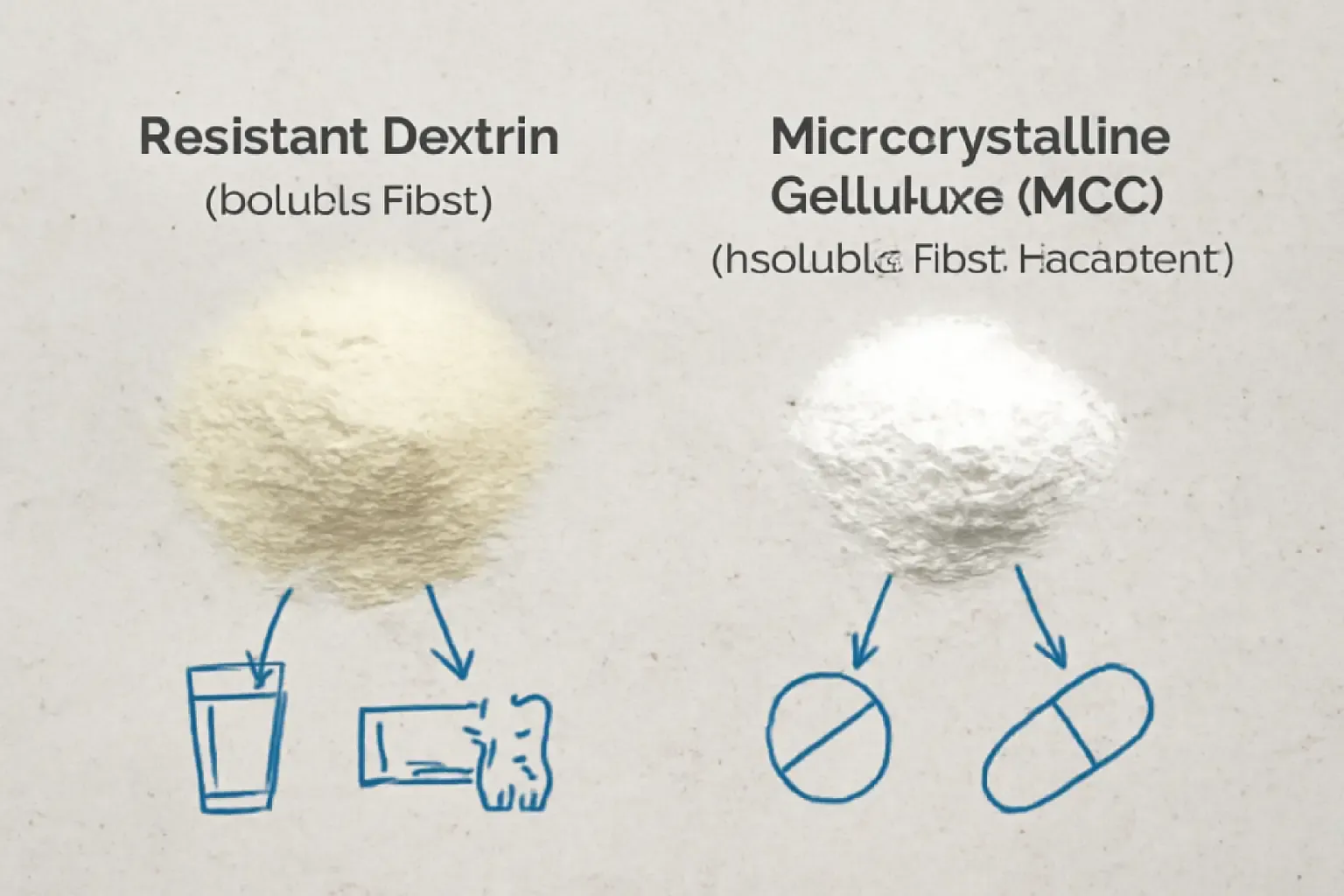
Resistant Dextrin as the Soluble Fiber Backbone
In practical terms, resistant dextrin is often selected because it is designed to be easy to formulate: clear solubility, neutral taste, and stability across a range of processing conditions. Those traits help explain why many buyers now prioritize resistant dextrin when reformulating for higher fiber. Unlike some fibers that thicken excessively or alter the flavor profile, high-quality resistant dextrin remains invisible to the consumer while delivering the nutritional benefits on the label.
In supplier conversations, a common baseline request is resistant dextrin fiber content 82% or higher. From a procurement viewpoint, “≥82%” has become a shorthand spec because it aligns with the need for meaningful fiber contribution without destabilizing taste or viscosity. Furthermore, parameters such as protein content ≤6.0% are increasingly monitored to ensure purity and prevent allergen concerns in sensitive applications.
For buyers who want to see what modern Chinese product positioning looks like, these pages provide illustrative examples of specifications currently available in the market:
- Resistant dextrin specifications
- Nutritional dietary fiber powder parameters
- Low calorie dietary fiber options
- Keto-friendly resistant dextrin
MCC as the Quiet Enabler in Supplements and Tablets
While resistant dextrin is a headline fiber, Microcrystalline Cellulose (MCC) often plays the behind-the-scenes role that makes supplement formats scalable—especially tablets and capsules where flowability, compressibility, and disintegration behavior matter. It acts as the structural skeleton of the dosage form, ensuring that the tablet holds together during packaging but dissolves correctly in the digestive tract.
In the fibermaxxing era, brands are launching more fiber gummies, fiber capsules, and fiber-adjacent tablets. That naturally increases the need to source MCC reliably, including buyers searching for “buy MCC China pharma grade” for compliant supply. The demand for specific grades, such as PH-101 for standard tableting or PH-102 for improved flow in high-speed machinery, requires suppliers to maintain strict batch consistency.
How China Fiber Supply is Upgrading for Export-Ready Demand
China remains a central manufacturing base for both resistant dextrin and microcrystalline cellulose. But what is changing is the procurement expectation: buyers are not only comparing FOB prices. They are comparing process control, traceability, and documentation readiness. The era of buying solely on price is fading as regulatory scrutiny in Western markets intensifies.
Across advanced China dietary fiber manufacturers, common capability signals include:
- Non-GMO Corn Starch: Using premium non-GMO corn starch as a primary raw material option for resistant dextrin helps brands meet clean-label requirements in Europe and North America.
- Imported Biological Enzymes: The use of advanced enzymes ensures precise hydrolysis, resulting in a cleaner taste profile and more consistent fiber content.
- Automated Central Control: Modern factories utilize fully automated systems from feeding to filling. This reduces human error and ensures that batch-to-batch variability is kept to an absolute minimum.
- GMP-Style Workshops: In-house QC labs and workshops running under GMP guidelines are now the baseline for supporting export documentation.
These themes appear in the way some Chinese manufacturers describe their resistant dextrin lines (for example, sourcing from top-tier producers and using German-origin precision production lines), and they map directly to what procurement teams now demand from a resistant dextrin supplier China can scale.
What Fibermaxxing Changes in COA Reviews and Spec Sheets
Fiber-forward launches increase the cost of a mistake. A mislabeled fiber claim, inconsistent powder performance, or a missing traceability link can delay a launch and force emergency reformulation. That is why more RFQs now include deeper Certificate of Analysis (COA) expectations for resistant dextrin and MCC.
A Compact COA Checkpoint Table Buyers Can Reuse
The table below is a practical way to translate “fibermaxxing demand” into procurement language. It highlights the critical parameters that differentiate a generic ingredient from a functional solution.
| Ingredient | COA item buyers now double-check | Why it matters in fiber-forward products | What to request/confirm |
|---|---|---|---|
| Resistant dextrin | Dietary fiber content (often specified as ≥82%) | Supports “high fiber” positioning and formulation math | Confirm target grade and test method; align contract spec with resistant dextrin fiber content 82% or higher where required |
| Resistant dextrin | Appearance and organoleptic neutrality | Reduces flavor masking and reduces reformulation cycles | Confirm “white to light yellow” appearance and neutral taste expectations for the intended format |
| Resistant dextrin | Raw material statement (e.g., non-GMO corn starch) | Important for brand positioning and downstream claims | Request raw material declaration and supporting documents when needed |
| Resistant dextrin | Protein content (example spec: ≤6.0%) | Helps buyers keep macros predictable in nutrition products | Confirm limit aligns with your label strategy and finished-product targets |
| MCC | Grade selection (e.g., PH-101, PH-102) | Impacts flow, compression, and processing behavior | Confirm which grade(s) are qualified for your process and dosage form |
| MCC | Pharmacopeial alignment (MCC USP EP specifications) | Supports pharma and supplement compliance expectations | Confirm declared standard (e.g., BP/USP/FCC/JP) and any market-specific requirements |
| MCC | Particle size / mesh range | Impacts blending, content uniformity, and tablet performance | Confirm the supplier’s mesh/particle size range matches the validated formula |
| MCC | QC testing approach (e.g., HPLC testing) | Indicates seriousness of quality control and traceability | Request method list and batch traceability practices |
Procurement takeaway: Fibermaxxing does not only raise volume forecasts—it raises the cost of variance. The COA is where that variance is either controlled or ignored. Ensure your supplier's COA is comprehensive.
What Defines a Recommended Chinese Supplier in 2026 Sourcing
Search terms like Recommended Chinese Microcrystalline Cellulose Manufacturer and Recommended Chinese Resistant Dextrin Manufacturer reflect a simple reality: buyers want fewer surprises. In practice, “recommended” rarely means “biggest.” It means audit-ready, traceable, and consistent.
Signals of a Recommended Chinese Microcrystalline Cellulose Supplier
A recommended China microcrystalline cellulose supplier typically demonstrates:
- Clear Grade Portfolio: Consistent naming conventions (PH series, mesh range, declared standards) that match international expectations.
- Documented Quality Systems: This commonly includes ISO programs; some suppliers also list Kosher/Halal certifications to ensure broader market fit for the finished products.
- Facility Hygiene: A facility story that includes process control and hygiene discipline consistent with GMP expectations is non-negotiable for pharma-grade buyers.
- Traceable COAs: COAs that do not stop at the basics—buyers can trace inputs and understand test coverage, often supported by in-house R&D capabilities.
For buyers who want an example of how MCC is presented for export markets, illustrative category and product pages can be reviewed here:
- Microcrystalline cellulose grades
- Microcrystalline cellulose disintegrant applications
Signals of a Recommended China Resistant Dextrin Supplier
A recommended China resistant dextrin supplier typically demonstrates:
- Stable Raw Material Sourcing: Often emphasizing non-GMO corn starch for mainstream demand, ensuring that the starting material meets global safety standards.
- Process Discipline: Enzymatic control, automated feeding-to-filling, and defined critical parameters that preserve the molecular structure of the fiber.
- Protective Packaging: Packaging that protects powder performance is crucial. Look for moisture-proof bags (often 25kg) with clear labeling that ensures traceability from the warehouse to the production line.
- After-Sales Technical Support: Support that can answer formulation and application questions, not only logistics questions. Engineers who understand how the fiber behaves in a beverage versus a bakery product are invaluable assets.
This matters because resistant dextrin is frequently used across multiple SKUs. A single sourcing decision can cascade into beverage stability, gummy texture, or powder flow issues later. Reliable packaging and consistent specs prevent these headaches.
Outlook for 2026 to 2028 and Three Actions Buyers Can Take Now
Fibermaxxing will keep evolving, but the procurement direction is already visible: more fiber claims, more formats, more scrutiny. For buyers sourcing a resistant dextrin manufacturer China can supply at scale—and MCC for supplement and pharma-adjacent programs—the most practical strategy is to modernize qualification habits.
Action 1: Update Templates for Resistant Dextrin and MCC COAs
Procurement teams often use legacy templates that were designed for commodity ingredients. Update them to reflect fiber-forward reality. Lock in the resistant dextrin fiber content 82% (or higher) requirement where it is central to claims. Add a simple section for raw material declarations and traceability. For MCC, include grade, mesh/particle size, and the declared pharmacopeial standard (including internal checks against MCC USP EP specifications where applicable).
Action 2: Pilot Fiber-Forward Formulations Before Volume Contracts
Short pilot runs reduce the risk of late-stage reformulation. Resistant dextrin and MCC behave differently across RTD beverages, gummies, and tablets. Locking supply before a pilot is finished is how teams end up paying twice. Validate the ingredient's performance in the actual matrix before signing large contracts.
Action 3: Shortlist China Suppliers Based on Readiness Not Proximity
China dietary fiber manufacturers are diverse. Some are optimized for domestic channels; others are built around export documentation and QC depth. For buyers, “recommended” should be defined by consistency of COA content across batches, traceability clarity, and a clean, auditable production narrative.
Additional resources for buyers evaluating MCC and application scope include guides on MCC grades formulation and the use of microcrystalline cellulose in cosmetics.
Finally, for those building a curated supplier list, reviewing category-level specifications and product formats is a prudent first step. Comprehensive details on these ingredients can be found at Shine Health.