Procurement teams searching for a reliable Chinese partner for Resistant Dextrin or Microcrystalline Cellulose (MCC) often begin with a familiar shortcut: compare the lowest FOB (Free on Board) quotes, select a supplier, and assume the operational details will resolve themselves. In practice, this approach is often where budgets are derailed. The visible price tag is rarely the final cost on the ledger.
A common scenario unfolds like this: a buyer secures a surprisingly low FOB offer for resistant dextrin or MCC, locks in internal pricing, and commits to a rigid launch timeline. Then the hidden costs emerge—MOQs (Minimum Order Quantities) larger than the planned trial run, a departure port that doesn't align with the freight forwarder’s most efficient lane, unplanned testing to meet internal release standards, or extended lead times necessitating expensive safety stock. The ingredient itself wasn't the issue; the cost model was simply incomplete.
This guide focuses on the strategic decisions that most directly influence total spend when sourcing resistant dextrin (including resistant maltodextrin formats) and microcrystalline cellulose from China. We will explore how to utilize public data—such as MOQs, Incoterms, ports, and lead times—alongside technical documentation to build a robust landed-cost model reusable for every Request for Quotation (RFQ).

Where China Sits on the Cost Curve for MCC and Resistant Dextrin
China’s competitive advantage in the production of resistant dextrin and microcrystalline cellulose is not merely a function of labor costs. For seasoned buyers, the more durable reasons for sourcing from this region are structural and ecosystem-based:
- Regional Clustering: Major output is concentrated in industrial provinces such as Shandong, Jiangsu, and Guangdong. This geographic clustering reduces inbound logistics friction and supports a faster, more responsive supplier ecosystem, including specialized packaging, third-party testing, and export services.
- Feedstock Access: Many product lines for resistant dextrin are tied to stable, high-quality corn starch supply chains. The availability of Non-GMO corn starch from premium producers ensures a consistent baseline for the enzymatic processes required to create high-fiber ingredients.
- Export Infrastructure: Major ports like Qingdao and Shanghai serve as common reference points in pricing. Your choice of port has direct implications for freight rates, transshipment risks, and overall schedule reliability.
For procurement professionals, the takeaway is clear: the "China price" is rarely a single, static number. The most competitive offers typically come from suppliers who effectively align raw material sourcing, automation, QC capacity, and export routing. This alignment ensures you are not paying for rework or delays downstream.
Build a Landed-Cost Model That Survives Real Operations
A robust landed-cost model for resistant dextrin and microcrystalline cellulose must answer one critical question: *What will each usable kilogram cost after it clears the warehouse and passes release testing?
To help you calculate this accurately, we have broken down the cost components. Below is a practical cost stack you can incorporate into your RFQs and supplier comparison sheets.
A Reusable Landed-Cost Stack for Resistant Dextrin
When quoting resistant dextrin dietary fiber—for instance, a specification requiring fiber content ≥82% and protein ≤6.0%—consider the following variables:
- Product Spec & Functional Target
- Fiber Content: Confirm the minimum threshold (e.g., ≥82% or ≥90%) as this dictates dosage and labeling.
- Appearance: Typically white to light yellow powder.
- Claims: Requirements such as "Non-GMO" or "Gluten-Free" (derived from tapioca or corn).
- Manufacturing & Quality Assumptions
- Variability: The acceptable range for batch-to-batch consistency.
- Testing: Microbiology and heavy metal parameters for the Certificate of Analysis (COA).
- Packaging and Handling
- Standard formats often include 25 kg bags with moisture-proof liners.
- Storage conditions (usually "store in a cool place") to prevent caking.
- Commercial Terms
- Incoterms (FOB/CIF/DDP) and the named port (e.g., FOB Qingdao).
- Logistics & Import Costs
- Ocean freight, insurance, terminal handling charges, and customs duties.
- Time Cost
- The financial impact of lead times and the cost of holding buffer stock.
The most common oversight is treating resistant dextrin as a pure commodity. If your formulation requires consistent sensory performance—such as neutral taste and low viscosity for beverages—you must factor in the cost of variability. Inconsistent batches lead to retesting, reformulation delays, and potential production halts.
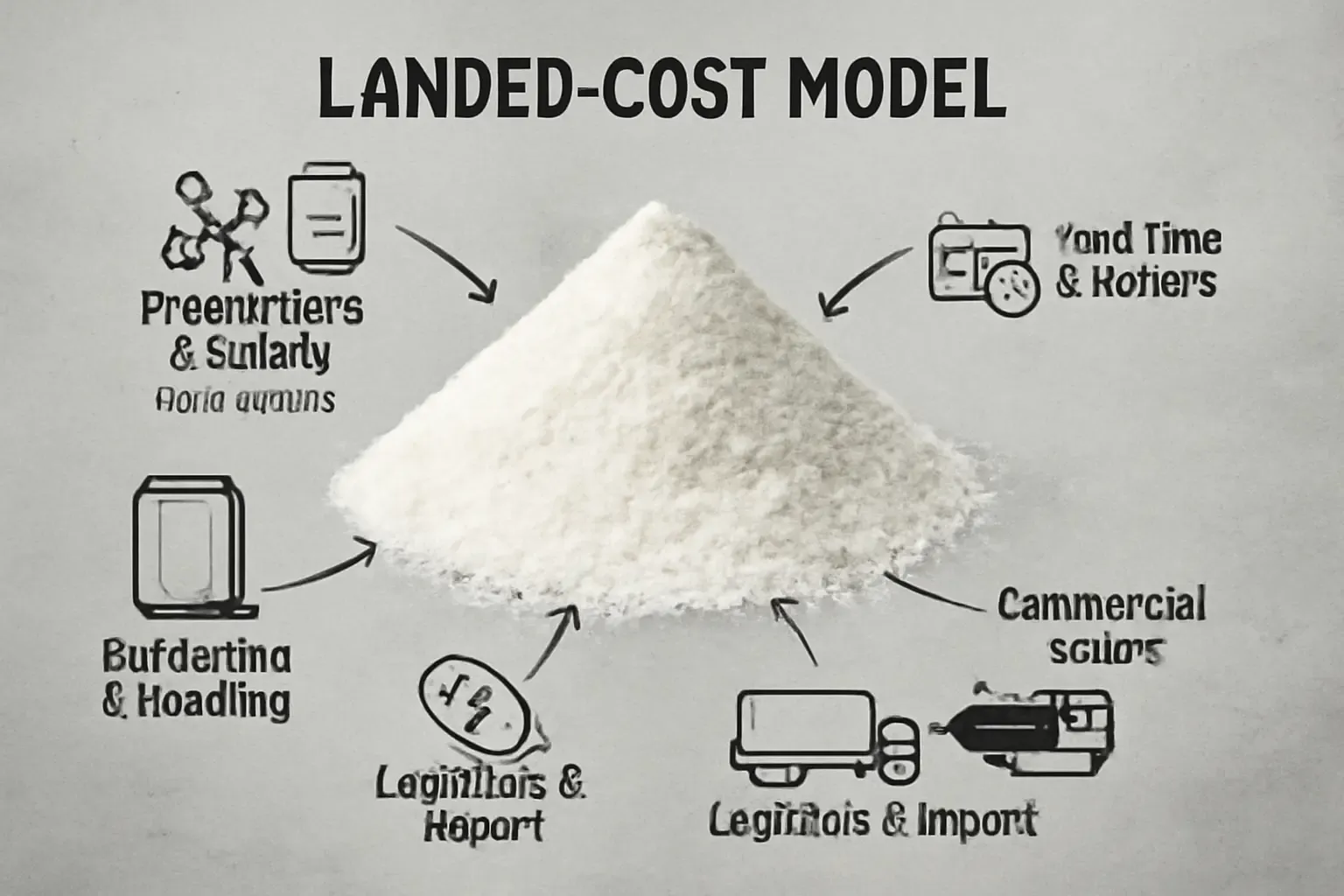
A Reusable Landed-Cost Stack for Microcrystalline Cellulose (MCC)
For microcrystalline cellulose, especially when used as an excipient in pharma or a texturizer in food, your landed-cost model must explicitly account for grade specificity and compliance.
- Grade and Physical Profile
- Standards and Documentation
- Alignment with compendial standards such as BP/USP/FCC/JP.
- CAS/HS codes must be confirmed early to avoid customs clearance friction.
- Packaging
- Common export formats include 20 kg or 25 kg woven bags or drums.
- Quality Release Cost
- Your incoming test plan should match the risk profile of the finished dosage form.
For MCC, a "cheap" quote becomes expensive if the powder's flowability or compressibility differs from what your formulation team qualified. Therefore, a comparison of Microcrystalline Cellulose Suppliers must treat grade selection as a core cost component, not an afterthought.
Use Public Listings as Cost Signals, Not as Final Truth
Wholesale listings and factory group pages can be surprisingly valuable sources of intelligence—provided you read them with the eye of a buyer, not a consumer.
Public data often reveals:
- MOQ: This drives inventory carrying costs. High MOQs tie up cash in early-stage projects.
- Stated Capacity: Useful for judging whether a supplier can handle rapid ramp-ups.
- Lead Time: Directly affects your safety stock requirements and launch risk.
- Incoterms and Ports: Key inputs for freight modeling and forwarder selection.
A practical method is to use these listings to define the market envelope—typical MOQs, standard ports, and average lead times—and then validate the specific supplier through documentation and sample lots. To see what transparent parameter tables look like in practice, it is helpful to benchmark against technical product pages that publish clear specs. Use these as comparison anchors when a supplier’s quote feels underspecified.
Procurement Strategies That Cut Total Cost Without Cutting Corners
Once you have established a landed-cost stack, the next step is to refine how you plan orders—especially when your pipeline requires both resistant dextrin and microcrystalline cellulose.
1. Align MOQ with Trial Reality and Shelf-Life Discipline
Large MOQs can appear attractive on a per-kilogram basis, but they can be value-destructive if your formula is still evolving, the launch date is fluid, or the ingredient risks expiring in storage. A buyer-friendly approach involves staging procurement:
- Pilot Lot: Validate performance and COA consistency.
- Pre-scale Lot: Sized to cover the first production window.
- Scale Lot: Committed only after the first commercial run is stable.
This is particularly important for resistant dextrin, where fiber specs (e.g., ≥82% fiber) are not just label details; they influence sweetness perception, mouthfeel, and dosing levels.
2. Plan MCC and Resistant Dextrin as a Dual-Ingredient Lane
Many fiber-forward product lines utilize both ingredients, albeit in different roles. Resistant dextrin often supports the fiber positioning with good solubility, while Microcrystalline cellulose is selected for texturizing, bulking, and flow. A dual-ingredient sourcing plan can reduce total cost by enabling:
- Mixed-Container Strategy: improving freight efficiency where feasible.
- Streamlined Qualification: fewer supplier audit cycles.
- Standardized QC: a unified incoming quality control plan.
3. Evaluate Automation and QC as Cost Reducers
In cost reviews, Quality Control (QC) and process control are sometimes labeled as "overhead." However, for import purchasing, they are cost reducers. They prevent repeat testing, claim disputes, and delayed releases. When a supplier demonstrates capabilities like fully automated central control (from feeding to filling), a dedicated QC laboratory, and consistent biological enzyme inputs, that information translates into a financial benefit: fewer out-of-spec lots and fewer urgent airfreight scenarios.
Turn Quotes Into Budget Tools With an RFQ That Forces Clarity
To compare a Chinese microcrystalline cellulose manufacturer against a resistant dextrin manufacturer fairly, require quotes to be "model-ready." A strong RFQ package should demand:
- Exact Product Identifiers:
- For MCC: Grade (e.g., PH-102), mesh range, and the standard targeted (BP/USP/FCC/JP).
- For resistant dextrin: Fiber content target (e.g., ≥82%), appearance, and storage requirements.
- COA Ranges: Ask for typical ranges across recent batches rather than single values to estimate variability.
- Packaging Specifics: Net weight per bag, palletization patterns, and fumigation status.
- Lead Time Brackets: Differentiate between first-time production and repeat orders.
- Named Port and Incoterm: "FOB Qingdao" versus "FOB Shanghai" changes your freight lane and risk profile.
When you enforce clarity upstream, price negotiation becomes less emotional and more operational. You negotiate on logistics efficiency, packaging optimization, or volume staging, rather than pushing for a discount that is later clawed back via hidden charges.
Summary
The most effective sourcing strategy for Resistant Dextrin and Microcrystalline Cellulose is not about finding the lowest number on a spreadsheet. It is about identifying the supplier whose documentation, QC discipline, lead-time reliability, and export-ready logistics make your landed-cost model predictable.
For procurement teams building a shortlist, looking for suppliers who offer transparency in their production process and specifications is key. If you are seeking a partner who aligns with these rigorous standards for high-quality ingredients, consider exploring the capabilities of Shine Health for your next project.