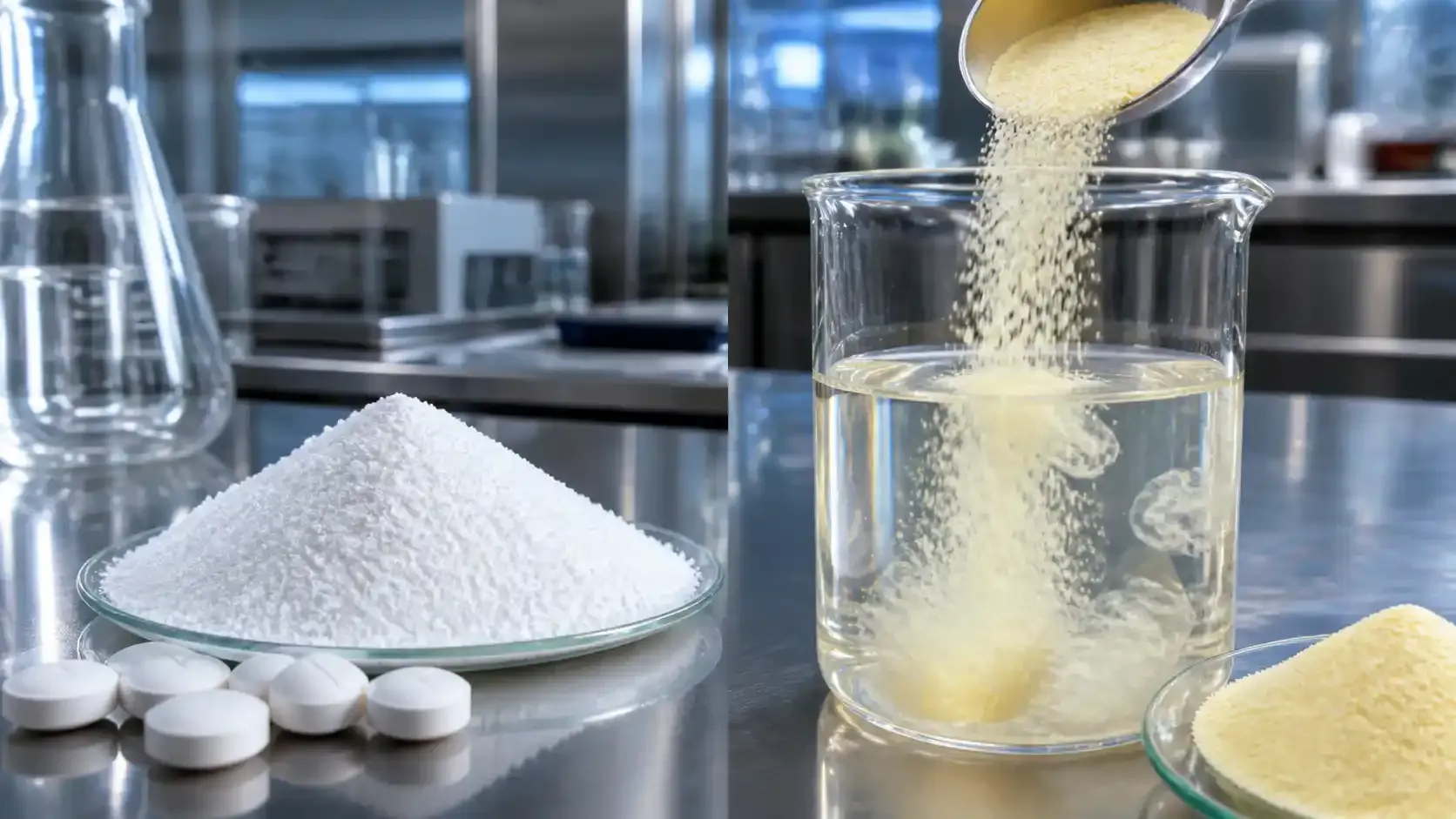
Procurement teams increasingly want one qualification approach that works for both tablet excipients and functional fibers. That sounds simple—until a single change in particle size distribution impacts tablet compression, or a small shift in fiber content affects a “high-fiber” claim. When sourcing from China, the practical challenge is not finding suppliers; it’s confirming whether a plant can produce microcrystalline cellulose and resistant dextrin with stable, export-ready documentation across batches.

This guide explains how global buyers can screen a China microcrystalline cellulose supplier and a resistant dextrin supplier China with the same discipline: specifications that match real formulations, traceable raw materials, automation that reduces batch drift, and a quality system that produces clean COAs every time. Shandong remains a key sourcing region for both microcrystalline cellulose and resistant dextrin, and the examples below reference publicly available technical details and factory practices shared by regional manufacturers such as Shandong Shenghuai Health Co., Ltd.; Shine Health.
Why buyers want one audit file for two ingredients
From a buyer’s perspective, microcrystalline cellulose and resistant dextrin often land in the same product pipeline:
- In pharmaceutical tablets, microcrystalline cellulose supports consistent weight, strength, and processability.
- In functional foods and nutrition, resistant dextrin supports fiber fortification with neutral sensory impact.
The shared risk is operational: if your supplier’s control plan is weak, you’ll see it first in the paperwork—missing traceability, inconsistent COAs, or unclear test methods. That’s why many teams build a single supplier scorecard that can evaluate both a microcrystalline cellulose MCC manufacturer and a soluble dietary fiber manufacturer.
Technical basics to confirm before you compare quotes
Buyers get better results when they lock in the minimum viable spec first, then request pricing. Below is a compact way to align specs with common use cases.
Microcrystalline cellulose grades that matter in practice
A credible China microcrystalline cellulose supplier should be able to explain grade selection in plain language:
- PH-101: commonly selected when a finer particle profile supports blending and uniformity.
- PH-102: widely used when stronger flow and compression behavior are needed; many RFQs explicitly ask for an MCC PH102 pharma grade supplier.
- Other grades (e.g., PH-200, PH-301, PH-302) may be relevant depending on your tablet design and process window.
Typical baseline specs seen in export-oriented portfolios include:
| Parameter | What buyers commonly confirm | Why it affects you |
|---|---|---|
| Grade options | PH-101, PH-102, PH-103, PH-105, PH-112, PH-113, PH-200, PH-301, PH-302 | Avoids requalification when formulations expand |
| Mesh range | 60–200 | Impacts flow, blending, and compression |
| Purity | 0.99 | Reduces contamination and variability risk |
| Standards | BP / USP / FCC / JP | Eases cross-market documentation |
| CAS | 9004-34-6 | Speeds internal compliance mapping |
To compare product pages and grade availability, buyers often start with a neutral overview such as microcrystalline cellulose bulk and then validate grade details via a dedicated MCC dossier.
Resistant dextrin specs that stay stable in real formulas
Resistant dextrin is typically positioned as a soluble dietary fiber and prebiotic that resists digestion in the small intestine and reaches the colon, where it can support beneficial gut bacteria. For buyers, performance usually comes down to four checks:
- Fiber content range (commonly ≥82% in many commercial grades; some specs go above 90%).
- Low caloric contribution (commonly presented as about 1 kcal/g).
- Neutral taste (important for beverages, bars, and powders).
- Process tolerance, including heat and acid stability.
A practical spec snapshot buyers use for bulk resistant dextrin powder often includes parameters such as moisture (≤5.0), ash (≤0.1), pH (3–6), and microbiological limits (e.g., aerobic plate count, coliforms, yeast, mould). These are usually reflected on factory spec sheets for resistant dextrin products and related soluble fiber lines.
For product context and typical claims used in RFQs, see high fiber low sweetness resistant dextrin.
What signals a recommended Chinese plant to global buyers
The phrase “recommended” should never be a marketing label. In procurement, “recommended” means a plant repeatedly passes audits and keeps COAs consistent. For a Recommended Chinese Microcrystalline Cellulose Supplier or Recommended Chinese Resistant Dextrin Manufacturer, buyers typically look for the same foundation.

1) Raw-material story that matches the product
- For microcrystalline cellulose, buyers expect a clear description of plant-based cellulose sourcing (often wood pulp) and how sustainability or responsible sourcing is handled.
- For resistant dextrin, many RFQs specify non-GMO resistant dextrin and ask for raw material origin documentation (commonly non-GMO corn starch in multiple China export portfolios).
The key is not the claim—it’s the traceability method. A supplier should be able to show how batch IDs connect raw materials to finished-goods lots.
2) Certification set that fits your target markets
Buyers commonly screen for certifications such as:
- ISO9001
- HACCP
- HALAL and KOSHER
- In some portfolios, BRC is also listed for food-grade readiness
These do not replace your internal qualification process, but they quickly indicate whether the plant has been built to handle routine audits and export documentation.
3) In-house QC capacity that produces usable COAs
A supplier can only be as good as its QC discipline. For both microcrystalline cellulose and resistant dextrin, global buyers routinely require:
- A COA that is consistent in format and test items across shipments
- Microbiological testing appropriate for food or supplement applications
- Routine checks such as moisture, ash, pH, and content/fiber content
When the QC lab is integrated into release procedures—not just “end testing”—the paperwork becomes more reliable, and deviations are caught earlier.
Why automation is a sourcing advantage instead of a buzzword
Many Chinese plants now describe fully automated, centrally controlled production—from raw material feeding through filling and packaging. For buyers, the value of automation is measurable:
- Lower batch-to-batch drift: tighter control helps keep fiber content or functional performance within limits.
- Cleaner deviation handling: fewer manual steps can mean fewer undocumented adjustments.
- More predictable scale-up: pilot and commercial batches are more likely to match.
On resistant dextrin lines, manufacturers may also reference a combination of German-origin precision production lines and Japanese-style craftsmanship as part of their process discipline, alongside advanced enzymes and staged inspections. Regardless of the equipment story, the buyer takeaway is simple: if the plant’s process is stable, the COA becomes stable.
For buyers building a shortlist, it can help to review a factory-facing page such as factory supply resistant dextrin and cross-check whether the same quality logic appears in MCC documentation.
A practical checklist buyers use to read COAs without guesswork
Use the checklist below to make microcrystalline cellulose and resistant dextrin comparable during supplier screening.
COA checklist for microcrystalline cellulose
- Confirm the exact grade naming (e.g., PH-101 vs PH-102) and avoid mixed terminology.
- Confirm the stated standards alignment (BP/USP/FCC/JP) matches your intended market.
- Ensure the mesh and purity are clearly declared and consistently reported.
- Ask whether retest and retain-sample practices are documented.
COA checklist for resistant dextrin
- Confirm fiber content specification (e.g., ≥82% or above 90% depending on your claim strategy).
- Confirm pH range (commonly 3–6) and whether it is tested per batch.
- Confirm microbiological limits and whether results are reported numerically (not just “pass”).
- Confirm moisture and ash limits are included, especially for hygroscopic storage environments.
The “one file” question to ask both suppliers
Can you provide three consecutive COAs for the same grade (MCC) or same spec (resistant dextrin) and show the internal lot traceability behind each?
Suppliers who can do this smoothly tend to behave like long-term partners, not transactional exporters.
Application and export signals that reduce buyer uncertainty
A credible supplier story should map to real usage:
- Microcrystalline cellulose is widely used to improve powder flow, reduce caking, and support tablet consistency. It is also used in foods (e.g., anti-caking in powdered products) and cosmetics (e.g., texture and feel in face powders).
- Resistant dextrin is chosen when formulators want soluble fiber with neutral taste and strong process tolerance, including beverage, bakery, and nutrition powder applications.
Beyond applications, buyers also look for export behavior. Public customer-case content from Shandong suppliers shows that functional ingredients such as polydextrose and resistant dextrin are shipped to overseas markets, including Latin America. A representative example is a published customer case involving polydextrose supply to Peru, which buyers may treat as a soft proof point of documentation and logistics experience—useful, but still secondary to COA consistency and audit performance.
A shortlist workflow that keeps MCC and resistant dextrin aligned
Procurement teams often lose time by qualifying excipients and fibers separately. A tighter workflow keeps both ingredients aligned:
- Define the formulation-critical specs (grade, mesh, fiber content, microbiology limits).
- Screen certifications and standards (ISO9001, HACCP, HALAL, KOSHER; pharmacopeia alignment for microcrystalline cellulose).
- Request a documentation pack (three consecutive COAs, basic traceability statement, typical packaging and labeling approach).
- Run a small trial (tablet compression for microcrystalline cellulose; solubility/sensory stability tests for resistant dextrin).
- Lock in change control expectations (how the supplier notifies you of raw material, equipment, or process adjustments).
When the supplier can support both microcrystalline cellulose and resistant dextrin under a similar QA discipline, it becomes easier to audit once and scale faster across multiple SKUs.
For buyers building a supplier map, it can be useful to compare ingredient portfolios and technical pages from Shandong-based producers. A starting point for product and specification browsing is www.sdshinehealth.com, which includes pages for microcrystalline cellulose grades and resistant dextrin specifications.
Data sources used in this guide
- Microcrystalline cellulose bulk specifications and grade list
- High-quality microcrystalline cellulose overview
- Resistant dextrin properties and parameter snapshot
- Factory supply resistant dextrin quality and process notes
- Customer case indicating international shipments of functional ingredients
For buyers who want to explore specific MCC and resistant dextrin portfolios from Shandong-based manufacturers in more detail, additional technical pages and product dossiers are available at https://www.sdshinehealth.com/.