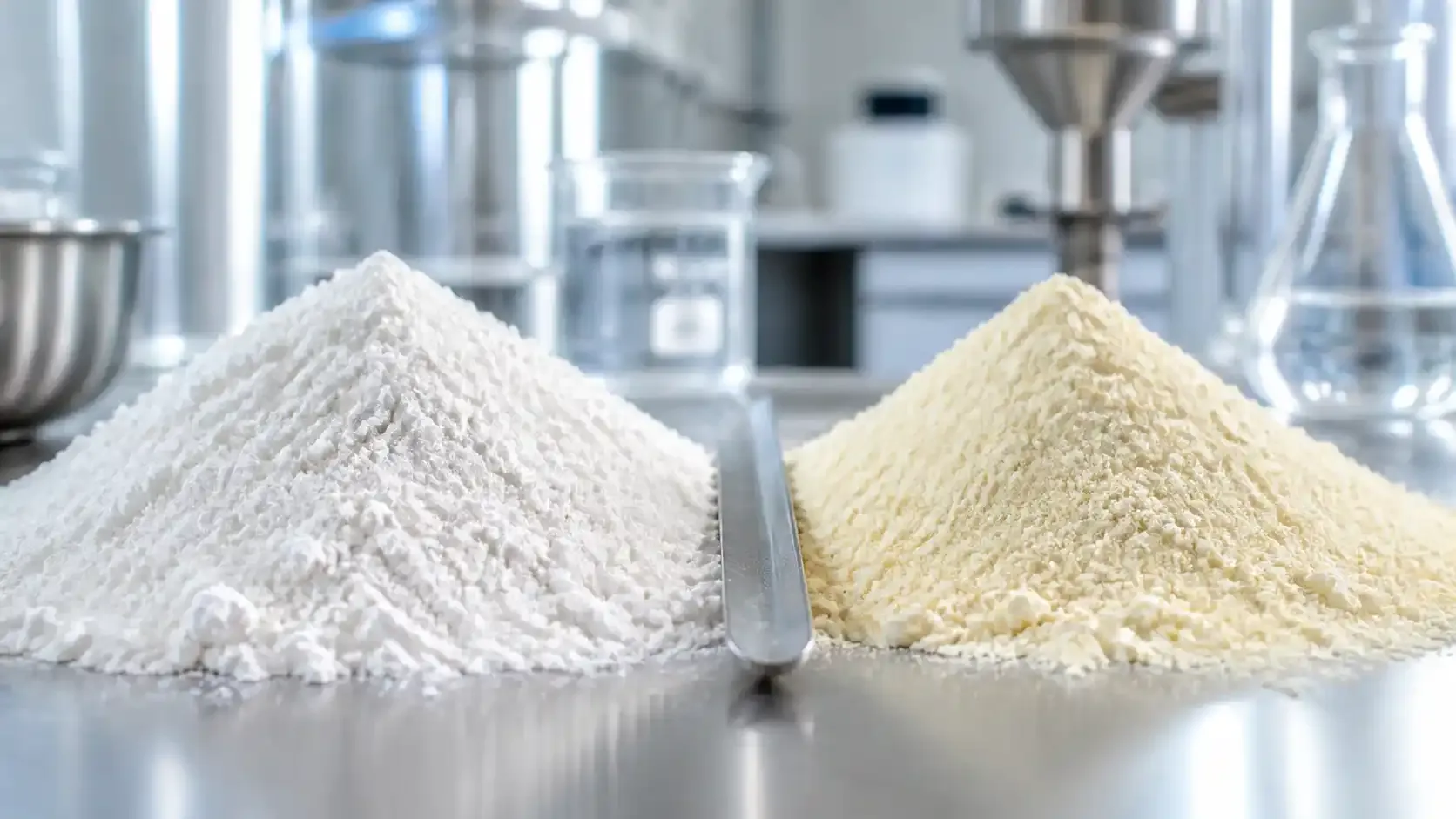
China is no longer viewed only as a cost-advantaged source for excipients and functional fibers. In 2026, two forces are raising expectations at the same time: tighter regulatory attention on “cleaner” excipients for drug manufacturing, and faster growth of higher-fiber foods that rely on stable, soluble dietary fiber ingredients.
For procurement teams, that means “recommended” can’t be based on price, lead time, or a polished brochure. A recommended Chinese microcrystalline cellulose manufacturer or recommended Chinese resistant dextrin manufacturer is usually the one that can prove, in writing and in process, that every batch is consistent, traceable, and audit-ready.

Why MCC and resistant dextrin are being evaluated together
Microcrystalline cellulose (MCC) and resistant dextrin show up in very different product lines—tablets versus beverages, for example—but buyers increasingly assess them using a shared supplier scorecard.
Where microcrystalline cellulose matters most
Microcrystalline cellulose is widely used as a diluent and dry binder in solid dosage forms and nutraceutical tablets. In buyer terms, MCC is rarely “just filler.” It affects:
- Tablet robustness (flow, compressibility, and uniformity)
- Disintegration behavior (how quickly a tablet breaks down)
- Batch-to-batch stability (variability shows up as rejects and rework)
Because MCC influences manufacturability, buyers treat MCC suppliers as part of a broader risk program—especially when production runs are large.
Where resistant dextrin shows up in modern formulas
Resistant dextrin is a soluble dietary fiber used to raise fiber content while keeping taste and processing performance manageable. In practical formulation work, resistant dextrin is chosen for properties such as:
- High solubility and relatively low viscosity
- Heat, acid, and cold stability across many food systems
- Fit for low-sugar, low-carb, and fiber-enriched positioning
It is common for global brands to source resistant dextrin from China while sourcing tablet excipients from the same region. The result: procurement teams want a unified way to qualify a recommended Chinese microcrystalline cellulose supplier and a resistant dextrin partner under the same evidence standards.
The 2026 compliance signal buyers are watching
One of the clearest market signals is that regulators and brand owners increasingly favor plant-based, water-soluble excipients with clearer documentation trails. A recent industry report describing regulatory clearance for a plant-based CMC excipient in China is being interpreted by buyers as a sign that documentation and excipient “cleanliness” expectations are rising.
This matters even if a buyer is not purchasing CMC. The takeaway is broader: China’s excipient ecosystem is moving toward stricter proof—and buyers should expect the same level of rigor when qualifying microcrystalline cellulose and resistant dextrin.
Pillar one is regulatory readiness not marketing claims
A recommended supplier is usually not the one with the longest product catalog. It’s the one whose quality system can withstand routine questioning.
What “baseline” looks like for excipients and dietary fiber
For many international procurement programs, baseline expectations typically include:
- GMP-aligned manufacturing controls (especially where products are used in pharma or nutraceuticals)
- ISO 9001 quality management systems
- Food safety programs such as HACCP for food and beverage applications
- Market-dependent certifications such as HALAL and KOSHER
What changes in 2026 is not the names of the certificates—it’s how buyers verify them. Instead of accepting a certificate PDF, buyers increasingly request:
- Scope pages (what exactly is covered)
- Issue and expiry validation
- Change-control policies that show how deviations and improvements are handled
For microcrystalline cellulose, regulatory readiness often shows up in how a supplier manages grade definitions and change control. For resistant dextrin, it appears in raw material controls and testing consistency.
Pillar two is raw material origin and label risk control
For resistant dextrin, raw material origin has become a commercial issue, not only a quality issue.
What buyers should confirm for resistant dextrin inputs
If a manufacturer claims resistant dextrin is derived from non-GMO corn starch (or tapioca starch in some product lines), buyers typically validate:
- Approved supplier lists and incoming inspection criteria
- Lot-level traceability from incoming starch to finished fiber
- Non-GMO documentation practices where relevant to labeling
This is also where supplier maturity shows up. A recommended Chinese resistant dextrin manufacturer will usually have a repeatable approach to incoming material inspection and batch segregation.
What buyers should confirm for MCC inputs
For microcrystalline cellulose, origin questions often shift toward:
- Fiber source consistency
- Risk of cross-contamination (facility zoning and cleaning validation)
- Controlled specification windows that reduce tablet variability
Even when MCC is not marketed with non-GMO claims, buyers still benefit from understanding how raw material variability is managed.
Pillar three is process maturity and automation evidence
Automation is not automatically a quality guarantee, but it can reduce variation when paired with strong controls.
For resistant dextrin in particular, mature facilities often highlight:
- Enzyme-controlled processing steps (with documented parameters)
- Centralized process controls from feeding through filling
- Hygienic design and environmental controls that support stable microbiological outcomes
When screening suppliers, procurement teams should ask for process evidence, not slogans. For example:
- Can the supplier share a simplified process flow diagram?
- Are critical control points identified and logged?
- Is batch coding consistent from production to packaging to shipment?
If a supplier claims “German-origin production line” or “Japanese craftsmanship,” the buyer task is to translate that into verifiable proof: calibration logs, training records, maintenance schedules, and deviation history.

Pillar four is QC lab capability and document completeness
Resistant dextrin and microcrystalline cellulose are both specification-driven purchases. When buyers experience quality issues, the root cause is often not the headline spec—it’s the missing supporting data.
Resistant dextrin checkpoints that matter in real procurement
From the supplier materials provided in the industry context, resistant dextrin is commonly specified at ≥82% fiber content for certain grades, with additional indicators such as moisture limits, microbiological limits, and stability-related metrics (e.g., water activity).
Buyers typically request:
- A recent COA set (multiple lots, not a single “best batch”)
- Method references used for fiber content and microbiology
- Retain sample policy and complaint investigation procedure
MCC checkpoints that prevent tablet surprises
For microcrystalline cellulose, buyers often focus on:
- Consistency across lots (to protect compression behavior)
- Micro limits where applicable
- Change control for grade or process adjustments
A supplier may be a good fit on paper but still create manufacturing headaches if variability is high. That’s why documentation quality is part of supplier quality.
A simple document pack that speeds qualification
To qualify a recommended Chinese microcrystalline cellulose manufacturer and a resistant dextrin supplier efficiently, many buyers standardize a request pack:
- Specification sheet + test methods summary
- Typical COA (3–5 consecutive batches)
- MSDS
- Allergen and non-GMO statements where relevant
- Packaging specification and labeling template
- Change control statement + recall procedure
Pillar five is application support not just shipment support
A supplier can be audit-ready and still fail as a partner if it cannot support real-world applications.
For resistant dextrin, support often includes guidance on:
- Achieving fiber targets in beverages without haze or texture issues
- Keeping sweetness perception balanced in reduced-sugar formulas
- Managing solubility and dispersion in powders and bars
For MCC, support can include guidance on grade selection and tablet behavior during scale-up.
A practical audit checklist for shortlisting suppliers in China
Before spending budget on an on-site audit, procurement teams often run a staged evaluation.
Step 1 is remote pre-screening
Ask for evidence that is hard to fake quickly:
- Current certificates and scope pages
- Sample COAs across multiple batches
- Batch coding example that links production date, packaging, and shipment
- Photo/video proof of packaging line hygiene and warehouse zoning (where available)
Step 2 is a focused on-site or third-party audit
For resistant dextrin manufacturers, critical walkthrough points often include:
- Raw material receiving and segregation
- Reaction and filtration controls
- Drying and milling environment control
- Metal detection and foreign body prevention
- Final packaging hygiene and labeling control
For microcrystalline cellulose suppliers, buyers often add emphasis on:
- Dust control and cross-contamination prevention
- Grade control and change management
Step 3 is service stress-testing
A recommended Chinese microcrystalline cellulose supplier is usually responsive under pressure. Buyers can test:
- Response time to deviation questions
- Willingness to provide method summaries and supporting data
- Capability to support packaging formats and labeling needs
Example box of how one compliant supplier is positioned
To make this framework more concrete, consider how a supplier such as Shandong Shenghuai Health Co., Ltd. (Shine Health) is described in the provided manufacturing context for resistant dextrin: use of non-GMO corn starch, advanced enzyme processing, automated central control operations, and an in-house QC laboratory. The value of this kind of profile is not promotional—it’s practical.
What procurement teams can do with such a profile is verify it:
- Request multi-batch COAs matching the stated fiber and microbiology ranges
- Confirm the claimed food safety and quality certifications align with target markets
- Check whether packaging and traceability match internal compliance expectations
For buyers reviewing resistant dextrin grades and applications, the product page for resistant maltodextrin can be used as an example reference point for common specifications and use cases without treating it as a substitute for a formal qualification.
Closing the loop from “recommended” to contract-ready
In 2026, the safest sourcing programs treat microcrystalline cellulose and resistant dextrin as risk-managed inputs, not commodities. The best outcomes usually follow a consistent pattern:
- Define minimum compliance and document expectations upfront
- Verify traceability and process controls before negotiating price
- Run a staged audit and service test
- Lock change control terms into supply agreements
If a procurement team needs additional comparison points while building a shortlist, the page for Factory Supply Dextrin Resistant can serve as a practical illustration of the type of manufacturing and packaging claims that should be converted into audit questions and evidence requests.
Data sources and notes
- Plant-based excipient regulatory clearance reported by The Manila Times (accessed via provided “hot news” context).
- China biopharma market context summarized by CHEManager (accessed via provided “hot news” context).
- Consumer demand for higher-fiber foods summarized by FoodNavigator (accessed via provided “hot news” context).
For readers who want a curated view of compliant suppliers that align with this framework, more industry and supplier information can be explored via the Shine Health website: https://www.sdshinehealth.com