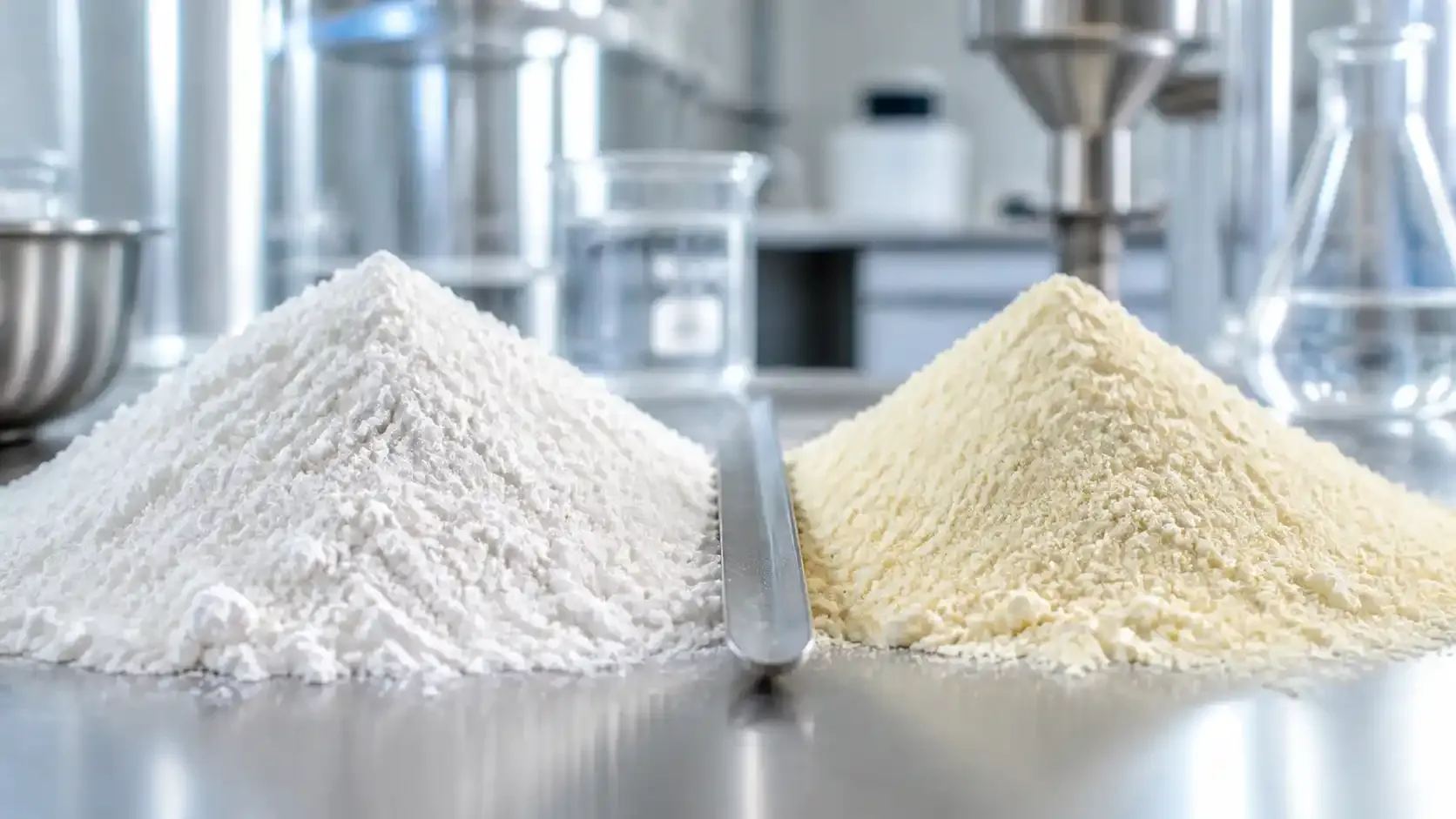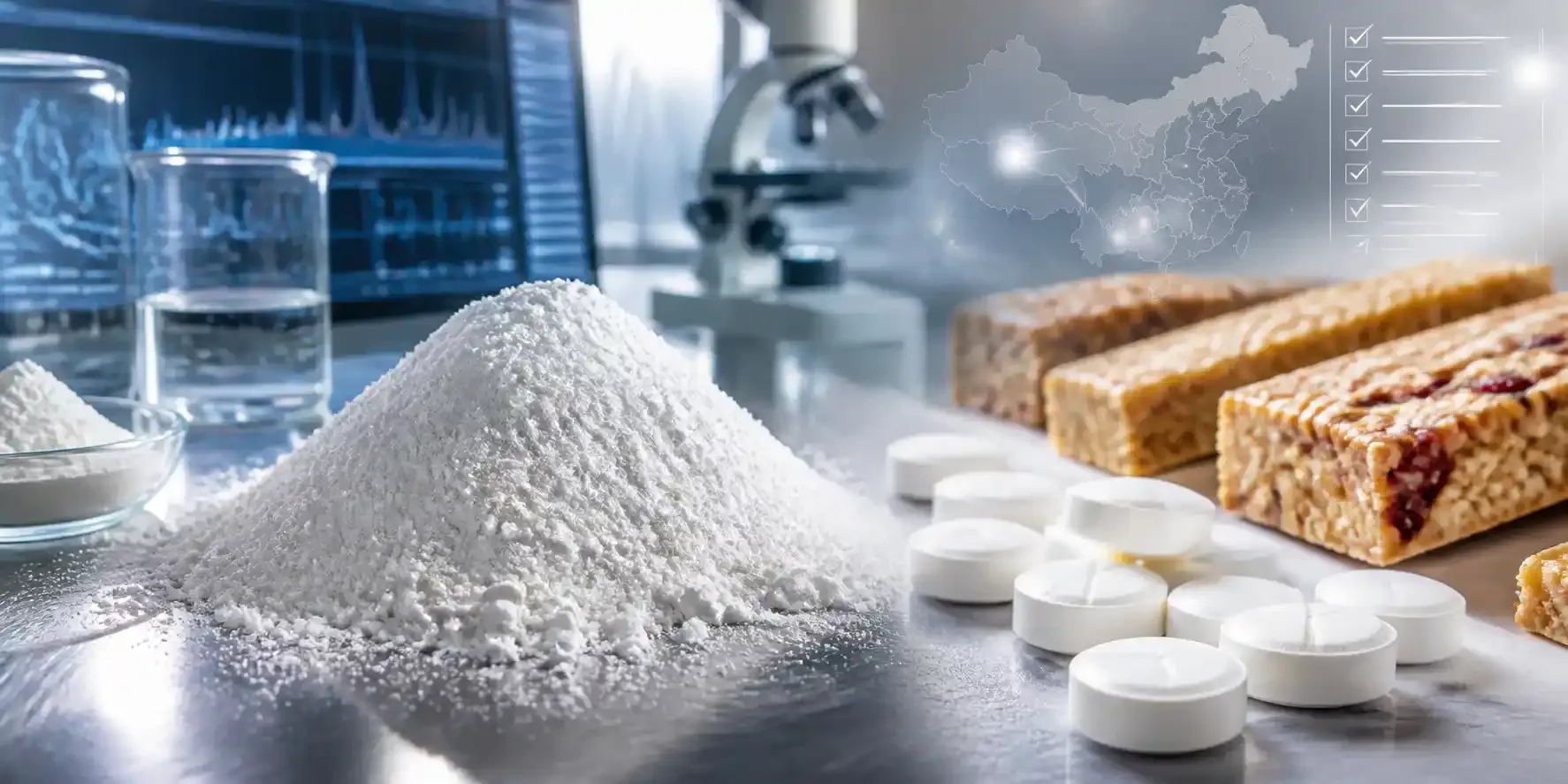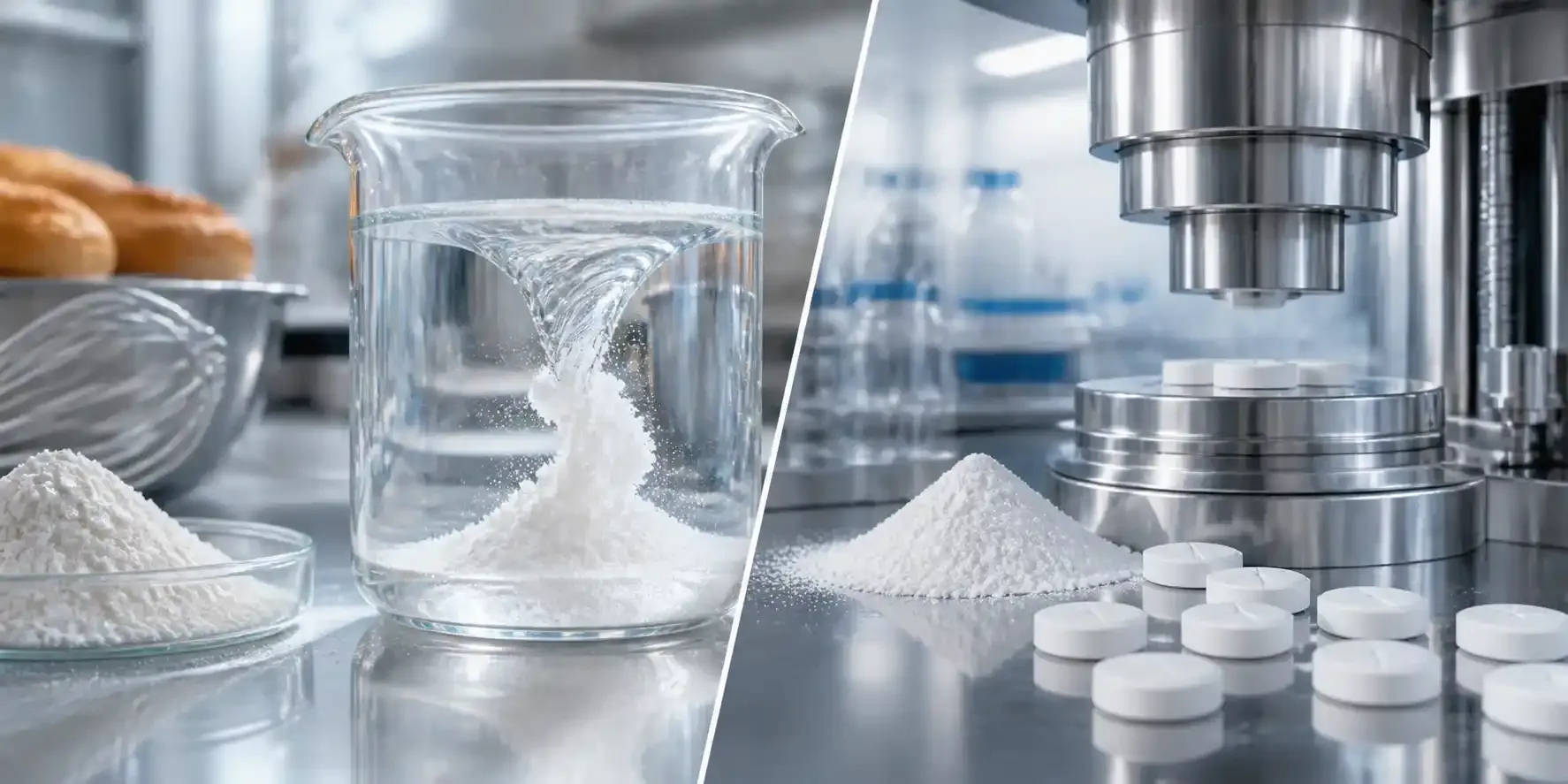
Procurement teams often shortlist a recommended Chinese microcrystalline cellulose manufacturer or a recommended Chinese resistant dextrin manufacturer based on price and a clean COA—then discover avoidable issues only after pilot runs: tablets cap or laminate, blend flow shifts, beverages haze, or fiber claims become difficult to defend during audit.
This article is written as an application-driven playbook. It shows how buyers can validate a recommended Chinese microcrystalline cellulose supplier and a recommended Chinese resistant dextrin manufacturer using simple, repeatable formulation trials—so the supplier is “recommended” because it performs in your process, not because it looks good on paper.

Why these two ingredients get qualified together in 2026
More brands are developing parallel pipelines: oral solid dosage products on one side, and fiber-fortified foods and supplements on the other. That convergence is why the same procurement team may need both a Chinese microcrystalline cellulose manufacturer and a Chinese resistant dextrin manufacturer on the approved list.
What “recommended” should mean in practice
For buyers, “recommended” is measurable:
- MCC should compress consistently and support target disintegration across batches and seasons.
- Resistant dextrin should deliver the fiber claim target (commonly ≥82% fiber content for resistant dextrin products) while remaining easy to formulate—low sensory impact, predictable solubility behavior, and stable performance across pH and heat.
When both ingredients are sourced from China, a China MCC and resistant dextrin supplier can reduce vendor complexity—but it also raises expectations around documentation discipline and site control.
Case 1 building a robust direct compression tablet with MCC PH101 and PH102
If the project goal is a stable direct-compression tablet, the fastest way to qualify a microcrystalline cellulose PH101 PH102 China source is to run a structured “stress test” that mimics production variability.
What to confirm before you request samples
A capable Chinese microcrystalline cellulose manufacturer should clearly state:
- Available grades (including PH-101 and PH-102) and intended functionality
- Pharmacopeia alignment where applicable (the industry commonly references BP/USP/FCC/JP depending on market and use)
- Mesh range and basic identity information
For an example of how some suppliers present MCC in a procurement-friendly way, buyers can review product and grade information on a page such as the one linked under the anchor text microcrystalline cellulose disintegrant.
A practical two grade evaluation plan
Run PH-101 and PH-102 as two distinct “workhorses,” not as interchangeable powders.
Trial A: PH-101 focus (compactability and content uniformity)
- Build a simple placebo blend plus your most challenging active (poor flow, low dose, or moisture sensitivity).
- Evaluate blend flow, tablet hardness at fixed compression force, friability, and disintegration.
- Watch for sensitivity: does a small moisture shift change hardness or ejection behavior?
Trial B: PH-102 focus (flow and scale behavior)
- Use the same formulation but push toward higher throughput conditions in your pilot press.
- Compare weight variation and any early signs of capping/lamination.
What a recommended Chinese microcrystalline cellulose supplier will demonstrate
A recommended Chinese microcrystalline cellulose manufacturer is usually the one that can explain why a grade behaves as it does—then provide technical guidance on when to select PH-101 versus PH-102 (or propose another grade if your flow or hardness targets require it).
Small questions that reveal big differences
When comparing a Chinese microcrystalline cellulose supplier shortlist, ask for these items in the same email thread:
- A COA template and an explanation of which parameters are treated as release-critical
- Retain sample policy and how long retains are kept
- Change control approach (raw material or process changes that may affect compressibility)
Clear answers here often separate a “workable” supplier from a truly recommended Chinese microcrystalline cellulose supplier.
Case 2 formulating high fiber products with resistant dextrin and resistant maltodextrin fiber
Resistant dextrin (often marketed in formats such as resistant maltodextrin fiber) is popular because it can help deliver fiber claims without the heavy viscosity or gritty texture that complicates many fiber fortification projects.
For buyer reference on typical positioning and specification highlights, see a page like resistant maltodextrin fiber, which outlines a resistant dextrin product with a commonly stated ≥82% fiber content target and general handling guidance.
Two application tests that de risk purchase orders
Instead of treating resistant dextrin as a single “fiber powder,” validate the performance in your highest-risk format.
Test 1: Ready to mix beverage or stick pack
Check:
- Dispersibility in cold water (clumping tendency matters more than lab solubility claims)
- Clarity after 10 minutes and after 24 hours
- Sensory neutrality at your intended serving dose
- Stability under your typical acid system if applicable
Test 2: Bar or chew format
Check:
- Binding contribution (too much can harden bars over time)
- Moisture migration over shelf life simulation
- Sweetness perception and aftertaste interactions with sweeteners
A recommended Chinese resistant dextrin manufacturer should be able to discuss typical behavior in bars and beverages and provide documentation that supports consistent manufacturing.
Documentation matters because fiber claims get audited
For a food grade resistant dextrin supplier China candidates list, documentation readiness is part of product performance. Buyers commonly request:
- GMO statement (especially when corn starch is the raw material)
- Allergen statement
- Traceability description (batch and raw material linkage)
- COA template and test methods for fiber content
For resistant dextrin marketed toward gut health positioning, buyers can also review how some suppliers frame application scope and production controls under resources such as gut health dextrin.
When one supplier covers both MCC and resistant dextrin the qualification standard rises
A single China MCC and resistant dextrin supplier can shorten internal onboarding. However, procurement should treat “one-stop” as a reason to tighten, not loosen, qualification.
What to verify at the supplier level
Whether the vendor is a Chinese microcrystalline cellulose manufacturer or a Chinese resistant dextrin manufacturer, the buyer should confirm three operational realities:
- Site and scope match the certificate: certifications are only meaningful if the scope includes the product and the manufacturing site that ships your batches.
- Automation and process control: automated, centrally controlled lines reduce batch drift and the frequency of corrective actions.
- Technical response quality: the fastest indicator of future success is how well the supplier answers technical questions during trials.
In public materials, some suppliers describe German-origin production lines, fully automatic operations, and GMP workshop management for fiber ingredients. Buyers should not accept those claims as marketing—use them as audit prompts.

A buyer friendly checklist that links specs to outcomes
Below is a field-ready checklist that procurement can use during trial qualification. It is intentionally short; the goal is consistency across projects.
MCC tablet checklist
- Confirm which grade(s) you are sourcing (e.g., microcrystalline cellulose PH101 PH102 China) and lock grade in the purchase spec.
- Run two pilot batches from different sample lots to catch early variability.
- Track: hardness at constant force, friability, disintegration, and any ejection anomalies.
- Request: COA template, change control statement, and retain sample policy.
Resistant dextrin checklist
- Confirm target fiber content (commonly ≥82% for resistant dextrin product lines) and test method alignment.
- Run at least one beverage and one solid format (bar, chew, powder blend) if your portfolio includes both.
- Track: dispersibility, clarity over time, taste neutrality, and tolerance observations from internal panels.
- Request: non-GMO documentation if relevant, allergen statement, traceability outline, and COA template.
When a supplier can support these steps cleanly, the label “recommended Chinese resistant dextrin manufacturer” is earned through evidence.
A balanced way to use Shine Health as a sourcing reference
Industry buyers often want an example of a supplier that publishes clear product pages and demonstrates cross-category capability in both pharmaceutical excipients and functional fibers. Shandong Shenghuai Health Co., Ltd.; Shine Health is one example that buyers can use as a reference point when building internal benchmarks for a recommended Chinese microcrystalline cellulose supplier and a recommended Chinese resistant dextrin manufacturer.
The practical value is not the brand name—it is the procurement pattern: clearly stated grades, common specification anchors, and transparent application framing that makes qualification faster.
Turning trials into an approval decision that holds up under audit
The most reliable approval decisions connect three layers:
- Specification layer: what the supplier promises (grade, fiber content, basic limits).
- Evidence layer: what your trials prove (tablet performance, beverage clarity, sensory neutrality).
- System layer: what the supplier can sustain (documentation, traceability, change control, consistent response).
If all three align, buyers can confidently shortlist a Chinese microcrystalline cellulose manufacturer for long-term tablet programs and a Chinese resistant dextrin manufacturer for fiber fortification—without relying on price as the primary proxy for value.
Data notes and sources
The following supplier-published pages were used as on-page sources for product examples, typical specification anchors, and application framing:
For buyers who want curated introductions to suppliers that align with the standards described above, further sourcing support and vetted supplier information are available via industry channels. To explore supplier options that match these MCC and resistant dextrin validation patterns, refer to resources such as the official site of Shandong Shine Health Co., Ltd.: www.sdshinehealth.com.