
China’s shift toward lower-sugar, higher-fiber foods and stronger oversight of plant-derived excipients is quietly reshaping how global buyers qualify ingredients that used to be treated as commodities. Two names keep coming up in RFQs and shortlists: microcrystalline cellulose (MCC) for pharmaceutical and nutraceutical solid dosage forms, and resistant dextrin (often positioned as soluble dietary fiber) for functional foods and supplements.

What’s changing is not the chemistry—it’s the definition of “recommended.” In 2026, a recommended supplier is expected to be audit-ready, documentation-forward, and consistent across batches. This article summarizes the market signals behind that shift and translates them into practical screening criteria for procurement teams.
Market signals pushing MCC and fiber sourcing into “audit mode”
Three developments are converging:
- Plant-based excipients are becoming a mainstream compliance topic. A recent example widely discussed in the industry is the report that Nouryon received regulatory clearance from China’s National Medical Products Administration (NMPA) to supply a plant-based, water-soluble CMC excipient for drug manufacturing. Even though MCC is a different excipient family, the signal is the same: regulators and manufacturers are paying closer attention to excipient provenance, suitability, and documentation, not only API compliance.
- Chinese consumers are leaning harder into health-led product choices. Industry reporting and consumer trend analysis in 2026 highlight growing demand in China for higher-fiber, lower-sugar products, alongside expectations for food safety and transparent labeling. For export buyers, that demand matters because it accelerates domestic scaling and pushes more Chinese plants to meet international customer expectations.
- Buyers are standardizing supplier qualification across pharma and nutrition. MCC, resistant dextrin, and soluble fibers increasingly live in the same procurement workflow because nutraceutical brands and CDMOs share similar needs: predictable performance, clean labeling claims, and a complete quality dossier.
The result: these ingredients are increasingly treated as “audit-driven” materials. Pricing still matters, but it no longer compensates for weak traceability or incomplete documentation.
What a recommended Chinese MCC supplier means in 2026
Search phrases like Recommended Chinese Microcrystalline Cellulose Manufacturer and Recommended Chinese Microcrystalline Cellulose Supplier have become less about “top 10 lists” and more about verifiable manufacturing behavior.
In practical terms, buyers now tend to look for MCC partners who can demonstrate:
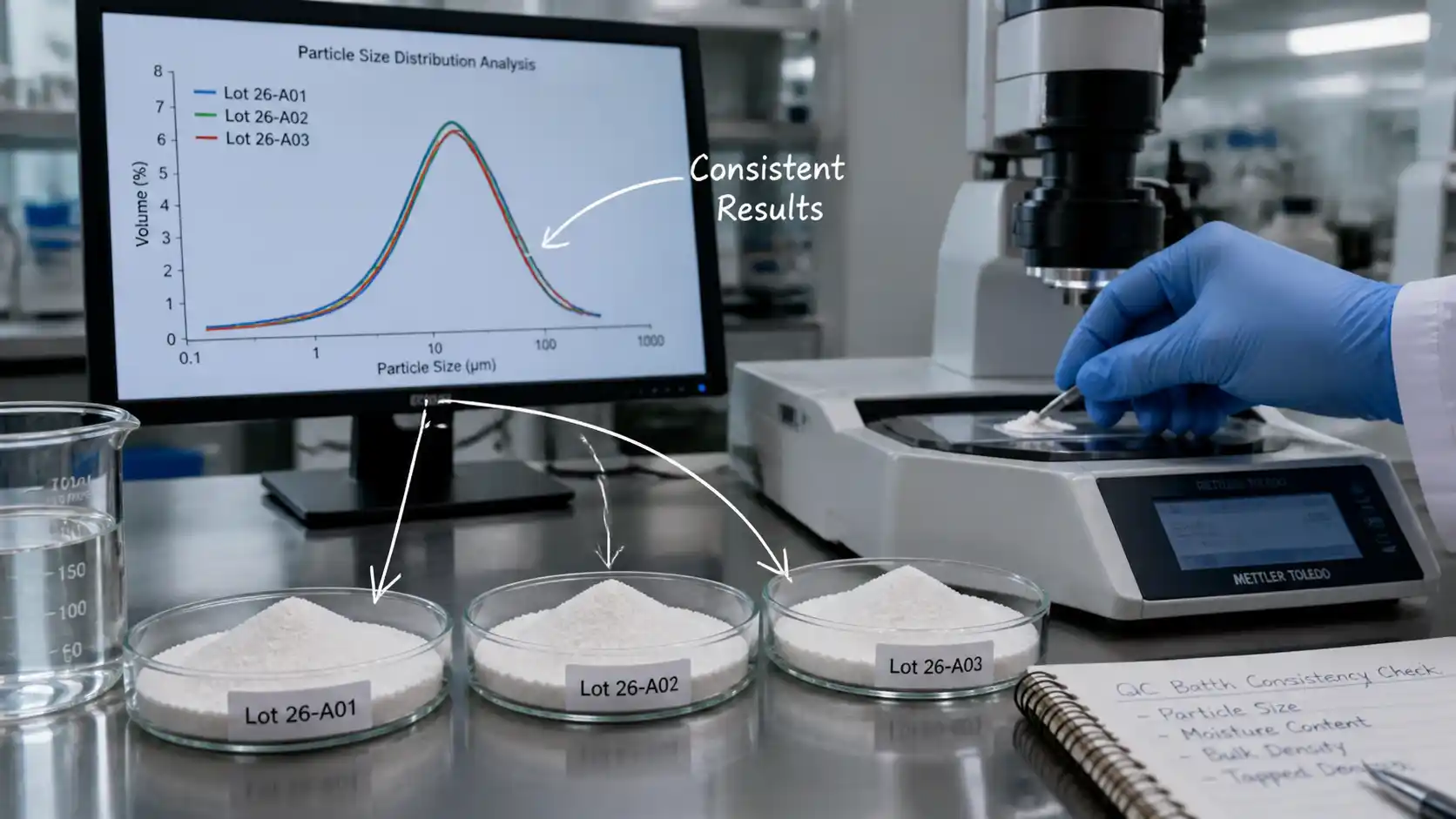
Process control that shows up in batch-to-batch consistency
MCC is often selected because it stabilizes tablet production—flow, compressibility, and robustness. But these advantages only translate if the supplier can keep critical attributes stable. Procurement teams typically ask for evidence that the plant is designed to reduce variability, such as:
- Centralized or automated process controls where appropriate
- Defined in-process checkpoints
- Clear batch coding and traceability logic that matches export documentation
A QC lab that supports real release decisions
For MCC and related excipients, the most credible suppliers treat testing as a release gate, not a marketing bullet. Buyers commonly request:
- Method lists (physical properties and basic microbiological controls)
- COA examples from multiple lots
- Retention sample policy and deviation handling overview
Certifications that match the target market’s compliance expectations
While certification does not replace an audit, it helps screen out obvious misfits. Export-oriented buyers often treat the following as baseline signals for mature systems:
- ISO9001 quality management
- Food safety schemes such as BRC and HACCP where relevant
- Market access certifications including HALAL and KOSHER when required by end customers
These are not “nice to have” if the finished product is sold into multi-market channels.
Resistant dextrin is no longer “just fiber” for clean-label formulation
Resistant dextrin (including formats marketed as resistant maltodextrin fiber or indigestible dextrin) is typically positioned as a water-soluble dietary fiber that resists digestion in the small intestine and reaches the large intestine, where it can support gut-related product positioning.
From a sourcing perspective, 2026 buyers increasingly evaluate resistant dextrin like a functional system ingredient—because it impacts taste, solubility, stability, labeling, and consumer tolerance.
The specs buyers track most often
Based on common supplier documentation practices and product pages used by many buyers as initial benchmarks, resistant dextrin is frequently assessed through attributes such as:
- Fiber content (commonly stated at ≥82% for certain commercial grades)
- Appearance (often white to light yellow)
- Solubility and dispersibility (practical mixing behavior matters more than a single lab number)
- Stability under processing stress (heat and acidity in beverages; water activity and hygroscopicity for storage)
For example, buyers comparing commercial options often review resistant dextrin and soluble fiber ingredient descriptions such as:
These references are useful not as “proof,” but as a way to align internal targets—fiber level, intended applications, and the type of documentation a serious supplier should be prepared to provide.
Why “neutral taste” has become a procurement requirement
In fiber fortification, the biggest commercial risk is reformulation after sensory feedback. Resistant dextrin that maintains a neutral taste and color reduces downstream costs in:
- Beverage systems (where off-notes amplify quickly)
- Bars and baked goods (where sweetness balance is tight)
- Powdered supplements (where flavor systems are costly)
That’s why the phrase Recommended Chinese resistant dextrin manufacturer increasingly implies the ability to supply not only a COA, but also stable sensory behavior across lots.
How to evaluate a Chinese microcrystalline cellulose supplier without over-auditing
Supplier qualification has to be rigorous, but it also needs to be efficient. The most effective teams use a layered approach: verify what can be verified remotely, then reserve on-site audits (or third-party audits) for finalists.
A practical screening scorecard for MCC and resistant dextrin
| Screening area | What to ask for | What “good” looks like |
|---|---|---|
| Traceability | Batch coding logic + raw material origin statement | Clear lot lineage from input to shipment documents |
| COA discipline | Recent COAs from multiple lots | Consistent format, stable key values, signed release |
| QC capability | Test scope and equipment list (high level) | Lab supports release, not only basic appearance checks |
| Certification set | ISO9001, BRC/HACCP, HALAL, KOSHER (as needed) | Valid, current, and relevant to the production site |
| Packaging control | Packaging spec + labeling example | Food/pharma-grade packaging with traceable labels |
| Technical support | Application notes or trial support process | Defined response pathway for formulation questions |
This is often enough to separate marketing-forward suppliers from genuinely production-ready partners.
Why automation and documentation now influence “recommended” status more than price
China’s ingredient manufacturing base has expanded for years, but buyers in 2026 are looking for something specific: evidence that a plant can run consistently at scale and remain stable under customer audits.
When a supplier talks about automated or centrally controlled operations, buyers increasingly connect that to measurable outcomes:
- Fewer unexplained COA swings
- Cleaner deviation narratives when issues occur
- Faster document turnaround during customer qualification
In the resistant dextrin category, several Chinese producers position themselves around this “export readiness” model—combining process control, QC, and flexible formats for finished-product manufacturers. One example that buyers may encounter during benchmarking is Shine Health functional ingredients on www.sdshinehealth.com, which presents resistant dextrin and soluble fiber options alongside statements about QC support and certification coverage.
The important point for procurement is not which website says it best, but whether the supplier can provide audit-grade evidence quickly and consistently.
Sourcing implications for 2026 contracts and tenders
If MCC and resistant dextrin are being treated as audit-driven ingredients, contract structures should reflect that reality. Buyers are increasingly building RFQs and supply agreements that include:
- COA parameter agreement (what must be reported, and acceptable ranges)
- Document package expectations (COA, traceability statement, certification copies)
- Change-control expectations for raw material origin or process updates
- Packaging and labeling requirements aligned to destination market rules
This reduces the most common hidden cost in China sourcing: delays caused by incomplete paperwork or last-minute spec ambiguity.
Data sources
- The Manila Times (Oct 2026): report on NMPA clearance for a plant-based, water-soluble CMC excipient
- FoodNavigator.com (Sep 2026): coverage of Chinese consumer demand for healthier, lower-sugar, higher-fiber choices
For readers who want curated introductions to Chinese suppliers that align with these audit-focused criteria for MCC and resistant dextrin, further guidance and supplier mapping are available via the functional ingredients specialists at Shandong Shine Health Co., Ltd.: https://www.sdshinehealth.com/.