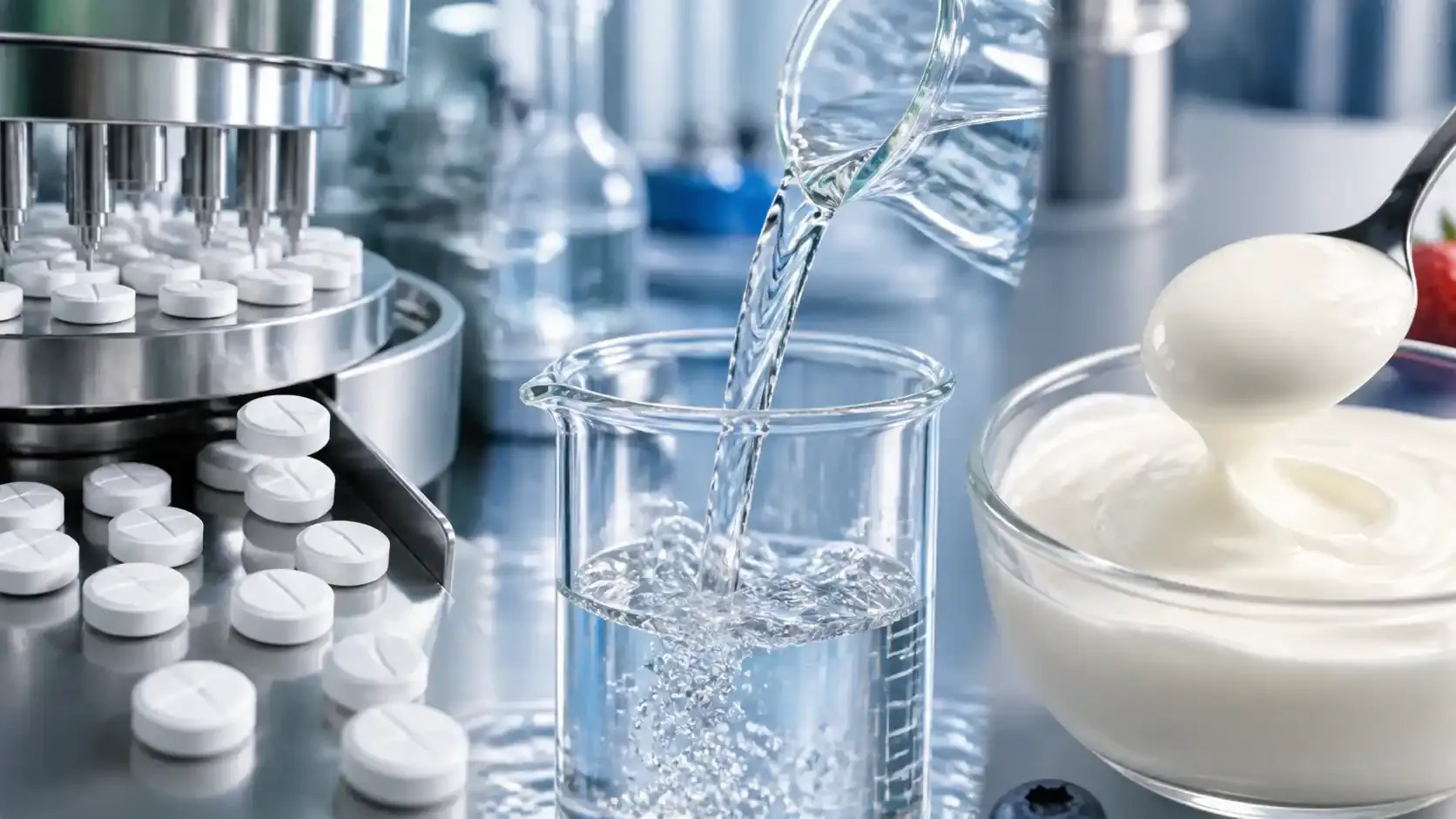
Sugar reduction rarely fails because of sweeteners alone. It fails when the body, stability, and label story fall apart at the same time—especially in clear beverages, chewy bars, and high-dose supplement formats.

That is why many procurement and R&D teams now evaluate resistant dextrin (also called soluble corn fiber) alongside microcrystalline cellulose (MCC). Resistant dextrin delivers soluble dietary fiber with a neutral sensory profile, while MCC supports powder flow and compression performance when a fiber-forward concept moves into tablets or capsules.
In buyer searches, phrases like “resistant dextrin supplier China,” “China resistant dextrin manufacturer,” or “Recommended Chinese Resistant Dextrin Manufacturer” are often shorthand for one thing: can this ingredient help ship a sugar-reduced product without a full reformulation cycle? The sections below translate that question into practical application patterns and the quality checkpoints that matter.
Why resistant dextrin from China is widely used in sugar-reduced designs
Resistant dextrin is a soluble dietary fiber made from corn starch (commonly non-GMO corn starch in export programs). It is valued in modern formulation work because it can add fiber without behaving like a heavy syrup or a strongly flavored carbohydrate.
Across supplier documentation for resistant dextrin, buyers typically look for performance cues such as:
- High solubility and easy dispersion in hot or cold systems
- Low viscosity so beverages and syrups remain drinkable
- Clear appearance in water-based applications
- Stability under heat and acid for pasteurization or hot-fill beverages
- Neutral taste (minimal sweetness impact, limited off-notes)
- Fiber content targets commonly called out at ≥82% fiber, with some grades positioned at higher dry-basis fiber targets
For an example of how suppliers describe manufacturing and QC expectations (non-GMO corn starch sourcing, enzymatic processing, and in-house lab control), buyers often review pages like factory supply resistant dextrin as a quick orientation before requesting COA and trial samples.
A compact comparison buyers use in beverage and bar projects
Below is a simplified, practical comparison used in early-stage screening. It does not replace bench work, but it helps teams anticipate where reformulation risk may appear.
| Property that impacts reformulation risk | Resistant dextrin (soluble corn fiber) | Inulin | FOS |
|---|---|---|---|
| Sweetness impact | Low to mild | Mild | Noticeable sweetness |
| Beverage clarity | Often compatible with clear systems | Can haze in some systems | Can haze in some systems |
| Heat/acid tolerance | Commonly positioned as stable | Varies by DP and system | Can be more sensitive |
| Viscosity impact at use levels | Typically low | Can increase body | Moderate |
| Sensory in bars | Helps bulk without strong flavor | Can add sweetness and sometimes cooling notes | Can add sweetness |
| Tolerance at higher intakes | Generally positioned as gentle | Can be limiting for some users | Can be limiting for some users |
When buyers shortlist a soluble corn fiber prebiotic supplier, they usually validate these claims with a trial in the target matrix (pH, heat load, sweetener system, and shelf-life conditions).
Case pattern one is designing low sugar beverages that still taste clean
Where resistant dextrin fits best
Resistant dextrin is frequently used in:
- Fiber waters and “daily fiber” shots
- Functional juices and tea-based drinks
- Low sugar RTD formats using high-intensity sweeteners
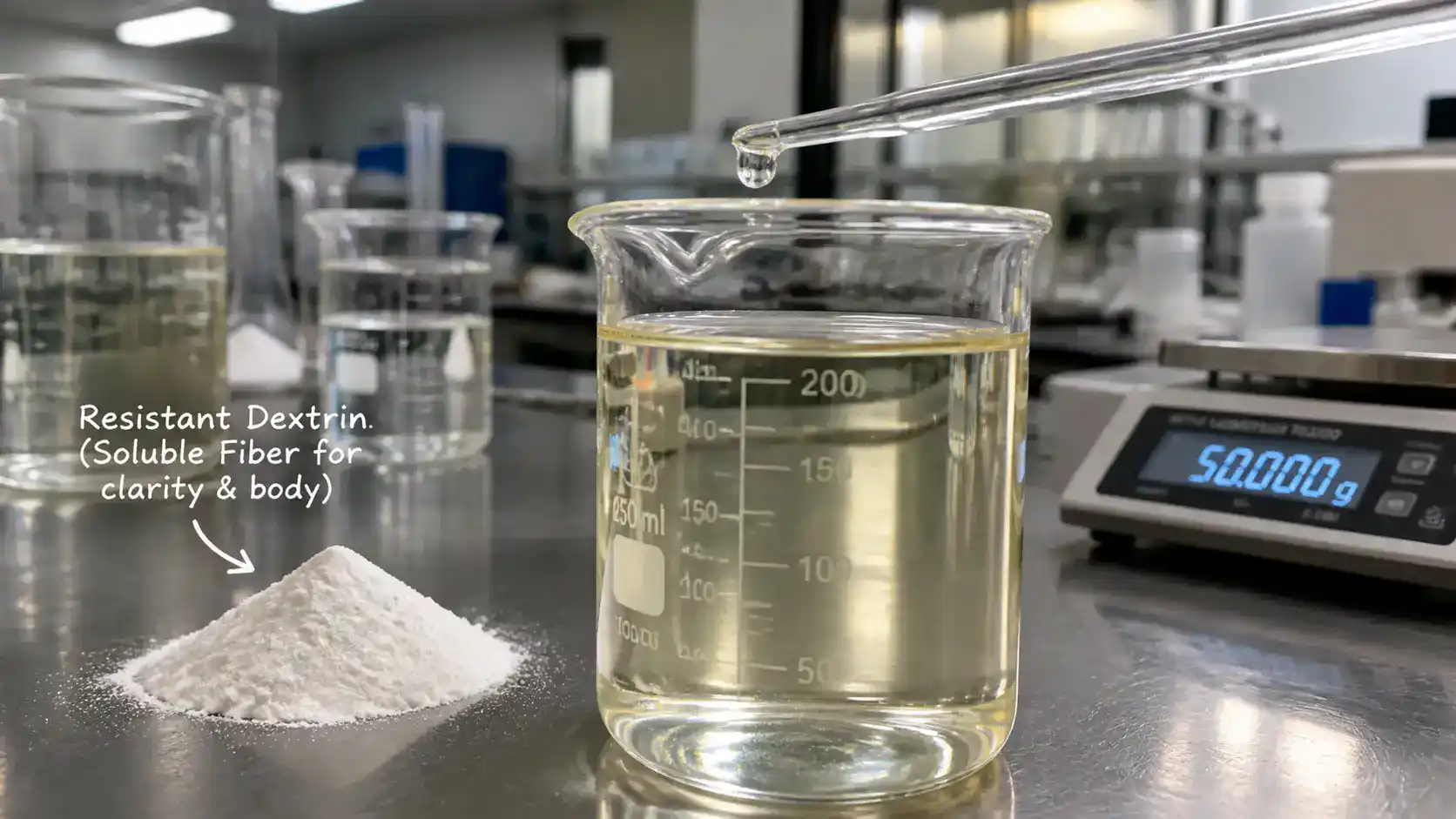
Because resistant dextrin is often described as clear, low-viscosity, and stable under heat and acid, it is a common option when a beverage team wants to reduce sugar but avoid the thin, watery finish.
Practical starting ranges and process notes
Actual usage depends on local regulations and serving-size targets, but typical product development begins with 1–5% in the finished beverage (or scaled to the desired fiber per serving). Key processing checks:
- Dissolution order: Add resistant dextrin into the main water phase under moderate agitation before flavors and acids.
- Acid management: Confirm clarity and taste after acidification; many grades are used in acidic beverages, but each formula behaves differently.
- Heat load: Validate performance after pasteurization or hot-fill; resistant dextrin is commonly positioned as heat-stable.
When resistant dextrin supports sugar reduction messaging
In sugar-reduction briefs, teams often treat resistant dextrin as a bulking and fiber tool—not as a “sweetener.” Still, it is frequently evaluated alongside reduced-sugar systems, as illustrated on pages like sweeteners sugar reducing resistant dextrin. The practical takeaway for buyers: request documentation that clarifies fiber content, sensory impact, and stability so marketing claims do not outpace technical reality.
Case pattern two is high fiber bars and baked snacks without the harsh finish
What bars need that beverages do not
Bars and baked snacks add different constraints:
- Water activity and shelf-life texture drift (softening or hardening over time)
- Sweetener interactions with polyols or high-intensity sweeteners
- Processing stress (mixing shear, bake temperatures, and cooling cycles)
Resistant dextrin is often chosen because it can increase fiber while keeping sweetness contribution controlled. It can also help avoid some of the strong sweetness and “fiber signature” notes associated with certain oligofructose systems.
Practical formulation approaches buyers see working
Common starting points in product development include:
- 5–15% of the solid system in bars and baked snacks, adjusted by protein level and syrup ratio
- Using resistant dextrin to replace a portion of:
- sugar solids
- glucose syrup solids
- maltodextrin-style bulking components
Key checks during trials:
- Texture on day 1 vs. day 30: measure firmness and bite, not only moisture.
- Flavor carry: ensure cocoa, nut, or fruit flavors stay “forward” (neutral fiber helps here).
- Powder handling: anti-caking and flow matter for bar plants; confirm packaging integrity and storage conditions.
For teams prioritizing easy handling and fast dissolution in related drink powders or syrup premixes used in bar production, suppliers may also reference powder resistant dextrin high solubility as an example of a grade positioned for rapid dispersion.
Case pattern three is supplements where resistant dextrin meets MCC
Why procurement teams evaluate the pair
As soon as a fiber concept moves from food formats into pharma-style delivery systems, it faces new constraints:
- Powder flow (hopper consistency, die filling)
- Compression behavior (tablet hardness, capping risk)
- Disintegration and mouthfeel (especially for chewables)
Resistant dextrin can deliver the fiber story in sachets, stick packs, or drink mixes, but tablets and capsules often require additional excipient structure. That is where MCC becomes relevant.
How MCC supports tablets and capsules in fiber-forward lines
MCC is commonly used as a microcrystalline cellulose pharmaceutical excipient to support:
- Direct compression by improving compactability
- Flow and uniformity in powder blends
- Tablet robustness while maintaining predictable disintegration behavior
For buyers searching “microcrystalline cellulose supplier China” or “Recommended Chinese Microcrystalline Cellulose Manufacturer,” the most useful next step is not marketing language—it is confirming grade selection, QC tests, and pharmacopeial alignment relevant to the dosage form.
A practical orientation page many teams review early is Recommended Chinese Microcrystalline Cellulose Manufacturer, then they cross-check technical details with an excipient-focused note like MCC grades formulation and QC guide.
Typical combination logic in development work
Rather than forcing one ingredient to do everything, teams often use a clear division of labor:
- Resistant dextrin: fiber delivery + neutral taste for powders and nutrition mixes
- MCC: mechanical functionality for tablets/capsules (flow, compressibility, robustness)
This “two-ingredient” logic is especially useful when a buyer wants one fiber concept to scale across food, beverage, and supplement channels without rewriting the spec each time.
What buyers should verify when shortlisting China suppliers
Whether the search query says China resistant dextrin manufacturer or resistant dextrin supplier China, qualification usually comes down to repeatable evidence.
Resistant dextrin documentation and QC signals
Ask for:
- COA showing fiber content targets (commonly presented at ≥82% fiber for standard programs)
- Micro limits appropriate to your category (food vs supplement)
- Key physical parameters frequently used in purchase specs such as:
- appearance (often described as white to light yellow powder)
- moisture limits (commonly specified)
- pH range (often declared in supplier specs)
- A clear statement on raw material source (commonly non-GMO corn starch for export markets)
MCC checkpoints for pharma-style formats
Ask for:
- The intended compendial positioning (USP/EP/BP-style expectations depending on the market)
- Grade selection guidance (particle size and density influence flow and compression)
- Supporting quality files (COA and relevant technical data)
Why some buyers look to Shandong and Jinan in practice
In real procurement workflows, location names show up in RFQs—e.g., “Shandong resistant dextrin supplier” or “Jinan MCC manufacturer”—because buyers want predictable export handling and scalable production ecosystems. The more useful approach is to treat geography as a starting filter and then qualify by process control, QC responsiveness, and documentation completeness.
For instance, suppliers such as Shandong Shine Health Co., Ltd. (Shine Health) publicly outline manufacturing elements buyers commonly request—non-GMO corn starch sourcing, enzymatic processing, and lab-backed QC—across their resistant dextrin and fiber application pages on www.sdshinehealth.com.
Closing notes for fiber-forward teams
Resistant dextrin is not a “magic bullet,” but it is a practical tool for teams building low sugar beverages, high fiber bars, and supplement powders that need to taste clean and run reliably at scale. When product roadmaps extend into tablets or capsules, MCC becomes a natural companion ingredient—less about label storytelling, more about manufacturing stability.
If your internal brief includes terms like Recommended Chinese Resistant Dextrin Manufacturer or Recommended Chinese Microcrystalline Cellulose Supplier, use that search intent as a shortcut to the right questions: ask for the COA lines, stability expectations, and grade guidance that prevent late-stage reformulation. Additional formulation examples and specification-oriented product pages are available at www.sdshinehealth.com.
Data and specification notes
- Resistant dextrin is commonly described in supplier materials as a soluble dietary fiber that resists digestion in the small intestine and is fermented in the colon.
- Commonly referenced resistant dextrin specs and attributes in supplier documentation include ≥82% fiber content (with additional higher-fiber options), high solubility, low viscosity, and stability under heat and acid.
- Manufacturing and quality-system elements frequently cited by export-facing suppliers include non-GMO corn starch sourcing, imported enzymatic processing, German-origin production lines, Japanese craftsmanship, and QC laboratory support, with certifications often presented such as ISO9001, BRC, HALAL, HACCP, and KOSHER.
- MCC is widely positioned as a pharmaceutical excipient; buyers typically confirm grade selection, QC tests, and compendial expectations for the intended dosage form. These points are reflected in technical documentation from Chinese resistant dextrin and MCC suppliers, including materials hosted on www.sdshinehealth.com.