Microcrystalline cellulose (MCC) and resistant dextrin solve very different formulation problems, yet buyers often evaluate them with the same “paper-only” supplier checklist. A more reliable approach starts with ingredient fundamentals—then maps those fundamentals to the manufacturing controls and QC evidence a plant must show to be considered a recommended Chinese microcrystalline cellulose manufacturer or a recommended Chinese resistant dextrin manufacturer.
Why MCC and resistant dextrin are now sourced side by side
Procurement teams increasingly see MCC and functional soluble fibers appear in the same sourcing portfolio for one simple reason: brands are building “health-forward” pipelines across multiple formats.
- Pharmaceutical and nutraceutical tablets/capsules frequently rely on microcrystalline cellulose as a foundational excipient for compressibility and processing stability.
- Food, beverage, and supplement powders lean on resistant dextrin (often positioned as soluble corn fiber or resistant maltodextrin) to raise fiber content without heavy sweetness or grit.
China’s supply base has grown in both categories. For buyers, the decision is less about geography and more about whether a microcrystalline cellulose excipient supplier China can demonstrate excipient-grade consistency, and whether a functional dietary fiber ingredient manufacturer China can demonstrate fiber performance that stays stable through real processing conditions.
Microcrystalline cellulose fundamentals buyers should understand first
Microcrystalline cellulose is a purified, partially depolymerized cellulose. In solid dosage manufacturing, it is typically selected for performance, not for marketing claims.
What MCC actually does in tablets
In practice, MCC is used as a:
- Filler/diluent to build tablet mass and support uniformity
- Binder to improve compactability and reduce friability
- Disintegrant support (often working with other disintegrants) to promote tablet breakup
Because MCC contributes to how a tablet compresses and breaks apart, MCC sourcing is rarely “plug-and-play.” Grade selection and batch-to-batch control matter as much as the COA headline.
MCC properties that influence manufacturability
Buyers evaluating MCC should connect the following attributes to the dosage form and equipment:
- Particle size distribution (PSD): affects flow, blend uniformity, and compaction behavior
- Bulk and tapped density: influences die fill consistency and tablet weight variation
- Moisture: impacts flow, sticking, and stability (especially in hygroscopic blends)
- Flowability: influences feeder performance and content uniformity risk
- Compressibility/compactability: directly affects hardness, friability, and lamination risk
A supplier can pass basic identity tests and still fail in production if these performance-linked properties drift.
Typical MCC COA checkpoints for excipient buyers
A buyer-oriented COA review generally checks for:
- Appearance and identification
- Moisture (loss on drying)
- Residue on ignition (ash)
- Microbial limits appropriate to the intended use
- Functional tests tied to tableting (e.g., flow and compaction indicators), when provided
When a procurement spec only lists “white powder, pass ID, low moisture,” it is rarely sufficient to qualify a new plant as a recommended partner.
Resistant dextrin and soluble corn fiber fundamentals that change supplier evaluation
Resistant dextrin is a soluble dietary fiber produced from starch sources such as corn (and sometimes wheat, depending on the product line). It is designed to resist digestion in the small intestine and reach the colon, where it can be fermented by gut microbiota.
In many buyer conversations, “resistant dextrin,” “soluble corn fiber,” and “resistant maltodextrin” are used interchangeably. From a sourcing perspective, what matters is whether the ingredient’s fiber content, solubility, stability, and microbiological profile match the intended application and labeling strategy.
Functional roles in food and nutrition formats
Resistant dextrin is commonly chosen to support:
- Fiber fortification with minimal flavor interference
- Sugar-reduction strategies (as part of a sweetness and bulking system)
- Texture and mouthfeel in powders, beverages, bars, and nutrition mixes
- Formulation stability where heat and acidity are part of processing
In other words, a resistant maltodextrin soluble corn fiber factory China is not only selling a fiber number; it is selling predictable behavior in your process.
Key specification parameters buyers can compare across suppliers
Based on typical market expectations and disclosed product ranges, resistant dextrin specs often include:
- Appearance: typically white to light yellow powder
- Fiber content: commonly offered in multiple tiers (e.g., ≥70%, ≥85%, ≥90%, ≥95%) depending on grade
- Moisture: often controlled at ≤5.0%
- Ash: frequently controlled at ≤0.1%
- pH range: often 3–6
- Water activity: commonly ≤0.2 for storage stability
- Microbiological limits: such as aerobic plate count, coliforms, mould, and yeast thresholds
For many buyers, the practical differentiator is consistency: can the supplier hit the same fiber tier, the same solubility behavior, and the same micro profile repeatedly—without needing incoming re-blending or special handling at the customer site?
The buyer’s comparison table that prevents misaligned audits
The most common sourcing mistake is auditing MCC and resistant dextrin plants with the same checklist, without translating “quality” into ingredient-specific failure modes.
| Buyer lens | Microcrystalline cellulose (MCC) | Resistant dextrin / soluble corn fiber |
|---|---|---|
| Primary end use | Tablet/capsule excipient; also used in some food/cosmetic systems | Soluble dietary fiber for foods, beverages, and supplements |
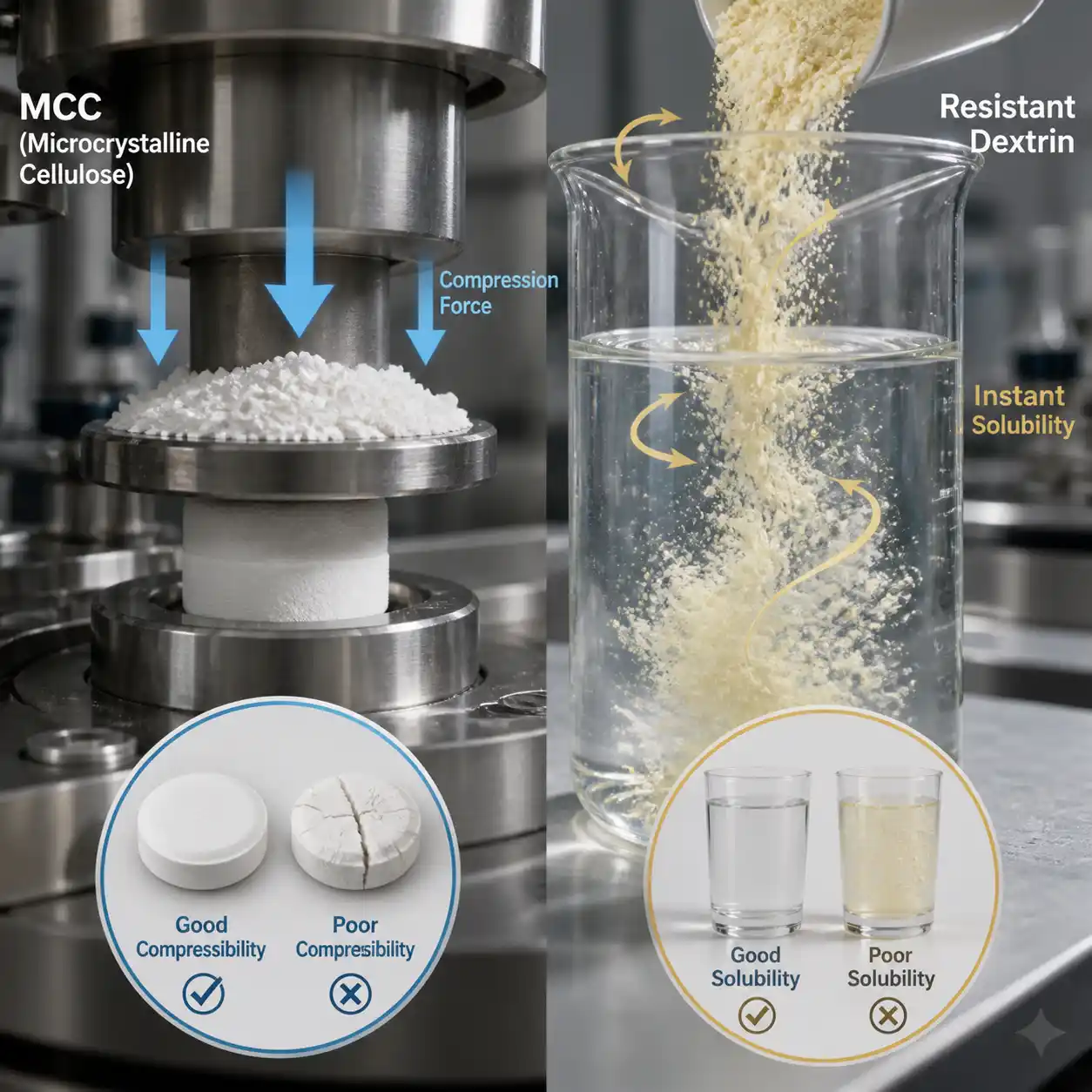
| What performance means | Flow + compressibility + robust tablet properties | Solubility + stability + fiber delivery with good tolerance |
| COA lines that matter most | Moisture, ash, microbial limits, and functional indicators tied to compaction | Fiber tier, moisture, ash, pH, water activity, microbial limits |
| Common “looks fine on paper” failure | Batch-to-batch compression variability leading to lamination/friability | Solubility or sensory drift, inconsistent fiber tier, micro deviations |
| Plant evidence that reduces risk | Controlled PSD, in-process checks, robust sampling plans, traceable deviations | Raw material traceability, controlled enzymatic process, release testing discipline |
A recommended supplier typically shows the ability to prevent the failure modes in the right-hand column—not just the ability to ship on time.
What to verify when shortlisting Chinese manufacturers for both ingredients
This section is where long-tail searches such as “how to choose a recommended Chinese microcrystalline cellulose manufacturer” and “what to check when sourcing resistant dextrin manufacturers in China” become practical.
1) Raw material traceability that matches the ingredient
- For resistant dextrin, many buyers prefer NON-GMO corn starch and clear traceability statements.
- For MCC, buyers generally focus on whether the cellulose source and purification controls align with excipient expectations and documentation.
Traceability is not a slogan; it is demonstrated through batch records, incoming testing, and supplier qualification procedures.
2) Process control that reduces batch variability
Buyers evaluating Chinese plants increasingly ask for evidence of stable, repeatable production. In the resistant dextrin context, disclosed manufacturing approaches may include:
- Use of advanced biological enzymes
- Precision production lines with automated control from feeding to filling
- Defined in-process checkpoints and hold/release criteria
The sourcing logic is straightforward: tighter process control tends to reduce viscosity drift, moisture variability, and micro surprises.
3) QC laboratory capability and release discipline
A robust QC lab matters for both categories, but the tests and sampling frequency should match the risk profile.
For resistant dextrin, buyers often expect routine monitoring for:
- Fiber content tier confirmation
- Moisture, ash, pH, and water activity
- Aerobic plate count and indicator organisms (per agreed limits)
For MCC, the most useful lab evidence is what supports consistent tableting performance—especially controls tied to PSD, moisture, flow, and batch disposition rules.
4) Certifications that help buyers manage downstream risk
Certifications do not replace auditing, but they can simplify supplier onboarding when aligned with customer requirements.
Commonly requested schemes in global trade include:
- ISO9001 for quality management
- BRC for food safety systems (relevant to dietary fiber ingredients)
- HALAL and KOSHER for market access
- HACCP as part of preventive food safety control
When suppliers claim certifications, buyers typically request scope pages and certificate validity details to confirm relevance.
A realistic example buyers can benchmark against
To avoid overly theoretical sourcing guidance, it helps to look at a disclosed manufacturer profile and compare it to the checklist above.
Shandong Shenghuai Health Co., Ltd.; Shine Health positions itself as a producer focused on pharmaceutical excipients and functional ingredients, with statements describing NON-GMO corn starch sourcing for resistant dextrin, automated production control, and QC lab coverage. Buyers who want a concrete reference point can review the technical positioning on the Shine Health pages for resistant dextrin and Resistant Maltodextrin, then use the same framework to benchmark any alternative shortlist.
The key is not to treat any single company as a default choice, but to use consistent criteria to decide whether a supplier is genuinely “recommended” for the intended application.
For buyers who want to further explore excipient and dietary fiber suppliers that align with these standards, more technical dossiers and supplier profiles are available via the Shine Health website: www.sdshinehealth.com.
Practical shortlisting checklist for technical buyers
The following checklist is designed for RFQ preparation, remote pre-audit screening, or first-round supplier qualification.
Microcrystalline cellulose supplier checks
- Confirm the MCC grade aligns with the dosage form and equipment (do not rely on “pharma grade” as a sufficient descriptor).
- Request a recent typical COA plus a clear list of release tests.
- Ask how PSD and moisture are controlled and what triggers batch holds.
- Review microbial limits and the supplier’s sampling plan.
- Verify how deviations and change controls are handled when raw materials or process parameters shift.
Resistant dextrin and soluble corn fiber supplier checks
- Specify the target fiber tier (e.g., ≥85%, ≥90%, ≥95%) and require evidence of consistent achievement.
- Confirm moisture, ash, pH, and water activity controls match the stability needs of the finished product.
- Align microbiological limits with the intended food or supplement application.
- Request documentation for NON-GMO sourcing if the label strategy depends on it.
- Ask what “high solubility” means in measurable terms for the supplier’s grades.
Cross-ingredient checks that reduce the most surprises
- Confirm the plant’s traceability from incoming lots to shipped lots.
- Validate that QC is not only final-product testing, but includes in-process controls.
- Ensure certification scopes (ISO/BRC/HACCP/HALAL/KOSHER) are current and relevant.