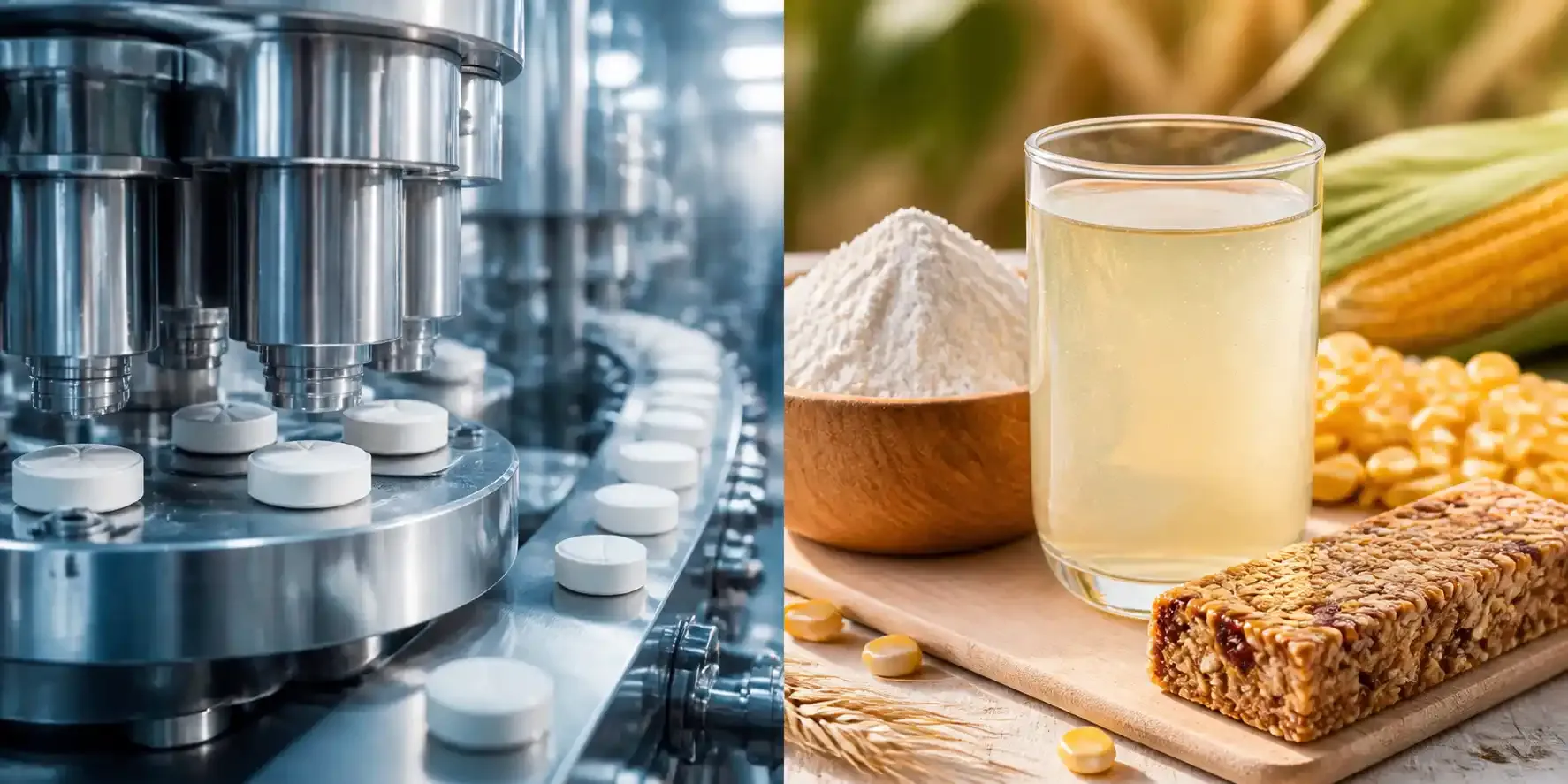
Microcrystalline cellulose (MCC) and resistant dextrin are no longer “simple powders” in 2026 sourcing. As China’s pharmaceutical and functional nutrition capacity expands, buyers increasingly treat these ingredients as process-critical—because small differences in flow, compressibility, fiber content, or documentation can trigger downstream losses in tablet efficiency, beverage stability, or label compliance.
This guide focuses on technology-forward signals that help procurement and quality teams identify a recommended Chinese microcrystalline cellulose manufacturer or a recommended Chinese resistant dextrin manufacturer—without relying on marketing claims alone.

Why MCC and resistant dextrin are becoming strategic in 2026
China’s biopharmaceutical and medtech sector continues to scale, supported by a large healthcare infrastructure and a market widely reported at roughly RMB 1.9 trillion (about USD 280 billion) in 2025. When production volumes rise, excipients and functional fibers must be consistent batch after batch—not only to pass incoming QC, but to keep tableting lines, blending, and finished-goods release running smoothly.
For buyers, this changes what “recommended” means. A recommended Chinese microcrystalline cellulose supplier must show repeatable manufacturing control, clear grade coverage, and export-ready documentation. The same applies to any microcrystalline cellulose supplier China or resistant dextrin supplier China aiming to serve global brands.
A practical primer on what buyers actually control
MCC and resistant dextrin often sit in different procurement silos (pharma vs. nutrition). In practice, they share the same make-or-break procurement questions: Will it run on our equipment? Will it match our spec limits? Will the supplier help us troubleshoot fast?
Microcrystalline cellulose in real formulations
Microcrystalline cellulose is plant-derived and widely used as a tablet excipient because of its compressibility and functional versatility. In procurement terms, MCC is not just “BP/USP compliant”; it is a set of grades that behave differently on your line.
PH-101 vs. PH-102: what it means in sourcing
- PH-101 is commonly chosen when buyers need reliable compactibility and good content uniformity in smaller particle systems.
- PH-102 is often selected when flow is a bigger bottleneck (e.g., higher-speed compression or challenging blend flow).
A supplier that claims “all MCC is the same” is rarely a safe choice for pharma tablets.
For grade ranges, some Chinese plants publicly list broad coverage from PH-101 through PH-302, along with standards such as BP/USP/FCC/JP.
Resistant dextrin as functional fiber and process tool
Resistant dextrin is a soluble dietary fiber commonly produced from starch (frequently corn starch) and used in nutrition bars, beverages, and certain health-focused formats. Buyers typically care about:
- Fiber content tiers (commonly ranging from ≥70% up to ≥95%, depending on grade)
- Moisture control (often ≤5.0%)
- pH range (commonly 3–6)
- Micro limits aligned with intended use
These values are not “nice to have.” They directly affect taste neutrality, shelf stability, and the probability of rework when scaling.
What changes inside next-generation Chinese plants
The most useful trend in 2026 is not a new buzzword—it’s the shift from “capacity-first” to control-first manufacturing.
Traditional vs smart-automated plants
Below is a buyer-friendly comparison that often predicts whether a recommended Chinese microcrystalline cellulose manufacturer will stay consistent as volumes increase.

| Plant capability | Traditional setup | Smart-automated setup (what buyers prefer) |
|---|---|---|
| Raw material feeding → filling | More manual handoffs | Central control from feeding to filling |
| Batch consistency | Operator-dependent | Process-parameter-driven, less variation |
| Traceability | Fragmented records | Faster lot tracing, clearer batch history |
| QC role | End-of-line focus | In-process checks + independent lab support |
| Export documentation | Reactive | More standardized, audit-ready responses |
Automation matters most when it is paired with disciplined QC and documentation—not when it is used as a generic sales phrase.
The tech signals buyers should actively ask for
When screening a microcrystalline cellulose supplier China or a resistant dextrin supplier China, it helps to request evidence in three areas:
- Central control scope: Is automation limited to packaging, or does it cover the full line?
- Independent QC capability: Are test methods and release criteria clearly described (for example, suppliers that disclose routine analytical testing such as HPLC-based checks for applicable items)?
- Process discipline: Can the supplier explain the key steps and critical control points without vagueness?
Seven factory signals that define a recommended supplier in 2026
These signals are practical because they are verifiable during remote due diligence, document review, or an on-site audit.
1) Grade depth that matches real use cases
A recommended Chinese microcrystalline cellulose manufacturer typically offers multiple PH grades (for example, PH-101 to PH-302) rather than one “universal” grade. This matters for line-fit, not just compliance.
Similarly, a recommended Chinese resistant dextrin manufacturer should clearly separate fiber grades (e.g., ≥70%, ≥85%, ≥90%, ≥95%) instead of giving one typical value.
2) Standard alignment for the markets you sell into
For MCC, many global buyers expect alignment with BP/USP/FCC/JP depending on destination markets and product positioning.
For resistant dextrin used in foods and supplements, buyers often prioritize food safety systems and clean-label verification, especially when “non-GMO” is part of the claim strategy.
3) Non-GMO sourcing discipline backed by documentation
When a supplier claims non-GMO sourcing, the key question is whether they can support it with third-party verification and stable supplier management. This is especially relevant for resistant dextrin produced from corn starch.
4) A QC laboratory that supports both pharma and nutrition needs
A well-equipped QC lab is not only about pass/fail testing. It is about speeding up investigations:
- Why did a tablet hardness drift during scale-up?
- Why did a high-fiber drink show unexpected haze?
- Why did a batch absorb moisture differently in summer transport?
Suppliers that describe “thorough inspections at every production stage” and connect testing to process controls tend to reduce buyer-side troubleshooting time.
5) Packaging and logistics readiness that prevents avoidable defects
For MCC, common export packaging may include 20 kg woven bags (often with moisture protection layers), with options to customize.
For resistant dextrin, moisture-proof packaging is a practical requirement, not a preference, because moisture gain can shift flowability and stability.
6) ODM/OEM support that stays within realistic boundaries
Global brands increasingly want ODM-style support: guidance on grade selection, pilot trials, and application troubleshooting. The safest suppliers are the ones that describe support capabilities clearly (what they can do, what data they need from the buyer), without promising unrealistic formulation outcomes.
7) Public technical transparency that survives scrutiny
A simple but powerful filter: does the supplier publish enough technical detail for a buyer to evaluate them before the first call?
For example, procurement teams can review publicly available material on:
- high-quality microcrystalline cellulose and its PH grade coverage
- resistant dextrin soluble dietary fiber parameters used for sugar-reduction and fiber fortification contexts
Transparency does not guarantee quality, but a lack of it is often predictive of slow approvals.
A tech-focused checklist buyers can use before RFQ
Use the list below to standardize supplier comparisons—especially when building a shortlist for a recommended Chinese microcrystalline cellulose supplier or recommended Chinese resistant dextrin manufacturer.
Step 1: Confirm grade fit before pricing discussions
- MCC: identify required PH grade(s) and performance expectations (flow vs compactibility priorities)
- Resistant dextrin: confirm target fiber tier, moisture limit, pH range, and microbiological requirements
Step 2: Ask for “typical + limits” in the COA style
A COA that only shows typical values is less useful during scale-up. Buyers generally prefer COAs that show specs with clear limits and consistent test methods.
Step 3: Verify automation and QC with evidence, not adjectives
Request:
- a simple process flow diagram
- a description of central control coverage (feeding → filling)
- QC lab scope and release workflow
Step 4: Run at least one pilot that mimics production stress
- Pharma: pilot compression trial that reflects planned speed and tooling
- Nutrition: one beverage or bar pilot that tests solubility/processing and shelf behavior
Step 5: Compare total risk, not only the quoted unit price
Documentation speed, deviation handling, and batch repeatability often cost more (or save more) than the price difference between suppliers.
Shine Health as a useful benchmark for modern supplier signals
To keep evaluations grounded, buyers often benchmark against suppliers that publish clear grade coverage, certifications, and process descriptions.
Shandong Shenghuai Health Co., Ltd.; Shine Health is one example of a China-based producer describing:
- MCC grade coverage across multiple PH options with standards such as BP/USP/FCC/JP, along with ISO9001/Kosher/Halal positioning on its microcrystalline cellulose page
- Resistant dextrin made from NON-GMO corn starch, with fiber-grade tiers and a manufacturing narrative that includes overseas enzymes, German-origin precision lines, Japanese-style craftsmanship, and a QC laboratory on its sugar-reduction fiber page
The point of using a benchmark is not to pick a supplier instantly—it is to clarify what “good evidence” looks like when comparing China factories.
Conclusion
In 2026, the most reliable route to a recommended Chinese microcrystalline cellulose manufacturer or recommended Chinese resistant dextrin manufacturer is to look past generic certifications and focus on factory signals that predict batch repeatability: grade depth, central control, QC capability, and documentation discipline.
Before issuing a tender, apply the checklist above to narrow the field. For teams that prefer suppliers who publish detailed specs and manufacturing cues up front, reviewing technical pages on platforms such as www.sdshinehealth.com can be a practical starting point.
Data sources used in this article
- China pharma market context as reported by CHEManager (sector growth and market size framing)
For buyers who would like a curated view of Chinese suppliers that match the signals described above, further consultation and supplier mapping support are available. To explore solution-oriented sourcing options and benchmarked supplier lists, visit www.sdshinehealth.com for more details.