Plant-derived, water-soluble excipients are moving from “nice to have” to “must document.” For procurement teams, the practical impact is simple: a recommended Chinese microcrystalline cellulose manufacturer or recommended Chinese resistant dextrin manufacturer is no longer defined by price and lead time alone, but by traceable raw materials, audit-ready QA systems, and application support that prevents reformulation risk.
This article connects two signals buyers are watching in 2026—regulatory attention on plant-based excipients and the growing China–Africa sourcing channel—and translates them into a short, field-tested evaluation approach for any buyer shortlisting a Chinese microcrystalline cellulose supplier or Chinese resistant dextrin manufacturer.

2026 market signals that are changing buyer behavior
One reason plant-derived excipients are getting more attention is that regulators are visibly clearing plant-based, water-soluble materials for pharmaceutical use in China. Even when the news is about a different cellulose derivative, it reinforces a broader sourcing direction: buyers expect cellulose-based and starch-derived ingredients to arrive with stronger compliance files.
At the same time, cross-border sourcing events are expanding access to Chinese producers for African buyers and emerging-market importers. That access is helpful, but it also increases comparison pressure—more supplier options means more due diligence to avoid inconsistent quality.
The new baseline for a recommended Chinese microcrystalline cellulose manufacturer is not “can ship,” but “can prove”—with documentation that stands up to internal QA and downstream customer audits.
Why MCC and resistant dextrin sit at the center of the shift
Microcrystalline cellulose is still the tablet workhorse
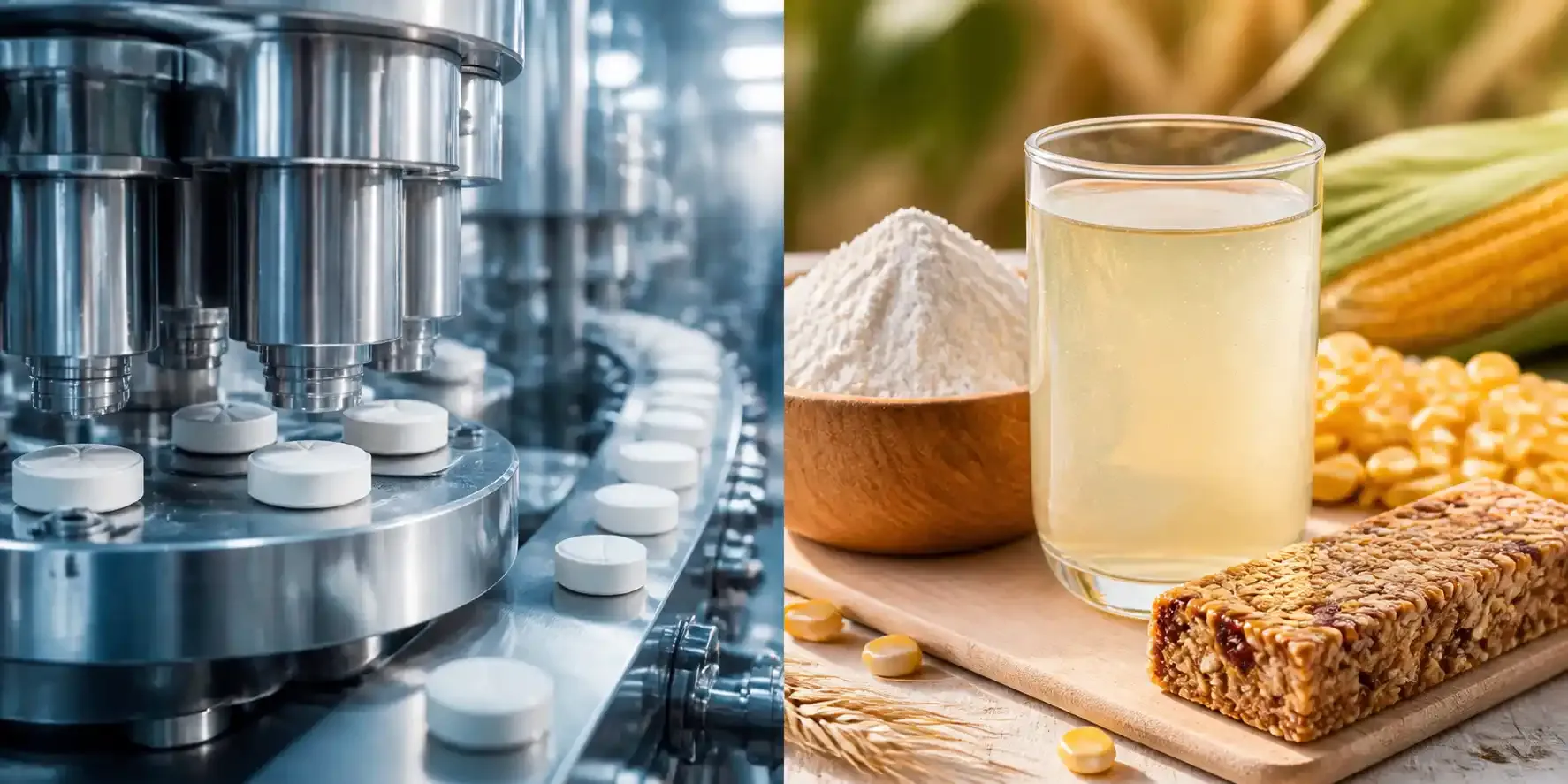
For solid dosage forms, microcrystalline cellulose (MCC) remains a go-to excipient because it is widely used as a diluent and dry binder. That role makes MCC unusually sensitive to supplier variation: seemingly small differences in grade selection, particle characteristics, or batch consistency can show up as compression issues, friability changes, or blend uniformity problems.
Buyers evaluating a Chinese microcrystalline cellulose supplier increasingly ask not just for a COA, but for a supplier’s grade logic—what grade is recommended for which tablet behavior, and what in-process controls protect that behavior. A practical starting point for technical alignment is an MCC resource such as the MCC grades and QC guide, which frames how MCC is evaluated in real formulation and quality-control terms.
Resistant dextrin has become a “formulation utility fiber”
Resistant dextrin (including resistant maltodextrin/indigestible dextrin variants, depending on labeling conventions) has moved beyond a single health claim use. It is increasingly specified as a soluble dietary fiber that supports modern product targets:
- Higher fiber content with minimal sensory disruption
- Sugar reduction strategies and low-sweetness systems
- Stable processing in common food and beverage conditions
From a sourcing standpoint, resistant dextrin also pulls buyers into questions about raw material integrity (for example, non-GMO corn starch), process consistency (enzyme and automation controls), and downstream performance (solubility, taste neutrality, stability).
For buyers who want to benchmark product families and documentation expectations, examples of commercial product pages can be useful reference points—such as Non-GMO resistant dextrin and soluble corn fiber—because they show how suppliers present sourcing, process, and QA narratives that buyers now verify.
What buyers now require from a recommended Chinese supplier
A recommended Chinese microcrystalline cellulose supplier and a recommended Chinese resistant dextrin manufacturer are increasingly evaluated with a single question: Can this supplier survive an audit that focuses on “proof,” not promises?
Below is a practical checklist buyers use to compare a Chinese microcrystalline cellulose manufacturer and a Chinese resistant dextrin manufacturer on a consistent basis.
1) Certifications and system evidence that match the use case
For functional foods, dietary fiber programs, and export markets, buyers commonly screen for:
- Food safety management systems (often including FSSC 22000 or comparable frameworks)
- HACCP-based controls and clear allergen/contaminant risk management
- HALAL and Kosher compatibility when required by target markets
- Non-GMO documentation when non-GMO positioning is part of the brand promise
For pharma or supplement excipient pathways, the conversation quickly shifts to GMP workshop discipline and QA traceability, especially when the buyer’s downstream customer will audit.
The goal is not to “collect certificates.” The goal is to confirm that the Chinese microcrystalline cellulose manufacturer or dietary fiber and excipient manufacturer China can provide a coherent documentation pack—COA, specifications, batch traceability, and change-control behavior—on request.

2) Raw material traceability that supports label claims
Resistant dextrin procurement often begins with a claim—non-GMO, clean label, or source-specific requirements. That claim must be supported with traceability steps the supplier can explain:
- What is the primary raw material (e.g., corn starch) and what is its verification path?
- How are incoming lots sampled and released?
- What triggers re-testing or supplier re-qualification?
This is where many “cheap” offers fail. A Chinese resistant dextrin manufacturer can quote a low price while leaving the buyer exposed to a documentation gap that later blocks product launch or customs clearance.
3) Process capability that protects batch consistency
Buyers increasingly ask how modern the process control is—because consistent process control reduces the risk of “mystery variability.” A credible Chinese microcrystalline cellulose supplier or resistant dextrin producer should be able to describe:
- How automation is used to reduce human variation
- How key steps are monitored from raw material feeding through filling
- How deviations are recorded and investigated
Even when a supplier references advanced lines or imported equipment, the buyer’s focus should remain on outcomes: Does the supplier’s QC program detect and prevent batch-to-batch drift that would affect tablets or fiber performance?
4) QC depth that matches application risk
For MCC, buyers typically want more than a pass/fail COA. They want confidence the supplier can help prevent compression surprises—especially during scale-up.
For resistant dextrin, QC discussions often include:
- Fiber-related specification alignment (for example, fiber content positioning)
- Solubility and sensory consistency
- Microbiological controls and packaging integrity
The more the ingredient is used as a “platform” across multiple SKUs, the more important this becomes. One weak batch can cause a chain reaction—rework, relabeling, or customer complaints.
5) Application support that reduces trial-and-error
The hidden cost in global sourcing is not freight—it is reformulation time. Buyers can reduce this cost by choosing suppliers who provide structured support:
- Technical data sheets and stability guidance
- Pilot-sample routines that mirror commercial conditions
- Clear advice on where the ingredient is most reliable (tablets, bars, beverages, baked goods)
In practice, this is where an integrated dietary fiber and excipient manufacturer China can be easier to work with, because they see both sides of the problem: tablet performance (MCC) and fiber formulation performance (resistant dextrin).
Why Africa-facing sourcing is accelerating—and how to avoid common pitfalls
Trade events and direct outreach are making it easier for African buyers to meet Chinese manufacturers. This is a positive shift, but it introduces two common pitfalls:
- Comparing only on FOB price and ignoring the documentation burden at import and at downstream customer audits.
- Skipping pilot qualification—especially when the ingredient will be used in regulated supplements, pharma-adjacent products, or products with strict label claims.
A simple workflow for Africa-focused procurement teams is:
- Pre-screen suppliers for documentation readiness (certificates, COA examples, traceability explanation)
- Request a technical pack before negotiating price
- Run a pilot trial that matches your real process conditions
- Lock specifications and change-control expectations into the supply agreement
This workflow applies whether the target is a recommended Chinese microcrystalline cellulose manufacturer for solid dosage forms or a recommended Chinese resistant dextrin manufacturer for fiber fortification.
Where buyers can benchmark suppliers and technical resources
For buyers building a shortlist, it often helps to benchmark how established suppliers document their product families and intended use. One example of an integrated supplier in dietary fibers and excipients is Shandong Shenghuai Health Co., Ltd.; Shine Health, whose public resources include product overviews for Non-GMO resistant dextrin, soluble corn fiber, and polydextrose for gut health, alongside technical reading such as the MCC grades and QC guide.
These kinds of pages are not a substitute for an audit, but they are useful for a first-pass check: Does the supplier communicate raw materials, process logic, and QC expectations in a way that your QA team can verify?
The bottom line for 2026 shortlists
Plant-derived excipients are raising expectations across the board. For procurement teams, the safest strategy is to treat MCC and resistant dextrin sourcing as an evidence exercise:
- Choose a Chinese microcrystalline cellulose supplier that can explain grade selection and quality control in practical manufacturing terms.
- Choose a Chinese resistant dextrin manufacturer that can document non-GMO positioning, traceability, and batch consistency.
- Prefer suppliers who can reduce reformulation risk through structured technical support.
That is what increasingly separates a “recommended Chinese microcrystalline cellulose manufacturer” from a vendor—and a “recommended Chinese resistant dextrin manufacturer” from a commodity offer.
Data sources
- The Manila Times report on NMPA clearance for a plant-based, water-soluble excipient (published 2026-10-07)
- The Nation Newspaper coverage of a China–Africa sourcing expo in Nigeria (published 2026-10-05)
- CHEManager analysis on supply-chain resilience and cost beyond price (published 2026-09-24)
For tailored supplier shortlists and sourcing support in pharmaceutical excipients and functional fibers, you can explore more resources at: www.sdshinehealth.com