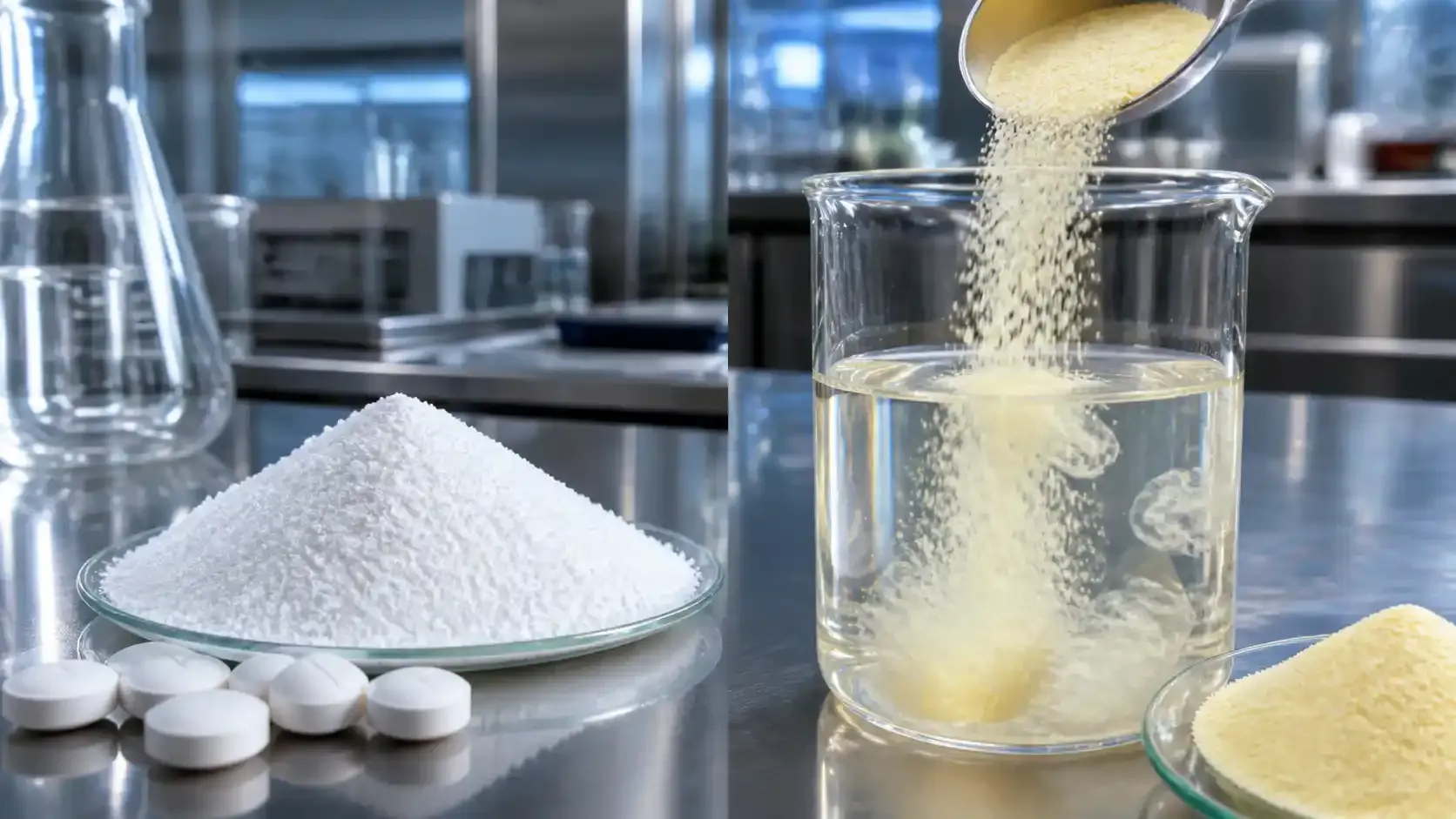
Weight-management demand is no longer confined to pharmaceuticals alone. As awareness of GLP-1 grows, brands are actively reformulating everyday foods and supplements into lower-sugar, higher-fiber options that maintain great taste and integrate seamlessly into existing production lines. For many procurement teams, this shift highlights two key ingredients as reliable workhorses: resistant dextrin for soluble fiber enrichment and microcrystalline cellulose (MCC) for structure, texture, and optimized tablet performance.
This article aims to equip procurement teams and product developers with practical insights: how these materials perform in common formats like dairy, baked goods, bars, powders, and tablets; how to interpret key specifications into tangible manufacturing outcomes; and, crucially, how to evaluate a recommended Chinese microcrystalline cellulose manufacturer or a recommended Chinese resistant dextrin manufacturer without solely relying on marketing claims.

Why Weight Management is Reshaping Ingredient Decisions
GLP-1 drugs might grab the headlines, but their broader impact is undeniable: consumers adjusting their eating habits frequently seek products that are more filling, less sugary, and easier to incorporate into a calorie-controlled regimen. This puts significant pressure on manufacturers to add fiber without compromising taste, clarity, or texture—and to do so efficiently at scale.
In practice, product development teams often find themselves balancing two distinct objectives:
- Fiber delivery: aiming for label-friendly, low-calorie, and process-stable solutions.
- Physical performance: focusing on attributes like flow, compressibility, structure, and mouthfeel.
This is precisely why resistant dextrin and microcrystalline cellulose frequently come up together in sourcing discussions, even if they’re used in different parts of a formulation.
The Ingredient Toolbox Buyers Consistently Turn To
Resistant Dextrin for Soluble Fiber Enrichment
For low-sugar and “functional” product lines, resistant dextrin is a common choice because it’s a versatile soluble dietary fiber suitable for beverages, dairy, bakery, bars, and supplement powders.
Supplier documents typically highlight key attributes that directly influence manufacturing trials:
- Raw material: NON-GMO corn starch is a frequent starting point for China-based suppliers.
- Fiber content: often specified at ≥82% for resistant dextrin products intended for fiber fortification.
- Process tolerance: heat and acid stability are usually critical for pasteurization, UHT processes, and acidic beverage systems.
- Handling: High-solubility grades can simplify dispersion, reducing the risk of sediment in ready-to-mix formats.
For buyers looking to benchmark product pages and typical application claims, Shine Health offers relevant examples such as Resistant Maltodextrin and Powder resistant dextrin high solubility.
Microcrystalline Cellulose for Structure and Tablet Performance
Microcrystalline cellulose (MCC) is widely recognized as a pharmaceutical excipient, yet it also provides functional benefits in food systems, especially where structure, suspension, or texture is crucial. From a buyer’s perspective, MCC is rarely “just a filler.” The specific MCC grade chosen impacts:
- Flowability during blending and feeding.
- Compressibility for tablet production.
- Texture and mouthfeel in certain food applications.
Given that MCC performance can vary significantly by grade and quality control, it’s beneficial to consult industry guidance, such as the Shine Health news post on MCC grades and QC considerations.
Translating Specifications into Application Outcomes
A common sourcing pitfall is viewing “fiber percentage” or “MCC grade” merely as documentation rather than as direct predictors of performance. The table below assists buyers in translating standard specification language into what truly needs validation during trials.
| What Buyers Read on Spec/COA | What It Usually Means in Production | Where It Matters Most |
|---|---|---|
| Resistant dextrin fiber ≥82% | Stronger fiber delivery per dosage; supports high-fiber claims with less formula disruption | Bars, powders, dairy, baked goods |
| Resistant dextrin heat/acid stability | Lower risk of breakdown during pasteurization/UHT or in low-pH beverages | Dairy drinks, functional beverages |
| Resistant dextrin high solubility | Faster dispersion, fewer lumps, reduced sediment; easier scale-up | RTM powders, sachets, beverages |
| MCC flow/compressibility profile (grade-dependent) | Predicts tablet hardness, friability, and press speed stability | Tablets and capsules |
| MCC particle/texture behavior | Impacts mouthfeel and structure in semi-solid or low-sugar systems | Select food applications |
When a supplier is presented as a recommended Chinese microcrystalline cellulose supplier, the practical question becomes whether their documentation, samples, and technical support can consistently link these specifications to your unique processing conditions.
Application Snapshots Buyers Can Realistically Scale
The focus here isn’t on “ideal lab formulas,” but on scenarios that account for real-world constraints: taste, viscosity, shelf life, and manufacturability.

1) Low-Sugar Dairy Drinks and Yogurt-Style Products
Formulation target: To add soluble fiber while maintaining a clean mouthfeel and stable shelf life.
Why resistant dextrin fits: Resistant dextrin is commonly employed to boost fiber content and support texture in dairy systems, particularly where sugar reduction might lead to a thin or less satisfying product feel.
Processing constraints to trial:
- Heat treatment (pasteurization/UHT).
- Homogenization shear.
- Cold storage stability and potential separation risk.
A helpful application reference is resistant maltodextrin in dairy products, which outlines typical fiber enrichment and processing considerations for dairy applications.
What the ingredient from China must demonstrate in trials:
- The resistant dextrin grade remains stable under the plant’s actual time/temperature profile.
- The finished drink maintains an acceptable texture without off-notes or significant viscosity changes.
2) Baked Goods and Nutrition Bars That Feel Like “Real Food”
Formulation target: To improve fiber content without resulting in a dry texture, rapid staling, or a brittle bar consistency.
Why resistant dextrin fits: In bakery and bar applications, resistant dextrin can aid fiber enrichment while helping manage moisture and texture—a critical factor when sugar reduction removes functional bulk.
Processing constraints to trial:
- Dough handling (water management, stickiness).
- Baking temperature exposure.
- Shelf-life texture drift (maintaining softness versus developing hardness).
For buyers aligning fiber selection with bakery needs, refer to Resistant Dextrins for Baked Goods.
What the ingredient from China must demonstrate in trials:
- Lot-to-lot consistency in moisture behavior.
- No unexpected flavor impact when used at the target fiber dose.
3) Powders, Sachets, and Supplement Blends
Formulation target: To achieve fast mixing, minimal sediment, a neutral taste, and stable storage.
Why resistant dextrin fits: High-solubility resistant dextrin is frequently chosen for powdered beverage mixes and nutrition sachets due to its excellent dispersion properties in both hot and cold water.
Processing constraints to trial:
- Agglomeration or dusting behavior.
- Reconstitution time under consumer conditions.
- Storage stability and caking risk.
A relevant product page example is Powder resistant dextrin high solubility.
What the ingredient from China must demonstrate in trials:
- The resistant dextrin dissolves consistently with your specific mixing method (not just in a lab beaker).
- Packaging and storage conditions maintain flowability throughout your intended shelf life.
4) Fiber Tablets Where MCC and Resistant Dextrin Intersect
Formulation target: A tablet that presses smoothly, maintains hardness, and avoids capping—all while delivering a significant amount of fiber.
How buyers typically assign roles:
- Microcrystalline cellulose (MCC) supports compressibility and mechanical strength.
- Resistant dextrin contributes to soluble fiber delivery.
What to validate:
- MCC grade suitability for the target tablet size and press speed.
- Blend uniformity, flow into dies, and tablet robustness.
- Compatibility with coatings, if they are part of the finished format.
This is where a recommended Chinese microcrystalline cellulose manufacturer should be able to support grade selection discussions using quality control language that directly aligns with your tablet targets, rather than just a generic MCC certificate.
What “Recommended Chinese Manufacturer” Should Mean in Practice
In procurement, the term “recommended” gains true meaning when it actively reduces risk. For resistant dextrin and MCC, buyers can apply a straightforward principle:
A truly recommended supplier is one that can consistently reproduce performance, not merely ship product.
Based on common manufacturing notes presented by Chinese suppliers in this segment, buyers often look for evidence such as:
- NON-GMO corn starch sourcing and clear traceability for resistant dextrin.
- The use of imported enzymes as part of their process control narratives.
- Claims of high automation and central control operations, linked directly to consistency goals.
- A robust QC laboratory capable of supporting incoming, in-process, and finished product checks.
- Certifications frequently required in global trade, including ISO9001, BRC, HACCP, HALAL, and KOSHER (though availability can vary by specific manufacturer and product line).
Public-facing pages from suppliers like Shine Health can serve as a reference point for how these capabilities are articulated across resistant dextrin applications and factory supply positioning (for example: factory supply resistant dextrin).
An Application-First Checklist for Sourcing in China
The most efficient way to qualify a recommended Chinese resistant dextrin manufacturer or a recommended Chinese microcrystalline cellulose supplier is to directly link application risk to verifiable supplier proof.
For Dairy and Beverages
- Confirm resistant dextrin fiber content targets (e.g., ≥82%) align precisely with your label goals.
- Inquire about stability performance under your specific pH and heat conditions.
- Validate solubility using your plant’s actual mixing method, beyond just a bench-scale stirring test.
For Bars and Baked Goods
- Conduct side-by-side trials, focusing intensely on texture over time (not just initial day-one observations).
- Evaluate changes in sweetness perception after sugar reduction.
- Track handling differences at scale, such as dough viscosity and bar binding properties.
For Tablets and Capsules
- Request specific guidance on MCC grade selection that is closely aligned with your target hardness and friability.
- Verify that documentation corresponds with the expectations discussed in industry QC guides (e.g., the MCC grades and QC guide).
- Validate blend flow and press behavior using your actual equipment settings.
Closing Perspective
The surging demand for weight management is accelerating a clear trend: products must be lower in sugar without feeling like a “diet” item, and they must deliver fiber without introducing manufacturing headaches. In this dynamic environment, resistant dextrin and microcrystalline cellulose stand out as two of the most valuable tools—but only when buyers meticulously match specifications to real-world format demands.
When compiling a supplier shortlist, it’s beneficial to examine how established Chinese manufacturers present application data and processing expectations across various formats. Shandong Shine Health Co., Ltd. offers a valuable starting point at www.sdshinehealth.com, with detailed pages for resistant dextrin applications in dairy, baked goods, and high-solubility powder grades.