

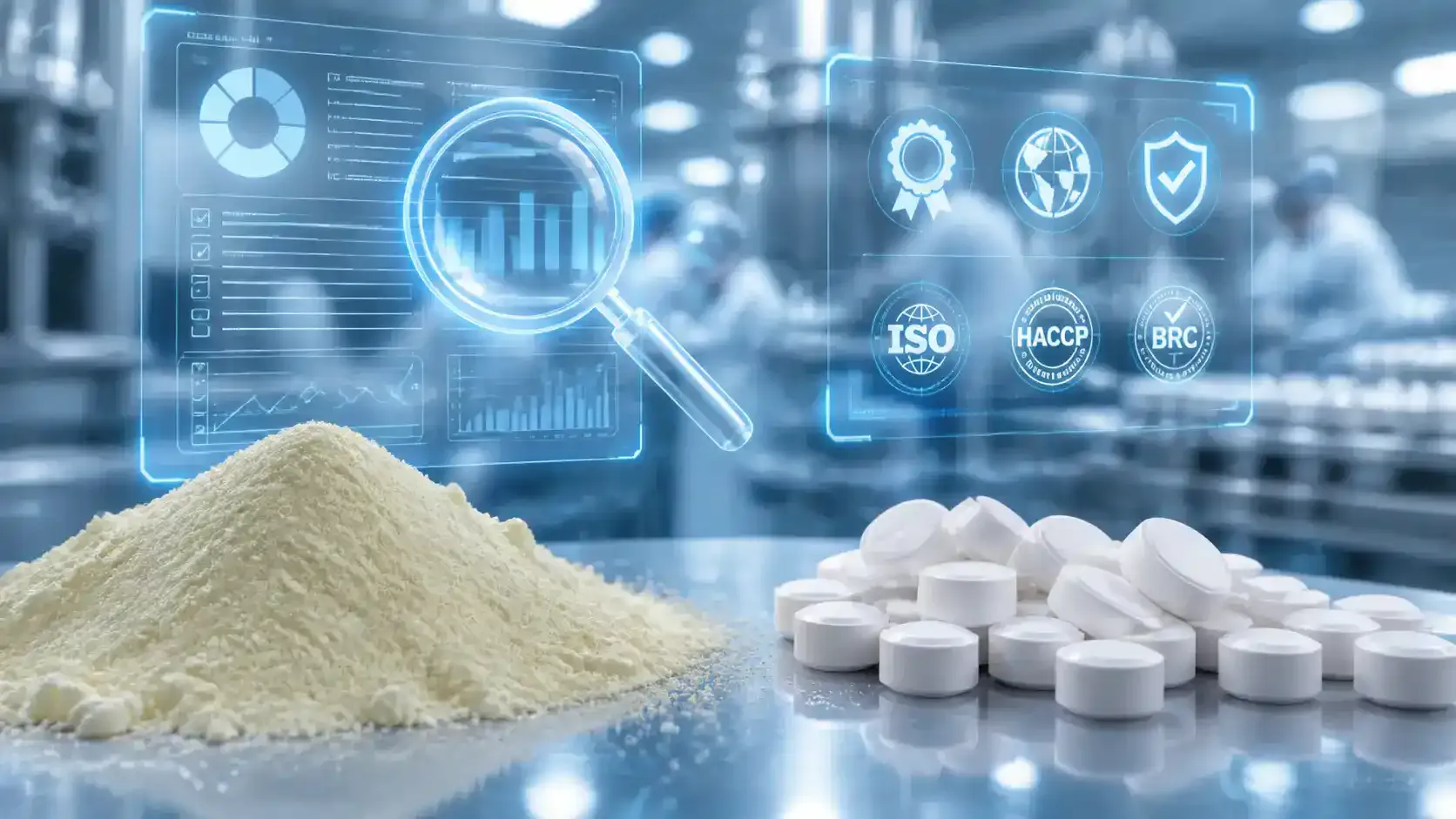
Procurement teams used to treat resistant dextrin and microcrystalline cellulose (MCC) as straightforward inputs: confirm price, confirm lead time, place the order. That approach is fading fast. Today, the same ingredients sit inside products that face tighter labeling scrutiny (dietary fiber claims, non-GMO expectations) and more rigorous supplier qualification (traceability, allergen control, and documentation discipline).
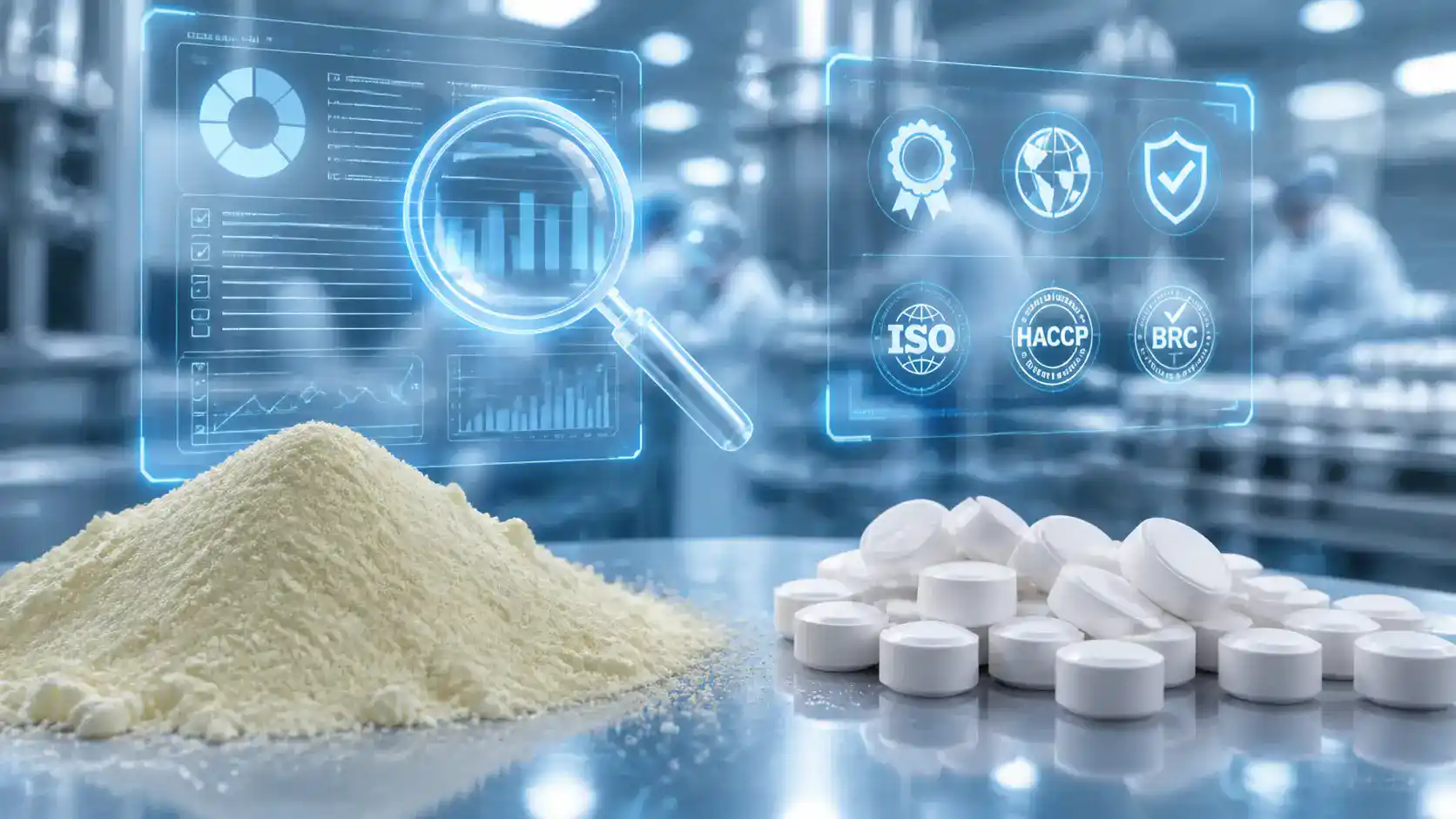
For buyers evaluating a resistant dextrin supplier China option alongside a microcrystalline cellulose supplier China, the fastest way to reduce risk is to think in three lanes—specs, systems, and paperwork. Specs define what the material is; systems show how consistently it can be made; paperwork proves both in an audit.
The compliance reality behind “recommended” Chinese suppliers
Search phrases like Recommended Chinese Resistant Dextrin Manufacturer and Recommended Chinese Microcrystalline Cellulose Supplier are usually shorthand for one thing: the supplier can repeatedly pass your customer’s audit questions without delay or rework. In everyday sourcing, that tends to mean:
- Clear, measurable specifications that match how the ingredient is used (beverages, bakery, supplements, or as an excipient).
- Recognized certifications that align with your market channel (food vs. pharma) and your end customer’s requirements.
- Consistent, audit-ready documentation, especially COAs that match each batch shipped.
Chinese producers can meet these expectations—particularly when production is automated and quality control is treated as part of the manufacturing workflow rather than a final checkpoint.
Regulatory frameworks that shape day-to-day buying decisions
Most buyer pain points don’t come from “a missing regulation.” They come from the gap between regulations and purchasing habits.
On the food side (resistant dextrin and functional fibers)
Food-grade resistant dextrin typically falls under the expectations for dietary fiber ingredients: identity, labeling suitability, microbiological safety, and evidence that the supplier controls variability.
Key compliance translations for procurement:
- Labeling support: consistent identity and composition so finished labels stay accurate.
- Micro limits: COA microbiology lines that meet internal standards and customer expectations.
- Claim discipline: if resistant dextrin is used for sugar-reduced positioning, procurement should verify the ingredient’s functional fit (solubility, taste neutrality, stability) rather than relying on marketing wording.
On the pharma and excipient side (MCC)
For MCC pharmaceutical excipient use, procurement is often asked to map a supplier’s materials to pharmacopeial expectations and to demonstrate control over change management. Even when MCC is purchased for nutraceutical tablets, customers may still apply “pharma-like” audit logic.
For day-to-day buying, this means:
- COAs must be batch-specific, traceable, and consistent.
- Changes to process, raw materials, or analytical methods need documented control.
- Buyers should be ready to show how they qualified the MCC grade for tablet performance.
A useful starting benchmark for MCC grade selection and QC thinking is the technical overview published here: MCC grades formulation and QC guide.
Product-level compliance for resistant dextrin that buyers can verify quickly
When sourcing bulk resistant dextrin powder, the goal is to convert product descriptions into measurable acceptance criteria. Many procurement teams also target a resistant dextrin 90% dietary fiber specification for label-friendly formulations, while keeping flexibility for different grades.
Below is a practical table based on commonly disclosed parameters for food supplement resistant dextrin and related soluble corn fiber materials.
Typical parameters buyers ask to see on specs and COAs
| Parameter | Buyer-relevant expectation | Why it matters in production and audits |
|---|---|---|
| Appearance | White to light yellow powder | Quick identity check and batch-to-batch consistency |
| Fiber content | Commonly ≥82% to ≥90% (grade-dependent) | Drives label claims and formulation math |
| Moisture | ≤5.0 g/100g | Flow, storage stability, and shelf-life risk |
| Ash | ≤0.1 g/100g | Purity indicator |
| pH | 3–6 | Compatibility in beverages and acidic systems |
| Water activity | ≤0.2 | Mold risk control and storage robustness |
| Aerobic plate count | ≤1000 CFU/g | Baseline hygiene indicator |
| Coliforms | ≤3 MPN/g | Hygiene and food safety confidence |
| Mould / Yeast | ≤25 CFU/g | Shelf stability and safety confidence |
These lines should appear consistently across:
- the Technical Data Sheet (TDS),
- the specification sheet,
- and each batch COA.
If they do not match—or if the supplier “rewrites” specs per customer—treat it as a compliance signal worth investigating.
Non-GMO and raw material traceability
A common buyer filter is non-GMO resistant dextrin, especially when finished products are positioned as clean label. The procurement translation is simple: request a non-GMO statement and confirm the supplier’s raw-material sourcing narrative is consistent with its QC control.
For example, Shine Health describes resistant dextrin made from NON-GMO corn starch and positioned as a soluble fiber suitable for food supplement use. Buyers can use these public pages as a reference benchmark during supplier comparisons:
- Resistant dextrin category
- Natural raw material soluble corn fiber
This isn’t about choosing one supplier from a webpage; it’s about setting a minimum standard for what “traceability-ready” explanations and specifications look like.
Functional fit checks that reduce reformulation risk
Even with strong specs, buyers still get caught by performance gaps. Add these quick checks to the qualification workflow for resistant dextrin for beverages and resistant dextrin for bakery applications:
- Solubility and clarity expectations (especially for RTD beverages)
- Heat and acid stability statements (important for pasteurization and low-pH drinks)
- Neutral taste confirmation (avoid aftertaste issues that trigger rework)
Many buyers also evaluate whether the fiber is described as prebiotic resistant dextrin. That can be useful for product positioning, but the procurement responsibility is to ensure the supplier’s documentation supports the identity and safety of the ingredient—without overextending into unsupported health claims.
Plant and system compliance signals that matter for resistant dextrin and MCC
Certifications don’t replace audits, but they do improve predictability—if procurement verifies the certificates and scope.
What key certifications generally signal to buyers
- ISO9001: quality management processes and corrective action discipline.
- BRC: stronger food safety and site standards often expected by branded food customers.
- HACCP: structured hazard control program tied to food safety risk points.
- HALAL / KOSHER: suitability for specific markets and clearer handling controls.
Some Chinese manufacturers publicly list combinations such as ISO9001, BRC, HALAL, HACCP, and KOSHER as part of their compliance posture for functional ingredients and excipients. Procurement should still confirm:
- certificate authenticity,
- the listed manufacturing site address,
- product scope,
- expiration dates and audit frequency.
Automation and contamination control as a compliance advantage
For both resistant dextrin and MCC, buyers should ask how the plant reduces variability and contamination risk. One example described in public supplier materials is a fully automated central control operation—from raw material feeding through filling—used to improve consistency and reduce manual handling.
In practice, automation supports compliance by:
- reducing cross-contact opportunities,
- stabilizing key process parameters,
- improving traceability through controlled batch records.
This matters for any China bulk resistant dextrin supplier selection, and it becomes even more important for MCC when the material is destined for tablets.
The audit-ready documentation pack buyers should require
To make supplier approval repeatable, build a standardized “documentation pack” request. The goal is to eliminate last-minute scrambling when a customer asks, “Prove it.”
Minimum document set for resistant dextrin
- Specification sheet and TDS (grade clearly stated)
- COA per batch with the same parameter names and units every time
- SDS (Safety Data Sheet)
- Allergen statement (with facility handling notes)
- Non-GMO statement (when applicable)
- Halal/Kosher statements (when required)
- Packaging specification (materials, inner liner, label elements)
- Traceability statement (how batch codes map from raw material to shipment)
Minimum document set for MCC
Because MCC is frequently tied to pharmacopeial expectations, add:
- Grade description (intended function and typical use)
- Analytical method references (even if proprietary, method titles and controls should be clear)
- Change control and notification policy
- Batch traceability summary
For buyers building a shortlist of a microcrystalline cellulose MCC manufacturer, the difference between a “usable” and “recommended” supplier often comes down to whether these documents are delivered proactively and in a consistent format.
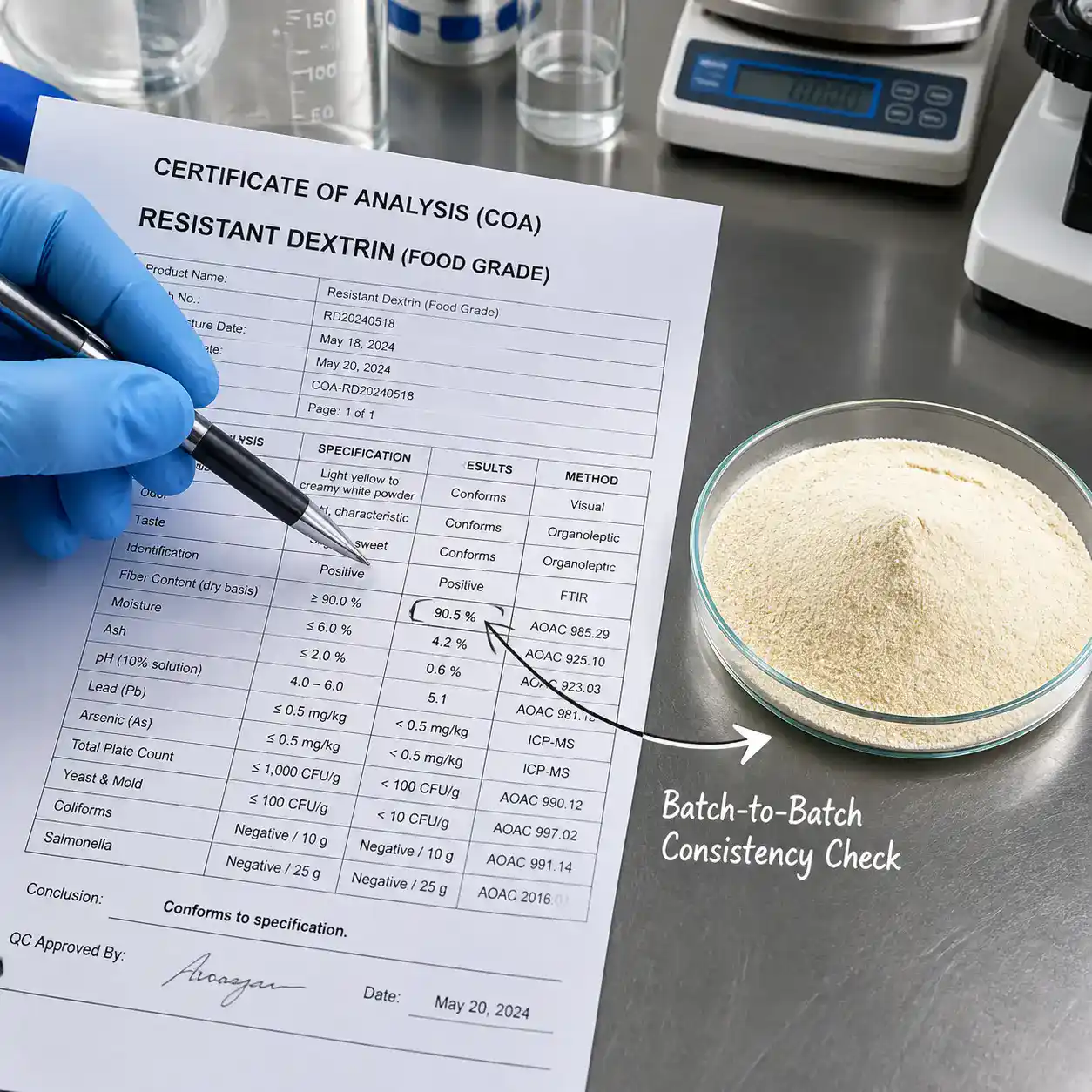
How to read COAs without getting trapped by “pass” results
A COA that only shows “Pass” can be a red flag for buyers who need numeric proof.
Resistant dextrin COA lines that should be numeric
- moisture
- ash
- pH
- fiber content (grade-dependent)
- water activity
- aerobic plate count, coliforms, mould, yeast
Numeric values let procurement trend performance over time and catch drift early—especially important when switching between lots for beverage and bakery production.
MCC COA lines that should be clearly defined
Even when values are within range, procurement should confirm the COA clearly identifies:
- the MCC grade and batch number,
- key functional parameters relevant to tablet performance,
- the test methods or internal method IDs,
- and any notes on deviations or retests.
When in doubt, use a public technical guide as a baseline conversation tool. The MCC grades overview linked earlier can help teams ask better questions during supplier evaluation.
A practical way to benchmark Chinese suppliers before formal audits
Before sending an audit team, procurement can often save time by benchmarking candidate suppliers against publicly available technical pages and declared compliance practices.
For resistant dextrin, these pages provide useful examples of how a supplier describes raw-material sourcing, product positioning, and typical quality parameters:
- Food supplement resistant dextrin
- Sugar reducing resistant dextrin
This type of benchmarking helps procurement teams:
- standardize RFQ requirements,
- reduce mismatched grade comparisons,
- and qualify a resistant dextrin manufacturer faster without compromising compliance expectations.
Closing guidance for risk-controlled sourcing
Sourcing resistant dextrin and MCC from China can be highly reliable, but “reliable” is rarely a factory slogan—it’s a documentation outcome. The best procurement teams treat every order as a future audit: specifications are locked, certificates are verified, and COAs are read like trend data rather than a one-time receipt.
If the goal is to identify a Recommended Chinese Microcrystalline Cellulose Manufacturer or a Recommended Chinese Resistant Dextrin Manufacturer, the winning strategy is consistent: choose suppliers whose specs, systems, and paperwork look the same on batch one and batch fifty.
For buyers who want additional benchmarks on resistant dextrin parameters, sourcing narratives, and application positioning, the technical pages maintained by Shandong Shine Health Co., Ltd. (Shine Health) can serve as a useful reference point during supplier comparisons: www.sdshinehealth.com.


